
Notes from UFC Freedom 250
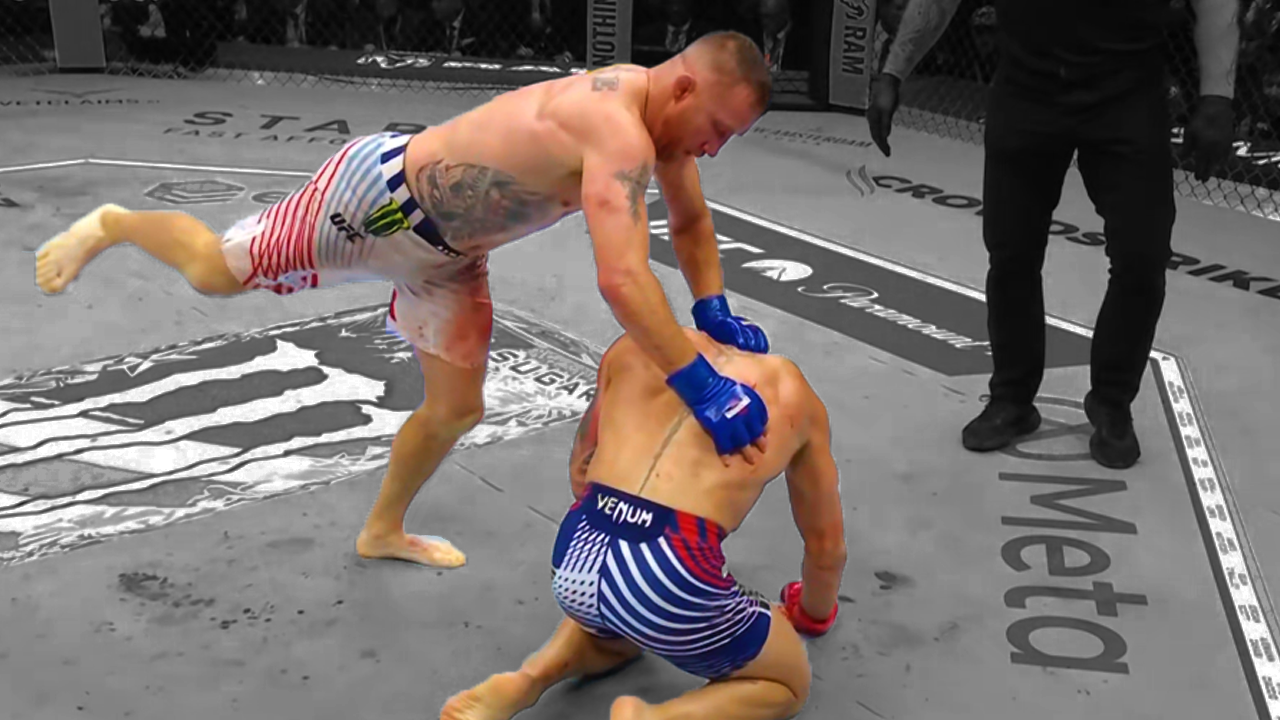
Gaethje Rounding Out the Uppercut Threat
Justin Gaethje’s performance against Ilia Topuria was a textbook case of using what you have to create a gameplan that is more than the sum of its parts. The dip, to collar tie, to uppercut has been a Gaethje staple for a long time, and in his last couple of fights he looked to have done the Prince Naseem thing of discarding everything except his favourite knockout punch. The way that Gaethje entered was always the same: lean deep down to the right, flail the left arm out to catch the opponent’s head, and then come back in with the right uppercut.
The jab was an enormous part of Justin Gaethje’s success here, and no one was more pleased to see it than this writer, who has been calling for it for years. But the jab and the collar tie uppercut had a symbiotic relationship. Obviously, the uppercut was improved by the jab because Gaethje could now dip in behind the jab and enter the clinch proactively, without an obvious and exposed lunge towards his opponent with his arms stretched out like a zombie.
But the part that many fans might have missed was that the jab gained just as much from the uppercut. It will not have evaded many that Max Holloway is just as good a jabber as Justin Gaethje, and jabbed at Topuria just as much, to much less impressive results. Part of it was that Topuria was able to keep Max Holloway, and Alexander Volkanovski while we’re on the subject, on the back foot, trying to circle and pump their jab powerlessly. Gaethje was able to make Topuria back up at many points in this fight, by falling back on the dip into the collar tie uppercut. In fact the first round was mostly just Gaethje with his back to the fence, lashing out like a cornered animal. Respect for the uppercut made Topuria back away and try to box his way in cleanly, and then Gaethje’s jab was able to come to the fore and in turn create more openings for him.
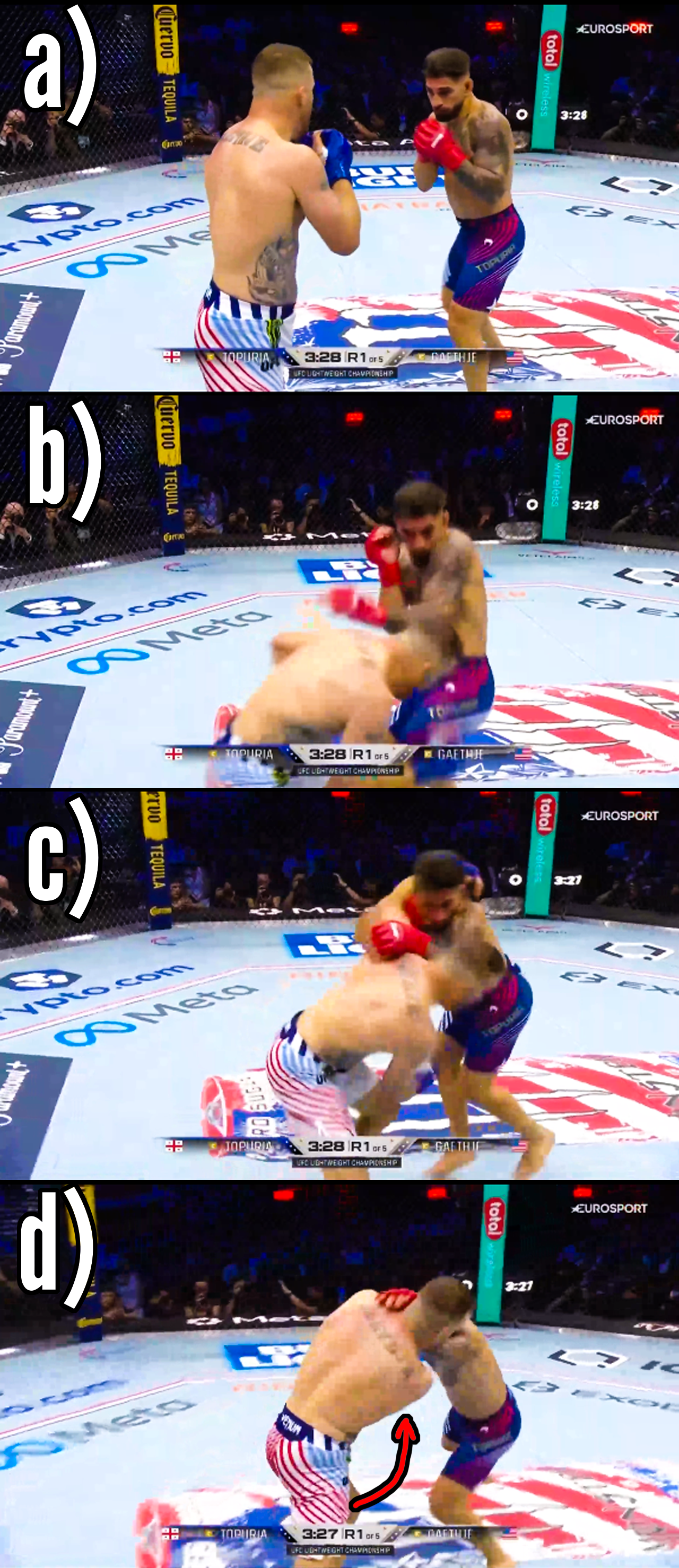
Fig. 1
This was crucial in the beginning of the third round, when Gaethje had been told by Trevor Wittman to stop jabbing while retreating and to go forward. Gaethje went out for round three and immediately pushed into the collar tie clinch, threatened the uppercut, and eventually skewered the already fading Topuria in the ribs with a knee, putting him on the back foot for much of the round.
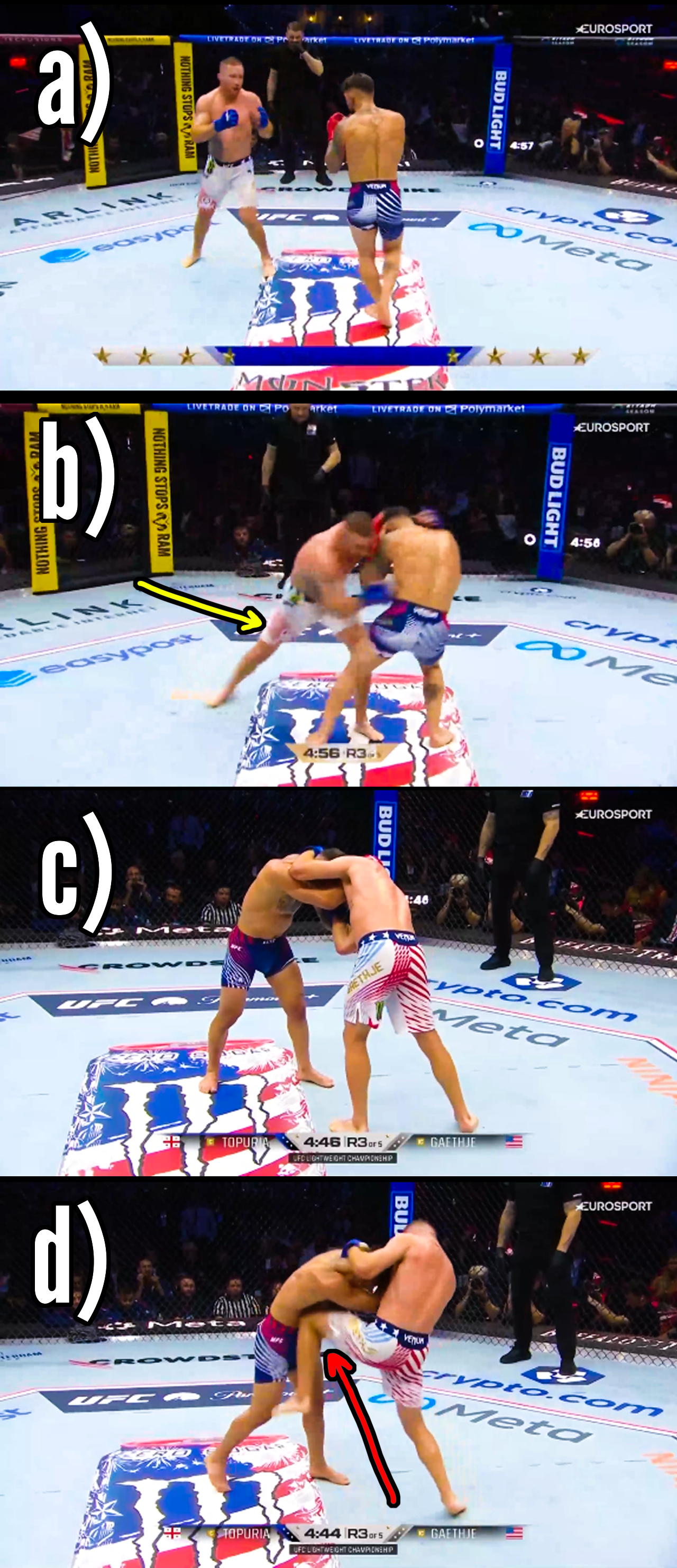
Fig. 2
In fact much of the fight was the interplay between Gaethje’s jab, and Topuria’s right hand across the top. In the early going Gaethje was getting the worse of the trade, but by the end he was turning with the blow, and using his left arm to leverage guard and then pull Topuria in, right onto the collar tie uppercut.
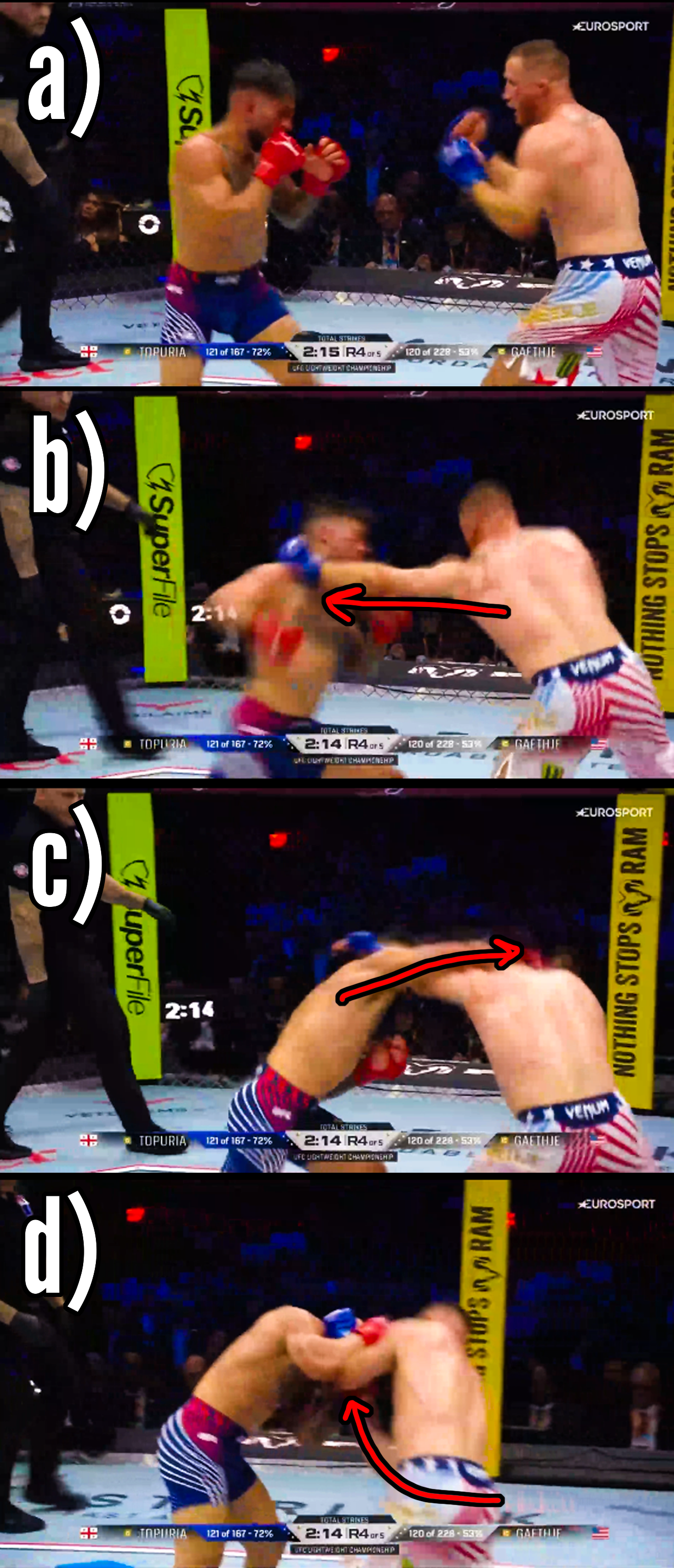
Fig. 3
Another great read that Gaethje and his team made was the high kick on the open side. Topuria’s lead shoulder is such an effective shield that he wants you to hit it hard, and then stand around to suffer the return. Topuria does not have that same sturdy barrier on his right side, only his glove, wrist, and awareness. Jai Herbert famously caught Topuria with a step up left kick on that side, and Volkanovski, Holloway and Emmett all had moments of success with the left hook in exchanges. Gaethje never caught Topuria dead to rights with the high kick, but he regularly pounded Topuria’s right arm and threatened disaster if Topuria didn’t keep his wits about him at all times. I particularly liked Gaethje’s attempts to score the step-up high kick as he pushed out of the clinch, Peter Aerts style.
Figure 4 shows Topuria faking a step in, Gaethje doing his old fashioned cover up, and then returning with a step up high kick.
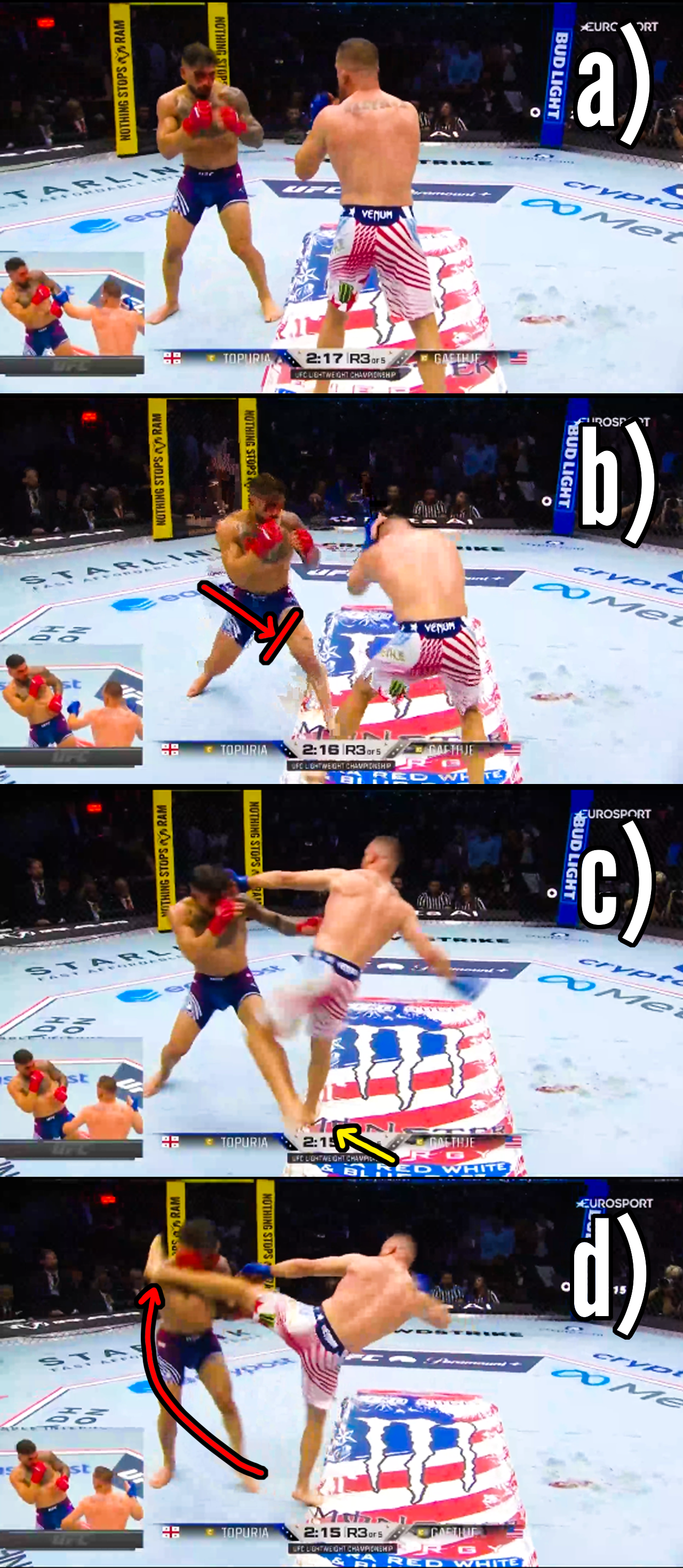
Fig. 4
Not only has Gaethje always had a jab that he refused to use, he has always been one of the few great dirty boxers active in MMA. His clinch striking in this one was marvellous and I hope he can push that advantage more in however many fights he has left in the game.
Chandler against the Cage
The Michael Chandler – Mauricio Ruffy bout was one of three carefully sculpted showcase match-ups on this card, and it was easily the saddest. Chandler is so far removed from what he once was and his technical fundamentals never got to the level where they could carry him once his athleticism waned. Chandler’s extremely wide stance was an interesting quirk when he could still explode across the floor with overhands, but now it is just a liability as he throws his head forward and hopes to pull his legs into keeping up.
This fight was another in the long list of demonstrations that the last place you should be against a “big moments” sort of striker is up against the cage. Ruffy’s wheel kicks and Ruffy’s body shots all came when Chandler put his butt to the fence, squared up, and put his forearms up as a cover. Against an elite striker, this should always be a last resort because it is simply presenting them a taster menu.
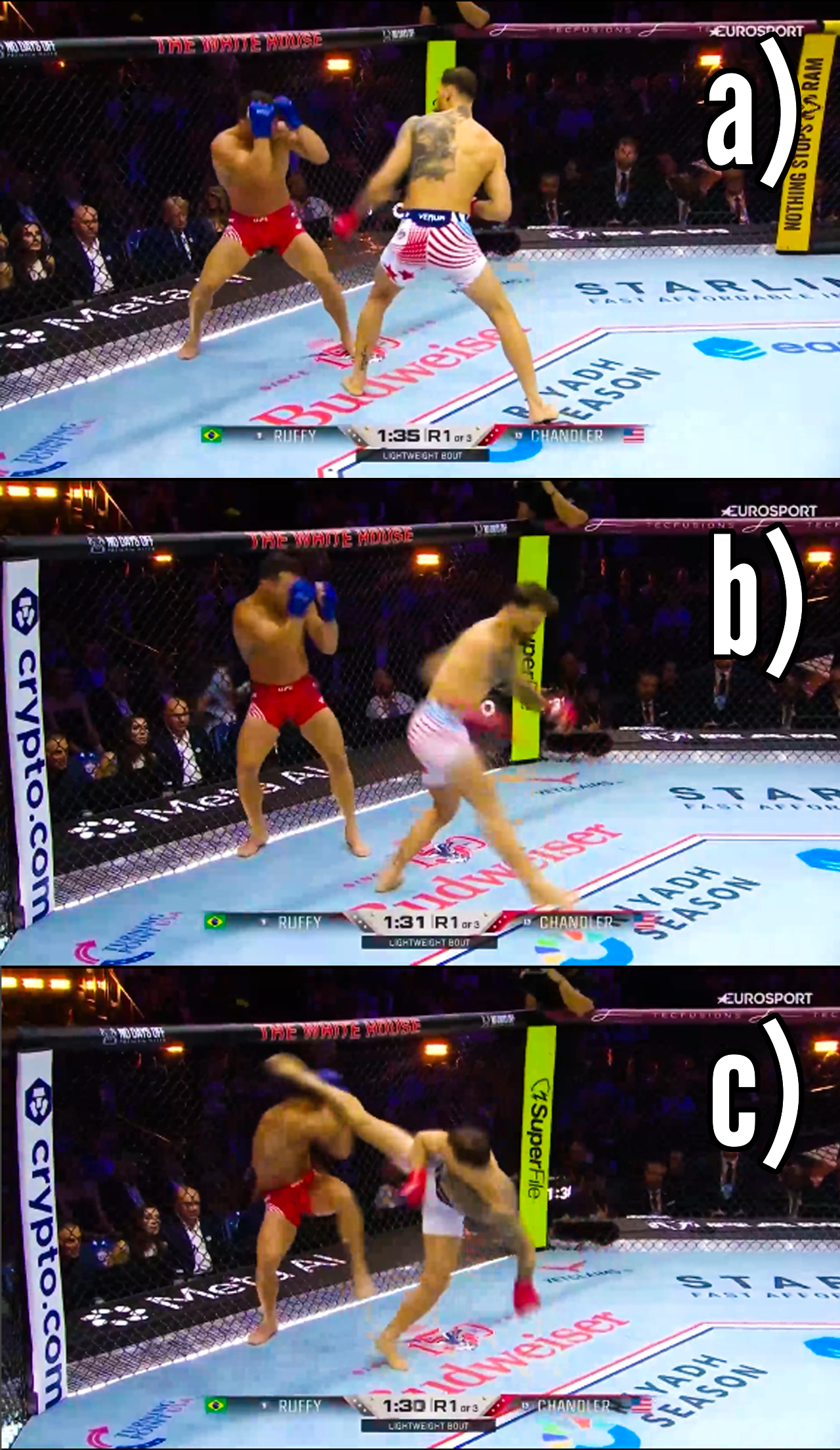
Fig. 5
The feet are the first line of defence. When you cannot take a big step back, the opponent loses a lot of the reason to be cautious. Every time they throw a wheel kick or a jumping knee you are down to left and right, and the wrong one gets you splattered.
Hokit Standing Mount
While heavyweight MMA is in many ways a different sport—pejorative—it is also a different sport in some ways that are interesting. Derrick Lewis main events are not what they used to be, but his ability to force his way back up and survive bad positions has always been worth studying. Josh Hokit stole something that Jailton Almeida did, and took the daring step of adding strikes to it.
The Almeida fight contains an example of classic Lewis. He is great at controlling opponents’ wrists even from the bottom of mount. And when he gets the chance, he will buck, roll…
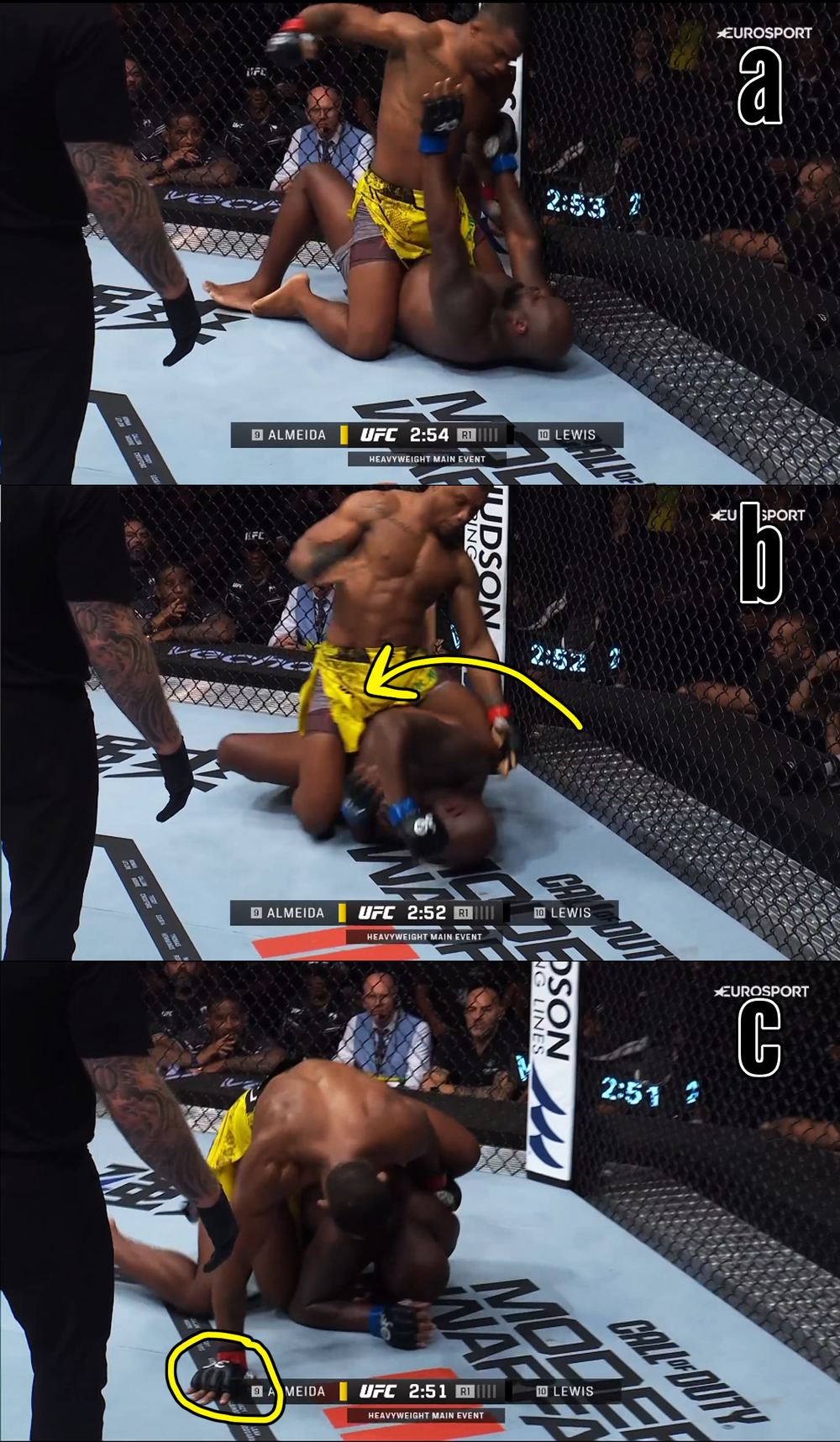
Fig. 6
And pull the opponent onto his back so that he can achieve backpack position, with them on the bottom. This removes all the threat of strikes, and puts Lewis just a bit of handfighting and hip turning away from being on top.
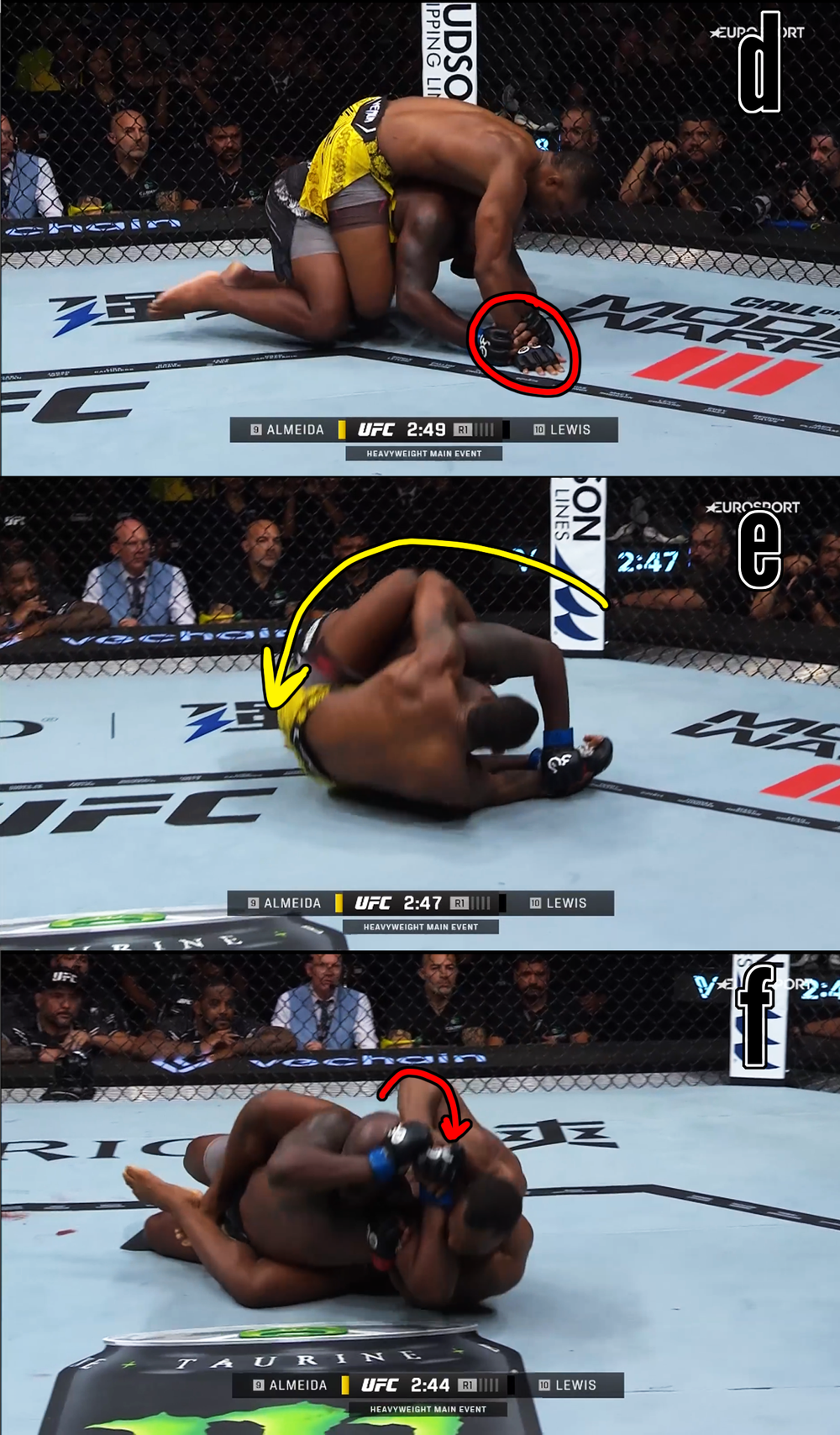
Fig. 7
After he did it to Almeida, Almeida found himself standing over the mount at several points, often with Lewis holding his hands. Almeida was as useless as a chocolate teapot in this position, but Hokit actually made it work.
By standing over Lewis, Hokit didn’t have to worry about being bucked off (a), because Lewis loves the hand in the armpit and big bridge that Fedor favoured. If Lewis rolled to his knees, Hokit would just let Lewis roll underneath him and stay disconnected, punching him from the turtle, rather than getting pulled onto Lewis’ back.
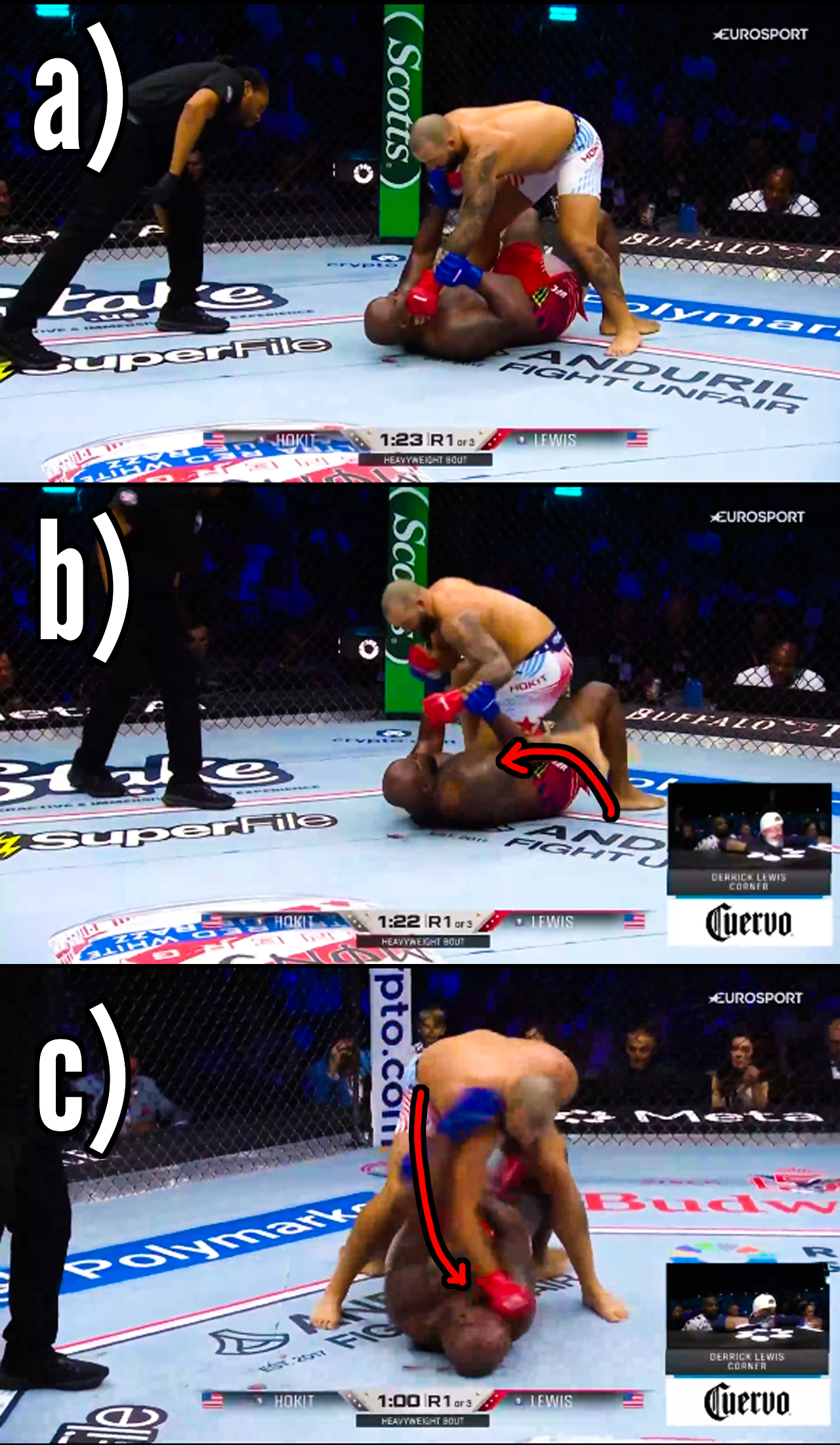
Fig. 8
Downward punches are often seen as a impractical because standing over the opponent is often less valuable than staying chest to chest. But there are situations where downward punches are extremely strong. Stepping a leg into headquarters / De la Riva guard against a supine opponent, the lead hand can “jab” down on the solar plexus as a surprisingly powerful punch. Petr Yan hurt Jose Aldo with this and Jorge Masvidal used it against Nate Diaz.
Hokit was able to punch down on Lewis, and even dropped a knee on his ribs (b), which was the best moment of the fight and honestly made the whole farce worth it.
Gane’s Jab, Level Changes, Southpaw tactics
Ciryl Gane’s southpaw jab looked sensational against Alex Pereira, but he completely disregarded the handfight. That has been an area that has given Pereira a lot of trouble in the past, but Gane fought with his lead hand low, leading Pereira around the ring after him. Whenever he felt the time was right, Gane would wave his lead hand (b), bring it to the centreline (c), and backfist in a jab down the inside of Pereira’s left hand (d), which was up and ready to parry, but rarely achieved the task.
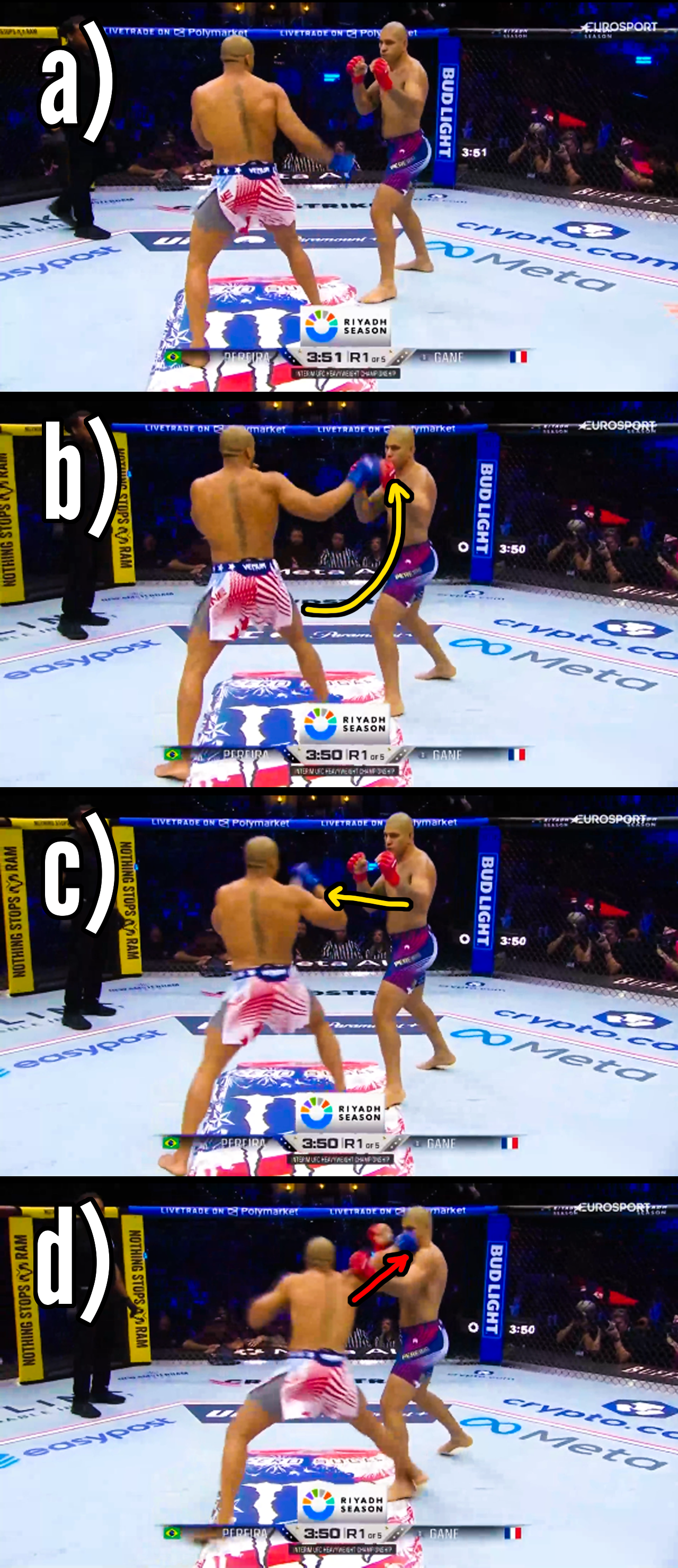
Fig. 9
The only time Gane did engage in the handfight, it was to distract Pereira before changing levels and attacking his legs.
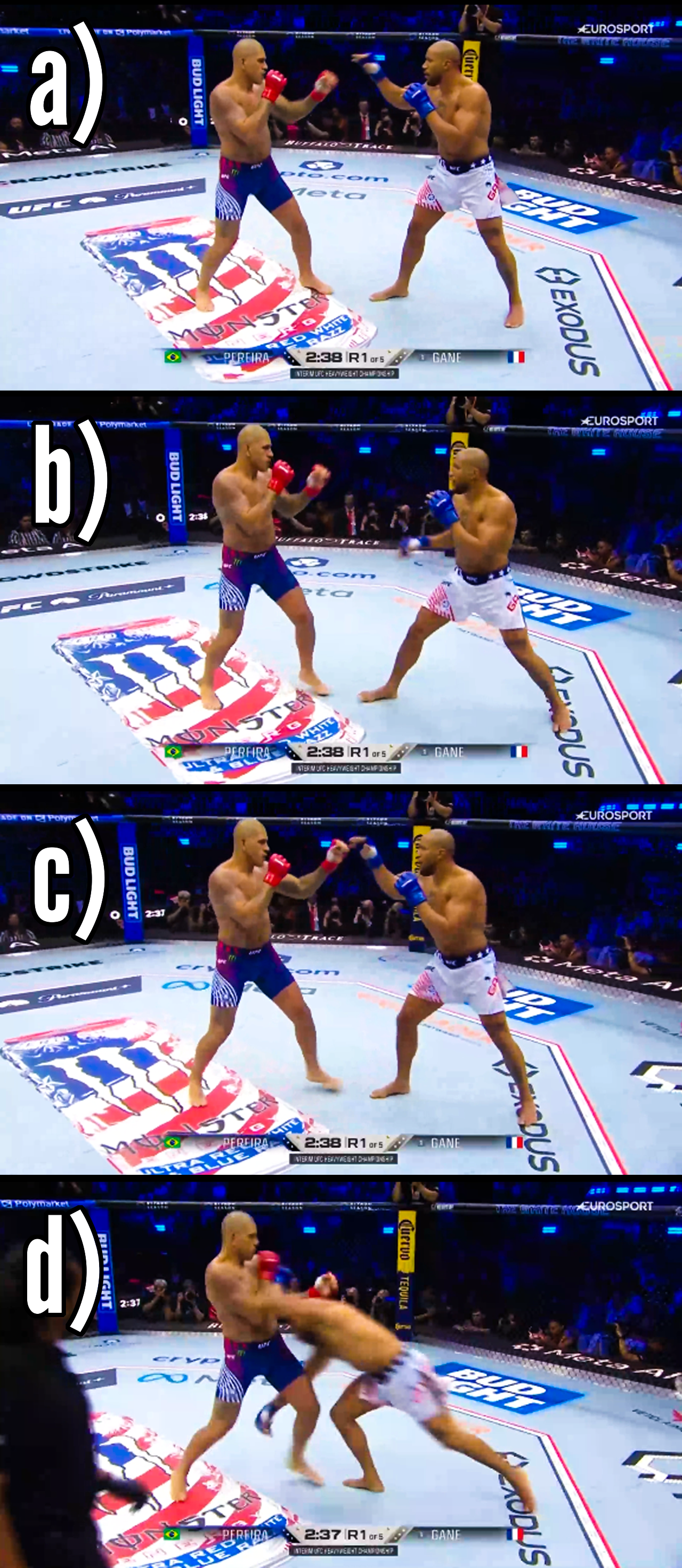
Fig. 10
There were some interesting shifting punches, and jab and dips into big overhands across the top. Gane also threw the left straight into overcommitted shift, the one that got him immediately taken down by Jon Jones. But it was certainly impressive to see Ciryl Gane, once a very promising kickboxer, give one of greatest big men in this generation of kickboxing almost nothing to work with. Gane is certainly a less exciting and varied fighter in his modern form than when he was chewing up much more experienced fighters on the French Muay Thai scene, but for all his strange quirks he is still a unique problem.