
The Unknowable Tom Aspinall
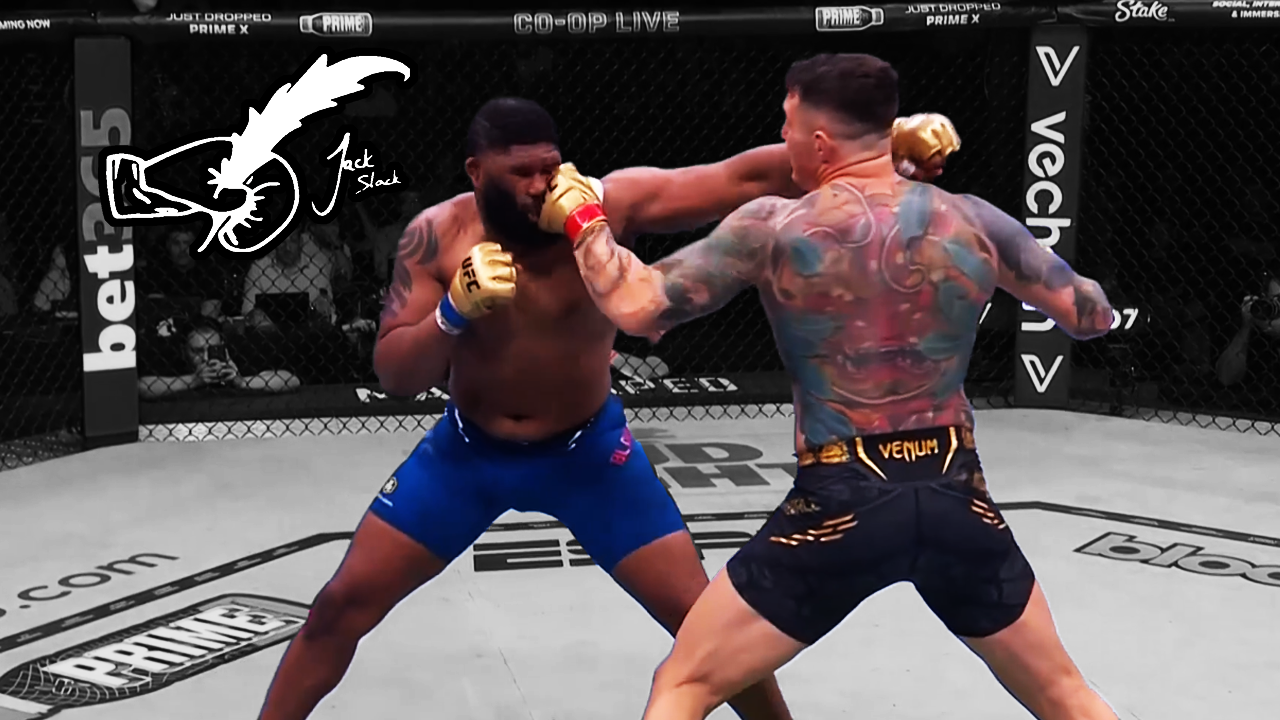
The heavyweight division is at once the least skilled and most dangerous place to compete. Everyone is lethal, everyone is horribly flawed. In this jungle of haymakers and heavy breathing there is nowhere to hide a shaky chin. Yet the heavyweight division does allow ample camouflage for something a little more sinister: skill.
Tom Aspinall is entering his tenth fight with the UFC and defending his belt for the second time, yet he might be the heavyweight division’s greatest unknown. None of his fights have gone beyond round two and most of them end in the first couple of minutes. We see him absorb tremendous blows without flinching and deliver his own with speed that is almost unfathomable in heavyweight MMA. Yet we do not know if at the eight minute mark he becomes every other heavyweight in the world and begins looking for opportunities to rest on his haunches between exchanges. He demonstrates genuine skill in some bouts, but the higher the stakes get the more inclined he is to run in swinging with his chin up from the first bell. His UFC title fights could fairly be described as James Thompson’s classic “Gong and Dash” strategy, if Thompson could take the blows. The joking refrain from many MMA fans and media is “well obviously Tom Aspinall is good, but is he actually good?”
The Slightly Better Bum Rush
One aspect that makes Tom Aspinall a little more than just a bum rush is his use of false entries. These are a type of feint, but where a shoulder feint or head fake is performed in striking range, a false entry tends to happen from a little further out.
Between Willie Pep – Advanced Striking 2.0 and Jersey Joe Walcott – Advanced Striking 2.0 we have explored the idea of abandoning the stance a good deal this year. By standing up out of the stance and bringing his feet closer to level, a fighter allows himself more mobility. It doesn’t matter if you’re talking about Tony Canzoneri in the 1920s, Muhammad Ali in the 1970s, or Tom Aspinall in 2025, there have always been fighters who want to move freely around the ring and are willing to abandon the safety of stance to do so.
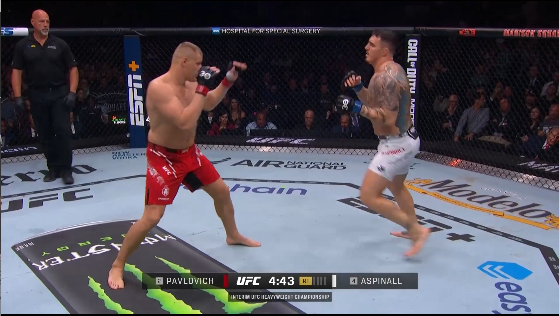
But if you want to throw good punches and move your head, you then need to spread your feet again.
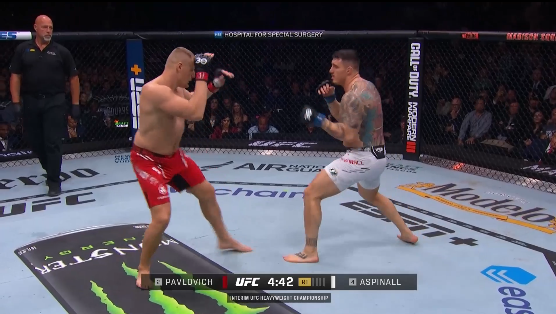
By abandoning or shortening the stance, you give yourself the task of dropping back into stance before you throw. That is an extra movement and a telegraph, but just as with the step up on Alexander Volkanovski’s inside low kick, that telegraph can be used to your advantage. To jab the opponent you have to stab your lead foot out into a stance first. That is a big, obvious movement so rather than try to hide it, many fighters use it. Stabbing the lead foot in and then pausing or rebounding off it, rather than entering for real, is called a “false entry.”
Ilias Ennahachi is a master of the false entry. He was the ONE Championship kickboxing champ for a while and still fights well at the highest levels of the game. Ennahachi bounces in and out with fake entries to numb his opponent to his legitimate attacks. Ennahachi has even better success using the false entry after knockdowns to draw out big swings from panicked opponents, then return on them when they are out of position.
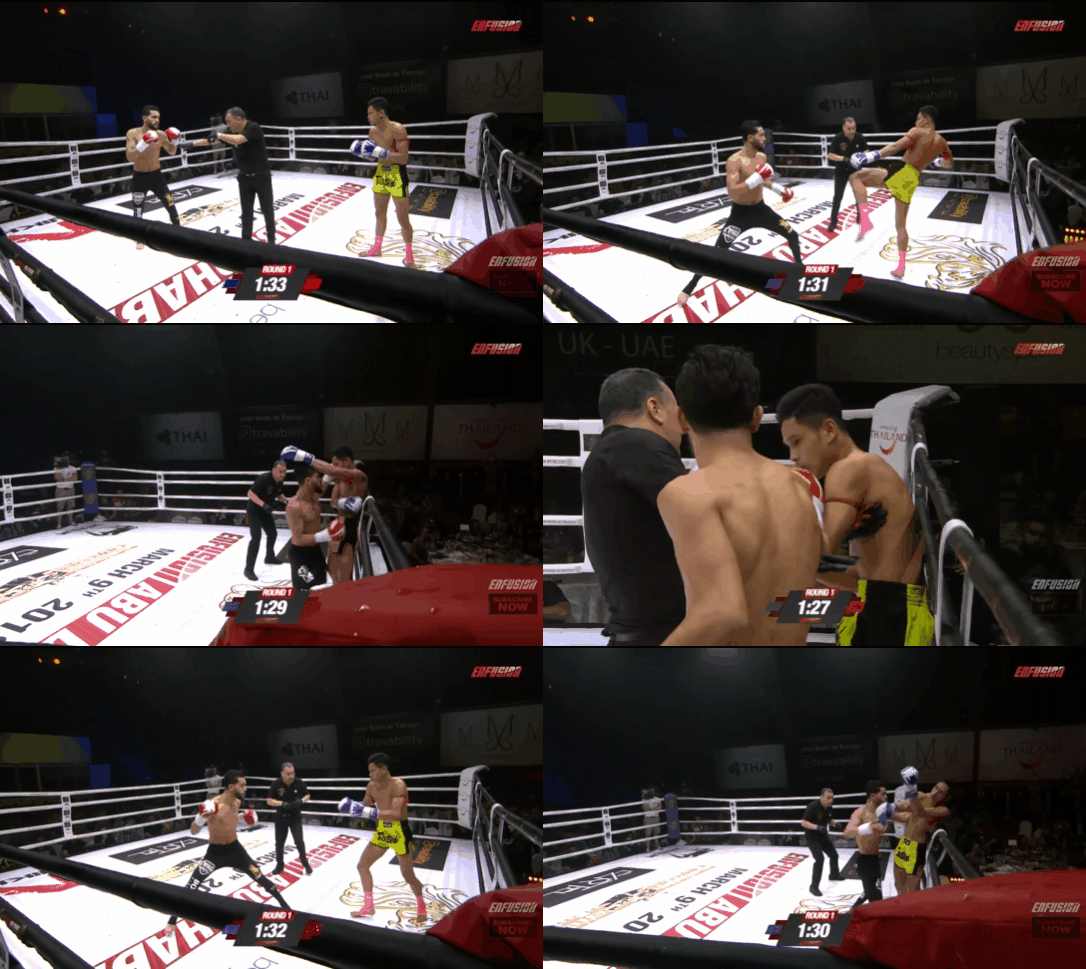
For Aspinall, the false entries mainly serve to make his opponent settle down. He will show them one, maybe two, and they will swing back eagerly at air. Then at some point they will stop reacting so promptly and begin waiting later into the movement. Fighters don’t like to be made to swing at air, and heavyweights don’t like to be made to exert themselves unnecessarily.
Beyond the simple set ups where a fake strike turns into a different strike, this is the most valuable use of feints for a high level fighter: to get the opponent waiting later to see what is real and what is fake. If a fighter sits on his hands and refuses to be made to reach for feints, eventually the feinter will be be standing on top of him by the time they initiate the attack for real.
Obviously not every fighter will react the same. After Aspinall feigned an entry and retreated a couple of times against Marcin Tybura, Tybura decided to wait for Aspinall to get a bit closer and this allowed Aspinall to pressure him back and get to work.
Andrei Arlovski went into something of a panic and began chasing after Aspinall as he dropped back through space. Arlovski ran himself onto counter punches in this way.
Chin Up in the Air
The entries are simple. Critics reduce Aspinall to “a good one-two” and not much else but in truth the same can be said of a number of all time great boxers. Tommy Loughran didn’t even have the “two” part, just one brilliant jab and some tie ups.
Aspinall’s standard one-two is accompanied by a step to half-past-ten, which allows him to slide down the inside of the opponent’s jab and use his right hand as a cross counter over the top. Simple stuff but obviously useful enough that this alone won and defended a world title for Aspinall.
If the occasion calls for it he will use other basic set ups. Aspinall’s false entries against Sergei Spivac generated a “goalposts” high guard response.
So when Aspinall entered he led with a slap on the outside of the guard as he stepped forward to his left and lined up his right shoulder with Spivac’s centreline. This allowed him to try to sneak the right straight down the middle of Spivac’s guard. This particular setup was a favourite of Mark Hunt in his UFC run. Aspinall did the same with a slap-to-uppercut, up between the forearms.
Like the great Cody Garbrandt before him, Tom Aspinall possesses a terrific body jab which he seldom uses. This is enormously frustrating because it unlocks so many doors and nobody in MMA has decent counters prepared for it. Against the southpaw Tybura he straightened his right hand out instead of arcing it over the path of the jab, and when he wanted to get closer he stepped in on an elbow that ended the bout.
But when we are talking about the various ways he used a slight curve in punches that differentiate his left-right from a one-two, we might be forced to admit that there is some truth to the observation that he does not show a whole lot of variety on the feet.
More concerning is the way that Aspinall cranes his neck and lifts his chin high in the air the moment that he gets excited. This is one of those technical errors that is so obvious that anyone who has seen one professional fight can point to and say “he shouldn’t do that.” And they would be right. I spend a lot of time examining all the different, effective ways you can fight and try not to be too dogmatic about any one, but raising your chin as you enter exchanging range has very few upsides. You could argue that it is easier to hit hard if you’re not crunching everything in and worrying about returns, but it is hard to weigh that against the constant blows on the chin that Aspinall does take when he enters.
Boxing did not used to care all that much about guards and chin position during punches. Georges Carpentier wrote a book in the 1910s where he explained keeping his non-punching hand up as if it were the cutting edge of fighting technology. And early filmed matches often contain fighters reaching for the opponent with their free hand instead of guarding, or even pulling it back to their body to generate more power. The problem is that if you are in range to land your right hand, you are in range for the opponent to land theirs, and they will be throwing.
Some fighters just never get it though. Derek Brunson used to whip his head back during exchanges to a comical degree. Every camp he would put out footage of himself shadowboxing or hitting pads with a tennis ball pinned between his chin and sternum. And then every fight he would get the itch to throw his power punches and suddenly he was The Fighting Pez Dispenser again.
Paddy Pimblett is another example. He was down a professional boxing gym every day between his MMA sessions, putting in the graft, and he still could not tuck his chin the moment the excitement started. He and his team did an excellent job of hiding that issue in recent fights by getting him to focus on kicks and distance management, then only clipping off the odd counter punch as the opponent overreached.
Tom Apsinall’s chin will crack at some point if he keeps recklessly trading punches with two hundred and fifty pound men. The idea that because he has taken the best shots from Sergei Pavlovic he can take a shot from anyone is not particularly convincing. Watch fighting for any length of time and you will see some all time great chins get broken by the least likely opponents. The issue is that when facing a great chin, you cannot bank on being the first person to crack it, you have to bring a gameplan that works around it. Sergei Pavlovic, of course, has no gameplan beyond windmilling, and it didn’t matter anyway because Aspinall knocked him out first.
But guarding your chin is not the only way to protect yourself from counters. It was good to see Apsinall using some punch-and-clutch against Alexander Volkov and Curtis Blaydes. Against Volkov he was able to punch into takedowns in this way, but against Blaydes he found himself in an exchange, discharged his right hand with the intention of killing Blaydes, and then ducked into the clinch and pushed Blaydes back to remove the threat of getting punished on the counter.
Gane as a Test
Tom Aspinall’s next opponent is one that could ask a few interesting questions of him and—if nothing else—perform some reconnaissance to help fill out our picture of Aspinall’s habits. Ciryl Gane is not generating a ton of hype coming into this fight because he lost to Jon Jones in emphatic fashion and got a gift decision over Alexander Volkov that many fans are still sore about. And for every unusual or tricky thing about his striking, there is a horrible flaw to balance it out.
Gane has a good jab off both hands and a colossal reach. He has brilliant body kicks that quickly expose the common heavyweight desire to lay down at the first sign of adversity. The inside-out front kick that he throws with his lead leg from open stance is particularly devious.
By angling his knee out he can make it more difficult to parry or catch his leg in traditional fashion, and lines the kick up with the angle of his opponent’s body if they are standing more bladed than square. Gane and Nassourdine Imavov have both been doing sneaky work with this kick in the last couple of years.
His knees and elbows from the clinch are strong, underused weapons. Better yet, he is a competent switch hitter in a division that has almost none.
Yet his takedown defence is consistently disappointing. He dives for leg locks that he does not have the finesse to finish on any but the lowest level of heavyweights. In spite of that terrific jab, it took him less than a minute against Jon Jones to try some kind of bullshit shifting left straight as Jones was walking towards him.
Then when he has his man hurt, Gane opens up to swing in a way that is downright farcical. He looks as though he is on ice skates and the harder he tries to hit, the less powerfully he seems to connect. He often ends up finishing the job by hitting the opponent in the back of the head and assuming—correctly—that the referee will call the stoppage before the foul. In fact if Gane took the Aspinall “just a one-two” idea literally, he might be twice the fighter for only throwing jabs and straights.
In my study of Gane on the way up, I was impressed that he was able to keep the bounce in his footwork late into the fight in spite of his size. Then Volkov forced him to grapple a little in round one of their rematch, and Gane came up from the mat puffing and flat footed for the rest of the bout. It might simply be the quality of opposition being better, but even in a one-sided blowout against Sergei Spivac, Gane looked slower than those days when he was storming through TKO and running up to the UFC title.
So where in that bleak analysis is the “test” for Tom Aspinall? Gane has a terrific chin, throws at a good clip, and attacks the body more than any other heavyweight. If he can drag Aspinall into the second and not already be dead on his feet like Arlovski, we will get some answers to questions most have their suspicions on already. A two hundred and fifty pound man that moves as fast as Aspinall and with such power is rare, but it seems unlikely that first minute Aspinall is the same as third round Aspinall. How much of Aspinall’s success is just his first round ability to teleport in on the opponent as they blink?
In terms of gameplan, Gane is probably best to try to maintain range and then duck into clinches when Aspinall enters. There is no point getting caught over the top of your jab in round one. If he wants to jab, he might stick to southpaw—which Aspinall doesn’t see much, and out of which Gane has a stiffer jab anyway. If he can initiate reactive upper body clinches without leaning down to tie up his shoes—as he did when he wanted to get under Volkov’s jab—he might be able to munch Aspinall’s gut up with some effective knee work and wear on the gas tank even more. And the more Aspinall slows down and lingers out at kickboxing range, the more the jamming side kicks to the lead knee are likely to hinder his blitzes.
It does not seem all that likely though. Aspinall’s key traits might be his brick hands and granite jaw, but he has shown he will take opponents down if the opportunity arises. His work from the top of Volkov’s half guard was brilliant. He applied good ground and pound, countered all of Volkov’s grips and controls, and attacked the kimura and straight armlock after he killed Volkov’s underhook. Aspinall was clearly looking to take Volkov down under his punches—the same way that Jones entered on Gane through unforced error.
Furthermore, so much of Gane’s best work is body kicks. Even well timed body kicks suffer from the fact that you are getting on one leg and offering the opponent the chance to hold the other. Volkov bundled Gane over off the first kick he threw, and the resulting scrambling left Gane exhausted minutes into the first round. Gane actually got back to his kicking in that fight, which is hard to do. The successful takedown normally gets the kickerboxer into “hands only” mode and he slowly loses the fight trying to box. If Aspinall repeatedly punishes the kicks with takedown attempts, Gane might end up reduced to poking and trying to run.
We cannot forget though, that Ciryl Gane has two powerful intangibles on his side. The first is the tendency for MMA to always find the daftest and most chaotic outcomes. Got a new, young heavyweight champion ready to mobilize the British fanbase? It would be a shame if he was awkwardly jabbed for five unimpressive rounds. That, and the Jon Jones curse. Jones has a kind of reverse karma where the worse he behaves, and the less care he shows the sport, the more he is elevated by it. What could be more appropriate for MMA than Gane vs Jones 2 for the belt, in a foregone conclusion at The White House?