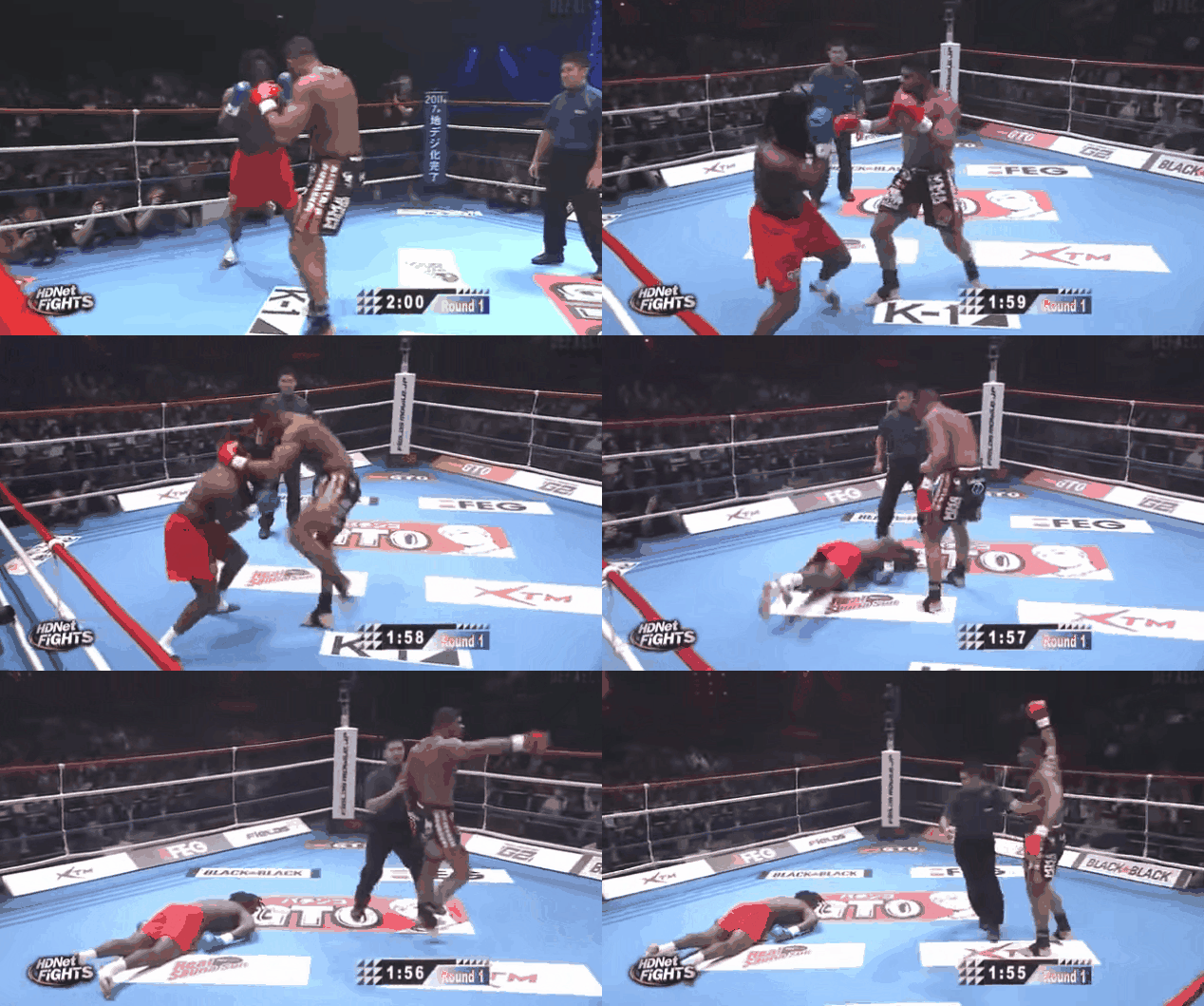
There might never have been a more skilled heavyweight MMA fighter than Alistair Overeem. Set aside any scruples you have over his flagrant use of steroids because if you believe testing does anything, Overeem was at least under enormous scrutiny after getting caught and having to humiliatingly slim down from his “Ubereem” peak. USADA was always listing him among their most tested athletes for the year. In terms of pure skill, there might not be another heavyweight in MMA history to have the number of threats that Overeem possessed in all areas.
Overeem was forever billed as a kickboxer but made his money in PRIDE FC as a ground-and-pounder. Then, as if to prove a point, he went to K-1 and won the most prestigious title in kickboxing. Throughout his career he won fights from the top, from the bottom, from the clinch, out in the open. And almost all of his problems came down to the fact that while he did not have a truly glass jaw, he was not built to absorb the kind of firepower that men of his own size were regularly throwing at him.
Being able to do “a bit of everything” in the familiar, MMA sense is more than enough to be considered one of the best-rounded heavyweights of all time. Yet Overeem had facets to his game that you could point to and say “no one else is doing that.” No other heavyweights had the kind of kicking game that Overeem did, heavyweights seldom kick at all. Almost no one in MMA was as much of a threat with ground and pound from the neutral position of the guard. And no one else, at any weight, in the history of the sport, has used knees like Alistair Overeem.
The knee is deceptive, because to the outside observer they do not achieve much. As with body punches, fans cannot discard the image they have of knees from action movies and Tony Jaa flicks, where men are doubled over with the first knee that hits them in the body. Knees deceive fighters too, because they will begin using them, see no visible results, and decide they are more effort than they are worth. The holy trinity of the knockout shot is power, placement and timing. People think of the knee as a power technique because on the heavy bag it clearly is. But more than almost any other strike, the knee benefits from a focus on placement and timing.
The last years of Alistair Overeem’s UFC run gave us Overeem at his best: focused on hammering in the knees that other heavyweights could not match and did not normally have to defend. Where Overeem would get caught with a good punch and stunned out in the open once a fight, the clinch gave him the chance to remove much of the unpredictability of striking exchanges. Other heavyweights, not having the craft, were not nearly as dangerous with Overeem hanging on their head, and his collar and elbow tie was a vital piece of the puzzle.
Here is a beautiful example of Overeem against Roy Nelson. Nelson had stunned Overeem with a punch and followed up with combinations as Overeem covered up against the fence. After Overeem got a little separation, he hip pumped his famous left body kick, and pulled into the clinch with the knee. Now Nelson was in Overeem’s office and had very little to show him.
Placement and timing can be linked because the trouble with landing good knees to the body is in exposing the parts of the body that will actually damage the opponent. Just as in grappling, the principle of the open elbow applies. When the opponent’s elbow is forced open, or they open it themselves, their ribs are vulnerable. Here is a very straightforward example of that principle: Alistair Overeem pins Frank Mir’s hand to the mat from the turtle—which can expose the body to knees—but Mir jumps up. As this happens, Overeem moves his grip from the wrist to behind and inside Mir’s elbow, physically pushing it away from his body and landing a good knee to the ribs.
The clinch knee game was also one that took advantage of Overeem’s height. At six foot five he was tall, even among the heavyweights, but when he was at light heavyweight through his PRIDE career he towered over many of his opponents. One of Overeem’s best shots was a curving knee that came over the top of the opponent’s guard and hit them in the side of the jaw. Andy Ristie was exceptional at this in kickboxing, often with no attachments, and his coach Lucien Carbin often teaches to arc the knee at the opponent’s wrist in their high guard with the intention of pounding through. Here he scores it against Oleksey Oleinik.
Overeem routinely used the overhook to set up his knees. Against Oleinik and others he entered on a collar tie and pulled himself onto the overhook—traditionally seen as a disadvantageous position in MMA wrestling.
The Mark Hunt fight shows the importance of the overhook for Overeem’s clinch striking. Hunt was good at securing underhooks from the clinch to begin with, mastering that one aspect—combined with the two-hands-under-the-chin face push—went a good way to completing his legendary career turnaround. Overeem spent much of the fight pushing Hunt onto the fence, and securing the overhook as Hunt took the underhook. By the end of the second round, Overeem was pushing into Hunt and draping his elbows over him, begging Hunt to take the underhook.
A classic technique from the overhook and wrist control is to pass the wrist to the overhooking arm, thereby tying up both of the opponent’s hands with one of your arms. Gentleman Jim Corbett was demonstrating this back at the turn of the twentieth century. In mixed martial arts, of course, you are pemitted to strike with the elbow, as Overeem often did.
As mentioned, the overhook is giving the opponent the underhook. If they are already on the fence, they are going to try to lift with that underhook to create space to circle off the cage. When Hunt raised his elbow to lift Overeem, Overeem lifted up a short right knee, directly to Hunt’s exposed ribs.
When Overeem had the underhook, of course, he could physically keep his opponent’s elbow from touching their body, and could attack the ribs pretty much whenever he wanted.
There are perhaps a handful of fighters in MMA who have used consistently used clinch knees to the body well. Among them I would count Demetrious Johnson and Islam Makhachev, and it is extremely noticeable when they are in the clinch that a great many of their transitions are eased along by a knee that makes the opponent squirm a bit. Clinch knees to the body are one of those techniques where they are so seldom done well, that opponents begin to panic and overcompensate. This brings us back to the last great Overeem performance, when he spoiled Sergey Pavlovich’s undefeated record.
After using a little punch-and-clutch to get his collar tie, Overeem was able to dig some decent knees to Pavlovich’s body. Pavlovich is by no means a softie, so the incredible overreaction he had when Overeem hit the clinch later in the fight should tell you all you need to know about the knee to the body. As Overeem grabbed the collar tie, the six foot three, two hundred and fifty pound knockout artist stood on one leg and curled up in a ball to prevent the knee hitting his midriff. Overeem probably could not believe his luck as he stepped through and kicked out Pavlovich’s standing leg, landing on top and pounding Pavlovich to the stoppage.