
On MVP, Risk / Reward, and Rampage Jackson

In spite of Saladine Parnasse’s excellent performance last weekend, discussion in mixed martial arts circles has focused on Michael ‘Venom’ Page. Page put on another horribly boring fight, that he seemed in control of, and won a 29-28 decision. This was the last fight on his UFC contract and they have since confirmed that they will not be bringing him back. That has given the MMA sphere a chance to reheat that age old debate: is it fighting or is it entertainment?
I have done the “every fight is a chess match” thing, and I have grown out of it. This is a sport: fighters do it for money, and the money is only forthcoming because people deem it is worth watching. But with Page there is another theme worth examining, that of risk.
The counter to criticism of Page’s fights is to ask why he should risk losing if he is in the process of winning. However, that counter comes with the acceptance that asserting yourself in a fight, taking any kind of action that is not purely evasive, is taking a risk. I have heaped scorn on Umar Nurmagomedov and Merab Dvalishvilli’s style of “preventing a fight from occurring” via level changes into takedowns every twenty seconds and then scoring no damage, but as Umar Nurmagomedov’s knockout loss to Song Yadong last weekend demonstrated: if you are still moving into the opponent you are still taking a risk.
Page comes across very well in interviews. He understands the game, he calls out the inequity in the business model of the UFC, and he gives an earnest assessment of his lackluster performances. While there are many keen to defend Page’s performance against Ruziboev, Page himself began apologizing for it the moment he got out of the cage.
A Tale of Two Talents
Page’s story contrasts with that of Salahdine Parnasse. Both were stars for second tier promotions outside of the UFC and had the offer from the UFC but delayed their arrival to get the best deal. In Bellator, Scott Coker made brilliant use of Page, matching him against ho-hum opposition to secure spectacular knockouts. When you look back at Page’s record it is very telling that his time in Bellator overlapped with many other respectable welterweights and he met very few. Lorenz Larkin, Yaroslav Amosov, Jason Jackson, even the shell of Rory MacDonald that fought in Bellator, none were deemed suitable match ups. The four match ups that were obvious tests for Page: Paul Daley, Douglas Lima twice, and Logan Storley were all less decisive and much less entertaining affairs.
Meanwhile, Parnasse was in KSW at featherweight. Their featherweight division was not nearly as strong as Bellator’s welterweight division, but Parnasse’s answer was to test himself. He won their featherweight belt, went up and won their lightweight belt, and then went up to a third weight class to fight for their welterweight belt. This is an almost unheard of feat in mixed martial arts where the gaps between weight classes are so large. He lost that welterweight fight, but it stands out because it was something he did not have to do. He was already KSW’s star, he could have rested on his laurels in a lightweight division that could not keep up with him, or run up his highlight reel. Especially knowing that every loss for a big name outside the UFC does the job of devaluing them at the negotiating table.
In spite of this, each man suffered a shocking knockout loss just as the buzz about them was building. In an otherwise uneventful bout, Page got caught trying to leap in with a counter to Douglas Lima’s low kick. He fell to the floor, bounced up, and his head was turned all the way around by an uppercut that scored a one in a million kind of perfect connection on the point of his sideways turned jaw.
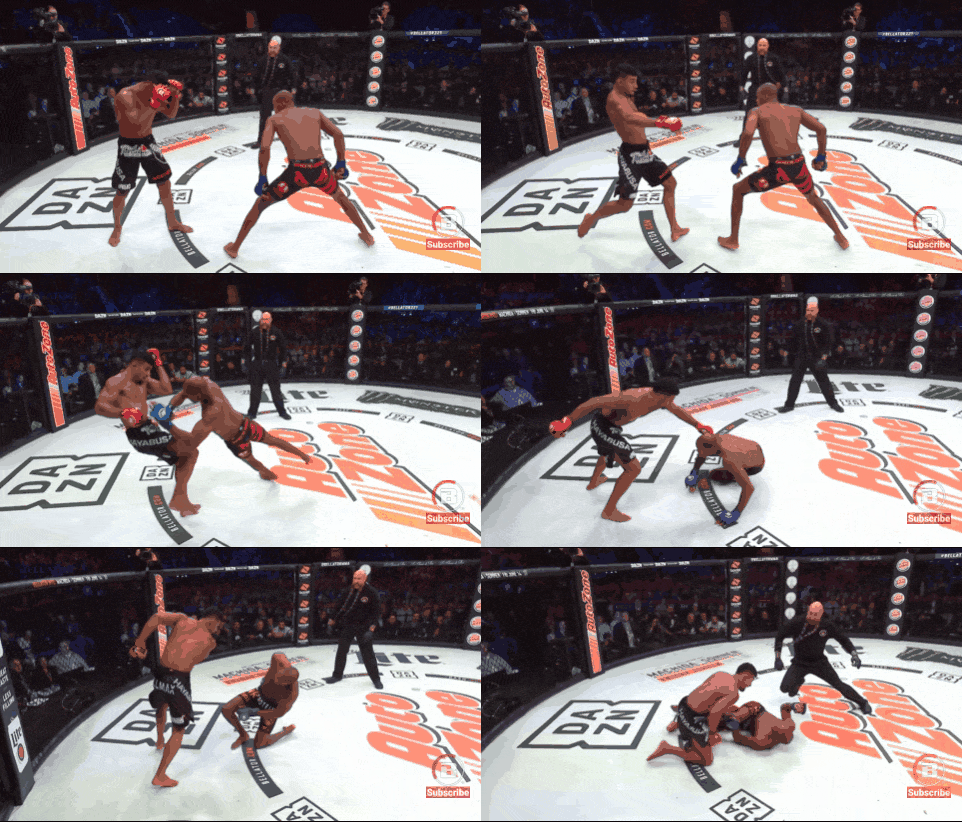
Parnasse fought the less remarkable Daniel Torres and, after landing a left hand and weaving, was caught over the top of the head with Torres biceps and knocked flat on his face.
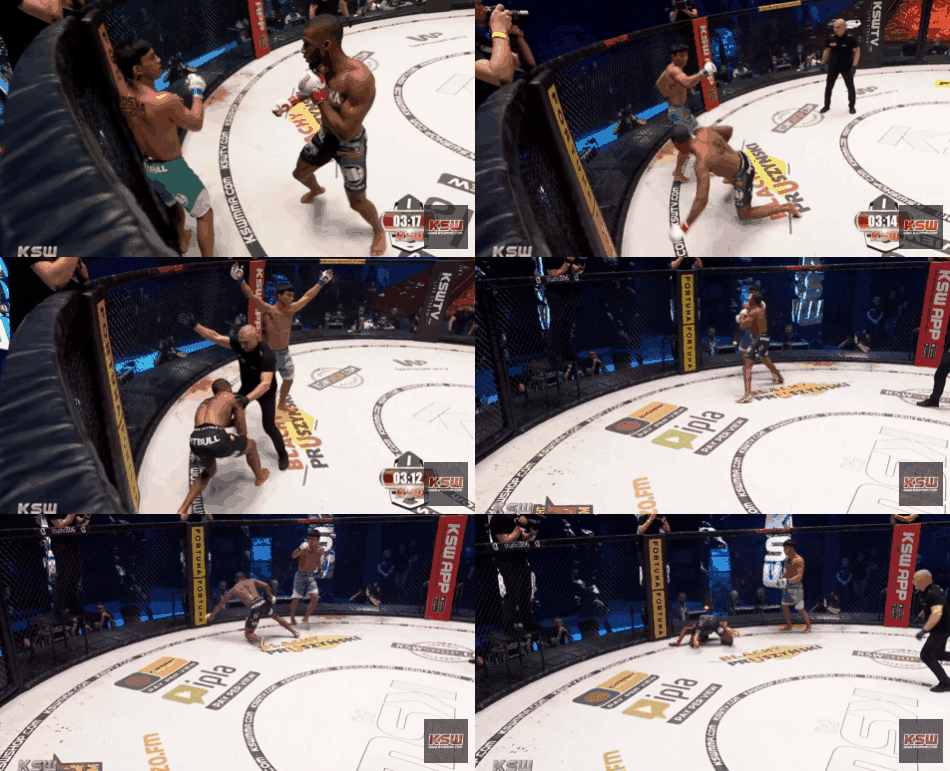
It was a plausible knockout, but it was almost without precedent. It represents perfectly the idea of risk in mixed martial arts because Parnasse weaved under the punch—by boxing’s definition— perfectly. Torres’ glove never came close to scoring a traditional blow, but Parnasse found disaster in the wake of it. There is no offensive action you can undertake in combat sports, in striking range, that does not incur the risk that you might get knocked out.
Those knockout losses might have been the making of Salahdine Parnasse and Michael Page. Parnasse got a rematch and went back to work outclassing Torres. His pace never slowed, and he put Torres through the ringer for twenty-five minutes, leaving no doubt who was always the better fighter. Page went from a title fight with Lima to a fight with a 2-1 librarian named Richard Kiely. He was built up on a diet of lesser fighters and two and a half years later he met Lima again. Lima was already long past it, his decline perfectly mirroring Tyron Woodley’s: he stood with his back to the fence, doing far too little. Page won a slow paced split decision with a little home cooked judging.
I have seen it theorized that the Lima loss is where Page became gun shy. And “gun shy” seems to be the only way to describe it: he publicly acknowledges that he needs to throw more in press conferences and interviews, he controls the range of the fight throughout, and then he does not throw. As Parnasse was having his coming out party, bombing out Dan Hooker in 2:35 with just twelve strikes, Page was being derided for landing twelve strikes over three full rounds with an obviously injured Nursulton Ruzobiev.
And that is what makes this stage of Page’s career so unusual and confusing. For most other fighters getting gun shy is the nail in the coffin on their competitive career. Yet Page’s mastery of distance allows him to continue denying his opponent the opportunity to engage. Page’s style is built around the intercepting counter and the long right hand lead, and with each he immediately falls into the opponent to off balance them or create a clinch. Every step of his game is built to mitigate the risk of eating a counter punch and yet he still cannot bring himself to pull the trigger more than once a round at most.
It might be concerning that the moment Page stepped outside of this big moment offense, to throw a low kick, he was taken down by Ruziboev and was stuck on the bottom for the rest of the round. It raises the question: how much is the inaction hurting Page, and how much is it hiding the limitations of his game at this late stage of his career?
Michael Page continued to beat opponents and the UFC could not work out whether to give him better fighters or worse ones, and ultimately ended up deciding that they did not want to be in the Venom business at all. Jake Paul’s own MVP promotion is already threatening to pick Page up, which is what you would expect, but it seems like that is just the most acceptable outcome for everyone. Page will knock out some third rate fighters on MVP’s cards, a very small number of fans will be convinced he has regained his spark, and he will continue to make paydays on his commendable skill in distance control.
But this all may be an uncharitable reading of Page’s style and career. I do not think Page is lying when he repeatedly promises to do more in his next bout. Traditionally, the old prize fighter who has lost every athletic and technical edge is often left with just the power of his punch to carry him through fights. For Page, his remarkable distancing seems like it might just be the last thing to go.
Delphine “Rampage” Benouaich
On the subject of risk, Delphine Benouaich had the polar opposite kind of fight to Michael Page. She was anything but elusive, and she delivered an electrifying stoppage of Sofia Montenegro late in the second round. Benouaich stood out because she was obviously flawed from the get-go. Her footwork was as graceful as an airport luggage trolley, and yet she outlanded and ultimately finished a larger, more dynamic opponent.
A huge part of Benouiach’s success was her use of high covers, mid-exchange. This enabled her to catch-and-pitch counter each time her opponent committed to trading blows.
Having quickly acquainted myself with Benouiach’s career, this appears to be a newer look for her. Or at least relying on it this heavily is new. She is usually a one-two sort of fighter. She use body jabs and body straights, which is terrific, but this Crazy Monkey stuff is a breath of fresh air. She did it just once in her losing effort against Tina Black, and landed one of her best blows off it.
This one-two-pause-three is a classic that has been used by some of the slickest boxers in history. Unless you want to race the opponent to the left hook and try to beat them on pure speed, it can be a better idea to throw the one-two, and cover up with your shoulders square. The instant you feel them hit your guard, you throw your left hook. This is an occasion where the cross guard works wonderfully, but folding behind just the right elbow, or reverse shoulder rolling as Jersey Joe Walcott and Roberto Duran did is also effective.
Crazy Monkey is a term from deep back in the 2000s, and it refers to a style of self-defence based boxing that South African coach, Rodney King teaches. King has put out plenty of instructional material over the years and I rank his methods highly on my list of “stuff you need to make sure your kid knows.” The crux of the system is that the hands and elbows are held extremely high, exposing the body, because 95% of punches thrown in real life altercations and in anger are targeted at the head.
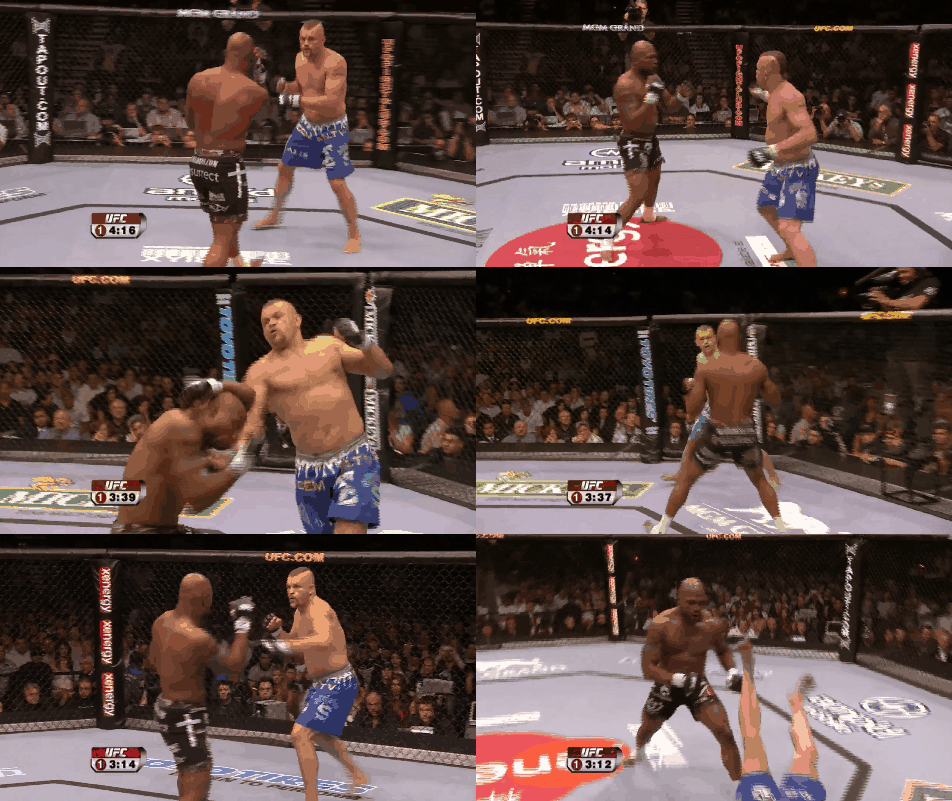
The method was given extra publicity by Quinton ‘Rampage’ Jackson, who was having great success using alternating high elbow blocks and turning it into punching flurries. Jackson started using this method after training with Colin Oyama and it was a large part of his transformation from wrestler to rounded threat.
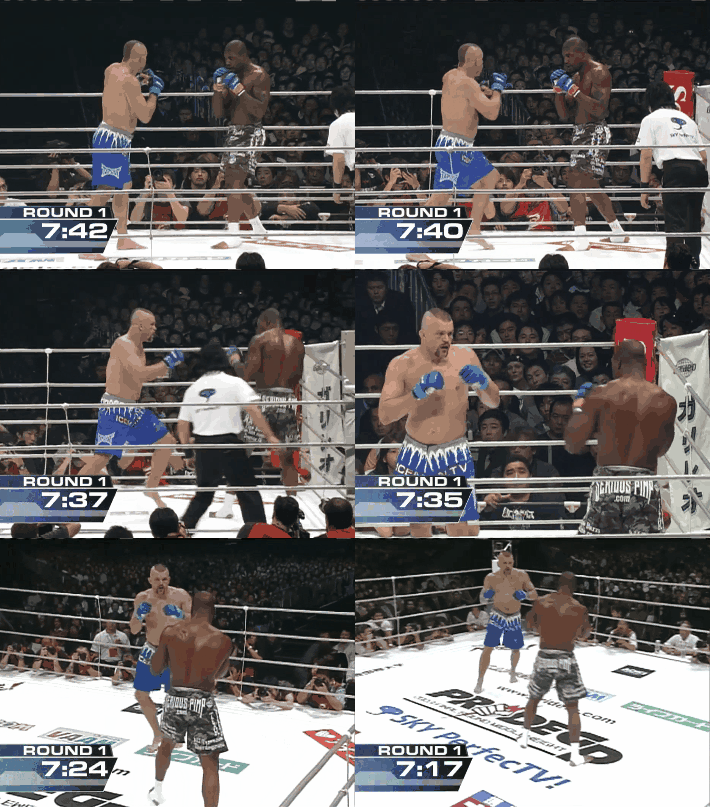
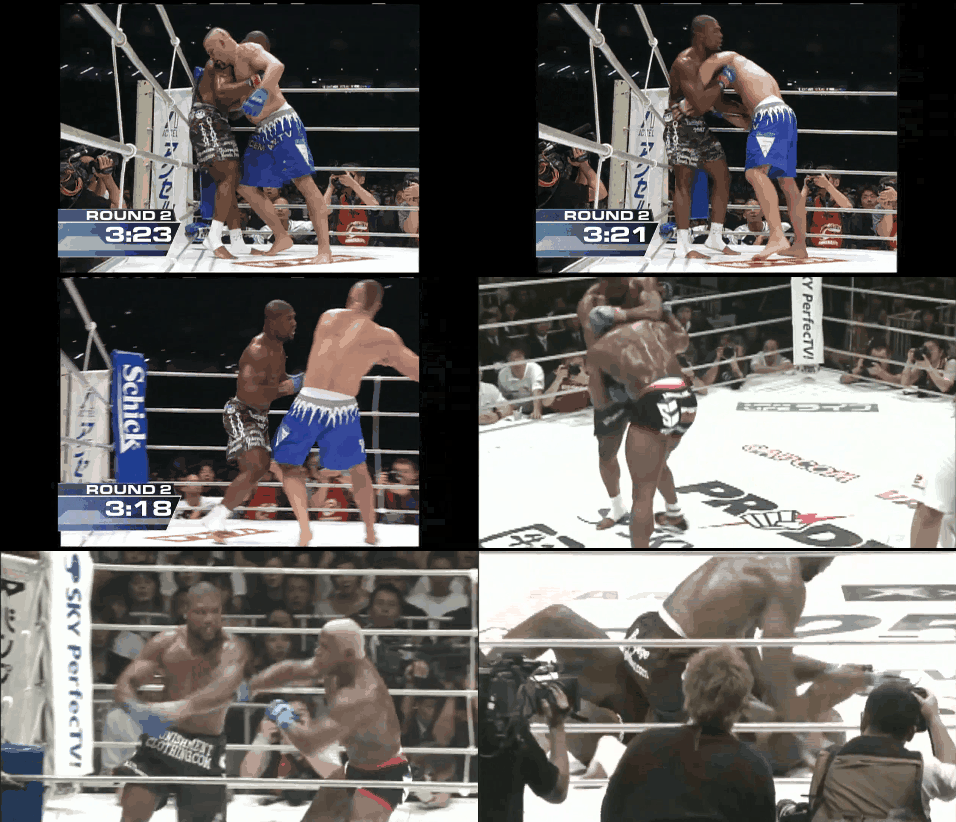
Jackson recently described the method as if you are “kissing your elbows” and credited it with his early career kickboxing knockout over Cyril Abidi at one of the PRIDE vs K-1 shows.

The trick of Jackson’s crazy monkey is the same as the shoulder roll. Making the punches miss is not the goal. The goal is to get the opponent to punch something that won’t hurt you, as hard as they can. That is the one time that they are certainly close enough to hit, and their feet are planted. Jackson’s knock out of Wanderlei Silva in their third fight is a perfect example as Wanderlei spreads his feet, thumps away at Jackson has hard as he can, and eats a left hook square on the jaw in reply.

In my decade writing about MMA, I have never been able to give Rampage the time his style deserved, and it is easy to oversimplify it as if Rampage’s game was just these alternating elbow blocks. But his crazy monkey defence was a tool that he incorporated as and when he thought it was appropriate. His use of the dipping jab and body jab into clinches and uppercuts was as much responsible for his successful connections. Jackon’s most effective uses of his crazy monkey blocks and counters came against looping power punchers: Chuck Liddell, Wanderlei Silva, and to some extent Marvin Eastman.
These examples from the Liddell fight show the crazy monkey’s utility. Jackson begins both clips boxing more traditionally with the jab and even springing back off it. Then as he brings his elbows up he steps closer to Liddell and begins to pressure him towards the ropes, inviting Liddell to punch him.
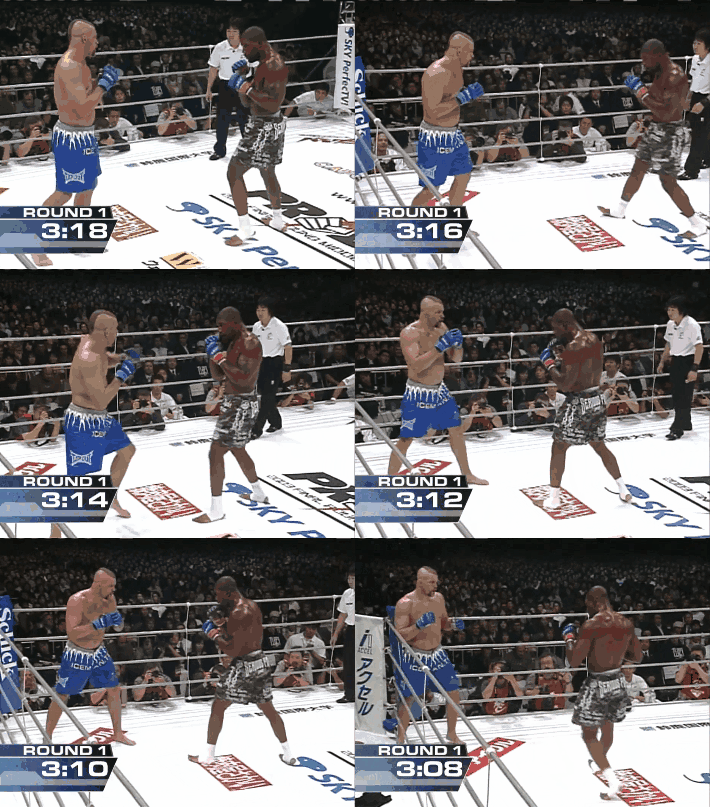

The major opening created by using this method is that the body is completely exposed. In all combat sports the “open elbow” is a usually a bad thing and something the opponent hopes to create in you. When you use this crazy monkey style of catch-and-pitch, you are creating the open elbow all by yourself. In a street fight, it makes all the sense in the world: you have to protect your brain and your consciousness, and anyone who is throwing good body shots in a street fight is already good enough that you’re in trouble. Do the same against a professional fighter in a sporting setting, and you are opening yourself up for free points.
The upshot is that if the opponent commits to the body shot—and particularly if he strays from jabs and straights to the body and starts looping power punches—he enters the catch-and-pitch range and exposes himself in just the same way. Chuck Liddell came into the rematch with Jackson aware of this opening, and found himself getting knocked out off a body shot.
Delphine Benouaich had a couple more looks that I enjoyed enormously. The first was weaving off her right hand. Obviously for wrestling this is a gamechanger. Gunnar Nelson scored all his takedowns off this, and Fedor Emelianenko ran right through a lot of men in the same way. But Benouaich’s clinch game seems to hinge heavily on the double collar tie and her knees.
Here is another fun parallel with Quinton Jackson. In his early PRIDE run, Jackson made a name for himself with slams, and ground and pound, and brutal knees in the clinch. When Jackson came to the UFC, the rules prohibited from kneeing the head on the ground, and his opponents must have felt a good degree of relief.
This combines with another little trick Benouaich uses: an inside low kick almost down by the ankle. You will see this used in Muay Thai a lot, and Buakaw used it against Mike Zambidis. Zambidis was a legendary overhand merchant and every time he stepped onto his lead leg to pitch a bomb, Buakaw would tap it out and drop Zambidis onto his hands.
Benouaich is doing better than most MMA fighters who use this kick by actually trying to capitalize on the most common reaction. When you kick the opponent’s leg out of their stance it will normally only slide a few inches before they catch themselves, but their head will drop. Benouaich makes sure that every time her shin hits the opponent’s, she follows with the uppercut or reaches for the double collar tie and starts on the knees again.
It is surprising that Benouaich has already run up against an answer that Rampage’s opponents took years to find. The technique of using a high elbow guard does not make a fighter more vulnerable to low kicks, but the context does. A fighter will only use these proactively if they want to catch-and-pitch. The beauty of catch-and-pitch is that the opponent roots themselves to throw hard, but on the flipside the fighter trying to counter must root himself to absorb those blows on his guard. A terrific counter for the crazy monkey—and fighters who want to spread their feet and use a ton of head movement, while we’re at it—is to bullshit them with three jabs or a 1-2-1, and then land a low kick.
We compared the high elbow catch to the shoulder roll earlier, but one crucial difference is that by carrying the hand low to shoulder roll, the fighter can see everything in front of him more clearly. A very high guard often obscures the fighters vision, which is especially troublesome when you start kicking the body and below.
All of this is of note because I do not look at Benouaich an obvious next world champion. Her feet are so obviously slow and her power is not amazing. Yet in her use of the crazy monkey to catch-and-pitch, and going first-and-third when she does it, she goes some way to making up for that. Her fight with Tina Black shows that when an opponent is committed to circling the cage, and only throws one punch at a time to continue moving, Benouaich cannot keep up. But ring cutting is not about speed as much as it is about reactivity and anticipation, and it can be taught. If Benouaich can bring the quality of her footwork up, if not her foot speed, she might be able to force the trades on her opponents that she can win on the third and fourth punch.