
Notes on UFC 332: No Mismatches Edition
If the news that UFC 332 broke the UFC’s all time knockout record for a single event rang hollow for you, you are not alone. Fascination with the number of knockouts on a card is equivalent to the “biohacker” who looks at the studies of grip strength as an indicator of health in the elderly and then begins direct grip training, expecting it to extend his life. Some of the best UFC events might have had a good number of knockouts, but if you build an event around mismatches and then achieve a heap of knockouts, you might have lost the fun in pursuit of the high score.
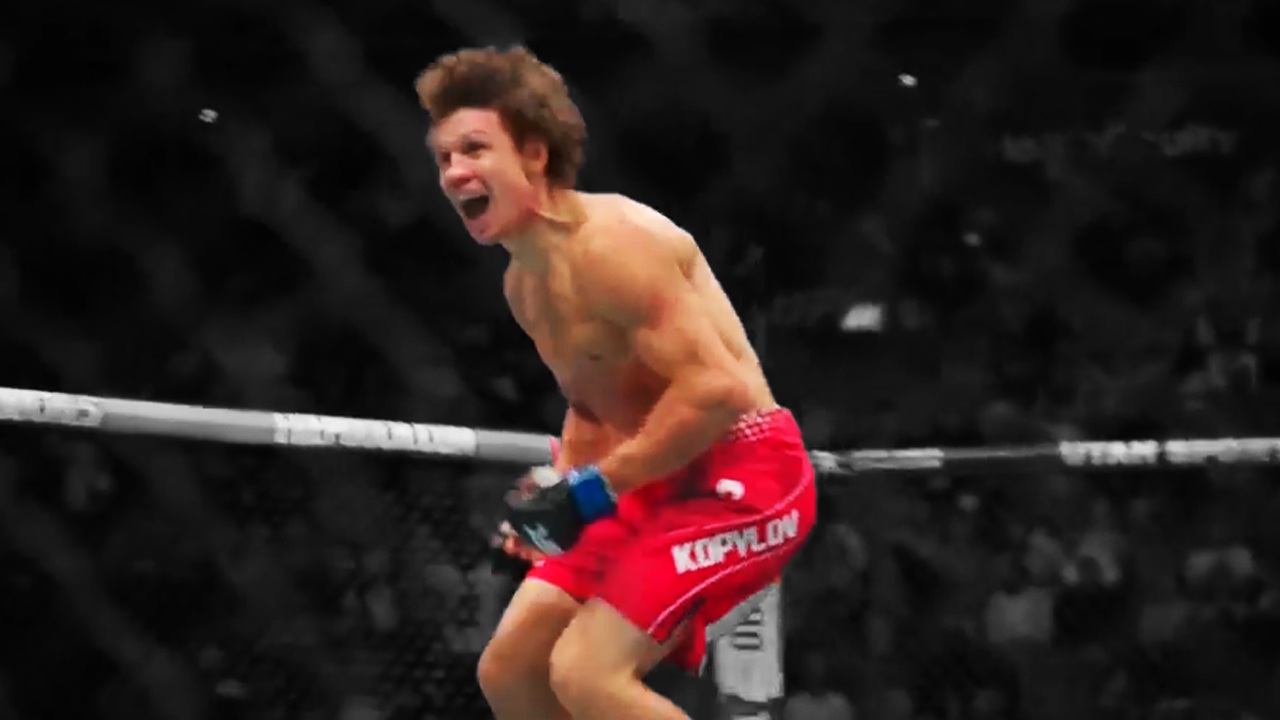
It is no surprise then, that the most exciting thing to happen on UFC 332 was Roman Kopylov bucking the trend and winning as the underdog. Ateba Gautier had been fed up on suspiciously easy dinners in the UFC, and with Kopylov’s recent form it looked like rolling out the red carpet into the real middleweight division. Yet the tricky and mobile Kopylov proved too much, too soon.
In January, Andrey Pulyaev dragged Gautier the distance by getting on his bicycle and circling the cage. Pulyaev, a southpaw, was often circling to the outside of Gautier’s lead leg, taking himself away from Gautier’s colossal right hand. During the Kopylov – Gautier fight it was bizarre to hear Daniel Cormier lauding Kopylov’s outside foot position because the stand out feature of Kopylov’s game is that he eschews outside foot position in almost every exchange. This was the central point of A Filthy Casual’s Guide to Roman Kopylov back in 2023.
Kopylov stood in front of Gautier, giving ground to half-past seven each time Gautier encroached on him. Circling out in this way drew long right hands from Gautier which Kopylov began to slip and duck under. With this “spiralling out” method of open stance fighting you can either draw the opponent into over extension for counters, or walk him straight onto your leads. Throughout the fight, Kopylov menaced Gautier with a simple left straight, which always found Gautier confidently marching in. Figure 1 shows an instance in round one where Kopylov cross stepped to inside foot position and then nailed Kopylov with the left straight.
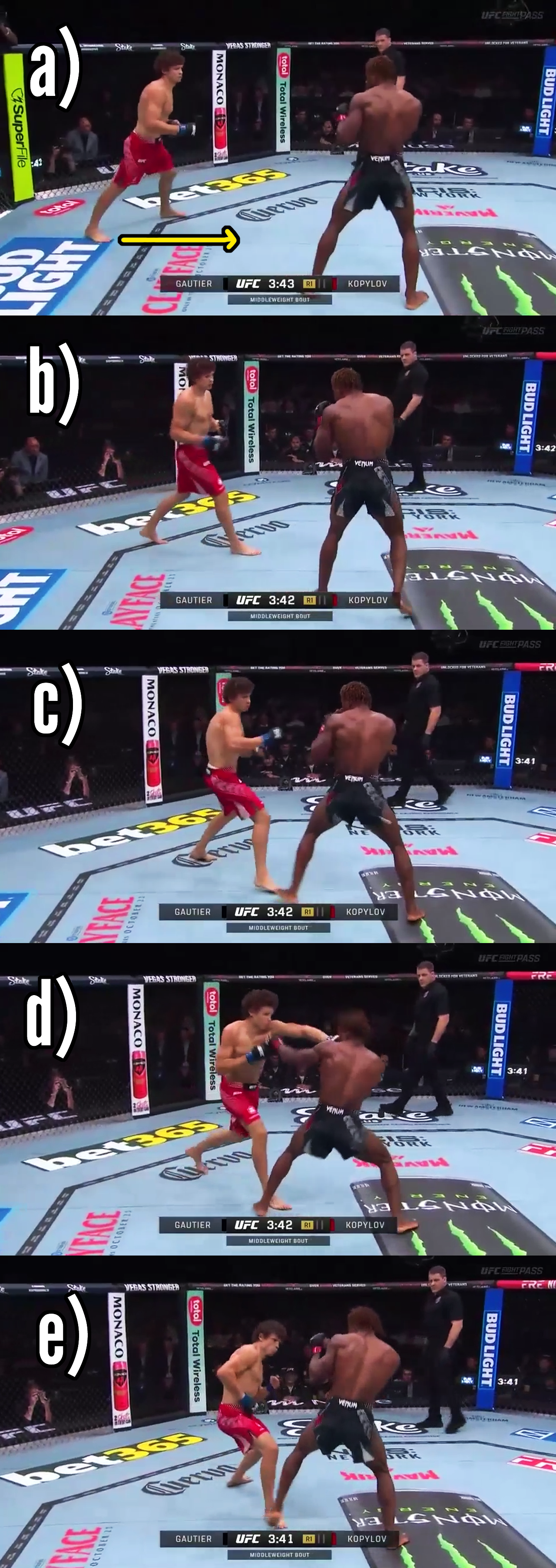
Fig. 1
In his spiralling, Kopylov often retracts his lead leg and begins performing what we call “athletic sidesteps” with his feet level. Figure 2 shows Kopylov shooting his left straight from inside position and immediately abandoning his stance to pivot around behind his left shoulder as Gautier’s terrifying right hand came back at him.
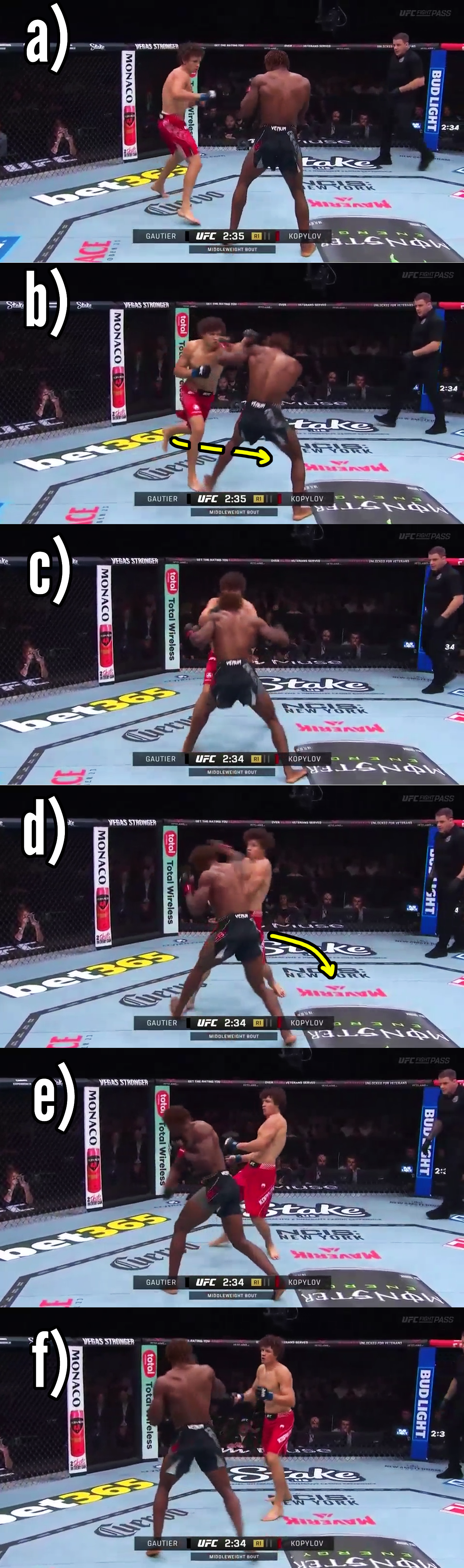
Fig. 2
In A Filthy Casual’s Guide I remarked that “most of a Kopylov fight is Kopylov retreating to his left, his opponent walking back up to him, and Kopylov hitting them with a jab, left straight or upjab.” The knockdown punch was nothing out of the ordinary, it was just the third time that Gautier had walked onto the exact same left straight.
It would be unfair to portray Gautier as hopeless here though. He recognized the direction of Kopylov’s movement early on and attempted a couple of right round kicks to the head and body to try to get Kopylov to change tact. This is the rare match up where the power inside low kick might have been a good look, as Kopylov’s lead leg trails in perfect position for it, and Gautier could have followed with his hands.
Welcome, Soldic
The other notable fight that was not a horrible mismatch was Roberto Soldic’s UFC debut. The Roberto Soldic everyone had been talking about only turned up when the second round began; his first round was one of those classic cases of “Octagon jitters.” Often this is a fighter being overawed by the move to the big show, but in Soldic’s case—just as in poor Xiong Jingnan’s—he was coming in cold off four years of extremely reduced activity, courtesy of ONE Championship.
Fans might also be underestimating Khaos Williams when they blame Soldic’s first round on nerves. Williams is explosive and awkward, and those traits are always at their strongest in the first half of the first round. Soldic came out trying to pressure Williams and then slide back just a few inches away from Williams’ returns. The stuff you want to do if you are going to do some smooth counter-fighting off your own leads, first-and-third. Soldic seemed was surprised when Williams didn’t just swing back but tried to jog through him throwing shifting / falling punches. As the minutes ticked away, Williams was much more reluctant to sprint at Soldic on his counters and fell into swinging back from where he stood, which Soldic could then slide away from and come back in with counters.
Williams also had a bit of success by throwing looping shots into linear pokes. This is a tactic that has been used by some of the great “awkward” fighters of all time, but also by the great technicians who are deliberately trying to be awkward. Willie Pep loved the big right uppercut swing into jab, and Sergey Kovalev threw the right hand to jab in every round of every fight. It puts your longest punch on the end of your combo, to clip the opponent on the way out, but it also offers a nice straight shot after the big clumsy swing if that swing is all the opponent expects from you. Figure 3 shows Williams applying the principle, albeit with a clumsy shift through with his feet.
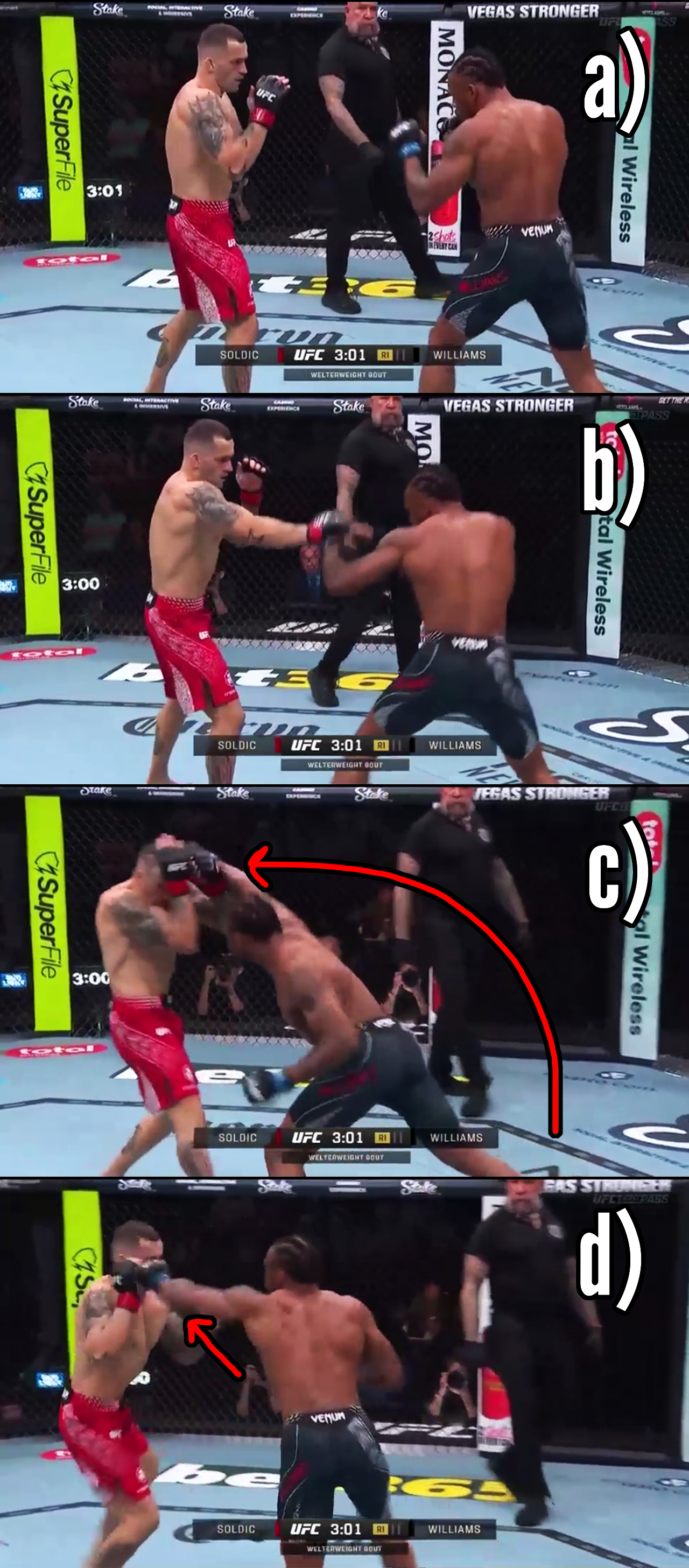
Fig. 3
The highlight of the fight was Soldics’ gorgeous jab, left straight to the body, right hook to the head combination. He landed this far too many times on Williams and by the end of the fight the right hook was wobbling Williams repeatedly.
A Bit of Mexican Boxing
Young Imanol Rodriguez also stood out, with his terrifically entertaining boxing game. At 5’4”, Rodriguez is at a height disadvantage even in the smallest division, but he mitigates this by entering fast and throwing in combination. Figure 4 shows him taking a deep step into a level change, and coming up with a left uppercut, left hook, right cross combination.
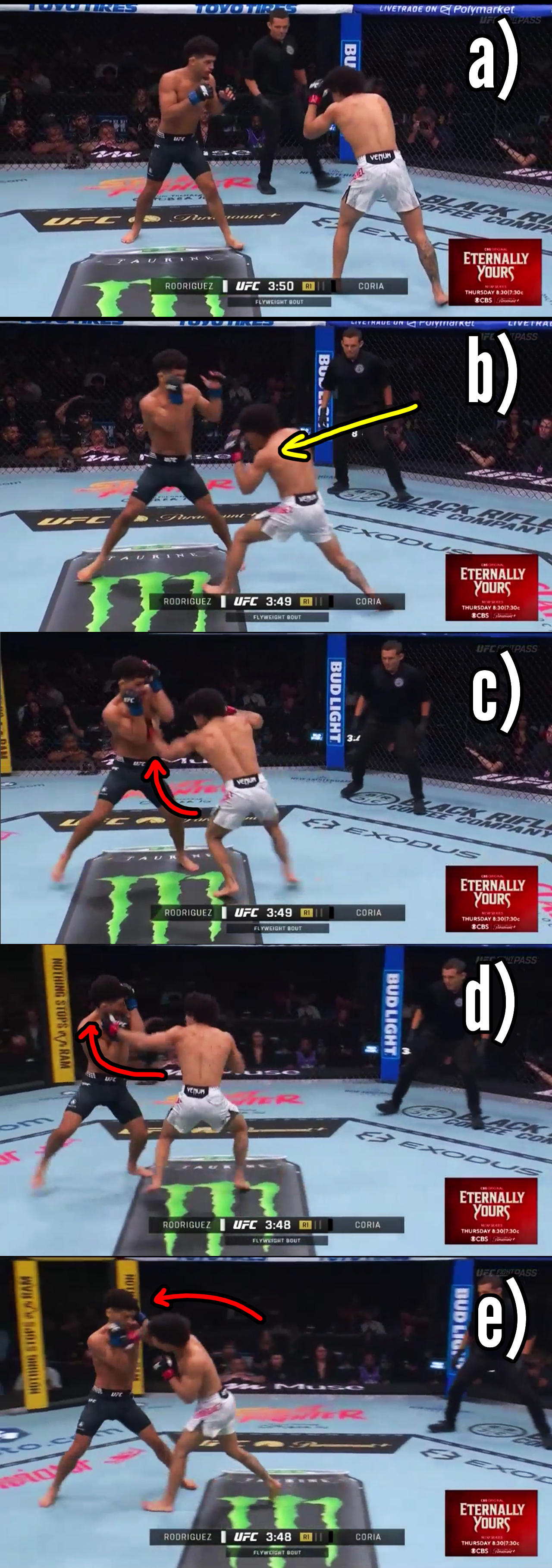
Fig. 4
The smaller man often puts himself at great risk of intercepting counters because he is pushing to close the distance so aggressively. It was wonderful to watch Rodriguez break off his bursts of offence just in time to feign an entry and draw out a massive missed elbow from his opponent.
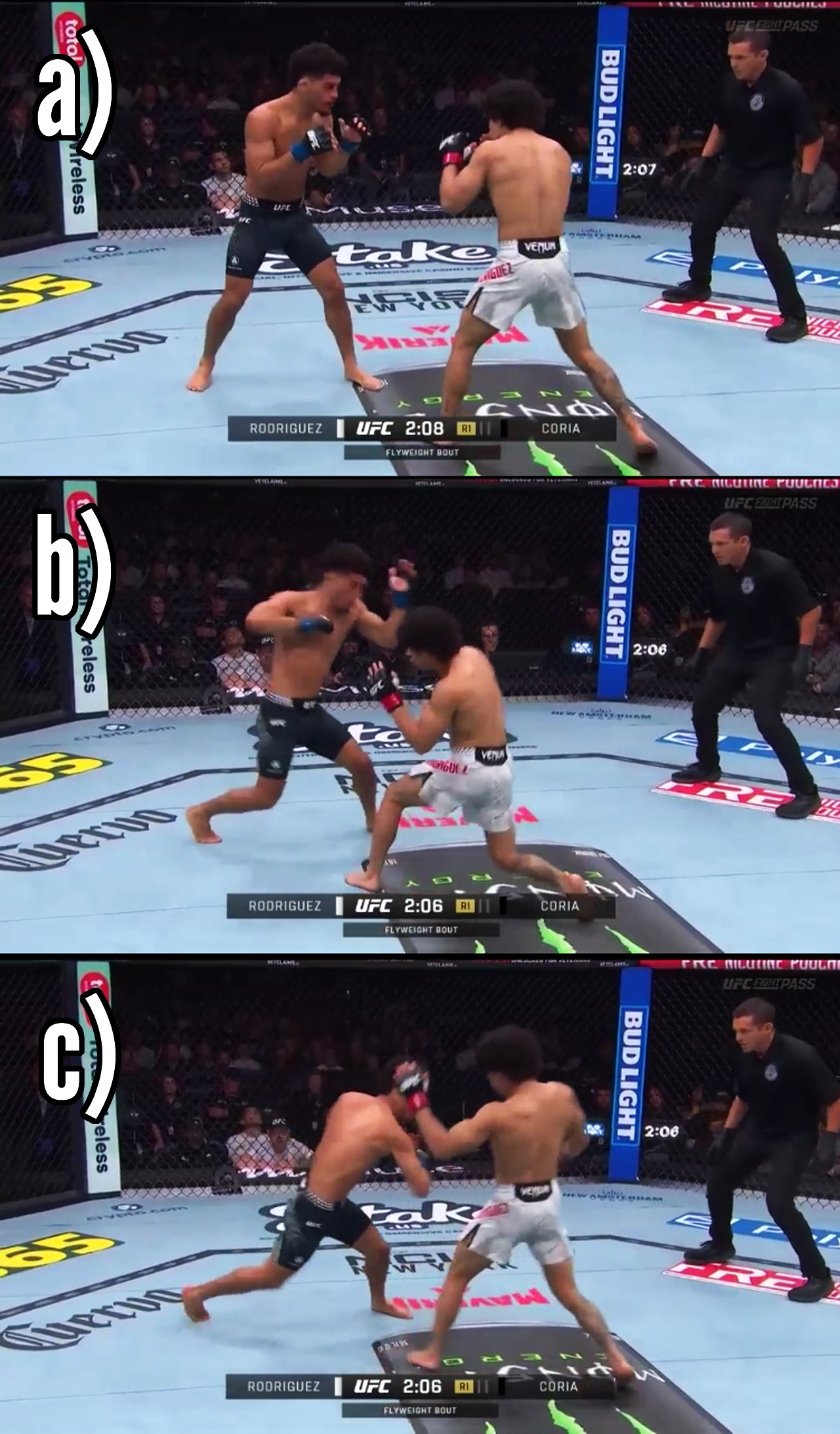
Fig. 5
It is always a little simplistic to romanticize national styles, but Rodriguez is clearly a young man who has grown up watching certain great Mexican boxers and emulates familiar parts of their games. One newer look that I am sure is being practiced in every gym in Mexico right now is Canelo Alvarez’s infamous right hand feint. It is strange because it isn’t mimicking the line of any real punch, but Canelo throws his arm out in the opponent’s peripheral vision and they adopt a high cover, while he cracks them with the left uppercut.
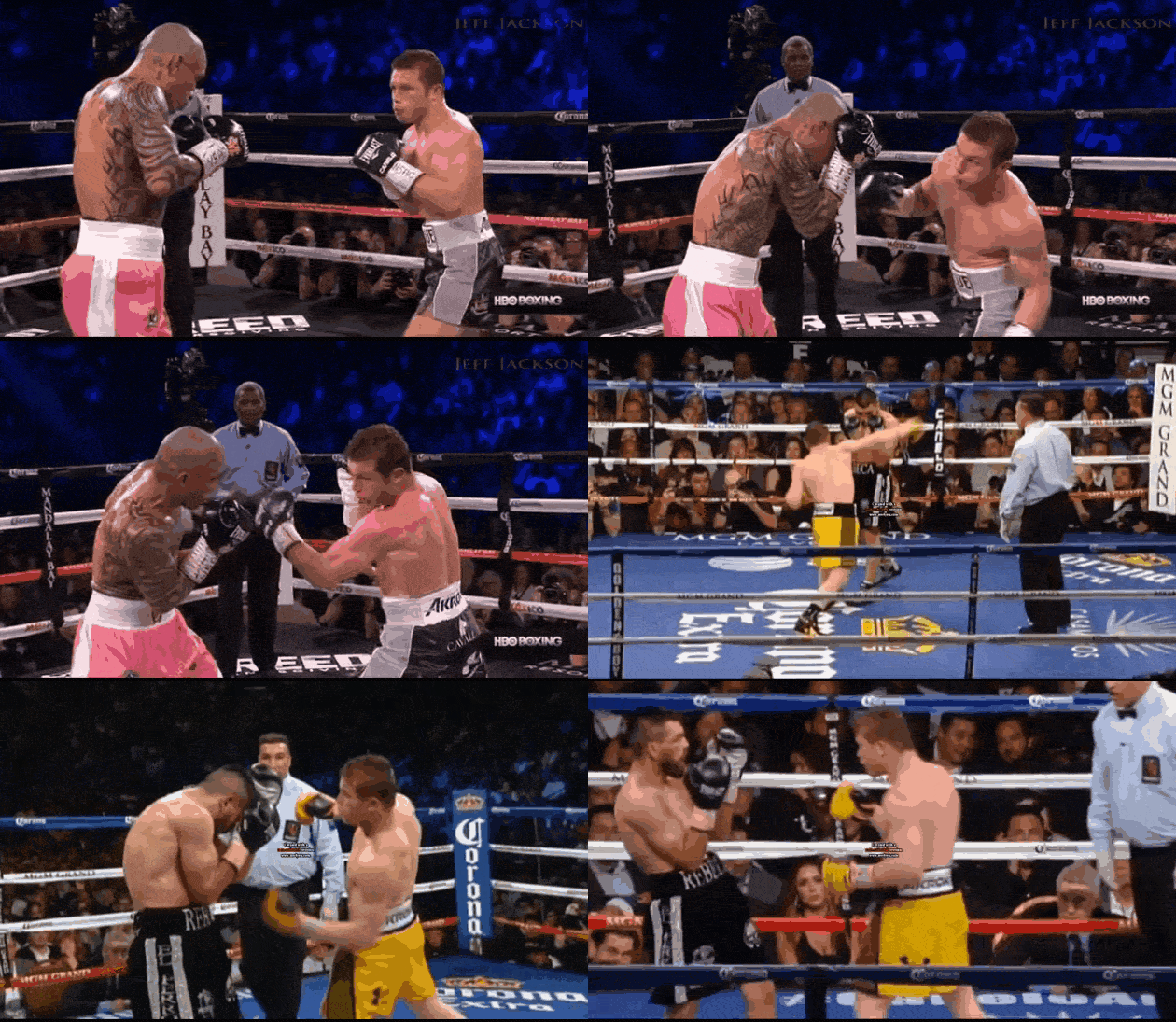
Fig. 6
Rodriguez showed this look twice in the short fight, and used it to enter on a nice level change left hook into another punching combination. Strangely enough, with all his lovely boxing it was his first throw-away front kick of the fight that scored Rodriguez his knockout. A helpful reminder that the right time in the fight to be poking the body is always right now, and then again afterwards.
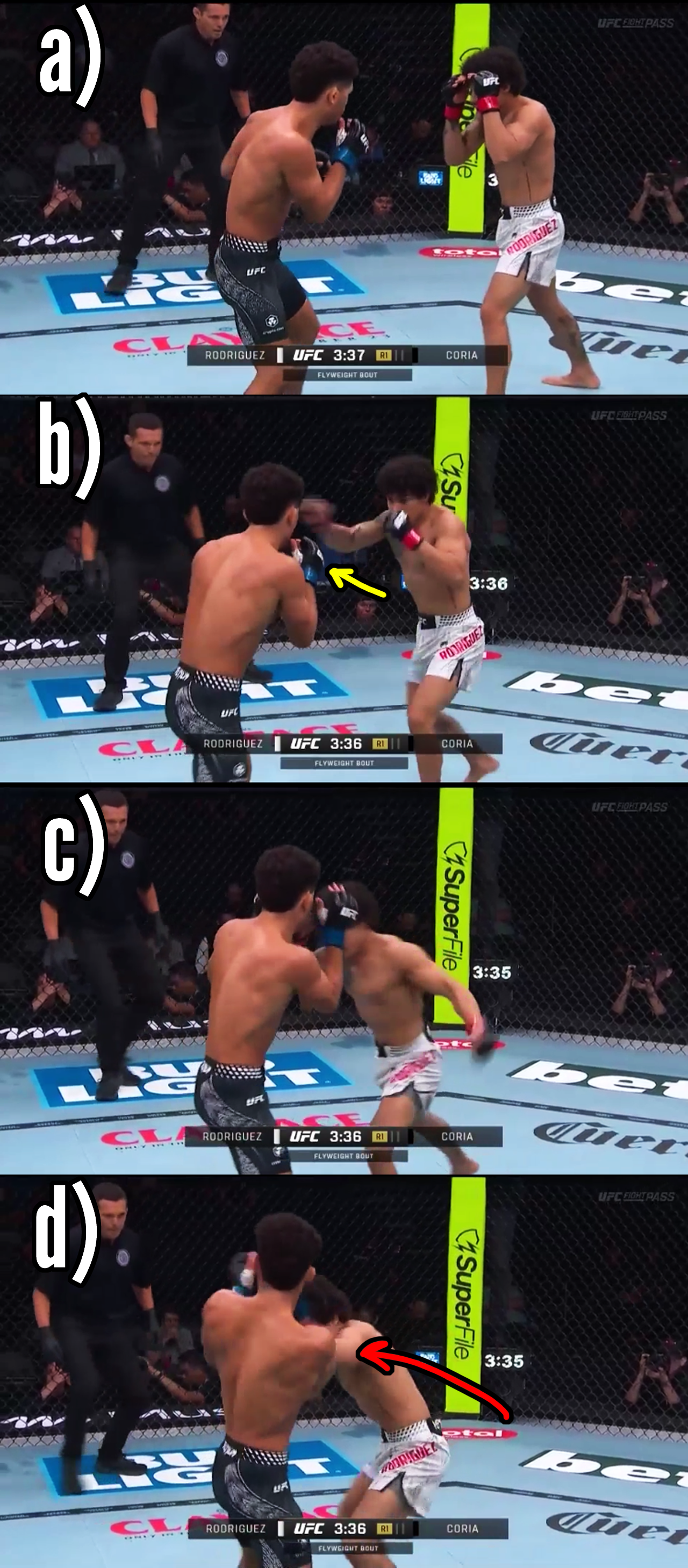
Fig. 7
The Old Warhorse
The most heartbreaking performance on the card came from Rafael dos Anjos. A quiet man, Dos Anjos probably belongs among the pantheon of truly great fighters in MMA, but he is often forgotten. At forty-one years old, ten years removed from holding the UFC lightweight title, he is he kind of fighter I dread having to watch get beaten up by younger athletes who couldn’t hold a candle to him in his prime. The surprise that made this harder to watch than the usual old man knockout is that Dos Anjos looked great. For four and a bit minutes, he was in there beating the piss out of UFC lightweight champion, Anthony Pettis in March 2015.
Gently dancing Hernandez to the fence, Dos Anjos answered every Hernandez lead with a quick parry and counter right hook.
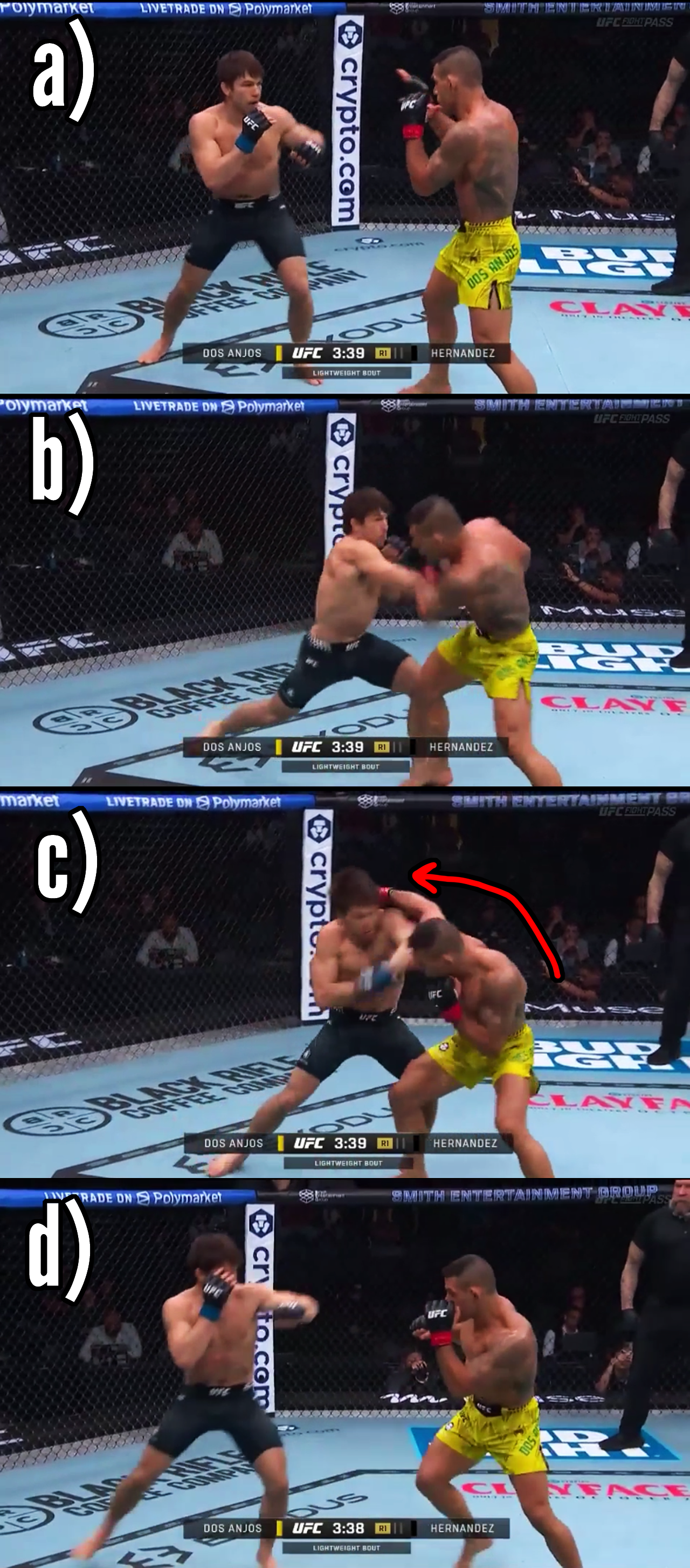
Fig. 8
Hernandez has always been a good runner. Jogging around the cage, switching stances, and jumping in with hard straights is his whole game. Dos Anjos, at forty-one years old and coming off a knee surgery, was majestic as he cut the cage on his man. He was never jogging to catch up to Hernandez, he never even looked to have much urgency, and yet he held Hernandez to the fence like he was suppressing a bubble under water. When Hernandez lashed out to get some space, Dos Anjos pitched his counter right hook and ran Hernandez to the fence. Figure 9 shows Hernandez trying to circle out to Dos Anjos’ right and eating a hard right hook to the body.
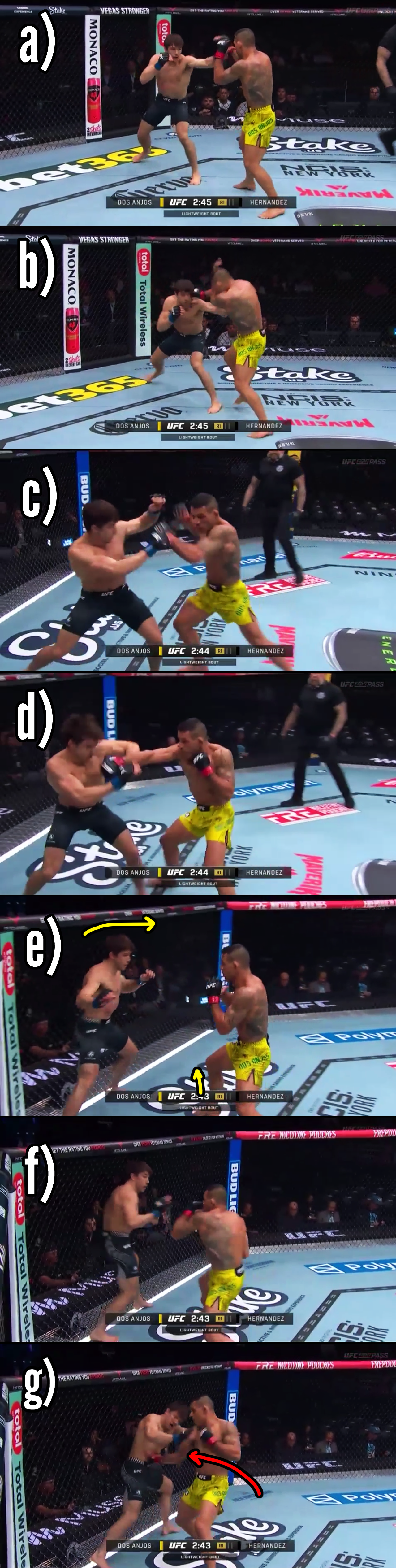
Fig. 9
Figure 10 shows Hernandez circling out to Dos Anjos’ left and getting hit with that vintage southpaw wide left. Recalling the Pettis fight in 2015, it was uncanny.
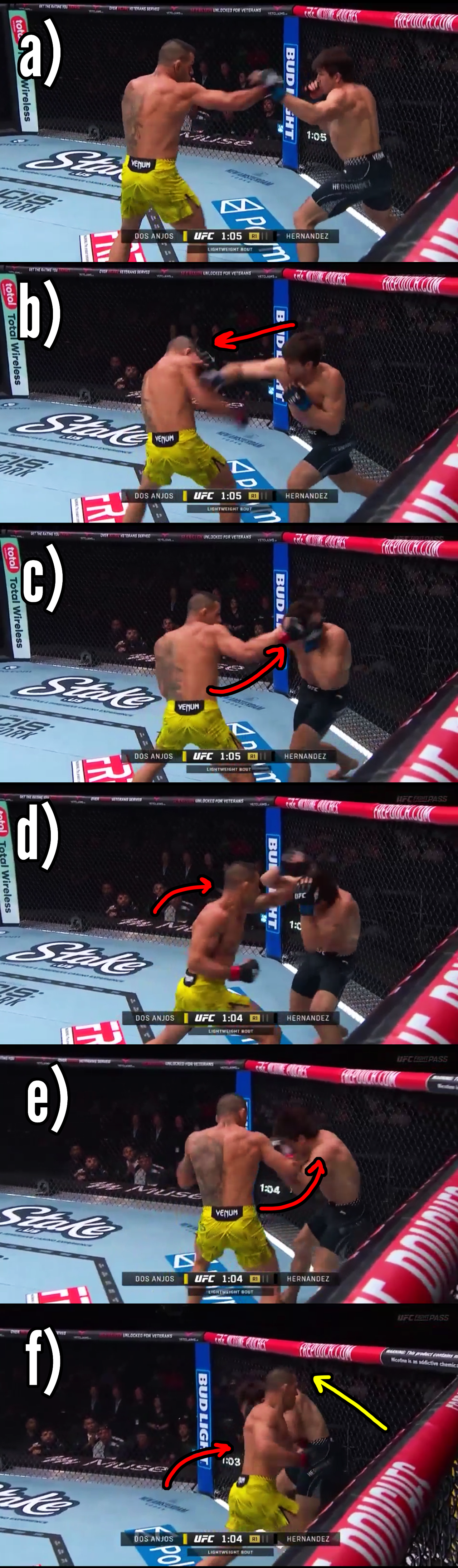
Fig. 10
Sadly, in order to pressure fight, you must use your body to create that pressure. Most MMA fighters are terrible at cutting the cage because they try to do it while staying in their safe, defensive stance. Pressure fighters take risks because they must walk themselves into exchanging range time and time again. You cannot simultaneously confront someone and hide from them.
Even using head movement and hand checks to mitigate the threat, a pressure fighter is going to eat stiff jabs because that is the price of entry. Rafael dos Anjos still has the feet of a graceful old dancer. His wits and instincts are still some of the finest in the sport, and he remains vicious, but he can no longer pay the toll. Two glancing southpaw right hands—a hook and a jab—were enough to shake Dos Anjos to his boots. Hernandez sealed the deal with ground and pound in round two and most who watched it could not help but think that Dos Anjos even five years past his prime would be more than Hernandez could handle.