
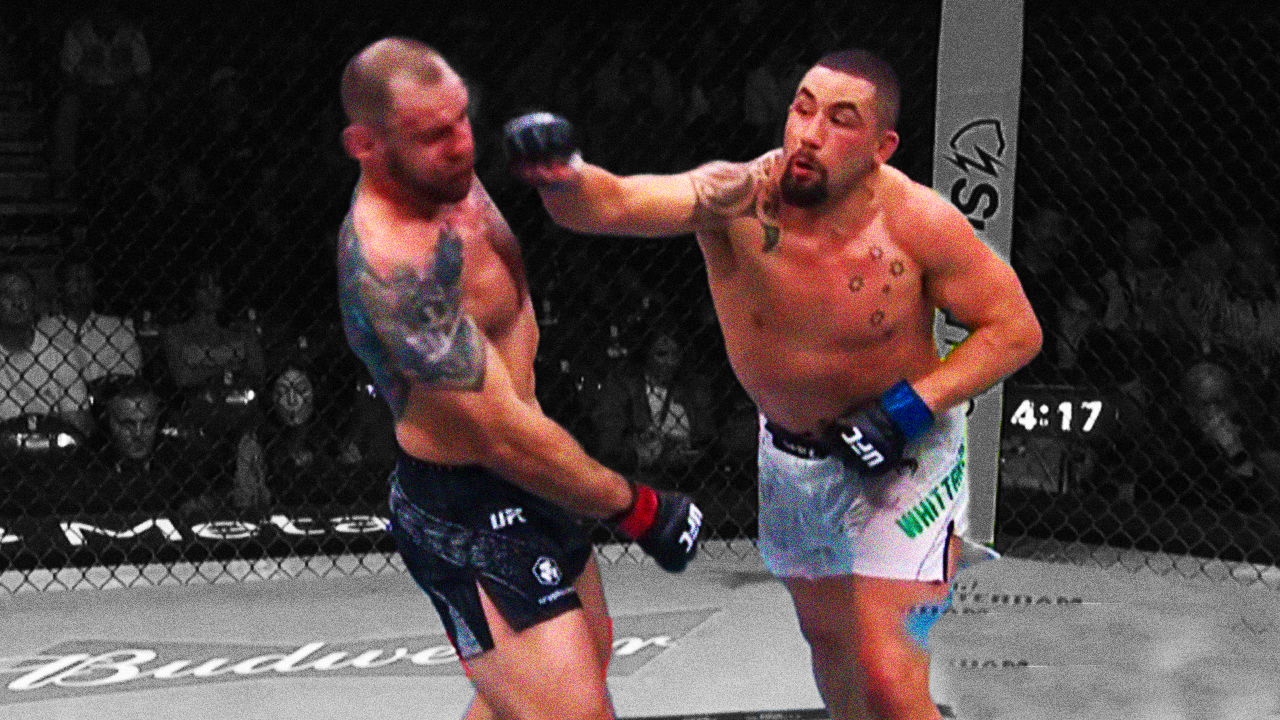
Perhaps the best use for Conor McGregor at this point is as a Trojan horse. His main event sucked up all the air in the sport, and brought thousands of lapsed fans back for one night. The fact that his fight was a dreadful non-event did not prevent those viewers from seeing some beautiful, high level mixed martial arts in the hours up to the headliner.
The beloved Robert Whittaker seemed to think he had reinvented himself at light heavyweight, but fans would have been happy if he simply didn’t get knocked out. The result was somewhere in the middle: Robert Whittaker looked small and out of place as Nikita Krlylov pushed him to the fence and leaned on him. But when the two men met out in the open, the faster, sharper Whittaker made it look like target practice.
One scenario we mentioned on the preview boicast played out over and over again. The lumbering footwork of Krylov, combined with a misplaced confidence in naked kicking, led to Krylov walking up into beautiful tai-sabaki counters from Whittaker. As the kicker steps up to throw his left leg kick, the counter fighter thrusts forward and down the side of the kicker with a strong jab, often taking him off his feet.
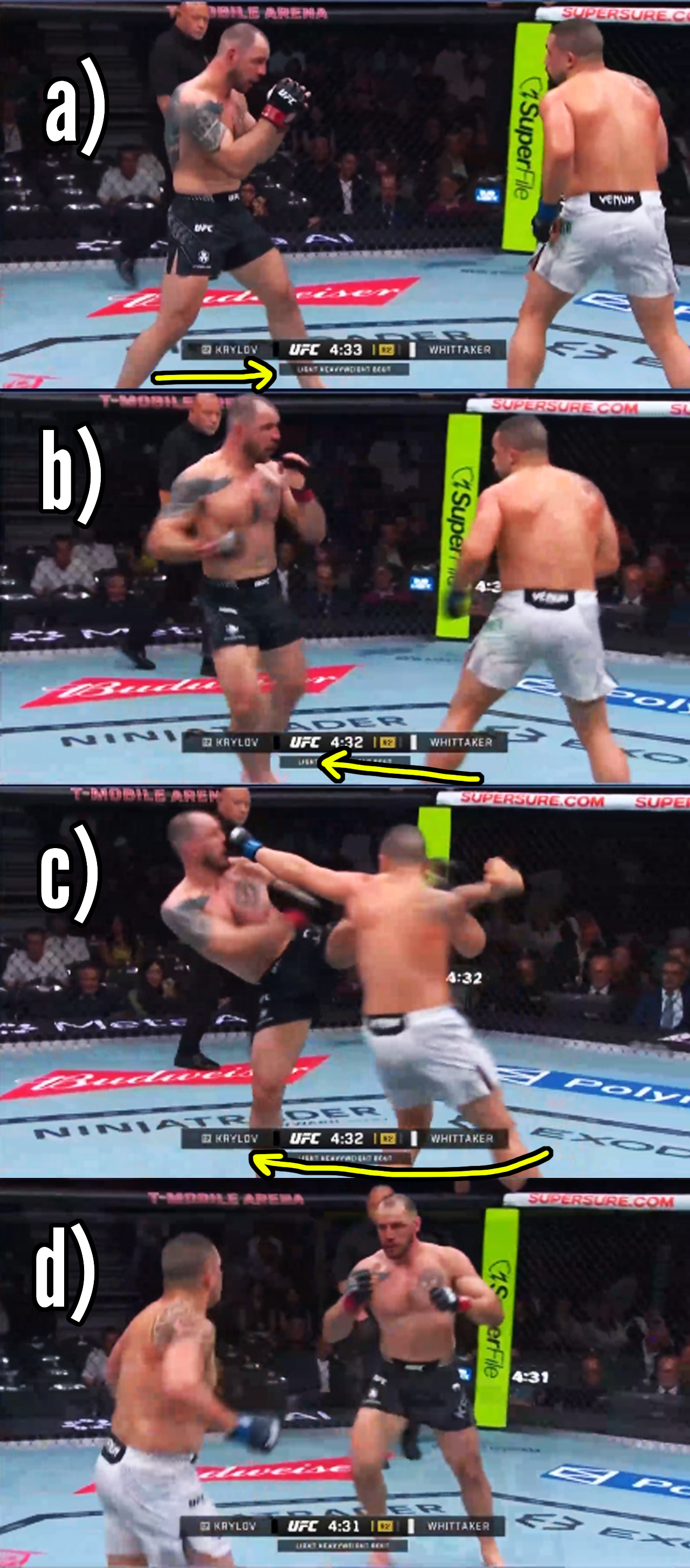
Fig. 1
Kyoji Horiguchi is a master of this counter and scored it in his first fight with Manel Kape. Whittaker himself had scored this against Yoel Romero.
It might seem as though this counter could only work against a step up left kick, but that step down the side can be achieved against front kicks off either leg and even knees. Krylov often raises his knees up to chamber even before turning over round kicks, so Whittaker was able to get some good mileage out of the same tai-sabaki counter throughout. Figure 2 shows Whittaker sliding down the side of a right knee / front kick and landing his right hand.
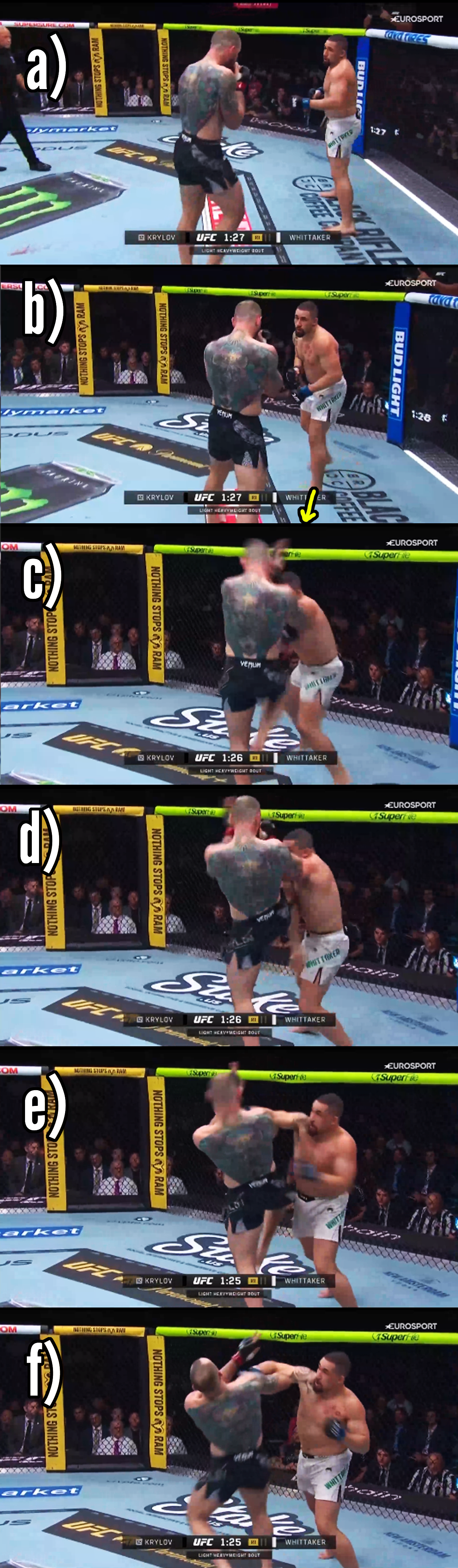
Fig. 2
Krylov found some success with a naked right low kick as Whittaker’s legs were so involved in lateral movement that he often was not in position to check or absorb the low kick. But as the fight progressed Whittaker began checking and immediately throwing either jab or a long, leaning right hand off one leg. And perhaps this is part of why the heavyweight kicker is so rare: throwing a giant leg around will often pull the giant body with it. The return on Krylov’s kicks was so slow that he ended up getting blasted off every low kick by the end of the second round. Often Whittaker would raise his leg and Krylov would kick right underneath it, swinging himself out of position.
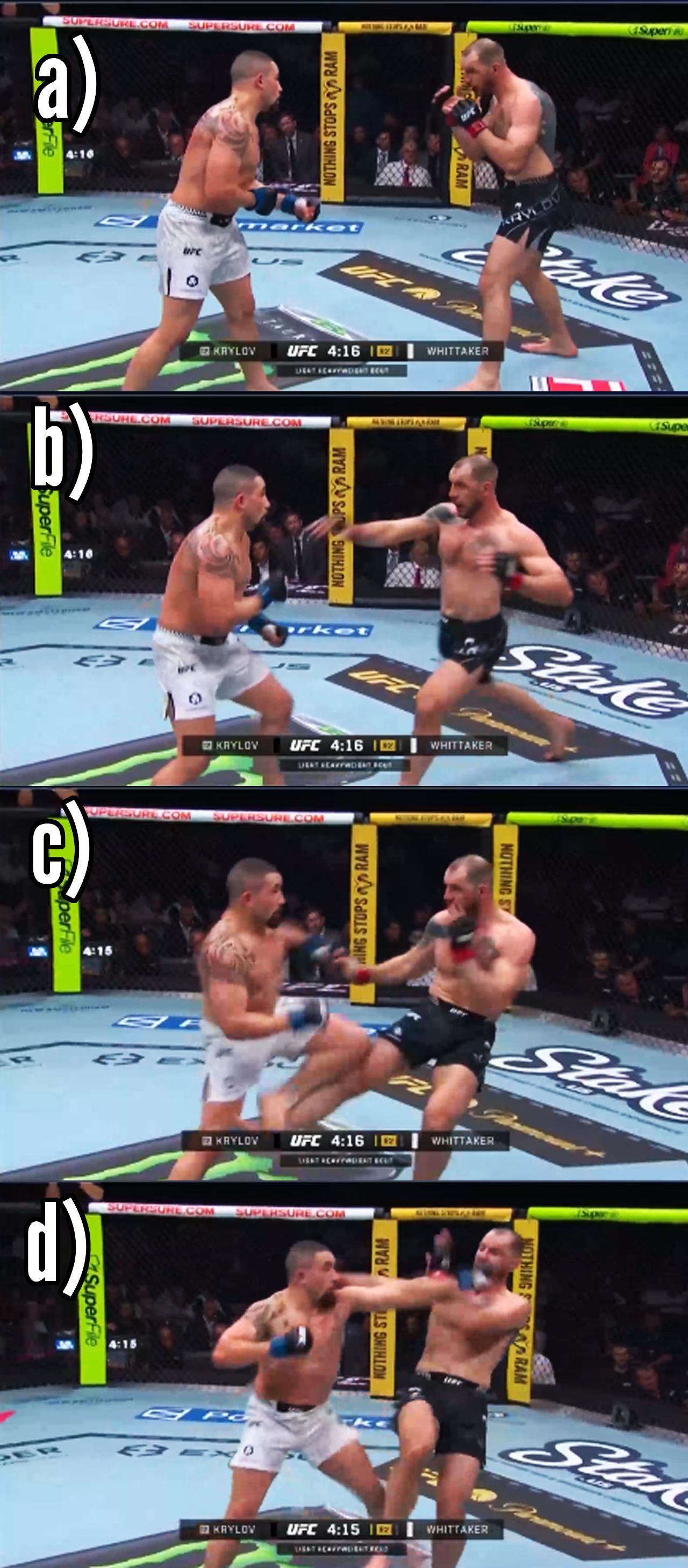
Fig. 3
Figure 4 shows Krylov kicking a check, and putting his foot down before trying to recover it, giving Whittaker an eon in which to counterpunch.
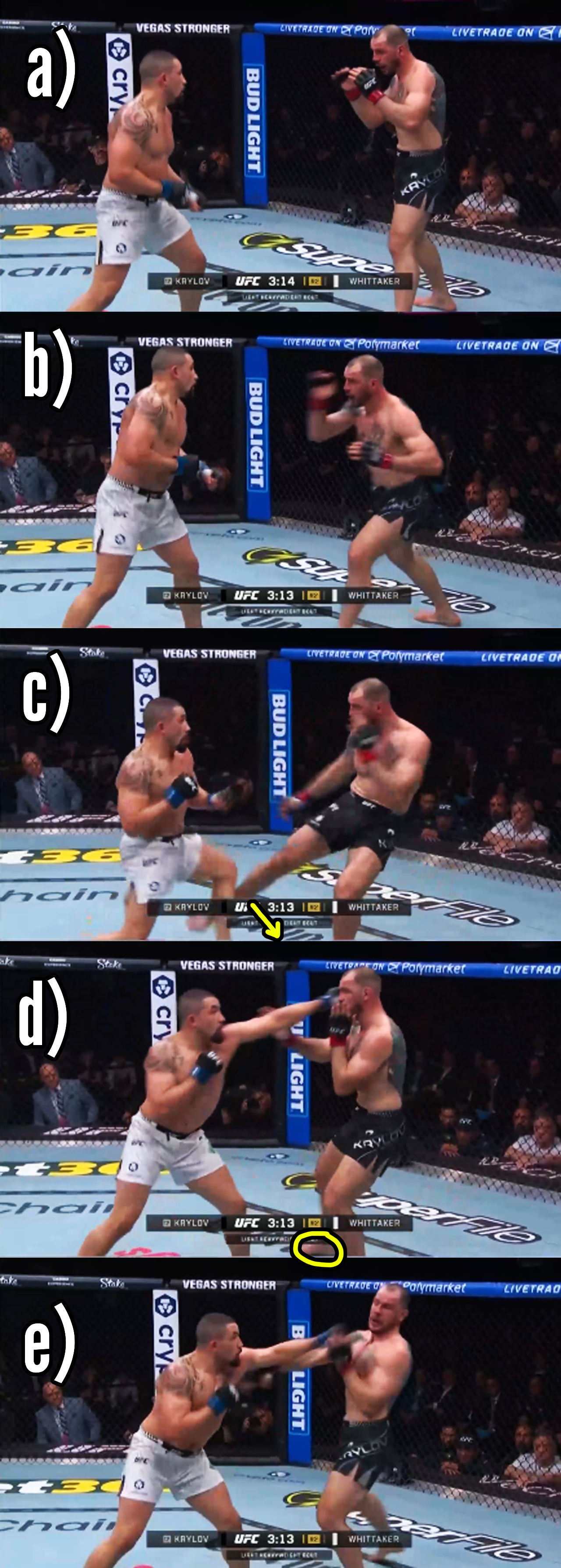
Fig. 4
While it was a largely disastrous performance from Nikita Krylov, it had a couple of the kind of moments that tricked me into expecting big things from him in his first UFC run almost a decade ago. Figure 5 shows a gouging round knee, off the lead leg, that Krylov used to intercept a Whittaker lunge. Renier de Ridder had great success with stepping knees against the often lunging Whittaker, but those were big stepping efforts, whereas this—if it worked as intended—would be more like a short counter left hook to the liver, delivered with the kneecap.
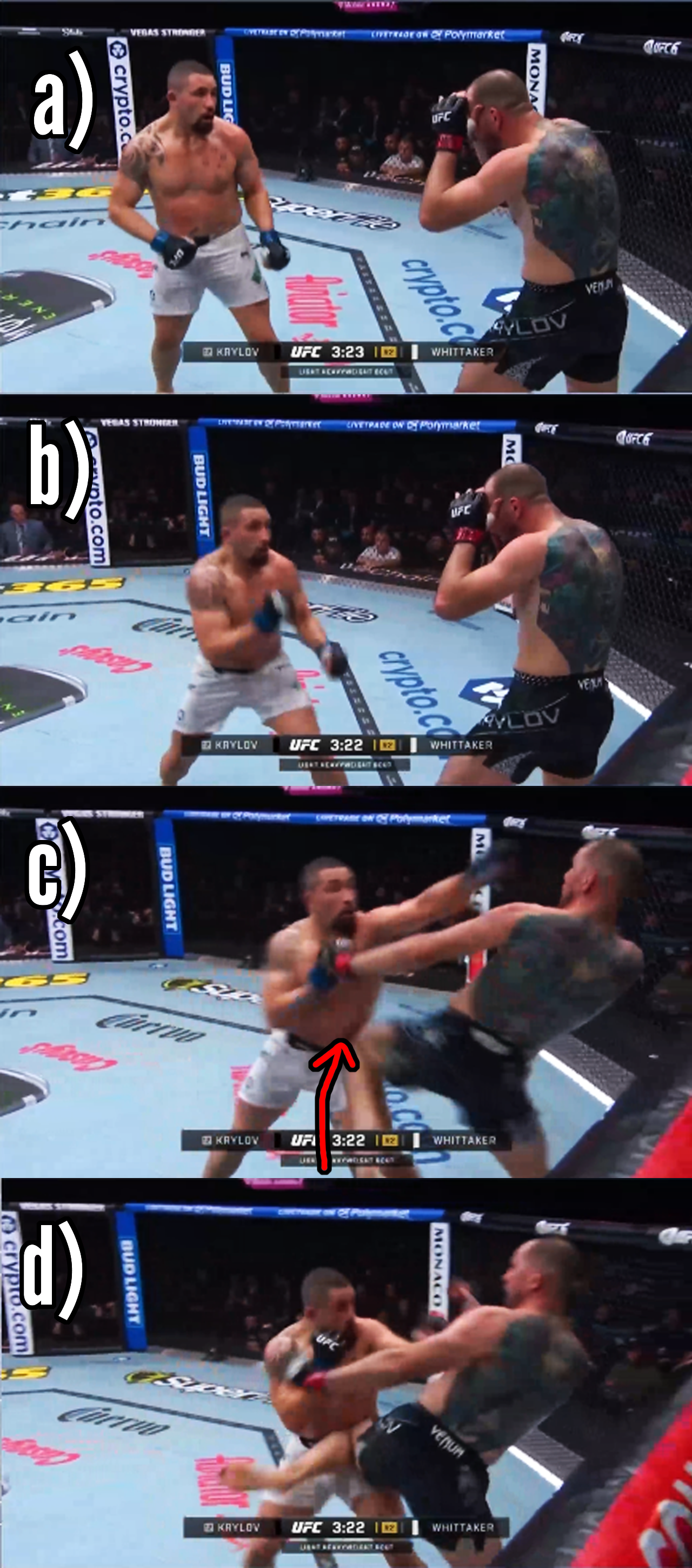
Fig. 5
Undoing the McGregor Legacy
While Conor McGregor was physically falling apart in the main event, his main MMA innovation was being undone on the undercard. McGregor was a number of interesting quirks that funneled the opponent onto his terrific open side counter. From an open stance, if you can draw the opponent’s rear hand, he throws open a window of vulnerability on his power side that is only closed when he gets back out to range, and his power hand back in guarding position.
Figure 6 shows the perfect example from the fight between Lone’er Kavanagh and Brandon Royval. Royval commits to a southpaw left straight and falls just short as Kavanagh sways back to his right. Because he has committed weight to the blow, Royval cannot help but fall forward and drop his hand (b) (c), giving Kavanagh the clean shot at his jaw over the top (d).
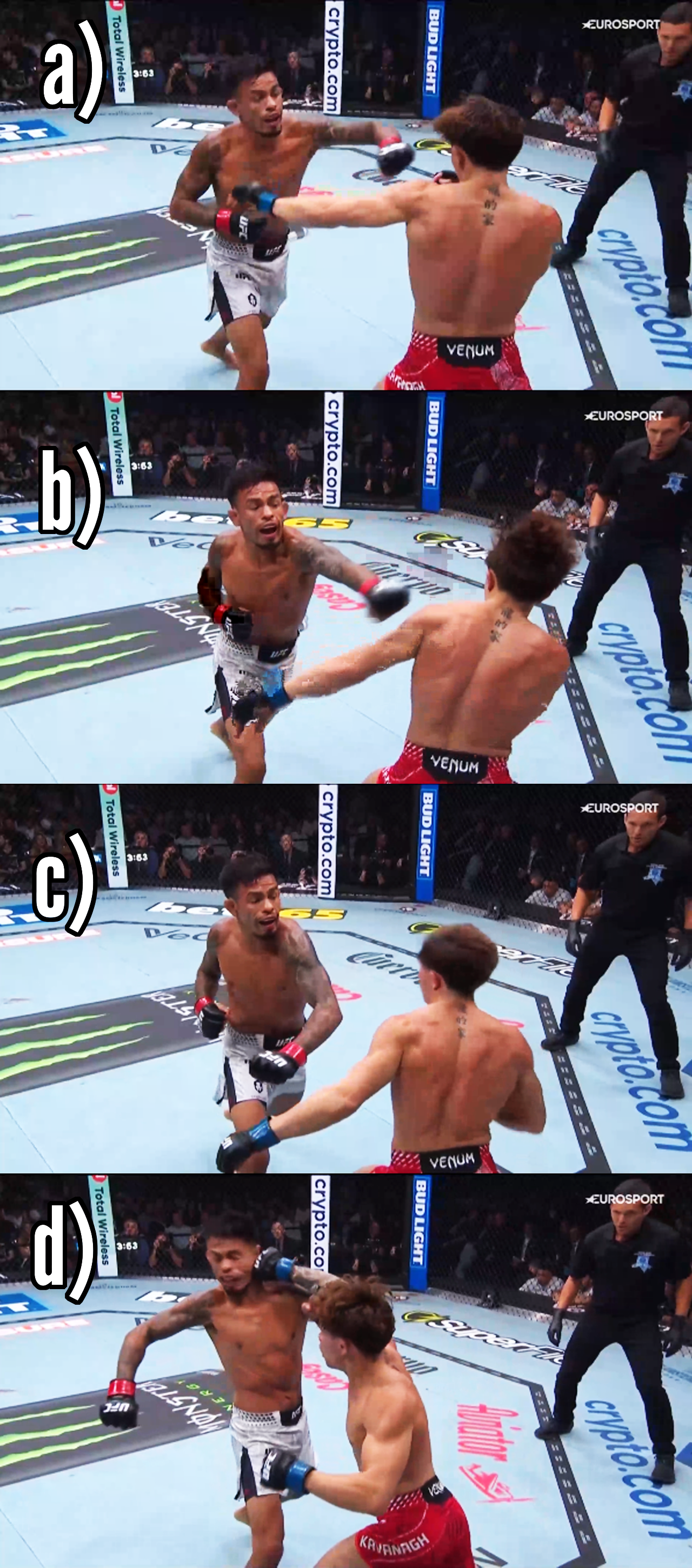
Fig. 6
But as Royval returned to his corner, his team were all over the read. They asked Royval to throw his left straight and his left high kick immediately after. This is something we discussed in the Max Holloway - Conor McGregor preview as a way to punish or discourage the open side counter. Just as your power hand is the only thing protecting your open side, his power hand is only thing stopping your shin slamming into his neck as he pulls back to that open side angle.
Instead, Royval came out and did something altogether different. He continued with the jabs and pressure that had been troubling Kavanagh in round one, but he began to handfight and it became obvious that the left straight was coming. Figure 7 shows how it happened.
Royval controls Kavanagh’s lead hand (a), he strips it and throws a left straight (b). But he does not commit his weight as completely as in his hurting efforts in round one. The lack of commitment gives Royval the chance to pull his head back (c), and throw a counter right hook (d). Royval is so concerned with pulling his head back that he cannot even rotate his body properly into the hook.
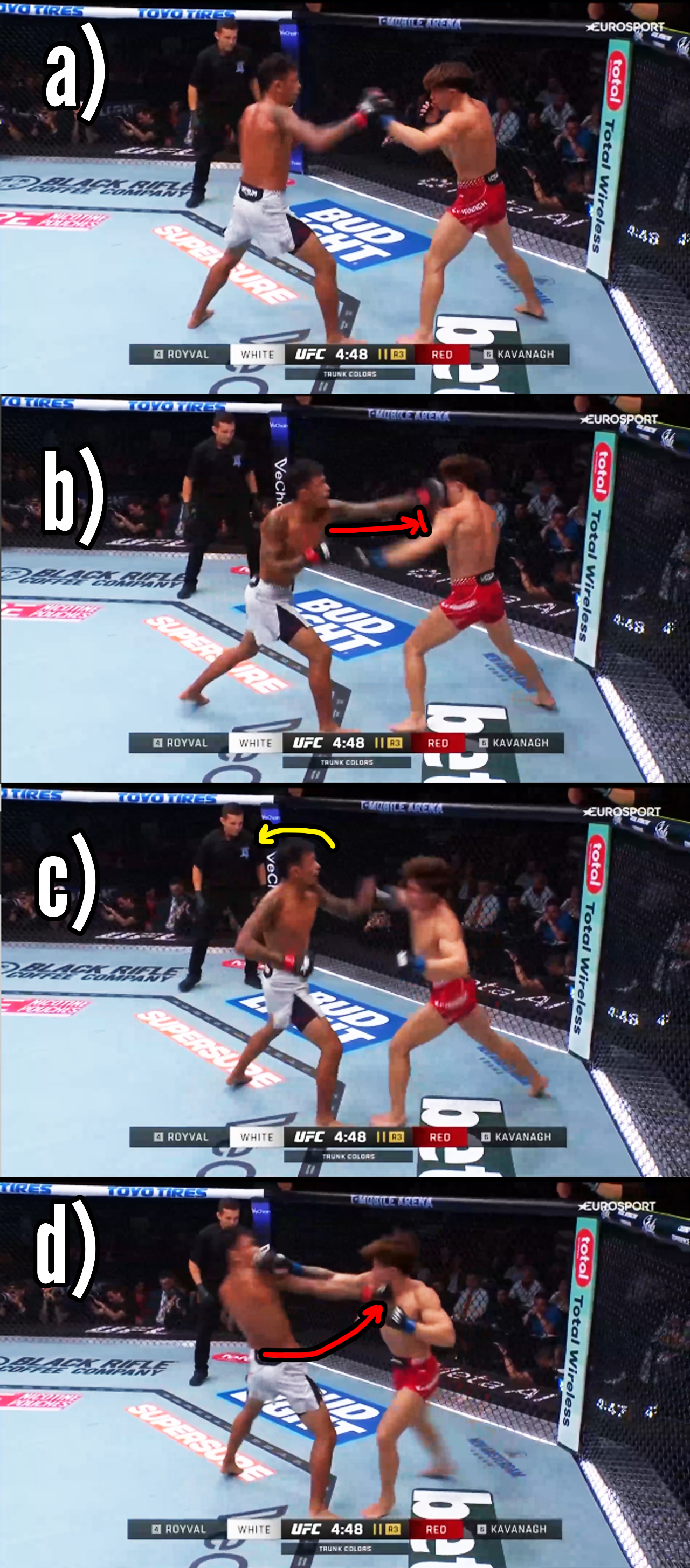
Fig. 7
I often describe the open side counter as “duel with flintlocks.” Because the counter fighter is hoping the opponent will miss and that he will be left lining up the clean kill shot. It is a game played with power punches and commitment. In this instance, Royval’s right hook was not particularly stiff, but Kavanagh had thrown himself forward to drop the bomb on Royval as he was seemingly dead to rights. Kavanagh ran his own head onto the punch, was rocked to his boots, and the fight was lost in the moments that followed. That is not to say that Kavanagh made a mistake: he simply took his shot and Royval had made a beautiful read.
In the nerd’s delight match between Farid Basharat and John ‘Mowgli’ Garza, Garza demonstrated his own answer to the open side counter. Figure 8 shows the sequence.
Garza flicks a jab and throws his right straight (b) (c). Basharat steps and sways back to the open side, setting the trap. As soon as he has thrown the right straight, Garza changes levels and begins side stepping into a weave (d). Basharat’s counter flies clean over Mowgli, who comes out of the weave with a left hook (f), which Basharat dips underneath admirably.
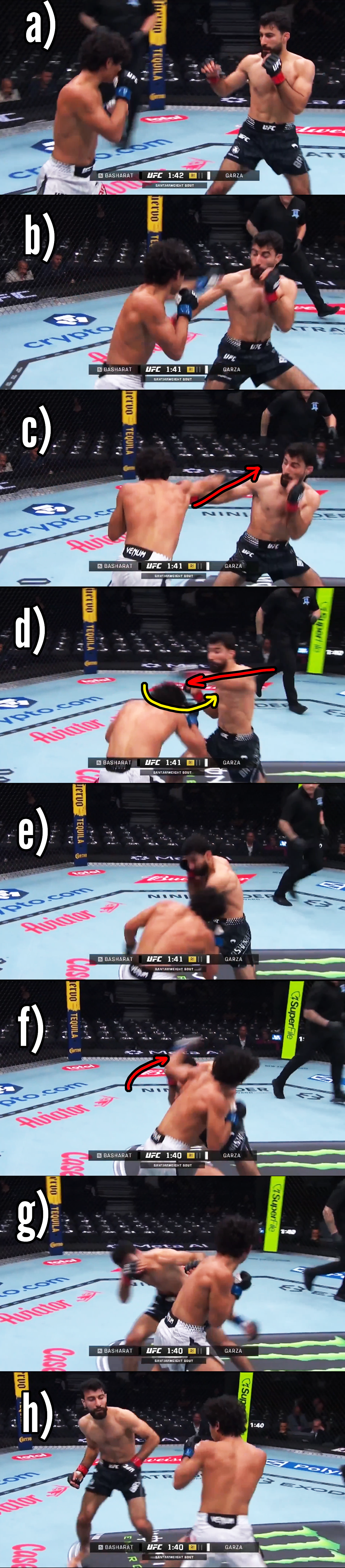
Fig. 8
Basharat is one of the trickiest and most underappreciated fighters in the UFC, and Garza had nothing to lose coming in at short notice. The flaws in Garza were obvious, and masterfully exploited by the better rounded, more experienced Basharat. Yet Garza’s boxing based game shone through like gold amid the silt.
Garza used the double jab throughout the fight to force Basharat back towards the fence, and to draw punches on his own terms which he could then use to set up his ripping body shots. Figure 9 shows a beautiful variation of the double jab, the jab-to-dipping-jab, which caught Basharat right on the snoot.
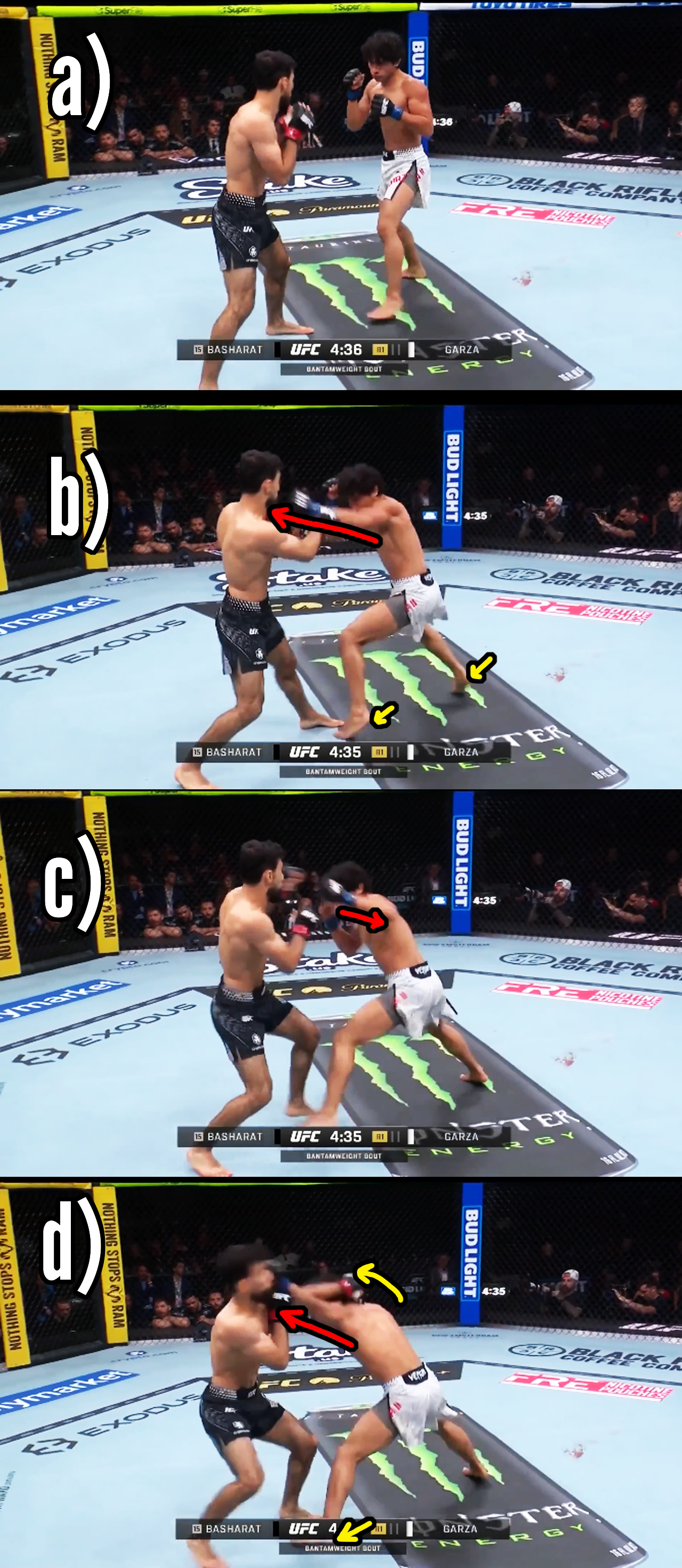
Fig. 9
I referred to Garza’s “boxing based game” and not just his boxing because he seems to have worked it out in the same way as Ilia Topuria. With the right footwork, and good head movement, a fighter can really bring the deeper aspects of boxing to lever in MMA, but it is still boxing applied within a full MMA skill set. Of course, Garza did a great job of scrambling and was defending takedowns well by the end of the fight, but a better example might be his couple of cracking body kicks. He only revealed he possessed these once he had already cut the cage on Basharat and corralled him right into the kick.
To expand more on this idea of a boxing based game: you can let the threat of the knee scare you off ever incorporating head movement or the body jab, or you can fight the fight expecting the odd knee and make the opponent suffer for it. Every time Basharat threw up a knee, Garza was standing upright, and then he would level change and punch the body in the wake of that failed knee. In fact every time Basharat threw a kick above the waist, Garza moved in to land the right straight or left hook to the body knowing he had Basharat on one leg for an instant.
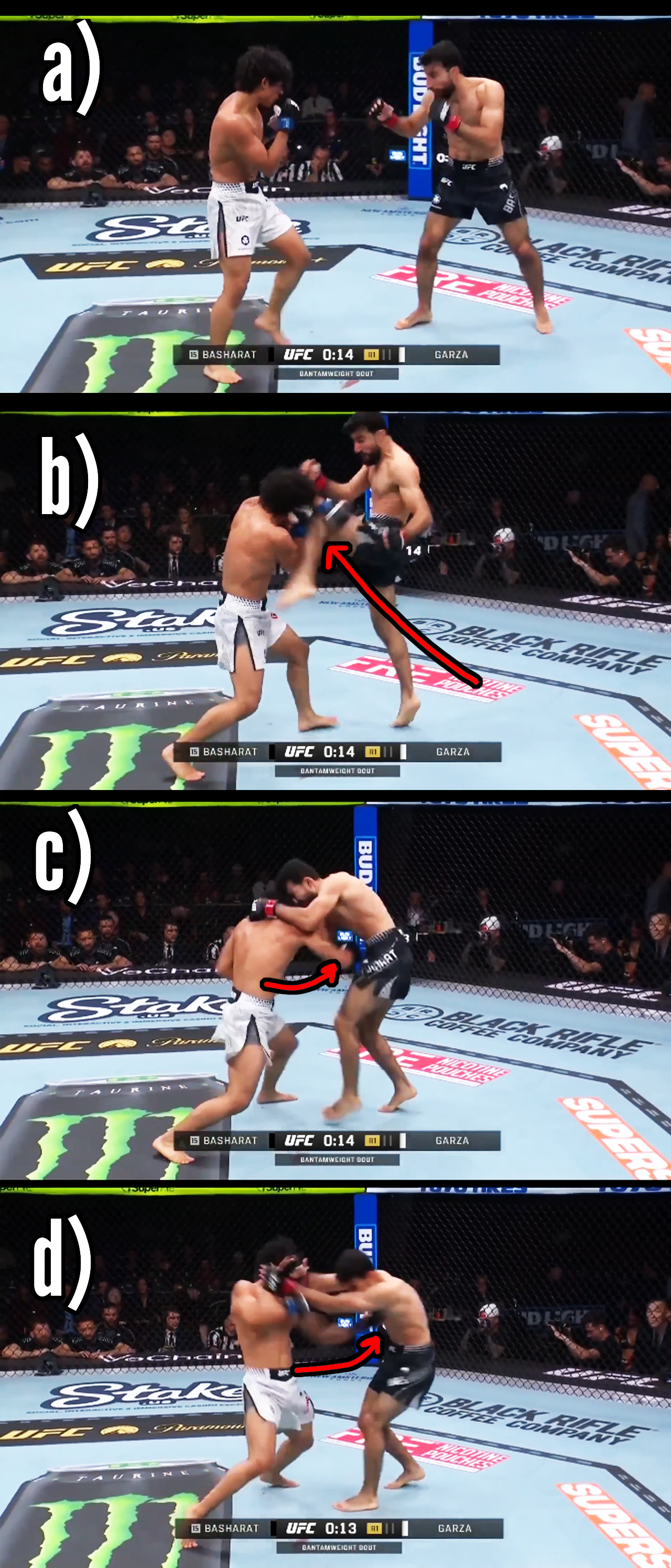
Fig. 10
This links with what Asu Almabayev did to Charles Johnson the other day: cracking him off every missed knee. Ducking onto a knee is scary, but the opponent cannot throw a knee at the whiff of any level change. If he does, he is easily faked out and punished.
Sandhagen versus Bautista
In terms of high level fighting tactics, Cory Sandhagen versus Mario Bautista was always going to be the pinnacle of this card. Two of the most varied and interesting fighters in the UFC’s most exciting division. I was as impressed with Bautista’s improvements as I was with Sandhagen’s ability to fight a close contest even with a suspected torn hamstring from the Suloev stretch.
Even after this near disaster, Sandhagen’s turtle game was still on full display. Figure 11 shows the first pathway from the turtle: Sandhagen gets up to his feet, walks to the fence, and separates Bautista’s hands while leaning against the cage. Then he can turn back into Bautista and get back to fighting on the feet.
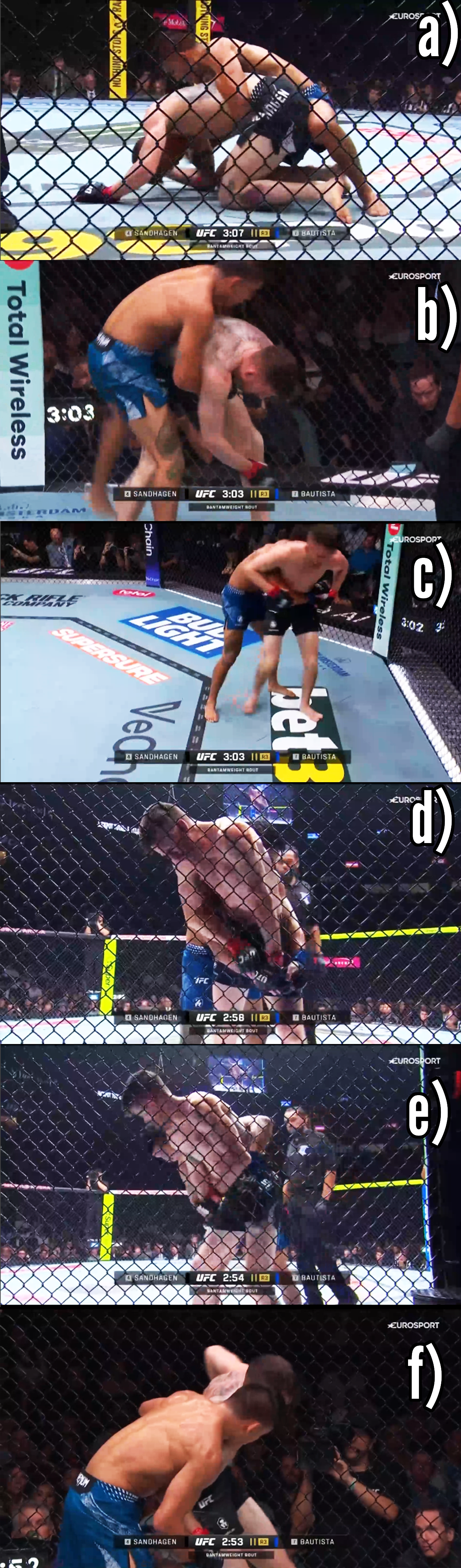
Fig. 11
The other pathway is to enter the legs. Typically if the opponent sits back behind Sandhagen, they give him the chance to stand up. If they try to put weight on his upper body, they give him the chance to roll through on a leg entry. Whether that is an outside funk or an attempt at a rolling kneebar, he gets attached and funnels his man to the 50/50.
Figure 12 shows Sandhagen turtled with Bautista heavy on his back, trying to punch him (a). Sandhagen rolls through and reaches for a leg (b), winding up inverted on Bautista’s left leg while Bautista is on his knees (c).
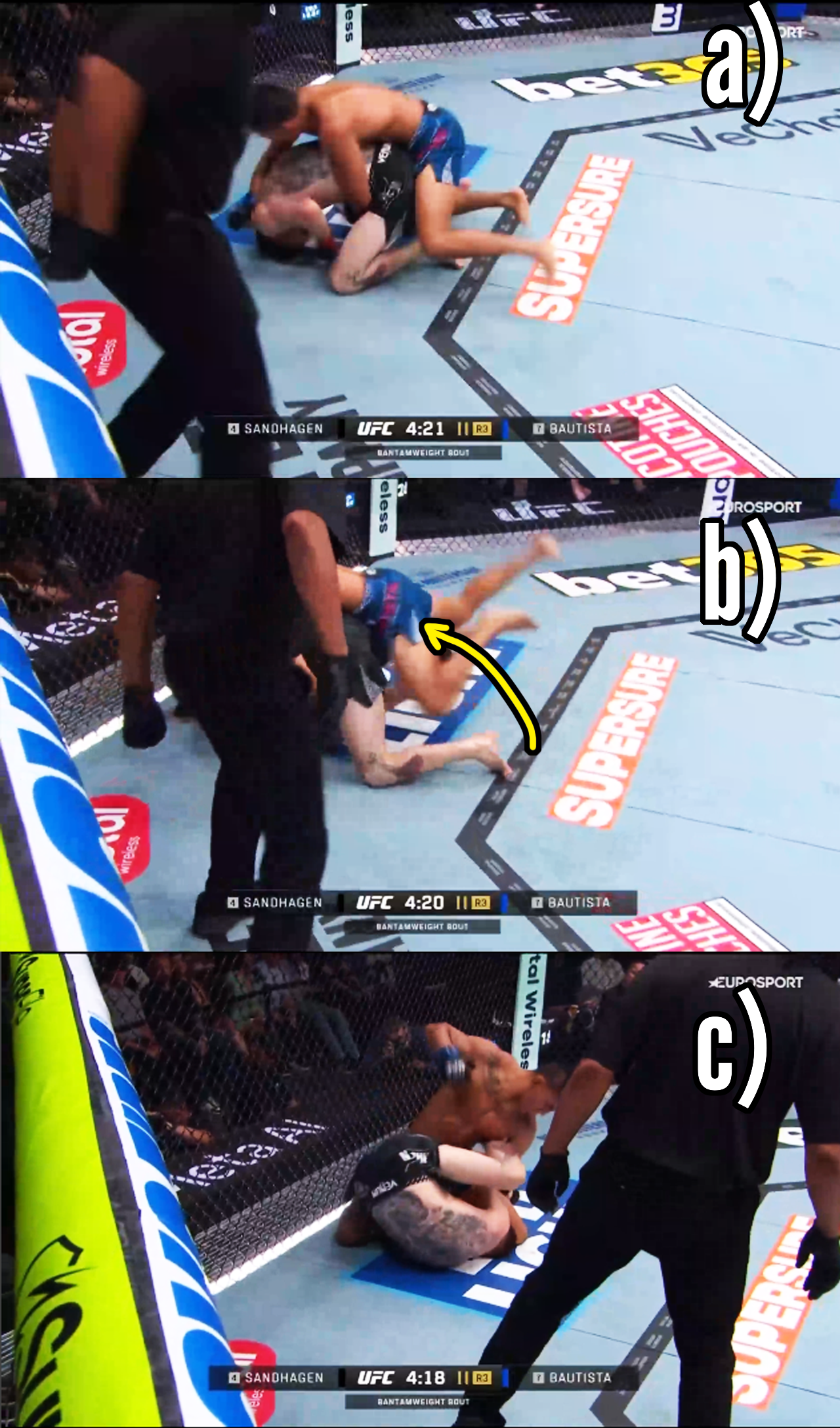
Fig. 12-1
Sandhagen brings his left foot in front of Bautista (d), in order to leg press him back (e), which enables Sandhagen to re-entangle the leg with Bautista’s foot now extended underneath Sandhagen’s chest (f), instead of underneath the kneeling Bautista.
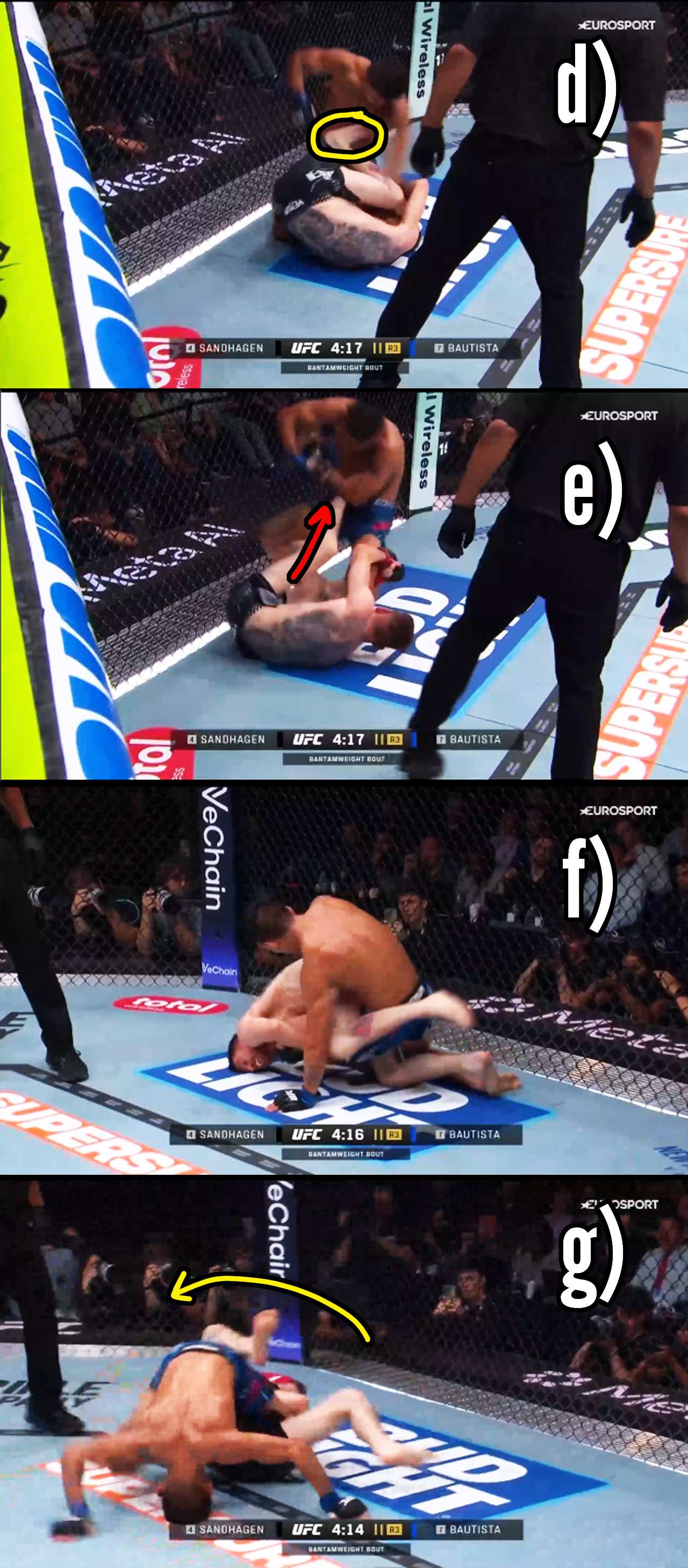
Fig. 12-2
In frame (f), Bautista is up on his left hand. If Bautista tried to perform a stand up from here, he would have to lift his trapped leg out, which he obviously cannot do. So in frame (g), Bautista hops over Sandhagen and lands on his other knee (h). Now his bottom leg—his heist leg—is free. This means that he can stand and begin disengaging or putting weight into Sandhagen.
But Sandhagen performs the small movement that has made all the difference in so many of his fights: he bridges his hips and passes Bautista’s left foot across to the other side of his body, putting him in the 50/50 (i). Unlike Deveison Figueiredo and TJ Dillashaw, Bautista does not immediately try to stand and put weight into Sandhagen, and instead gets his knee on the mat to hide his heel—just as Ethan Crelinsten did when we examined the Combat Jiu Jitsu Worlds.
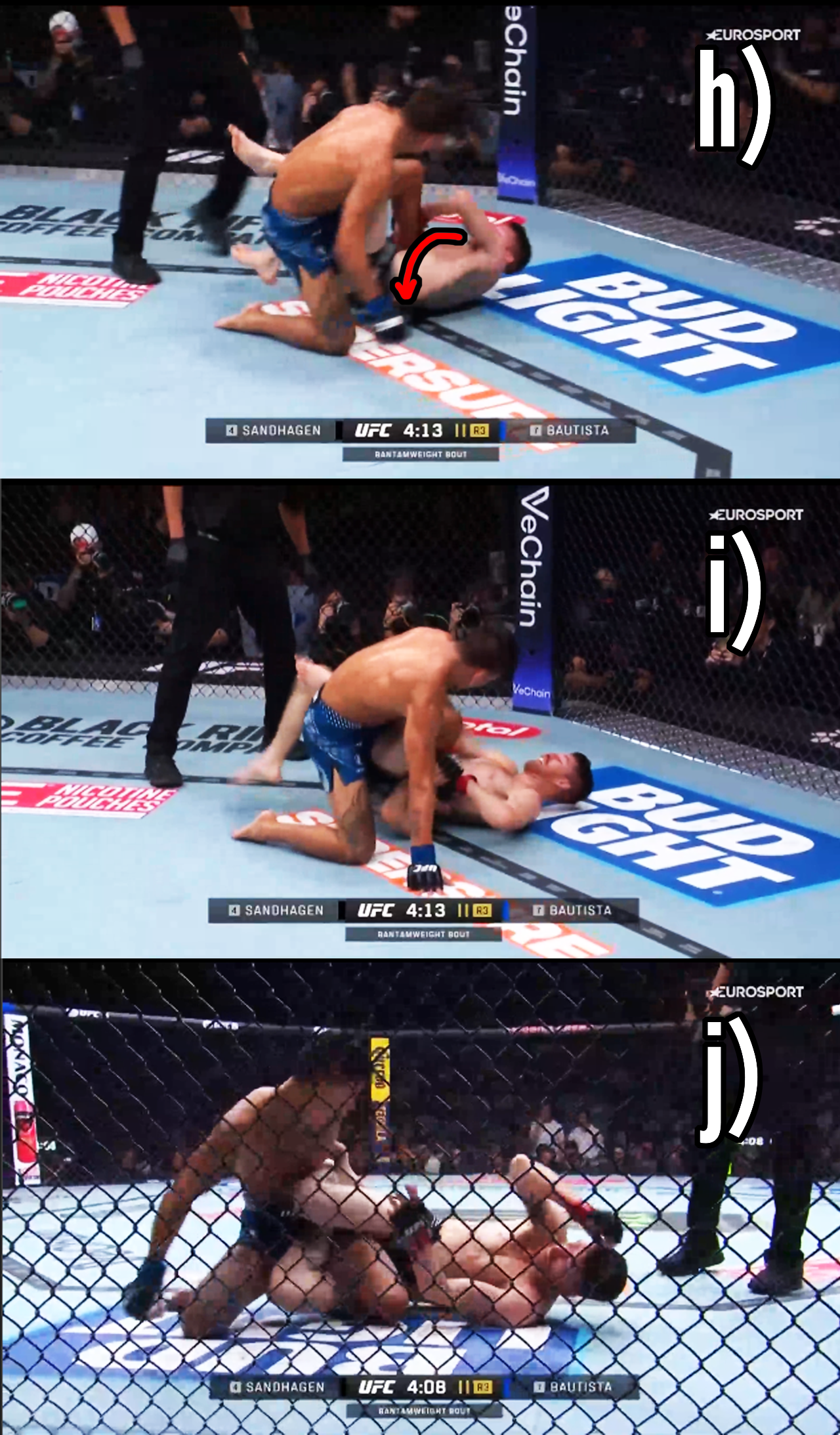
Fig. 12-3
Sandhagen credits his 50/50 excellence to training with Ryan Hall, who also trained Thanh Le, seen here performing his own rolling leg entry and executing that same pass-over to the 50/50 against Ilya Freymanov, before finishing the heel hook from backside 50/50.
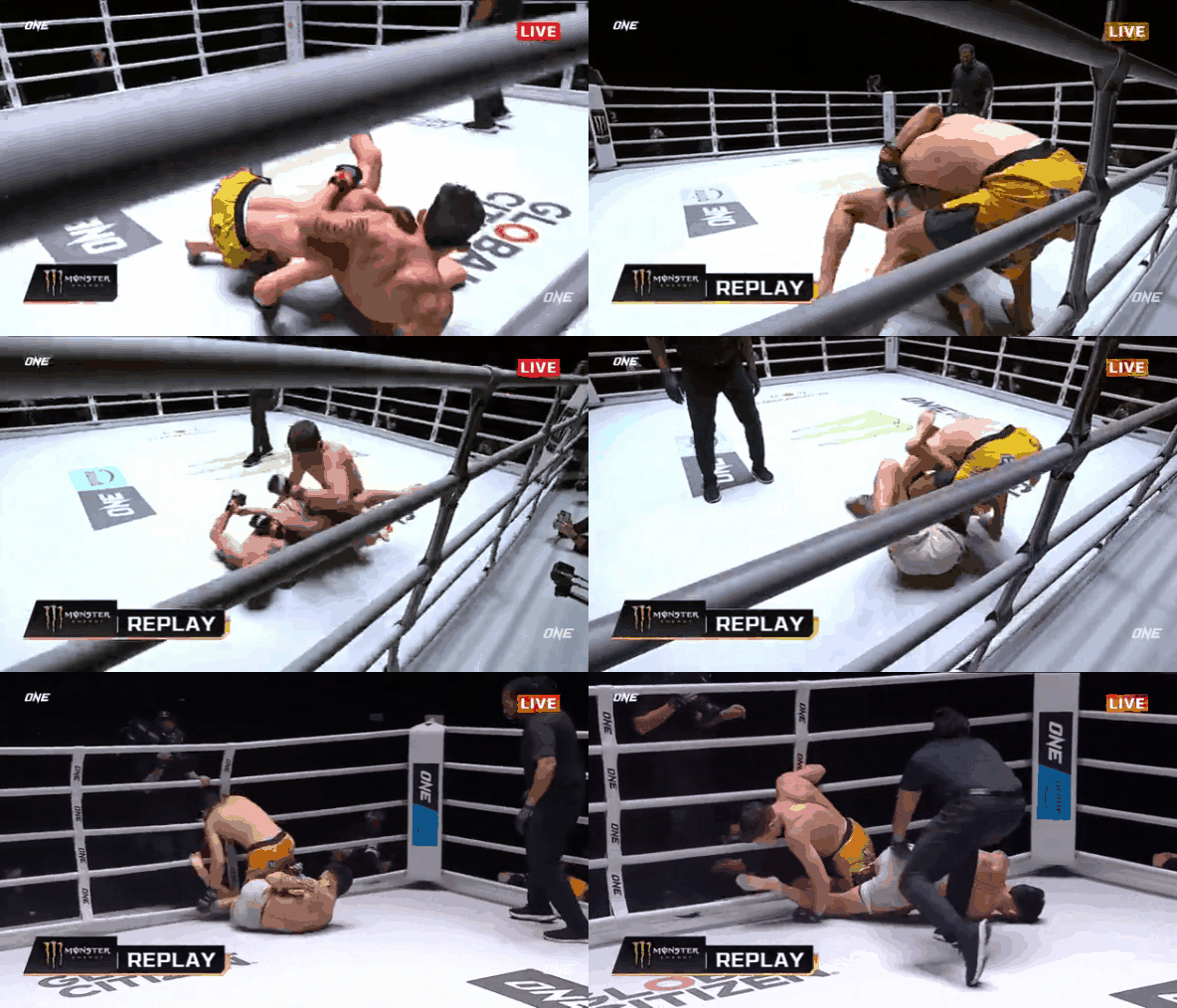
Fig. 13
Just as in the Garza fight, this match was a showcase for level changes in striking. Bautista’s level change to left hook knocked Sandhagen down midway through the fight, but Figure 14 shows a beautiful sequence that hints at the potential of level changes in MMA striking.
Bautista enters with a level-change, right straight to the body, as Sandhagen tries to slice him with an intercepting up-elbow (b). As Sandhagen pivots around, Bautista comes up with the left hook (c), followed by a wide right swing to the head (d).
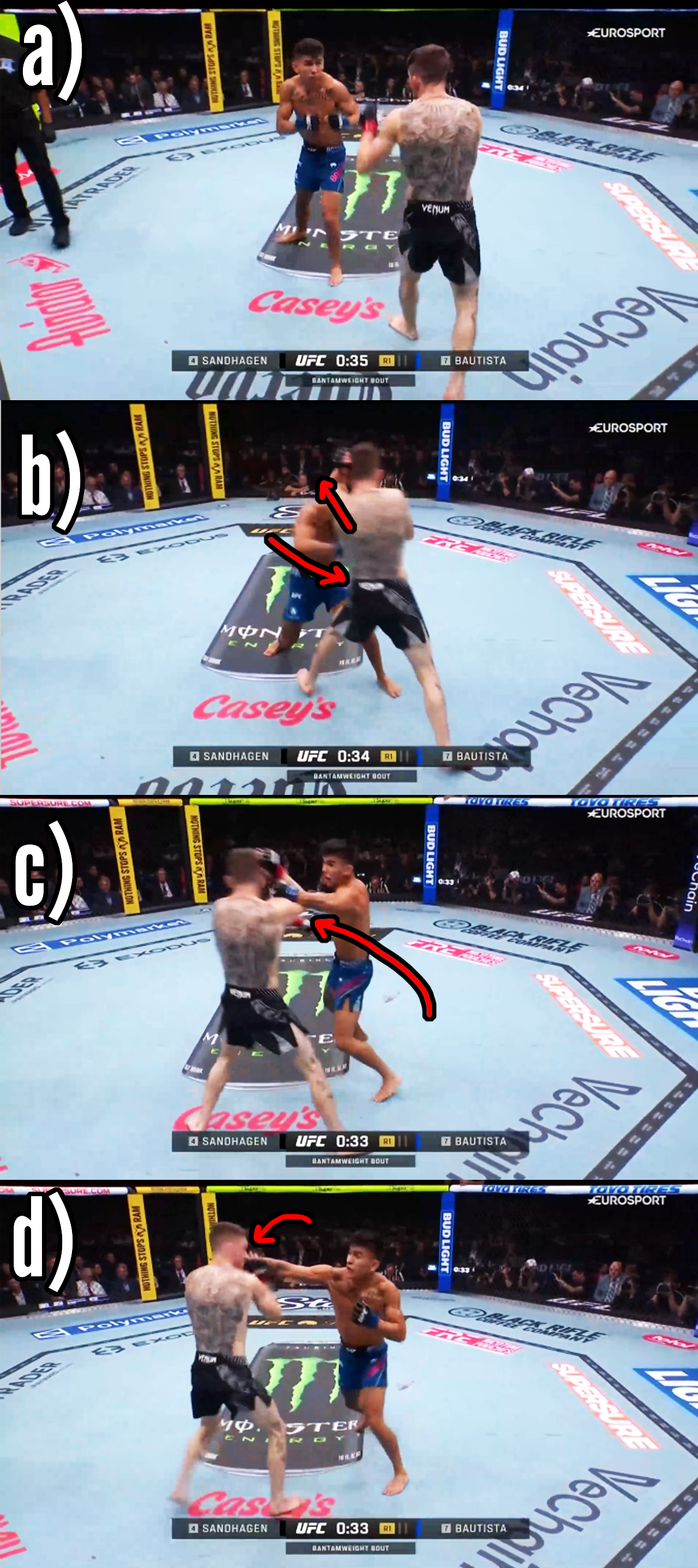
Fig. 14-1
Bautista level changes under Sandhagen’s return and shifts through to pursue him (e). Bautista comes up out of the level change with another right hook (f) which Sandhagen is able to leverage guard. As Sandhagen punches back again, Bautista level changes for a third time in this exchange, hits Sandhagens hips and runs through him for a clean takedown (g), (h), (i).
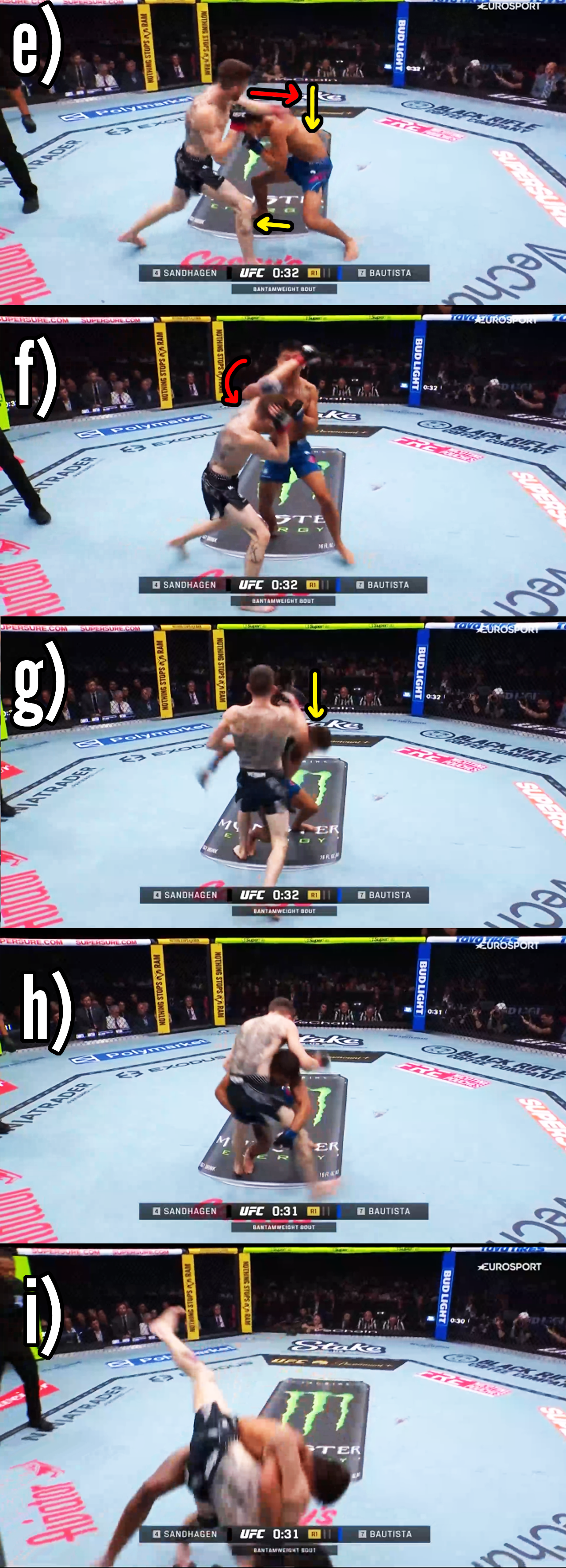
Fig. 14-2
Throughout the fight, Sandhagen showed the occasional knee, but did little work with the uppercut to dissuade Bautista from level changing with impunity. The bout was so filled with adjustments and counters that it might be worth a long form film room episode at a later date.