
In Evloev, I am reminded of the great bodybuilder, Dorian Yates. Once Yates won the Olympia, he was notorious for hiding from public view and further competition until the same time the next year. Yates worked out with just his training partner, behind closed doors, in a full tracksuit, hiding his progress from the world. Every year he would turn up to the Olympia and stun his opposition and the judges, looking even bigger than the last time he had won.
Movsar Evloev has made his way to this opportunity on a relatively light body of work. In his UFC run he has averaged just over one fight a year. He fights so infrequently that you watch him compete, think you are getting the read on him and how he is developing, and he turns up to his next fight having adjusted his game in a completely different direction.
In his first few UFC fights, Evloev was defined by a sensational jab. Everything else he did around it looked janky and uncomfortable, but he had the keystone of a good boxing game. And then as he developed and became more comfortable striking with better opposition, that jab got relegated to a supporting role. His fight with Lerone Murphy was lauded as a great showing of his striking but it was largely throwing straight armed swings in combination, kicking the body, and eschewing the poker of a lead that carried him through his early UFC run. You will see fighters swing freely on lower level opposition and retreat behind the parapet of a good jab when they start meeting other fighters who know what they are doing, but it is rare to see it happen the other way around.
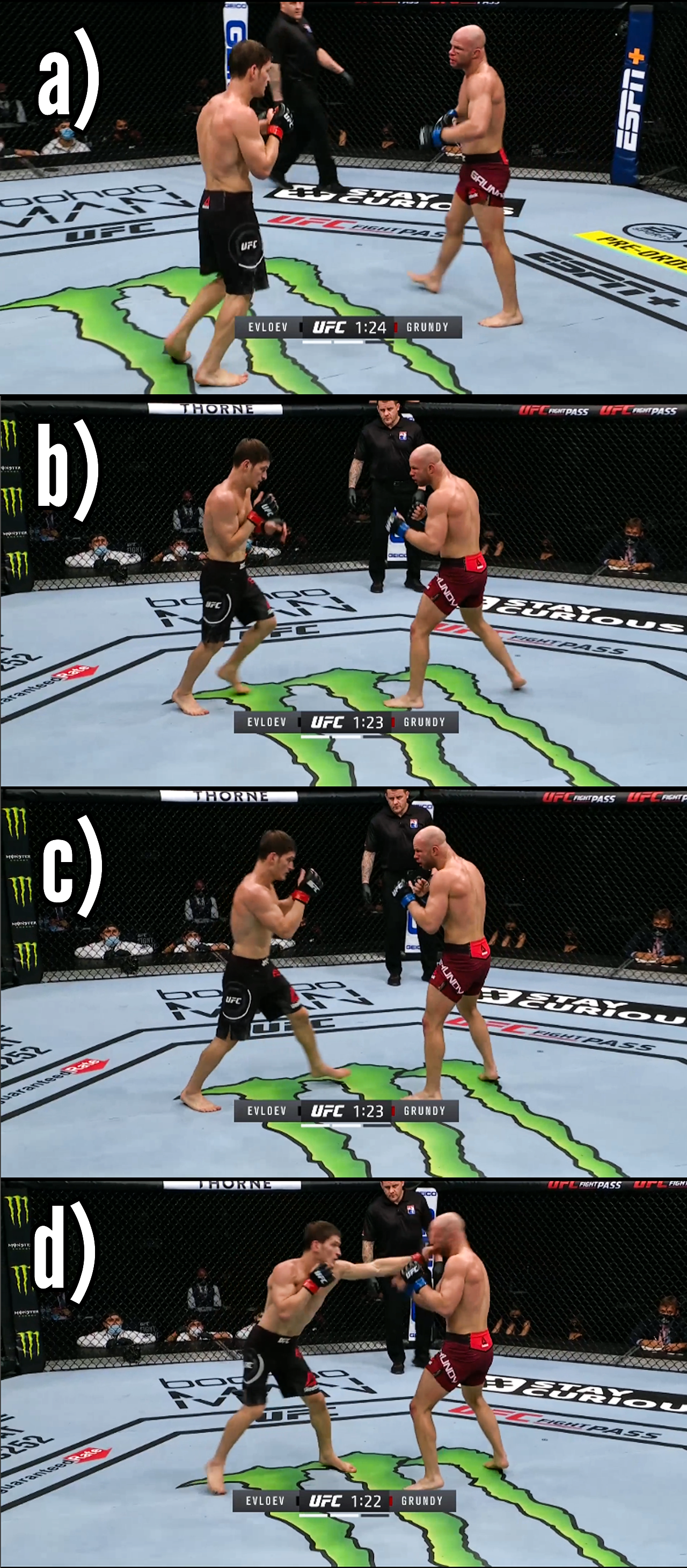
Evloev had the intangibles, if not the mechanics. He still suffers from the same flaw in form that allowed Muhammad Ali to get outjabbed by Ken Norton, his right hand is always down by his chest, so if his opponent jabs at the same time as him, Evloev gets jabbed himself.
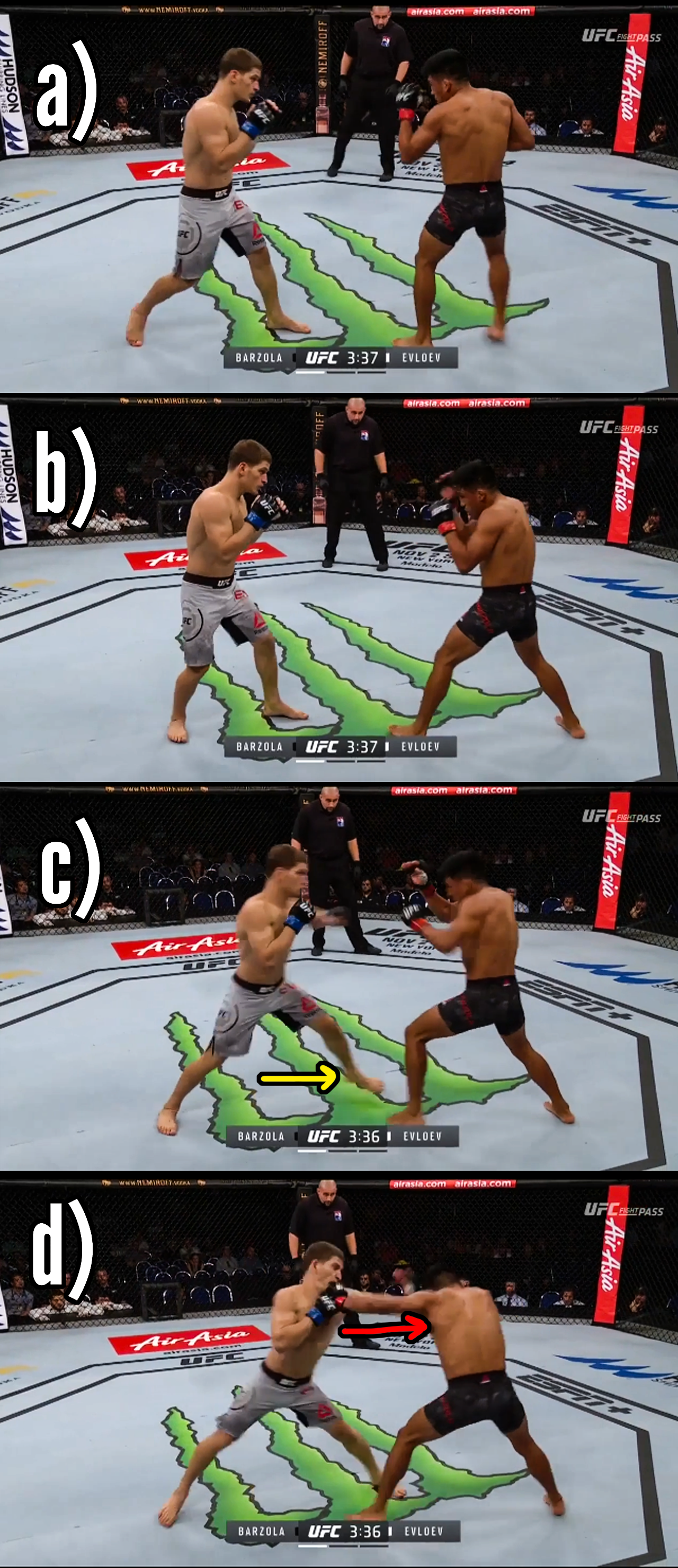
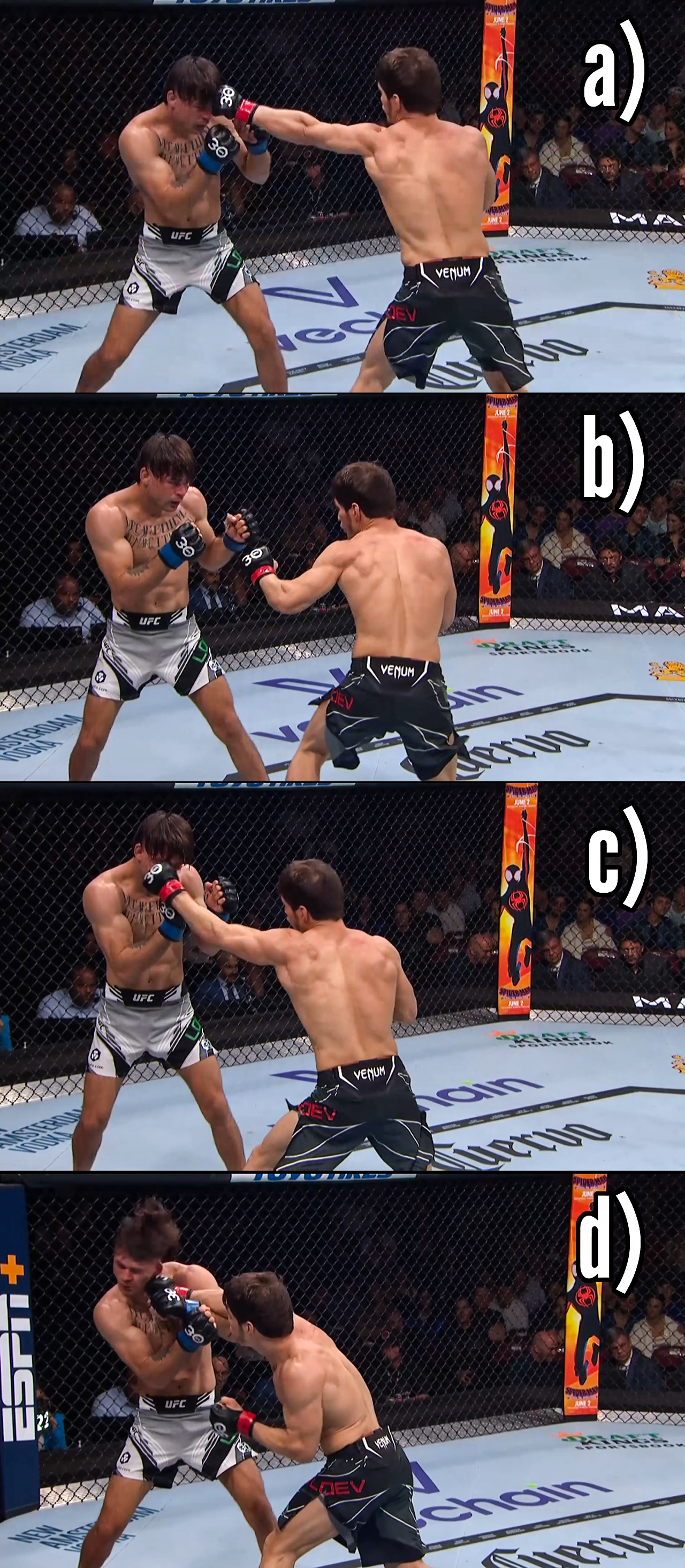
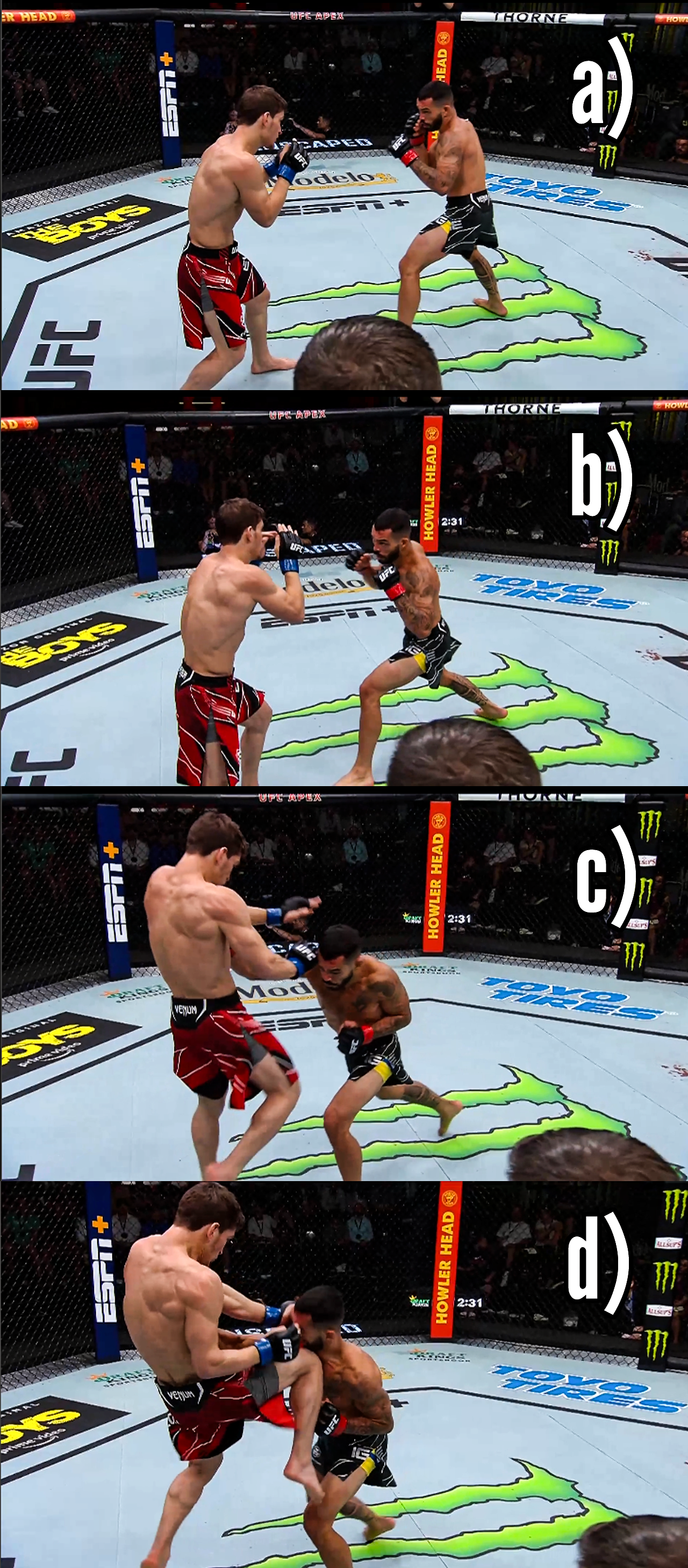
But this was not a huge problem because Evloev discovered and perfected the feint. We are always saying the feints must look like the strikes and the strikes must look like the feints. A few weeks ago, highly praised kickboxer Cong Wang spent an entire UFC title fight headbanging feints at Natalia Silva in a way that looked nothing like any of her real strikes. Evloev has worked it out though: a small step towards the opponent and a slight level change. In Figure x, Barzola flails wildly to parry a strike that doesn’t come.
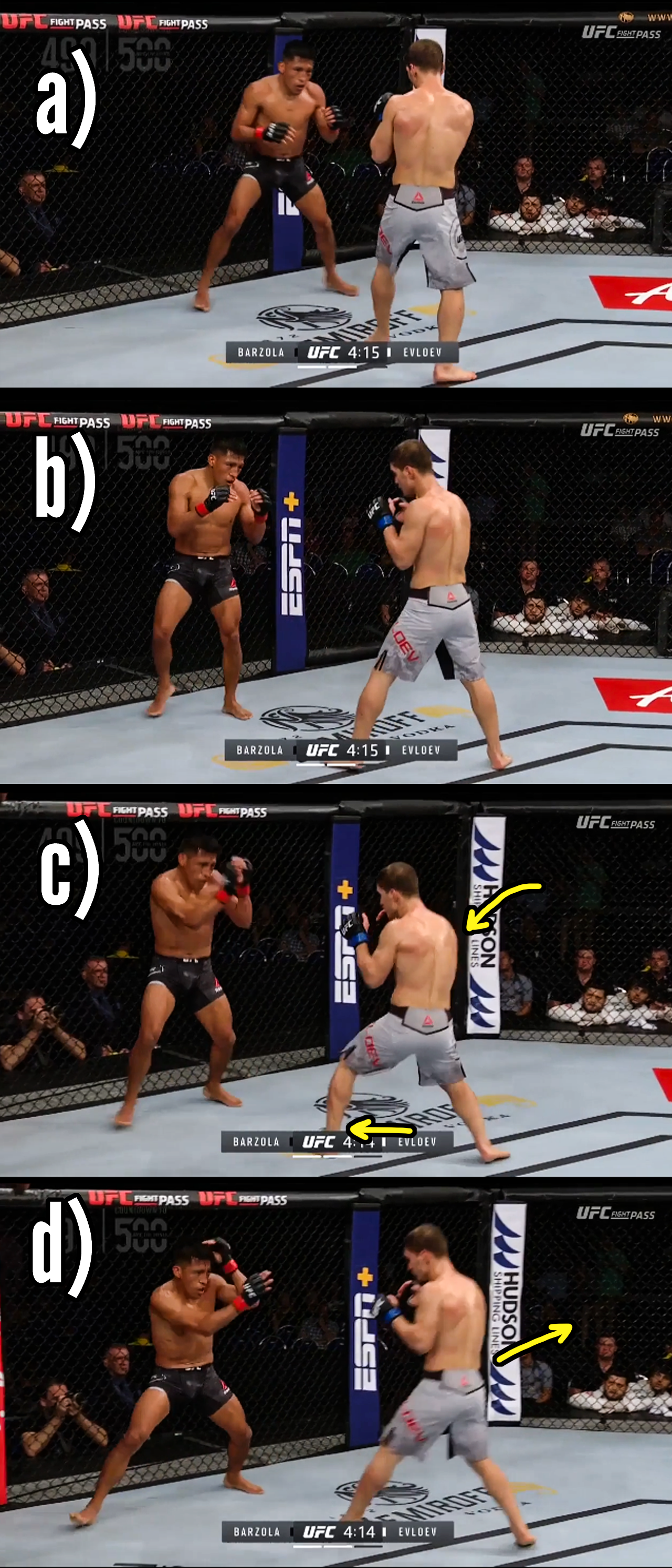
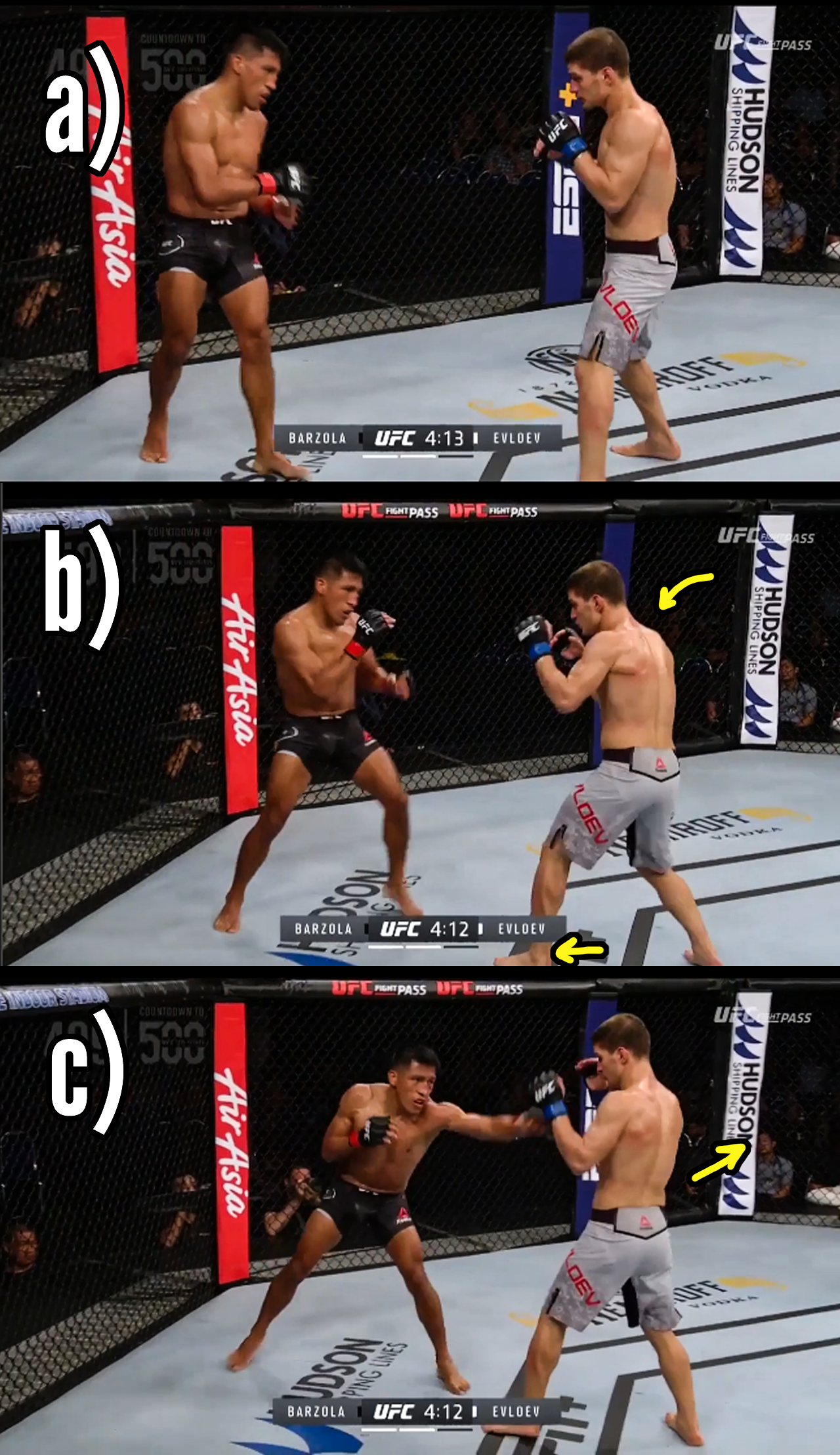
Figure x takes place seconds later. Evloev shows another, subtler feint, and Barzola thrusts himself into a jab that falls short and leaves him out of position.
Until quite recently, Evloev was a major proponent of the double jab. Because his jab was so much more developed than the rest of his game, he was happy to poke it out twice just to make sure he was close enough to his cumbersome right hand. In fights with Arnold Allen and Lerone Murphy the double jab was entirely absent.
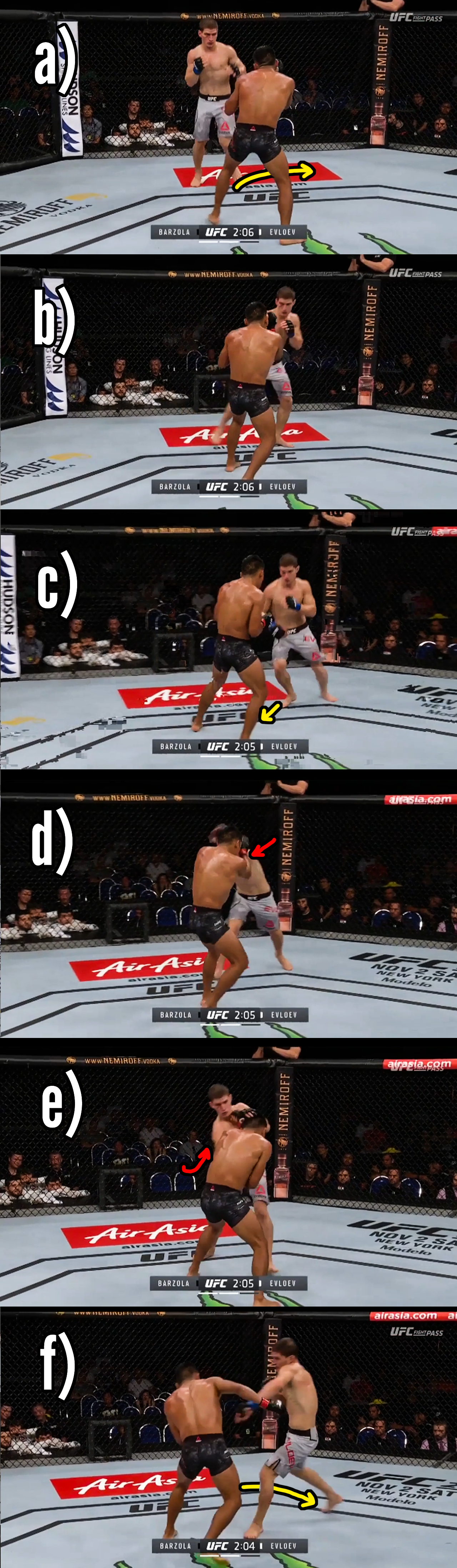
Going back to his fight with Enrique Barzola, Evloev might have been on the way to becoming a Willie Pep clone with wrestling. Evloev was all jabs, feints, and Pep Steps. That is, stepping his lead foot back to level, sidestepping around to the left, and re-engaging with a southpaw left straight as the opponent follows. Refer to Advanced Striking 2.0 – Willie Pep for more on that sort of movement. Evloev ate Barzola alive with that look and then, when he returned to the cage nine months later, he never showed it again.
In Figure x, Evloev retracts his left foot to sidestep to his left with his feet level (a), (b). As Barzola follows, Evloev steps back in on Barzola, leading with his right foot this time (c). Evloev skewers Barzola with the left straight (d), shifts through to throw an orthodox right uppercut (e), and pivots off around his left foot (f).
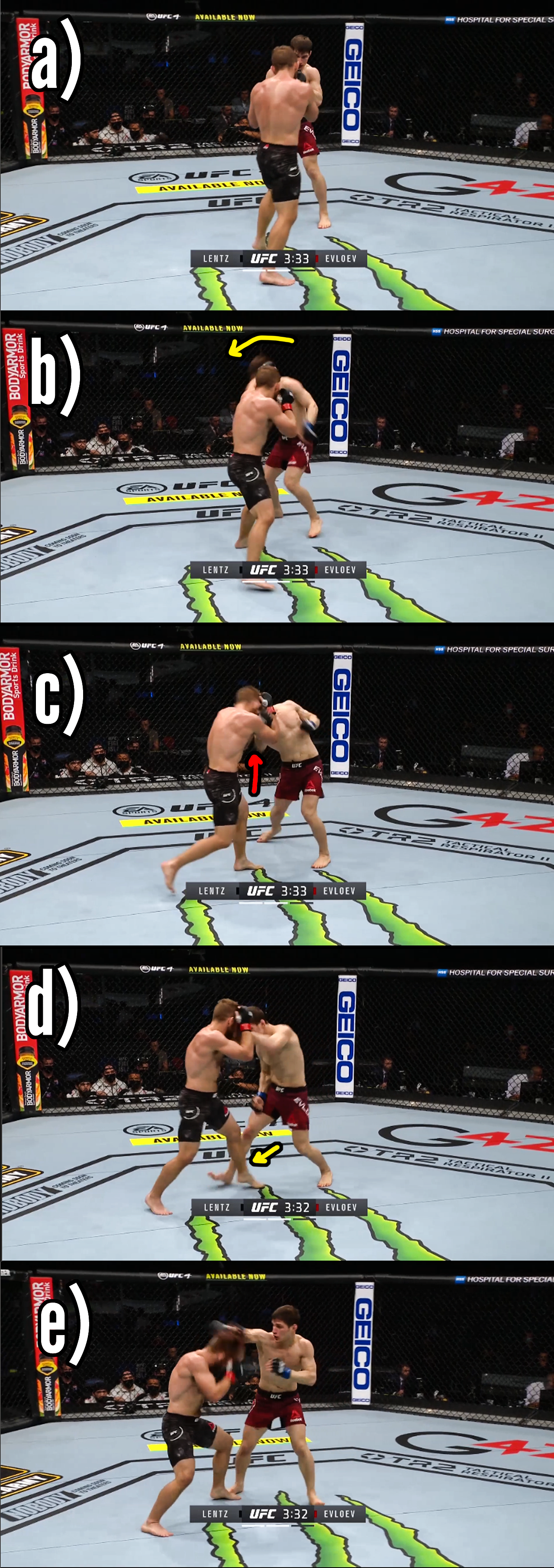
Another Pep look that the is the long right uppercut, often as a lead. In this case, as Evloev discarded his old parts and plugged in new ones, the uppercut survived. He lands it well on the counter off an outside slip, provided he can get the opponent jabbing with him. But the uppercut is more useful in how it builds from Evloev’s punch-and-clutch game. Figure x shows a counter right uppercut where Evloev slips the jab (b), lands the uppercut (c), and shifts through to throw a southpaw right hook at Nik Lentz.
Punch and Clutch
Before MMA fighters learned to jab, they learned to “jab and shoot.” This meant flashing the longest punch from beyond range and shooting for a takedown—hoping that the opponent would bring both arms up in panic. As we graduated from strikers versus grapplers to all around fighters, that stopped working so well. Punch-and-clutch is a tactic from boxing whereby you throw a power punch—any of the ones that aren’t the jab—and fall in on your opponent to mitigate the sizeable window you leave for a counter.
Punch and clutch has always been a brilliant way to enter on takedowns in MMA because it forces the punching fighter to get closer in. It also demands less of him technically than a convincing jab, and the punch might actually matter. The king of punch and clutch was Fedor Emelianenko, who used his right hand to weave in on upper body clinches and his terrific morote-gari / standing double leg. Gunnar Nelson was a much less threatening wrestler but he hid his deficiencies entirely with punch and clutch.
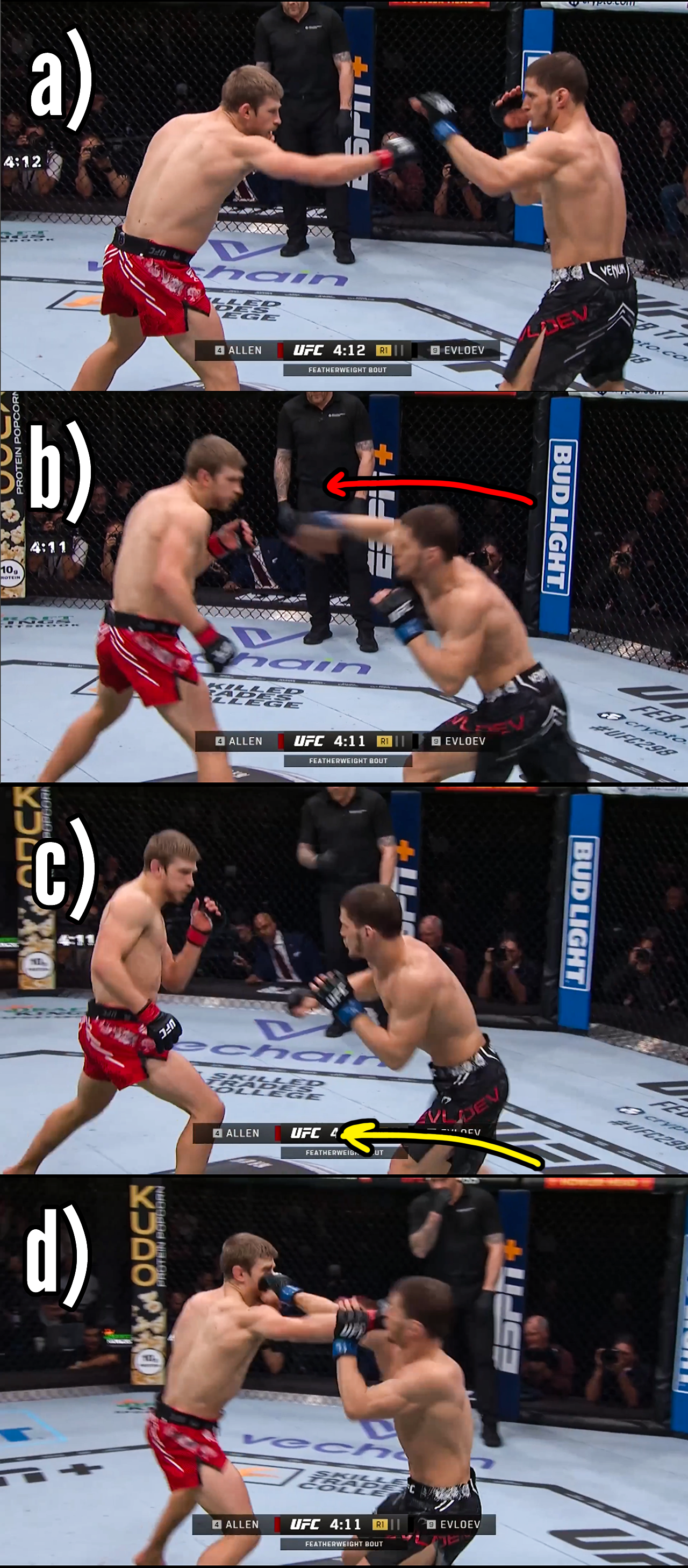
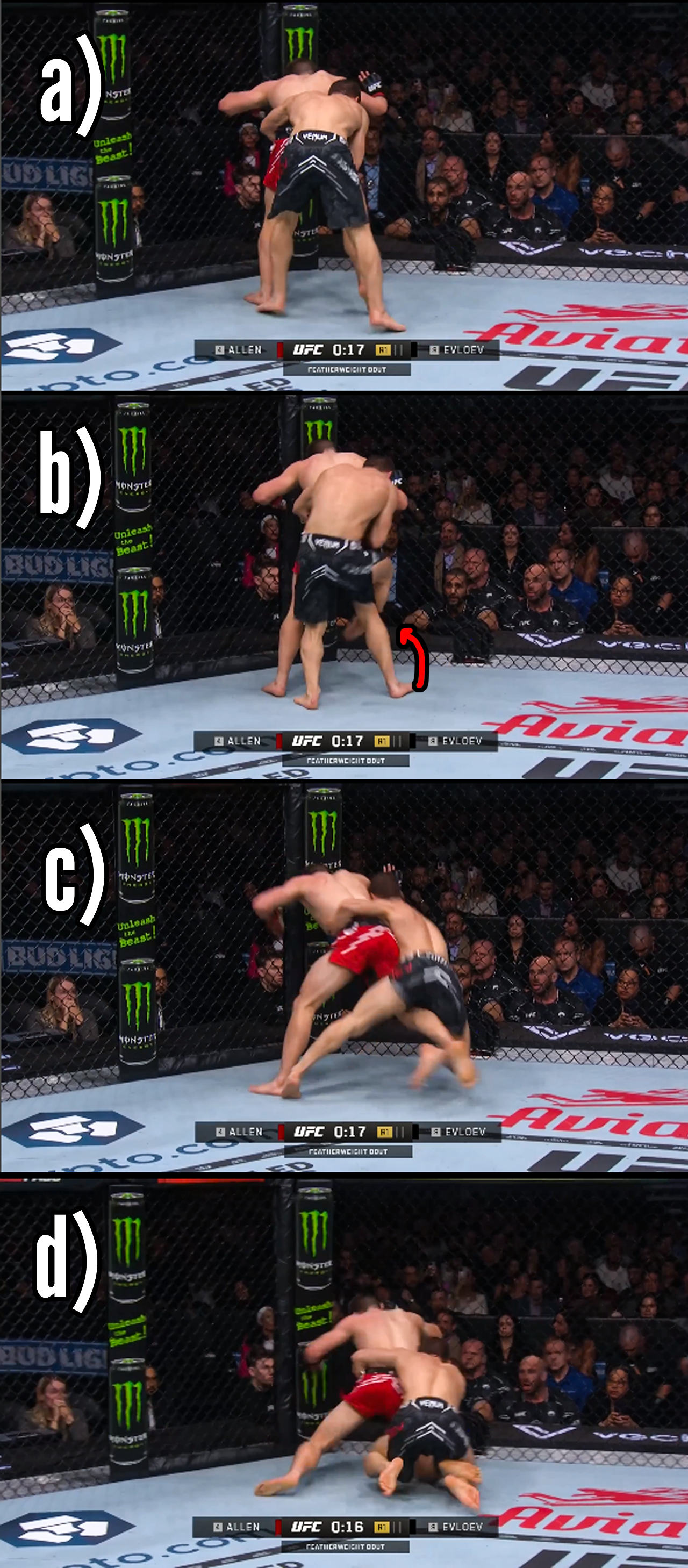
Evloev’s method of punch and clutch is peculiar because it rarely carries him into a tight upper body clinch by weaving him in under the opponent’s armpit. Instead he swings a big right hand, leaning well off to his left side, and then comes in low at the opponent’s hips. It is not at all uncommon for him to continue the right hand and dive onto the mat by the opponent’s feet and pick up a single leg.
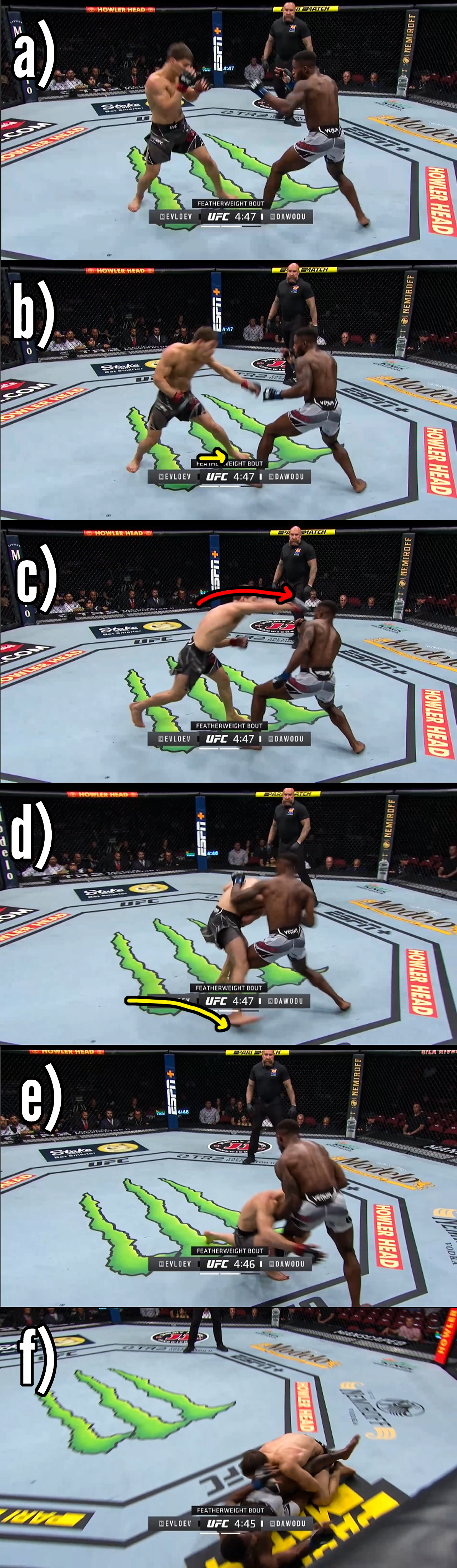
The uppercut comes in here when Evloev throws his loopy right hand, dips in at the opponent’s hips, and the opponent throws their hips back to avoid a takedown attempt. Evloev comes up into a collar tie and beings hammering them with the uppercut. We often call the uppercut a counterpunch that counters posture, rather than a specific strike. Any time the opponent’s head is forward of their hips, they are vulnerable to the uppercut, and this means the uppercut has terrific interplay with level changes, as the opponent retracts his lead leg and tries to get his lower extremities away but leaves his head hanging out. Evloev’s collar tie uppercuts are a less dynamic, mauling variation of the Chad Mendes level change to uppercut set up.
Alexander Volkanovski
This brings us to Alexander Volkanovski. The featherweight king is some years removed from his best days, but eighty-five percent of one of the greatest fighters of all time is still too much for most of the featherweights who have ever put on the gloves. Moreover, Volkanovski has only looked troubled by massive punchers. His conditioning, his wrestling and his ability to fight to a gameplan are still almost nonpareil. In Evloev he also finds himself in the fun position of having more firepower. The last time Volk found himself packing the big iron on his hip was probably his third fight with Max Holloway: the one fight fans want preserved in the Library of Congress as a lesson for future generations.
The wrestling is especially compelling in this match-up because Evloev has not been an unstoppable force, but rather a slightly more active force. When Evloev shoots he tends to get a single and have to chain wrestle through to a finish. Against elite opposition—Sterling, Murphy, Allen—it is not uncommon that as he goes through this chain wrestling, they stumble their way onto the fence, and then he cannot reliably convert it into top time. In a world where all the “evs” and “ovs” of Russian MMA are cage wrestling their way to wins, it is notable that Evloev is at his best in the open mat and decidedly less of a force when facing the cage walking game that has been commonplace in high level MMA for a decade or more. When he wrestled Dan Ige at the fence, he looked middling. When he got Ige down in the middle of the cage, he battered Ige for the full five minutes, flat on his back. It was even more stark because in the third round they wrestled at the fence again and Ige did fine.
In addition to just being a very good wrestler, Volkanovski has two tactics that might make Evloev’s task a slog: his head-to-fence game, and his whizzer get up. Let us discuss the first part of that. Every week we see fighters concede the back bodylock against the fence to defend a takedown, or build up to that position from the mat. The goal is then to separate the hands and turn back in. Cory Sandhagen is a master at that. The man with the back bodylock wants to either trip his opponent to the floor or step around the side of him and run him down with a mat return or lift.
Figure x shows Dan Ige standing with his shoulder to the fence, fighting the hands. Evloev steps around Ige’s leg, off balances him, and lifts him, dumping him on the mat.
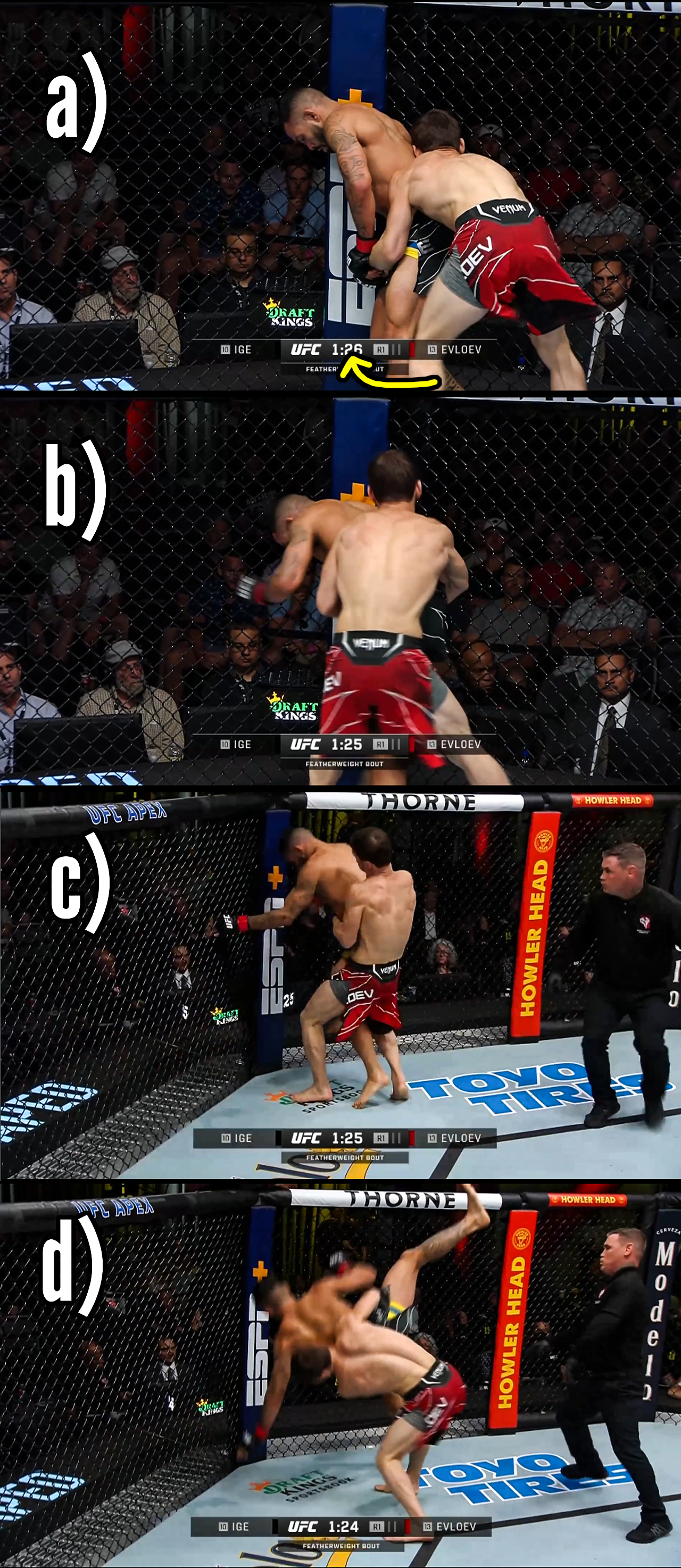
The curious thing that Volkanovski found, and demonstrated emphatically against the great Islam Makhachev, was that if he kept the top of his head pressed into the fence and his rump pointing directly towards the centre of the cage, he could continue fighting the hands but removed many of Makhachev’s offensive options. If Makhachev stepped around the side of Volk’s leg, he could not drive Volkanovski over it and run him down towards his head, or create a lift. When Makhachev did try to pull Volk down, he fell almost underneath the smaller fighter and they quickly came back up to the feet.
In many ways this position is reminiscent of Kazushi Sakuraba sticking his head out of the ring under the bottom rope and giving the Gracie’s nothing to work with. In both cases, pulling him backwards seems like a logical solution, but he is leaning into the cage or through the ropes, his weight isn’t budging easily.
When Ige faced into the cage, and did not give Evloev the chance to run him parallel to the fence, Evloev was pushed to the limits of his knowledge to get Ige off his feet. He had similar trouble with Arnold Allen at several points in their fight. One move he attempts is the Tani-Otoshi or “Valley Drop” that Petr Yan and Donald Cerrone both loved. Switching the feet and pulling the opponent backwards over them. But he struggled to get Ige’s weight out of the fence and Ige stumbled around the trip and back to the fence.
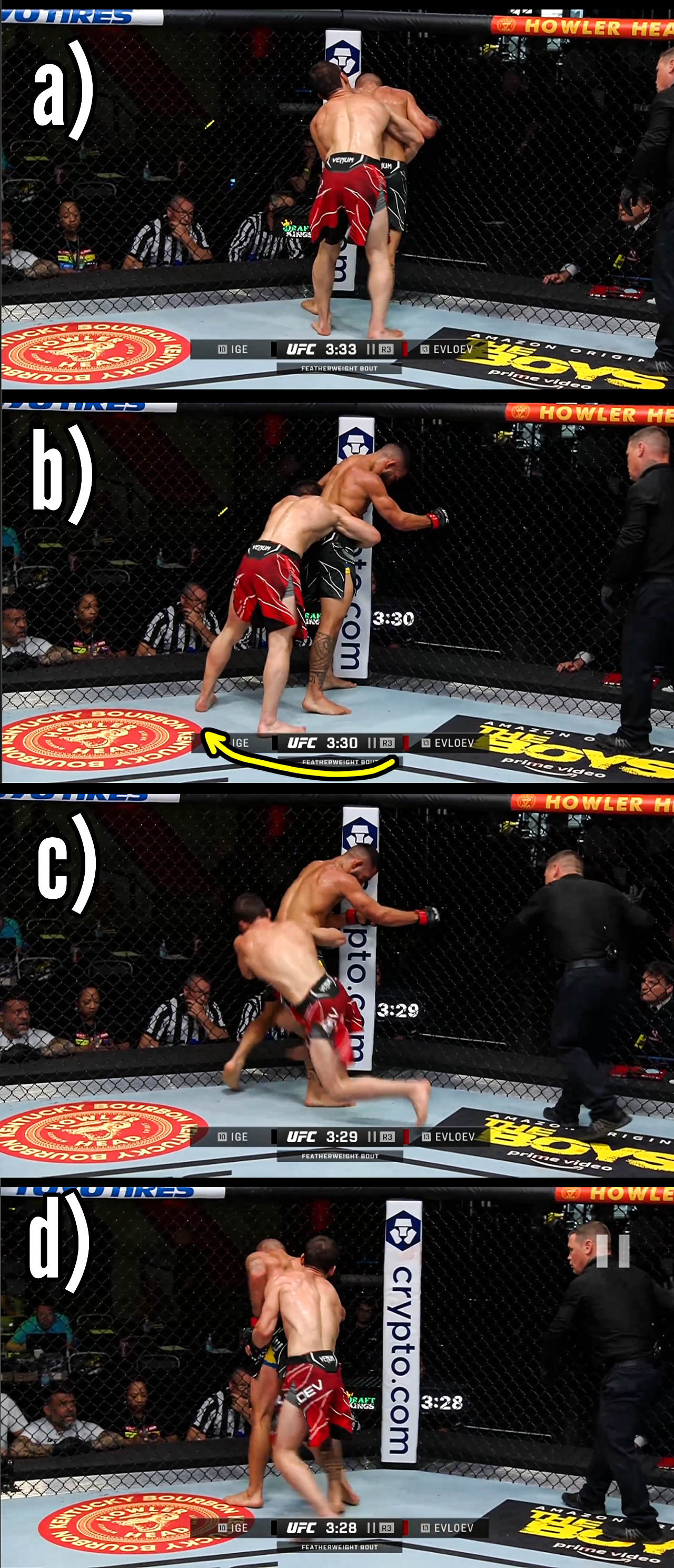
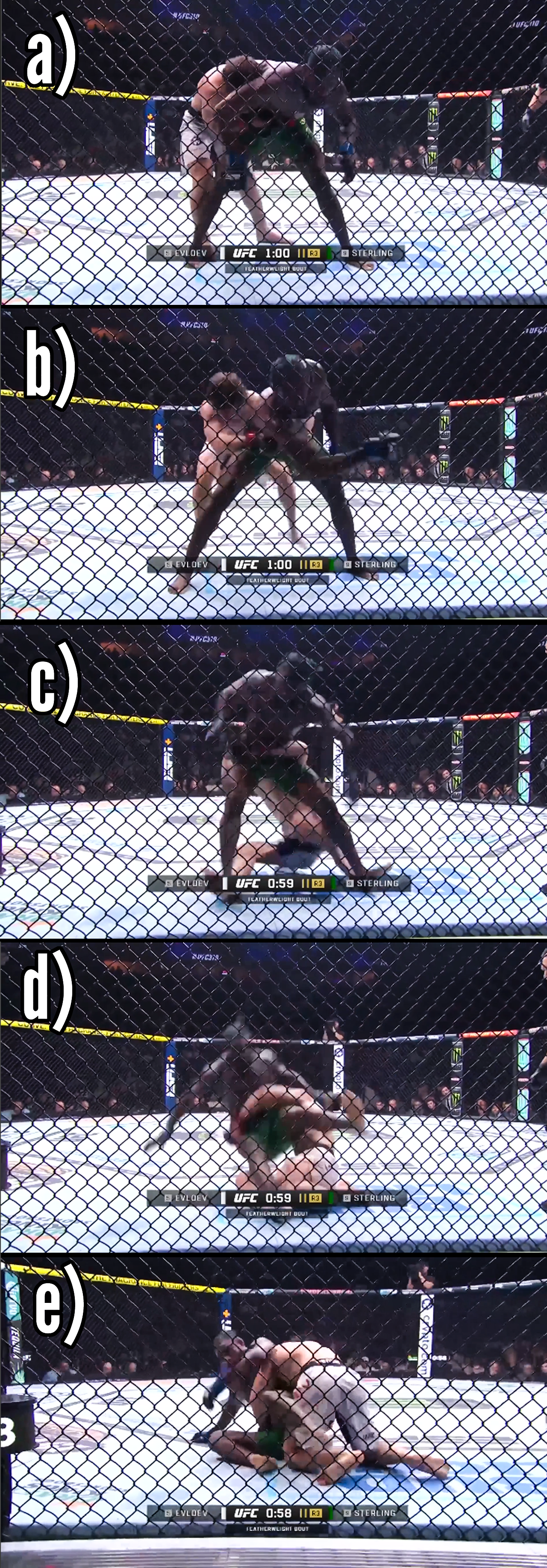
Contrast that with a successful example of a similar trip against Sterling. This time Evloev doesn’t switch his feet, but instead “stands on” Sterling’s feet as he pulls him backwards. Aljo had his head in the fence, but then let Evloev pull him back away from it, and instead of getting back to position, began trying to back elbow him. This goes down well with the fans, but not the judges.
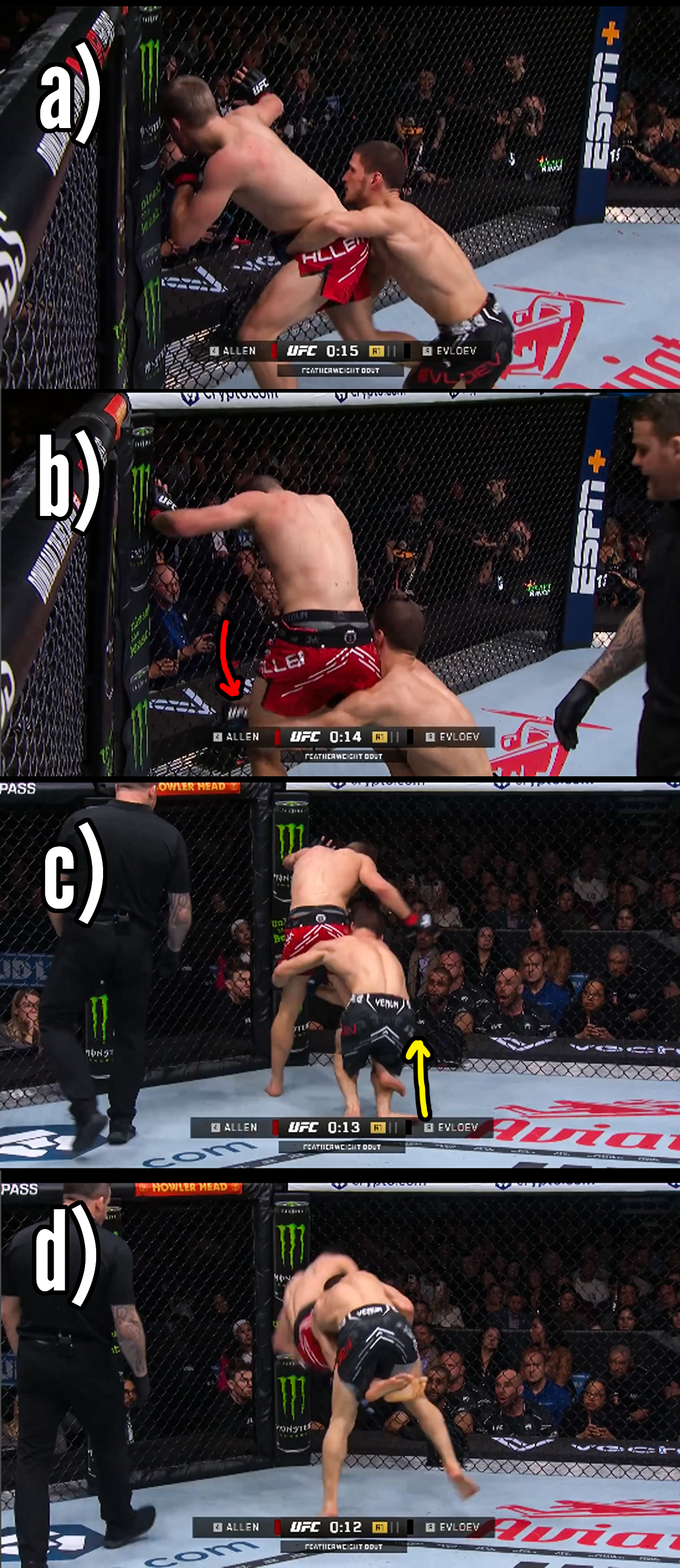
Evloev has demonstrated one interesting answer to this position in his fights. He performs an ankle ride by hooking the opponent’s leg low, pulling it out, and kneeling down on top of it. This breaks them down to the turtle briefly, but it might be more important for what happens next. In Figure x, Arnold Allen immediately jumps up to the same position on the fence, but Evloev is still sat on his ankle and has his hands locked around Allen. As Allen jumps up, Evloev slides his locked hands down to the thigh, then stands up with the ankle he his sitting on and double legs Allen. It was an elaborate way to change from an upper body clinch to a lower body attack.
Alexander Volkanovski
- Punch and DIVE
- Falling Short
- Shifting Through
Drifting out to Right
- Especially against Southpaw
-