
Manuel Torres - Knockout King of the Overswing
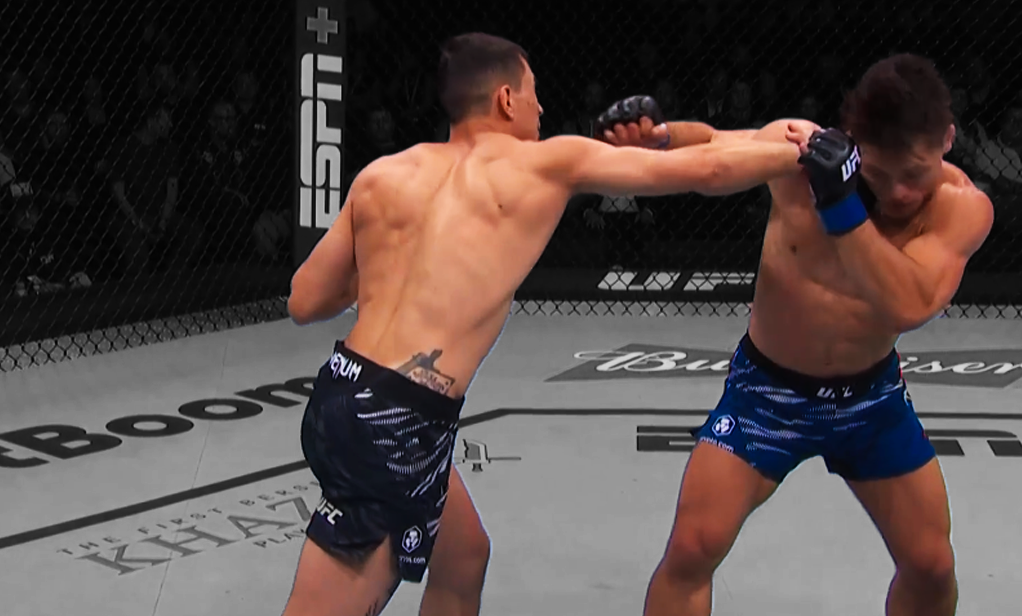
“How long can he keep winning when he fights like this?” That has been the unavoidable question in the opening moments of every Manuel Torres bout since he arrived in the UFC. Yet five times out of six, he has emphatically felled his opponent less than two minutes later. I am reluctant to use the term “rough diamond” because it feels so cliché in combat sports, but there is no better phrase to describe Torres: a fighter with all the physical attributes, a heap of technical flaws, and a few redeeming moments that give you a glimmer of hope that the quality is in there and he can be chipped away at to reveal something better.
At the centre of Torres’ myriad of undesirable qualities is the way in which he allows his aggression to overpower his mechanics. He wants knockouts, so he swings hard on every blow, and invariably he overcommits and serves up easy counters to his opponents. His fights with Frank Camacho and Nikolas Motta demonstrate this beautifully. Every time Torres steps in to swing it is a hard 1-2 or a left hook into right hand, and he squares himself, throws the hardest punch he can against their guard, and then stands still for a good half eternity, ready to eat the return. Everyone from Ignacio Bahamondes to Grant Dawson has hit him with flush counters as he stands there like a Punch Out character, displaying his moment of vulnerability. His tendency to smother his own right hand also works against his intentions.
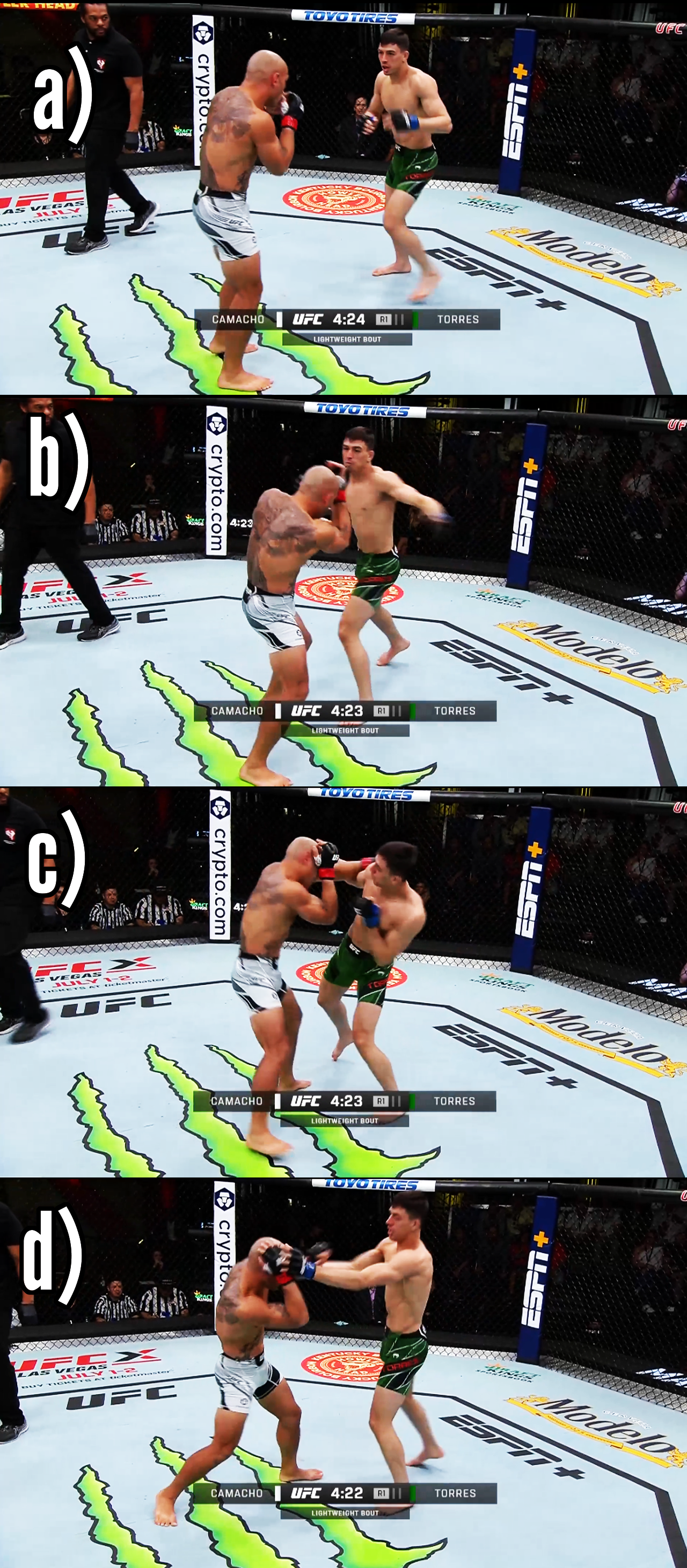
Fig. 1
A love of the left hook has made things worse. When he wants to lead with the left hook, Torres—whose head is almost always stationary—will square up and telegraph his intentions, then step in and eat whatever the opponent instinctively throws back.
Figure 2 shows Torres’ usual overcommitted left hook. In this instance, Torres steps so deep that he has to pull the punch back towards him.
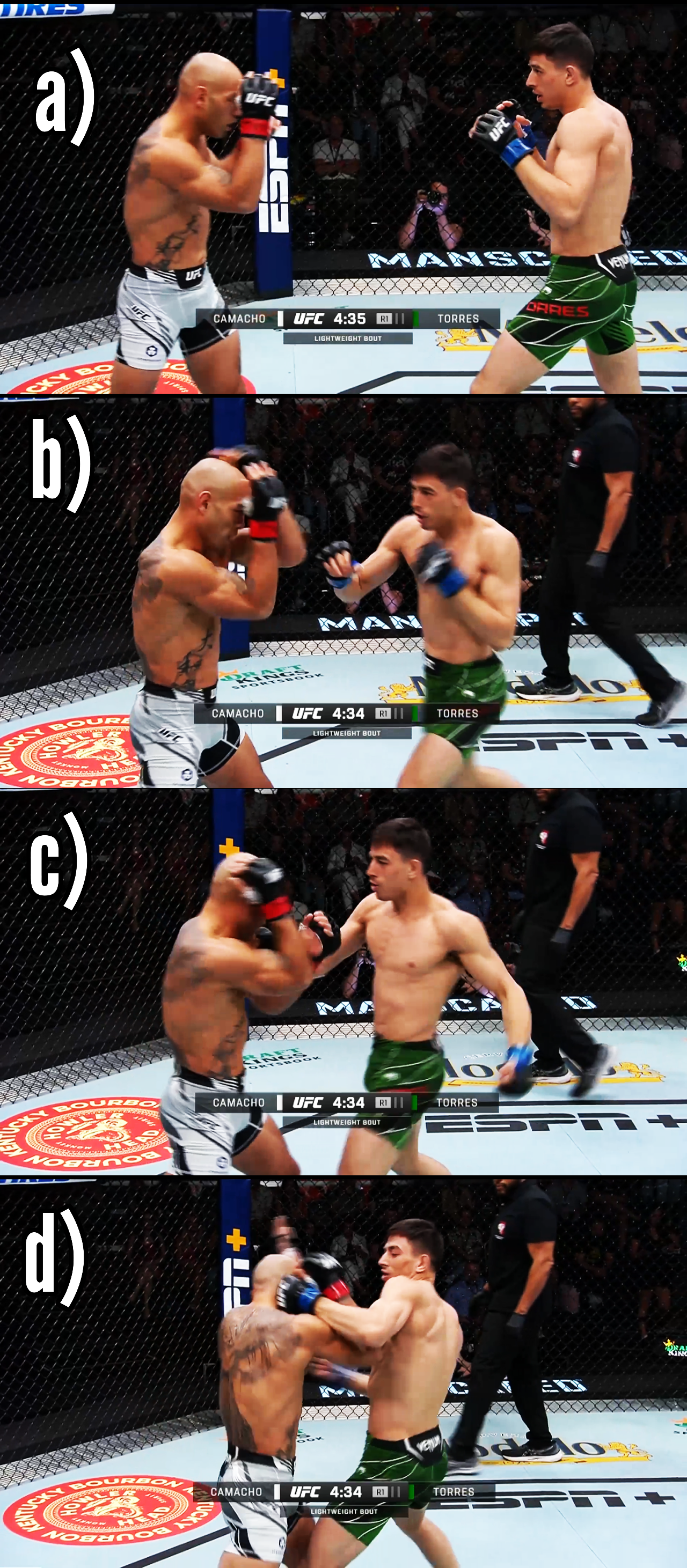
Fig. 2
Figure 3 shows how this squaring of the body, starting from a stationary base and taking a big step in at the same time, serves as an obvious telegraph. The telegraph is also the opening for any form of counter punch. Camacho was daunted by Torres’ power and still broke this left hook off with his jab on a couple of occasions.
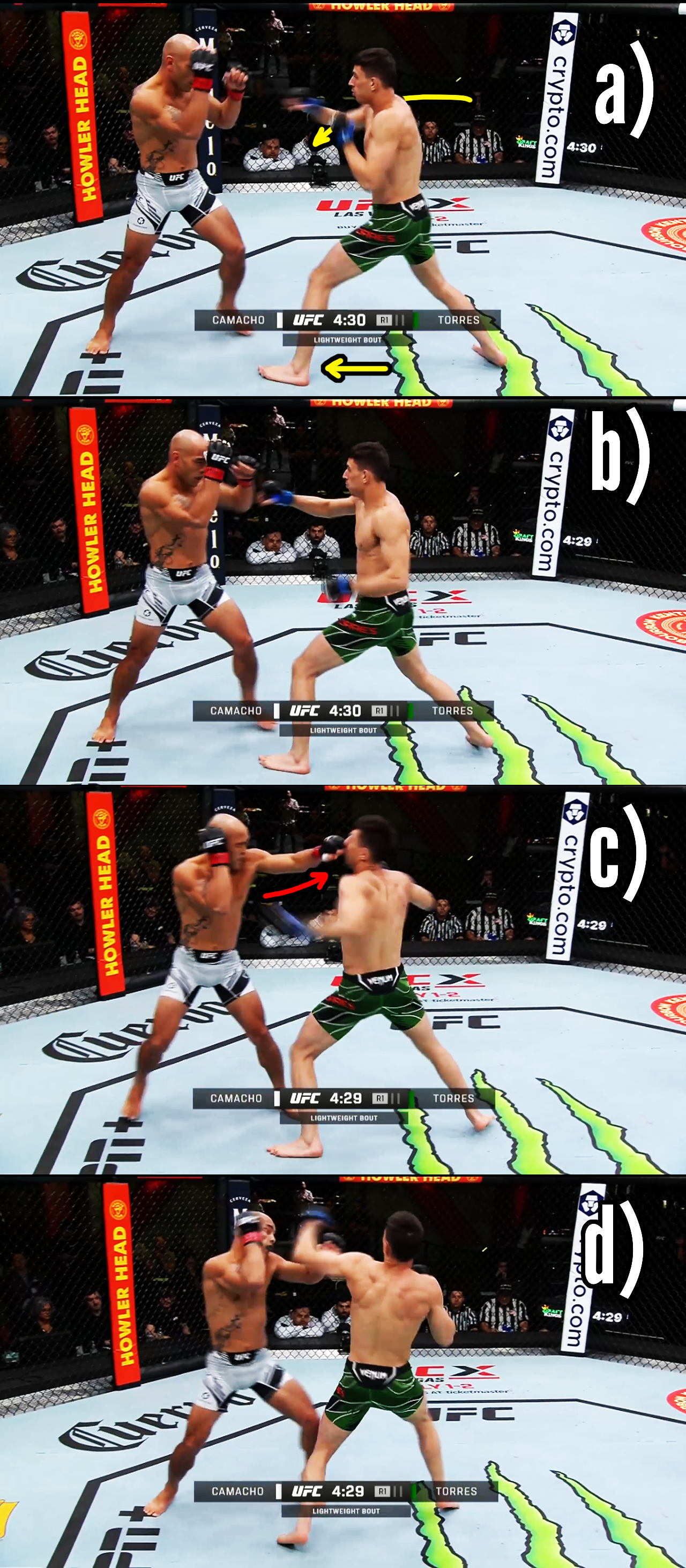
Fig. 3
There are a few fighters who insist you can and should throw everything as hard as possible, Bas Rutten has been preaching that for years, but one of the inevitable stumbling blocks is that hitting hard requires a good weight transfer and when you throw your weight in you have to give up control of it for an instant. Nowhere is that more obvious that in Torres’ loss to Ignacio Bahamondes. Torres was already massively overcommitting with his one-twos, but as an avid switch hitter he often found his way into southpaw, serving up the open side counter. Two near identical open side counters from Bahamondes handed Torres his first UFC loss.
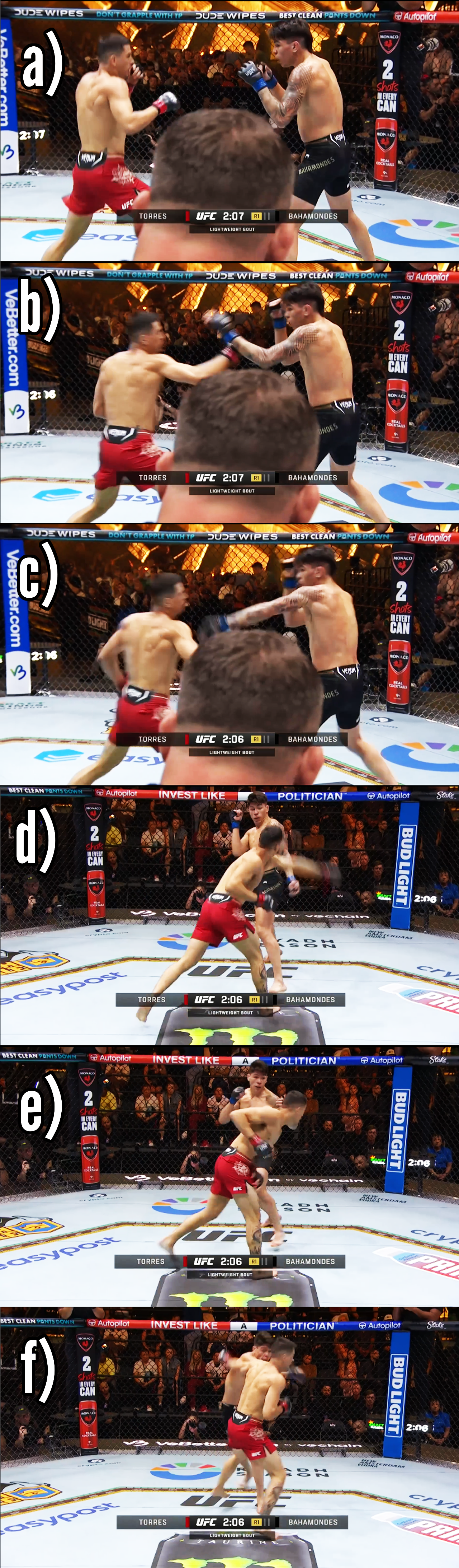
Fig. 4
Against Bahamondes, Torres’ issues with overcommitting were amplified by the fact that Bahamondes was significantly taller and longer than Torres. At 5’10, Torres falls on the taller end of the lightweight spectrum, but in a division that contains men as tall as Tom Nolan and Fares Ziam, it is dangerous that he relies so much on his length to land and his height to protect him.
Figure 5 shows the knockout punch from Torres vs Bahamondes. To return to that idea of a good punch needing weight, Torres fully commits his weight to the blow and it is as if he has thrown the ball on a set of leg irons—the punch pulls Torres up to it, bringing his feet up to level and leaving him completely exposed to the counter.
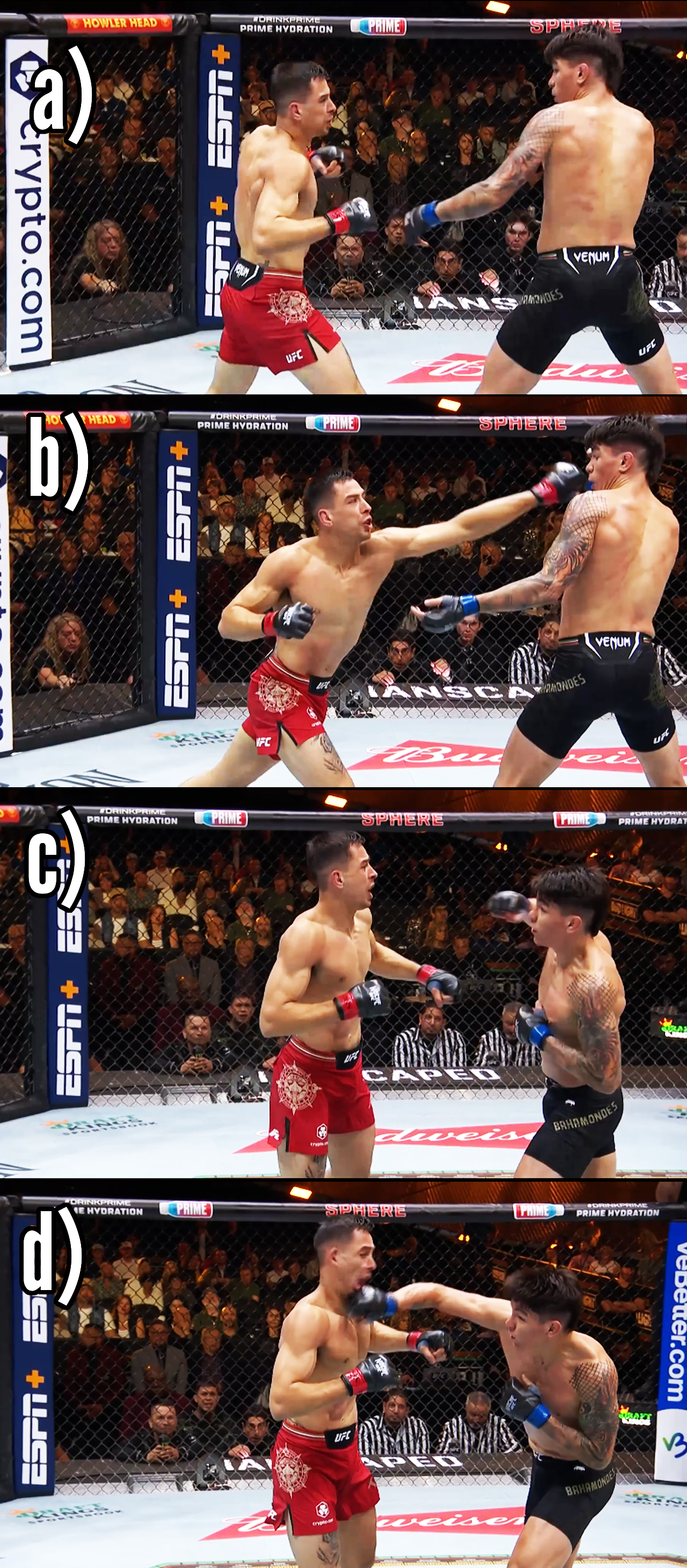
Fig. 5
Those tall man habits have laid down roots in Torres’ defence as well. He spends most of his fights moving forwards, and then steps back and leans away as the opponent returns at him. Figure 6 shows how that worked in his match against Nikolas Motta.
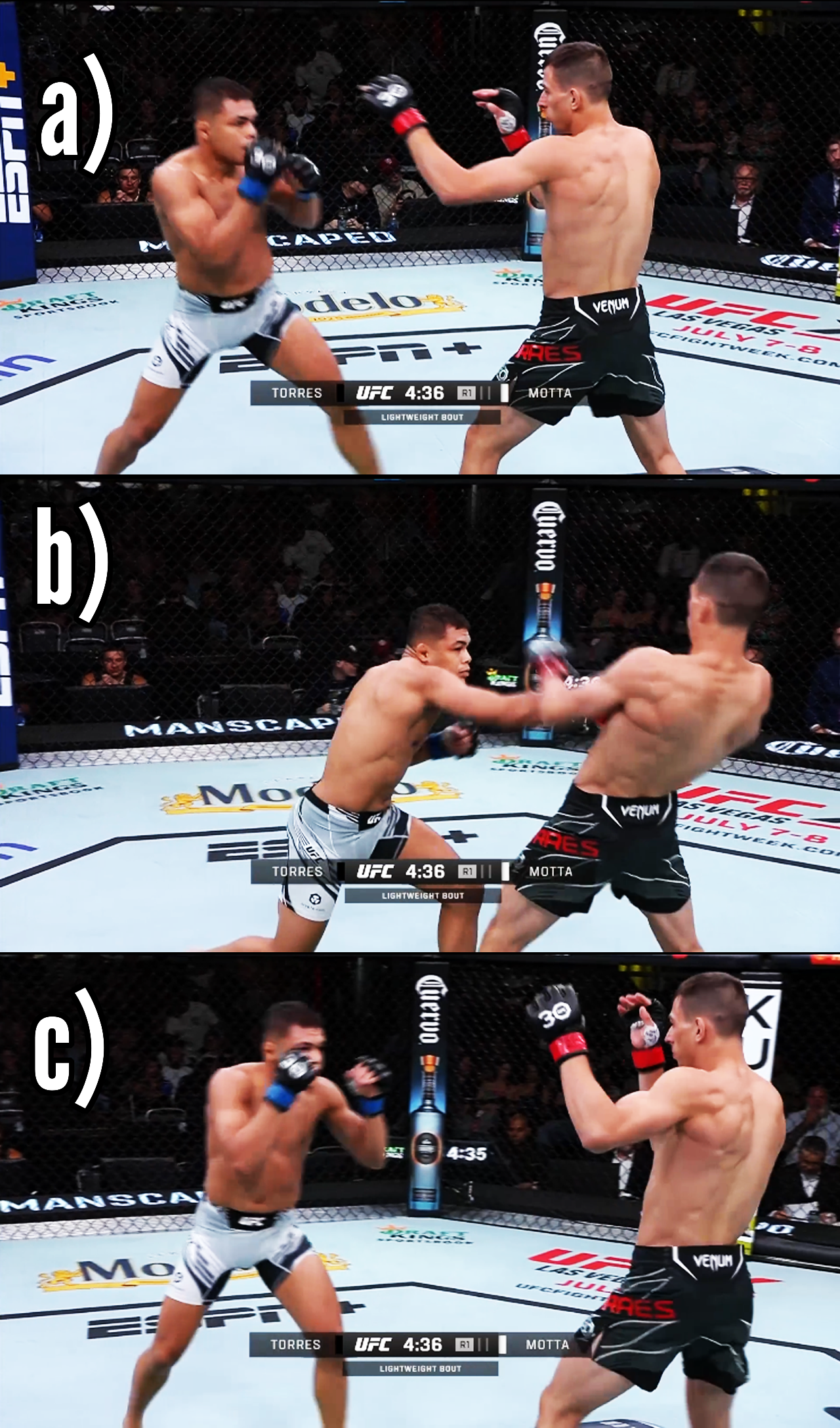
Fig. 6
The much shorter Motta quickly showed the issue with this. When Torres was pressuring in on him, Motta committed to an extra step and extended a combination to catch the reclining Torres dead-to-rights on the end of it.
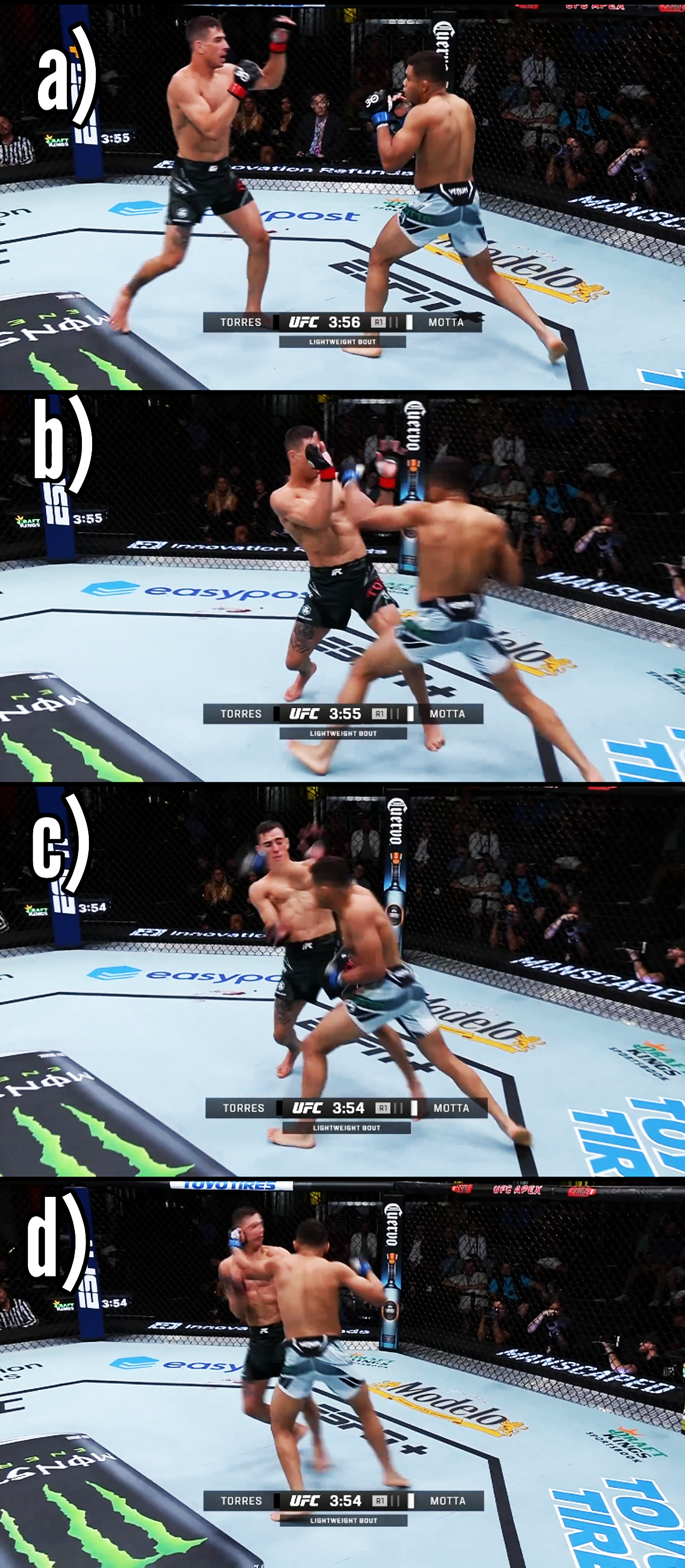
Fig. 7
Fluke or Renaissance
If it seems as though this is a hit piece against Torres, rest assured that I would not have spent the time on him if he did not have such a bright spark of potential. Some of his reads have been brilliant and if he isn’t defensively sound, he at least has that “gift for violence” we discuss on occasion. That mysterious trait that let fighters like Matt Brown know just when they needed to hit the body, or push the pace in the middle of the fight, or cover their opponent’s mouth in a stagnant grappling exchange. Torres is one of those fighters who is particularly attuned to what would hurt an opponent most in the moment and when that moment is ripe. One such moment came when Torres got annoyed at losing a couple of boxing exchanges against Motta, switched to southpaw, jumped deep into outside foot position, and ran through Motta’s punches with a battering ram of an elbow strike.
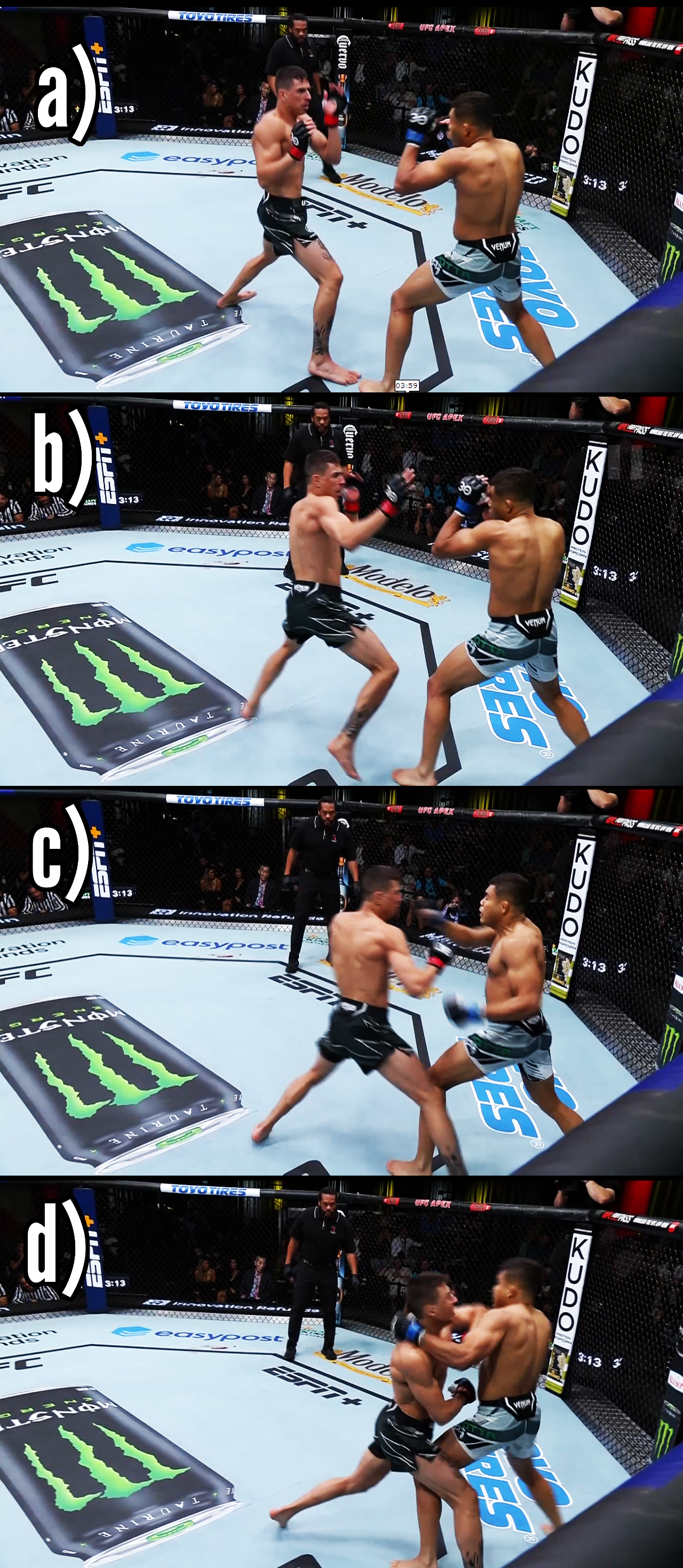
Fig. 8
After Ignacio Bahamondes destroyed Torres in four minutes, it seemed as though “El Loco” did some introspection. Since that loss, Torres has taken two fights and has looked surprisingly patient. Or as patient as he could look while still stopping his opponents inside the first round.
Against Drew Dober, Torres fought a long range kickboxing bout in the centre of the cage. He did not push forward recklessly and smother his own punches, he tried to snipe at Dober with front kicks, round kicks, and long one-twos. His form was still a bit too passionate, as Figure 9 shows, but his length often saved him from the famous Dober right hook.
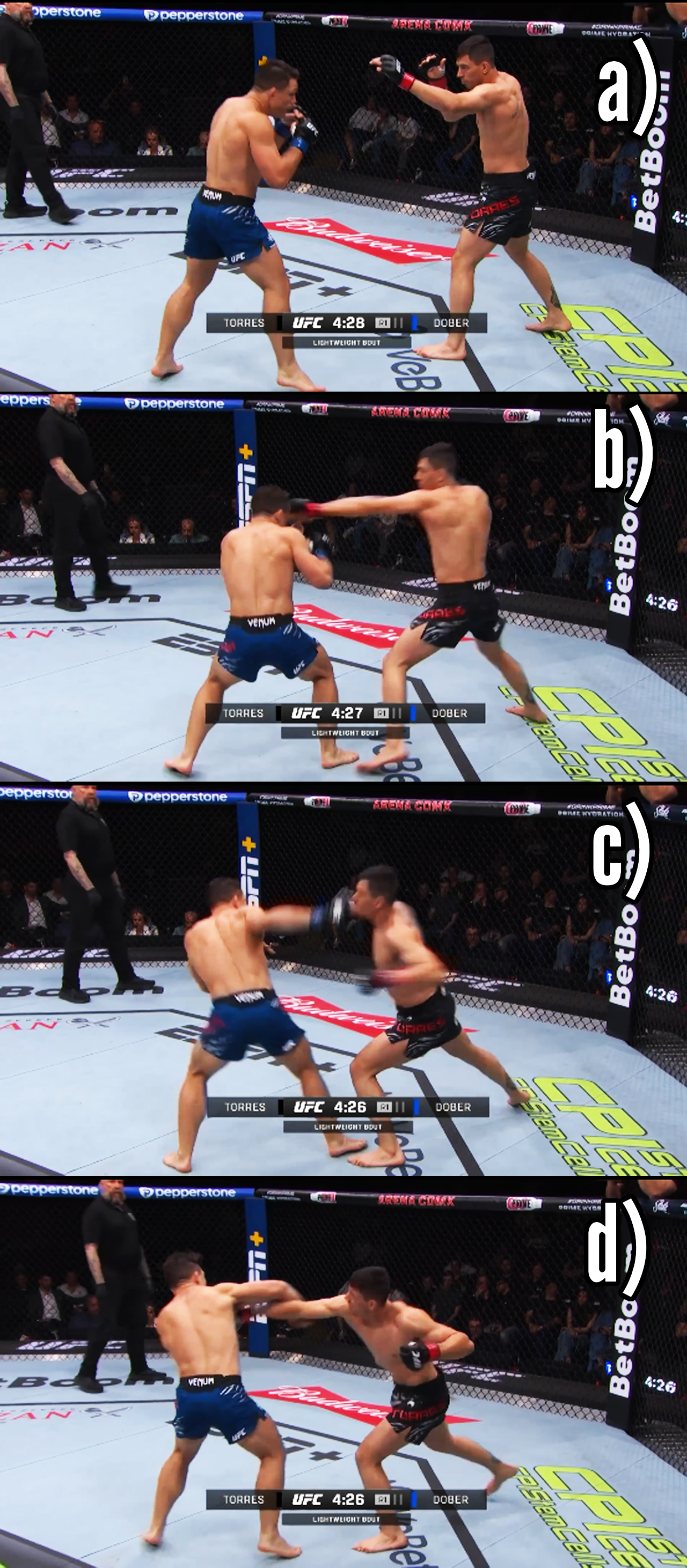
Fig. 9
This is where we get into the old story of tactics versus mechanics. You can change your tactics on the stool between rounds, or even between exchanges. You are not going to be able to change your mechanics without a lot of time and work, because all the bad reps in the gym only serve to embed it more firmly in your muscle memory. Here is a clip of Torres shooting his one-two and then immediately falling forward into southpaw, completely out of position. This is what we often call “shifting by necessity” because unless you were planning to do something clever with your shift, it was probably a mistake.
Fig. 10
Fighting long and slightly more measured paid off though, as Torres promptly dropped and finished Dober with the same one-two.
Fig. 11
Torres’ last fight, against Grant Dawson, might have been his most promising yet. Dawson is an overwhelming wrestler with horrible striking, but Torres still did something very interesting: he switched to southpaw to maintain an open stance match up. This enabled him to fight the orthodox Dawson in the exact same manner he had fought Dober. It also fed Dawson the right leg to shoot on and made shooting to the double or ducking into a clinch much trickier.
Figure 12 shows Dawson attempting a shot from long range, and Torres retracting the lead leg and sprawling beautifully, before angling out and jumping up to push his advantage.
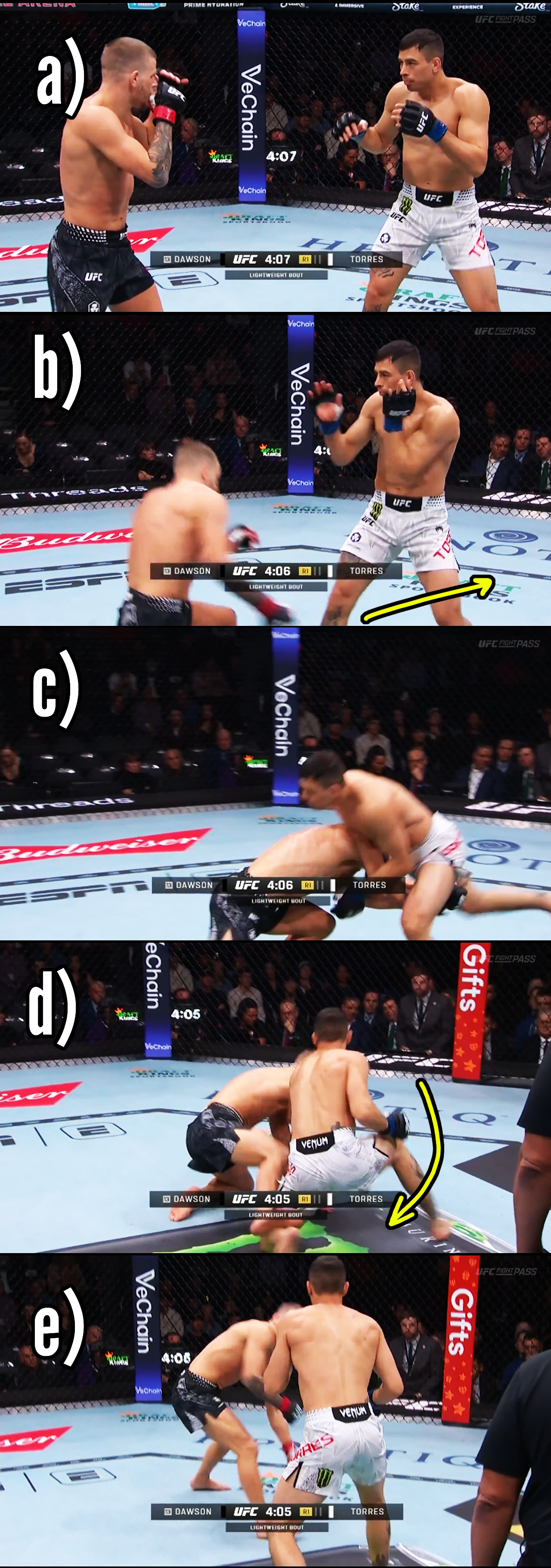
Fig. 12
This mirroring of stance is very common in point karate competition. The left hook is a no go, so you are often better off using your lead hand to check your opponents while you look for the big, easy to see, reverse punch to make the judges’ jobs easier.
Figure 13 shows exactly where Torres has been finding success in his recent fights. He leaps in, slaps the lead hand down, and pitches his wild left hand—with the cover of an angle through his outside foot position.
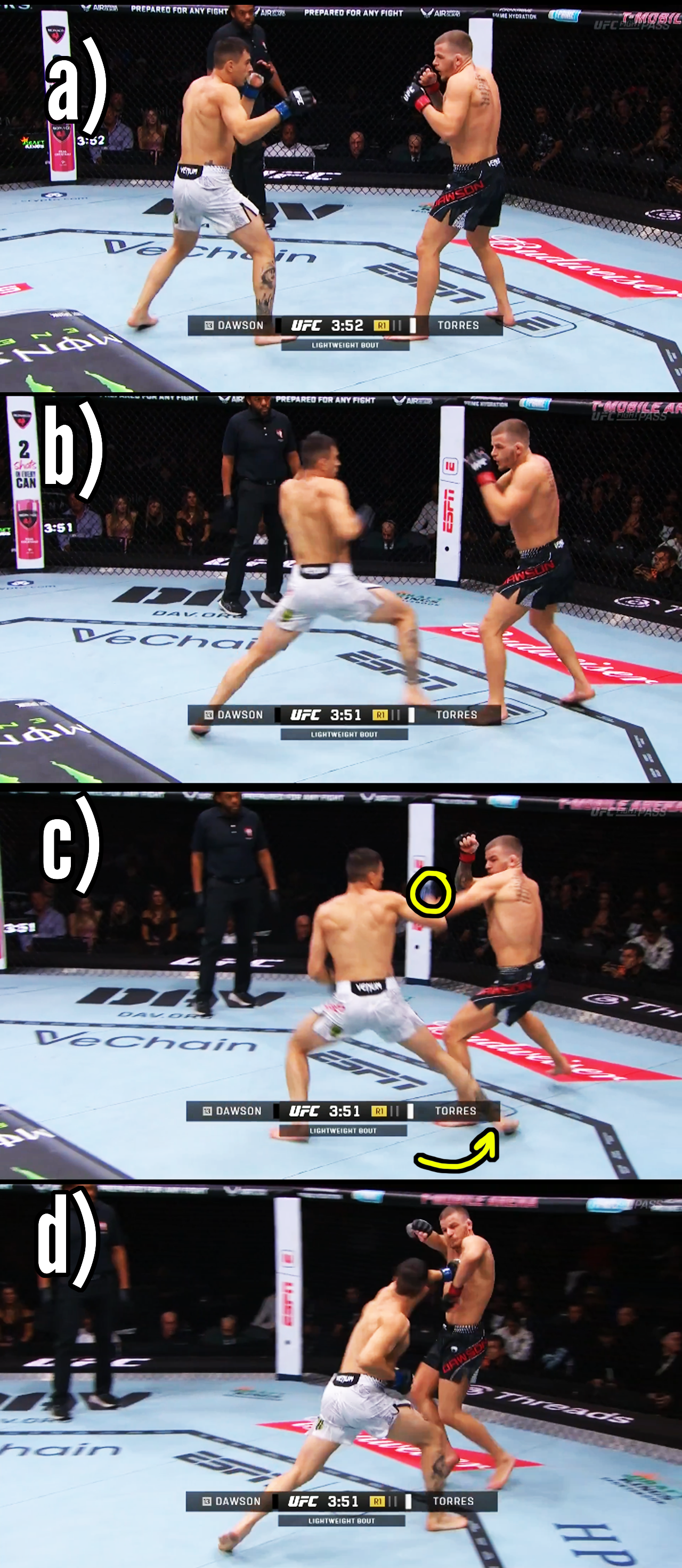
Fig. 13
It is obviously early days, and with Torres fights never getting past the first round this apparent rebirth might only be coincidence. But if we were to ask how Torres can improve this new open stance, longer range strategy, I would suggest the handfight. He always pumps the one-two, but his jab is a largely ineffective tool, certainly much less effective for him than his opponents’ counters are for them. For this reason I would say eschew the jab and get to work controlling the lead hand. This would make measuring and maintaining distance easier, but also allow Torres to slowly encroach on his opponents and bully them. Carlos Prates has been doing this in the UFC with tremendous success for a while.
Even with the focus on maintaining range, pecking with long kicks, and skewering one-twos, Torres’ offence is still a bit obvious. It is as though he is saying to himself “right, here we go” and biting down on his mouthpiece before each committed attack. He jumps in and either jabs or swats at the opponent’s hand mid-leap. If he could handfight effectively he could apply pressure and remain closer to his opponent, mitigating the need to rush in and to to sell out on every attack.
This weekend, Manuel Torres meets Rafael Fiziev. Fiziev has not been the same since his disastrous knee injury against Mateusz Gamrot, but he is still a fantastic striker who has held his own against Lumpinee champions Yodpayak and Sorgraw in Muay Thai. If Torres really is just a height advantage and some power, he might find Fiziev the same kind of insurmountable obstacle as Bahamondes. But Bahamondes is a taller, longer striker than Torres, where those advantages will still favour Torres against Fiziev.