
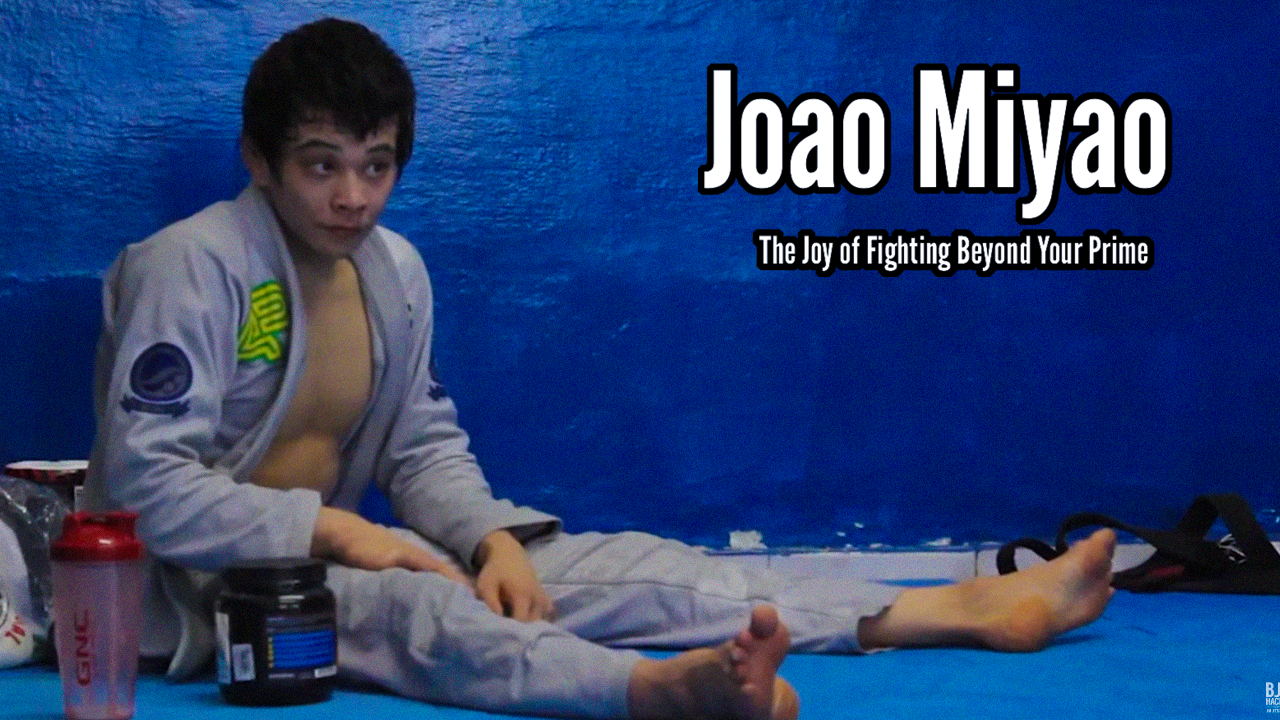
The greatest threat Joao Miyao faced at UFC BJJ 6 was getting down into the bowl shaped grappling pit without further injuring his knees and ankles. Those joints have been pulled on and torqued by the best grapplers in the world for more than fifteen years. There are whole highlight reels of both Miyao brothers refusing to submit to fully extended kneebars, or a toe hold where their foot is doubled back on itself. When Muhammad Ali said “Suffer now and live the rest of your life as a champion,” he was talking about the training. The Miyao brothers extended that attitude to fighting through submission attempts that were not really “attempts” because they were succeeding in their goal of doing irreparable damage to the recipient’s joints.
As one observer put it, rather unkindly, Joao Miyao looks both thirteen and fifty-nine years old. His slight frame, the child-like mobility he has developed in his hips and spine, offset by his stiff, limping gait and the wrinkled face of a man who has spent decades on the mat getting minor niggles, serious injuries, and a constant stream of skin infections.
The Miyao brothers were a subject of fascination when they began to breakthrough in the jiu jitsu world. Twin brothers: the true best starting point for combat sports success. Both constantly accompanied by a world class sparring partner the same height, weight and shape. And they both excelled with the berimbolo, an inverted back take from the bottom that was as good as witchcraft in the early 2010s. It was both unstoppable and the death of “real” jiu jitsu, for the streets.
Their careers diverged at several points—first Joao competed in more no-gi, and then Paulo. Paulo became fluent in English while Joao teaches in Portuguese or through an interpreter. At one point Paulo failed a rare Jiu Jitsu drug test and graciously took the suspension with a statement that almost spelled out “sorry I was the one that got caught.” Curiously, despite both being known as gi specialists, Paulo won the gi worlds or “Mundials” several times while Joao greatest successes came in the IBJJF no gi worlds.
While no gi grappling is now an established sport of its own, this has been a recent development. Eddie Bravo began his Eddie Bravo Invitational in 2014, and at that time there was still difficulty booking top Brazilians for matches because training at the top sport jiu jitsu gyms was still seasonal. To book a no gi superfight outside the regular tournament schedule would find you short on training partners. Joao Miyao was one of the first elite Brazilian grapplers to buck that trend when he entered EBI 4 back in 2015.
In the 2010s, at the height of their powers, I felt like I had little to say about the Miyao brothers because of their gi centric, impractical-for-fighting styles. In the years since I have come to realize that both brothers—and especially Joao—were pioneers in a number of methods that are commonplace in both no gi and mixed martial arts today. Joao Miyao’s successful debut in UFC BJJ, where he bested longtime UFC flyweight Jussier Formiga, is a great chance to give the man his dues.
K-Guard
While the Miyaos were known for their De La Riva guard and particularly the berimbolo, Joao quickly developed an affinity for the K-guard in no gi competition. This was when so few people were playing the K-guard that it didn’t have a name. On the forums people used to call it the “shin hook” or “kneebar guard.” Mikey Musumeci was occasionally playing it in the gi around this time and calling it the “leg hug.”
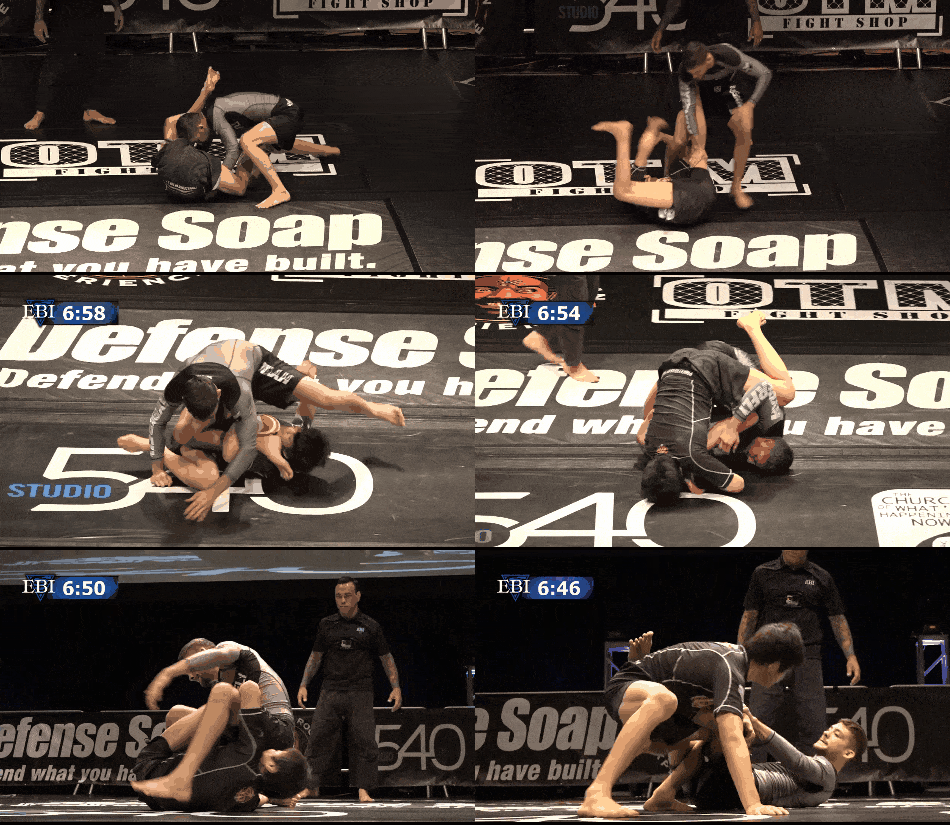
Fig. 1
Figure 1 is from Joao’s first EBI match, in 2015. Lachlan Giles would make the K guard famous in his ADCC absolute division run, four years later. Now, K guard is near ubiquitous.
It was John Danaher’s philosophy on leg entanglements that broke through first—heavily influenced by Marcelo Garcia’s method of guard play. Danaher’s team focused on inside position with their legs: butterfly guard and butterfly half guard. They elevated their opponent and kicked through to entangle legs. The K guard is about outside position, spinning out and around the opponent. In that way it is similar to the De La Riva / berimbolo game with which the Miyao brothers already excelled.
If K guard were just a powerful attacking position, that would be a good argument for its use. A factor that makes K guard even stronger is its accessibility. If you can get the opponent between your feet, you can immediately attack with K guard.
Mikey Musumeci uses K guard to enormous effect in no gi competition, where almost no one allows him to use his world class De La Riva guard effectively. Often he will use a no gi lasso, looping his leg over the opponent’s biceps as they try to pass his guard, and use that to get his feet around them. From there he will scoop inside their thigh and immediately enter K guard.
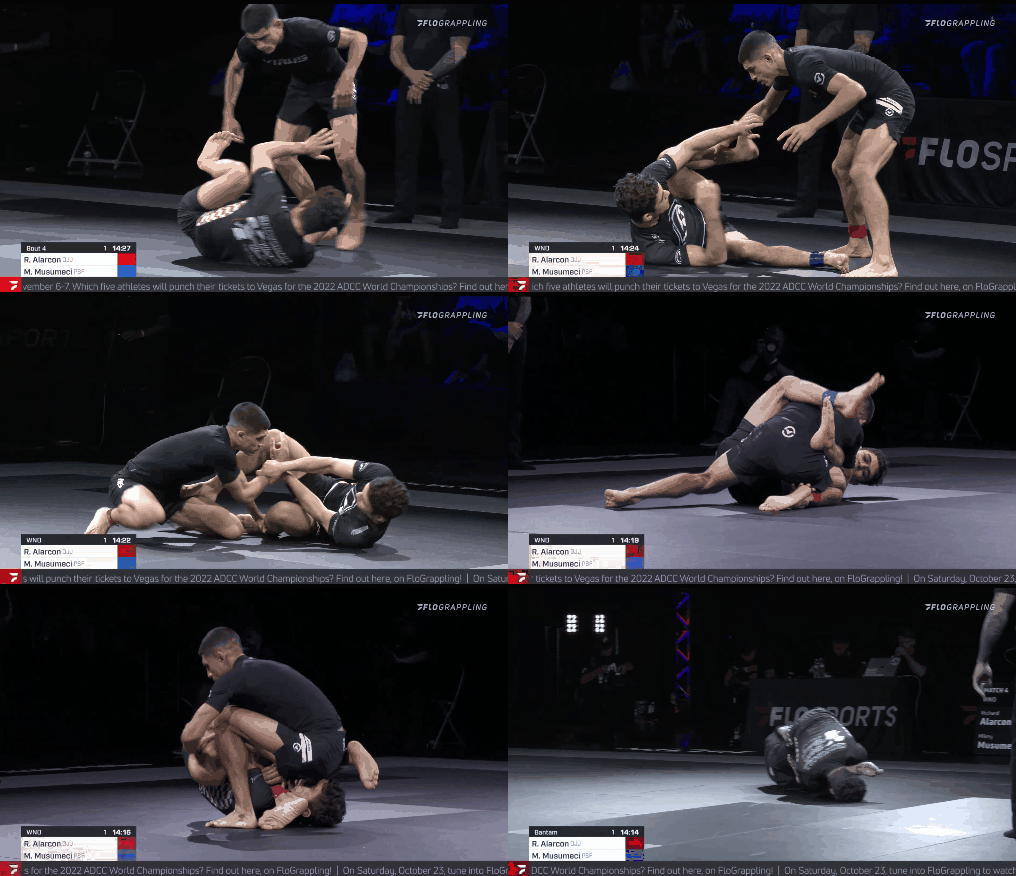
Fig. 2
Roman Dolidze uses the K guard to great success in MMA. While he spent most of his fight with Anthony Hernandez getting battered, he did demonstrate that when he got to the turtle, he could roll through to the K guard and threaten Hernandez’s legs.
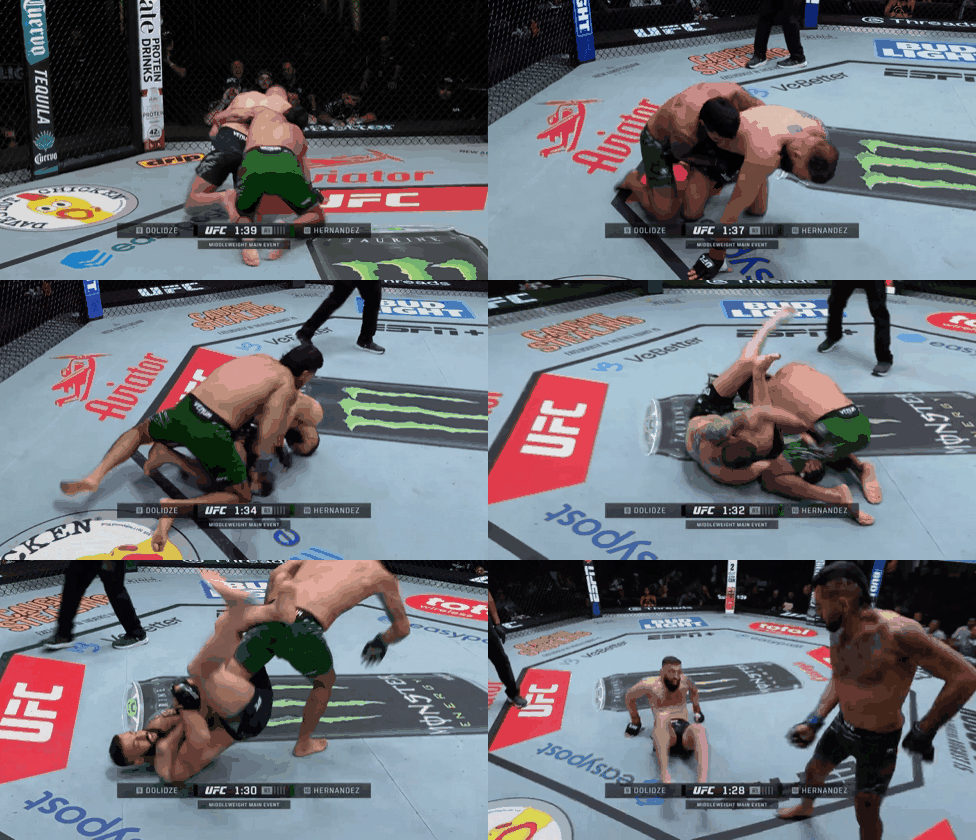
Fig. 3
This pairs with Ryan Hall’s idea of the Outside Funk. For more on that check out Carlos Vera’s fights in the UFC, particularly against Rinya Nakamura.
Here is a beautiful clip of Miyao following Dilon Danis through a cartwheel and rolling back to put Danis between his legs.
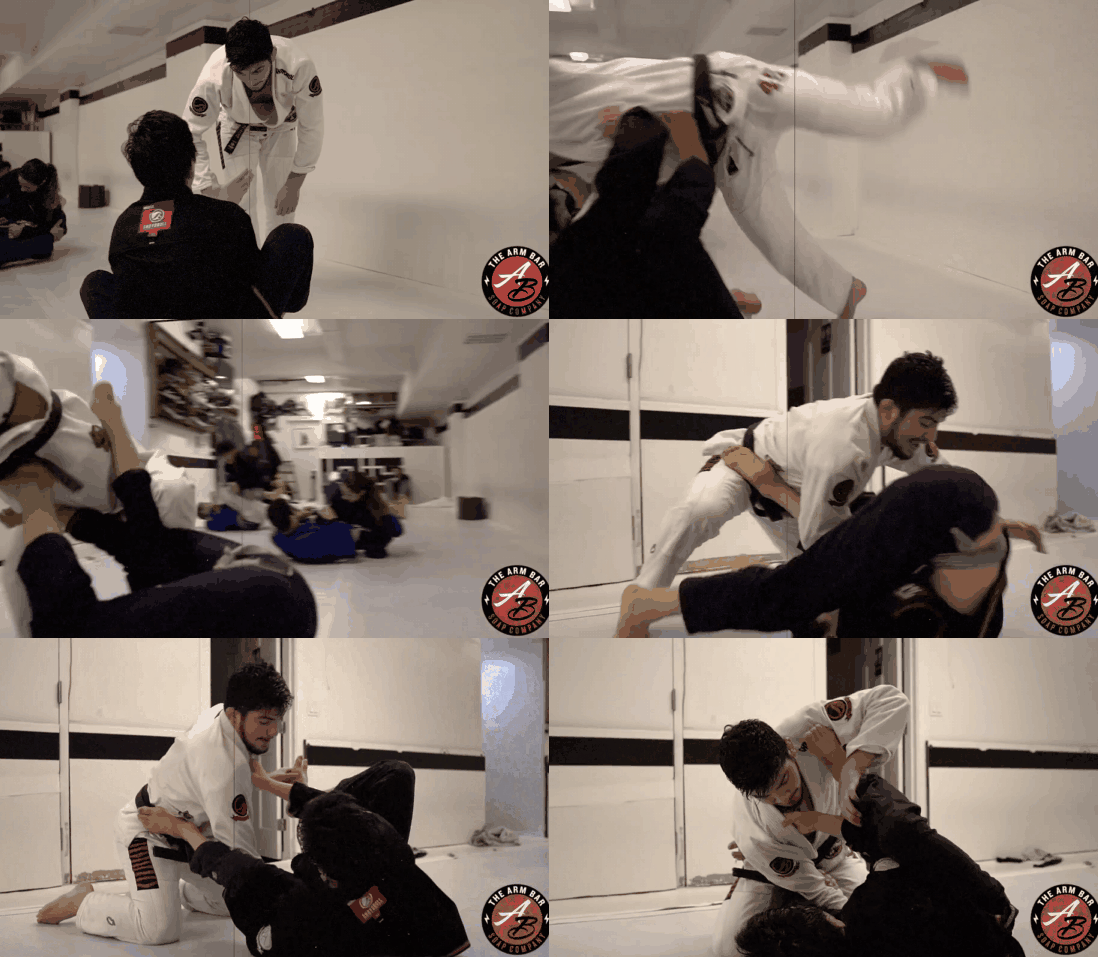
Fig. 4
Lachlan Giles began experimenting with allowing the opponent to pass his guard all the way to north south, and then attacking the K guard from there. Giles has a brilliant, two hour long course called “North South Retention” on his Submeta platform, but one of the keys is this idea of the cross foot hook into the armpit. This is something that the Miyao brothers have been using for a long time. In Figure 5 it is Giles’ right leg performing the cross pummel.
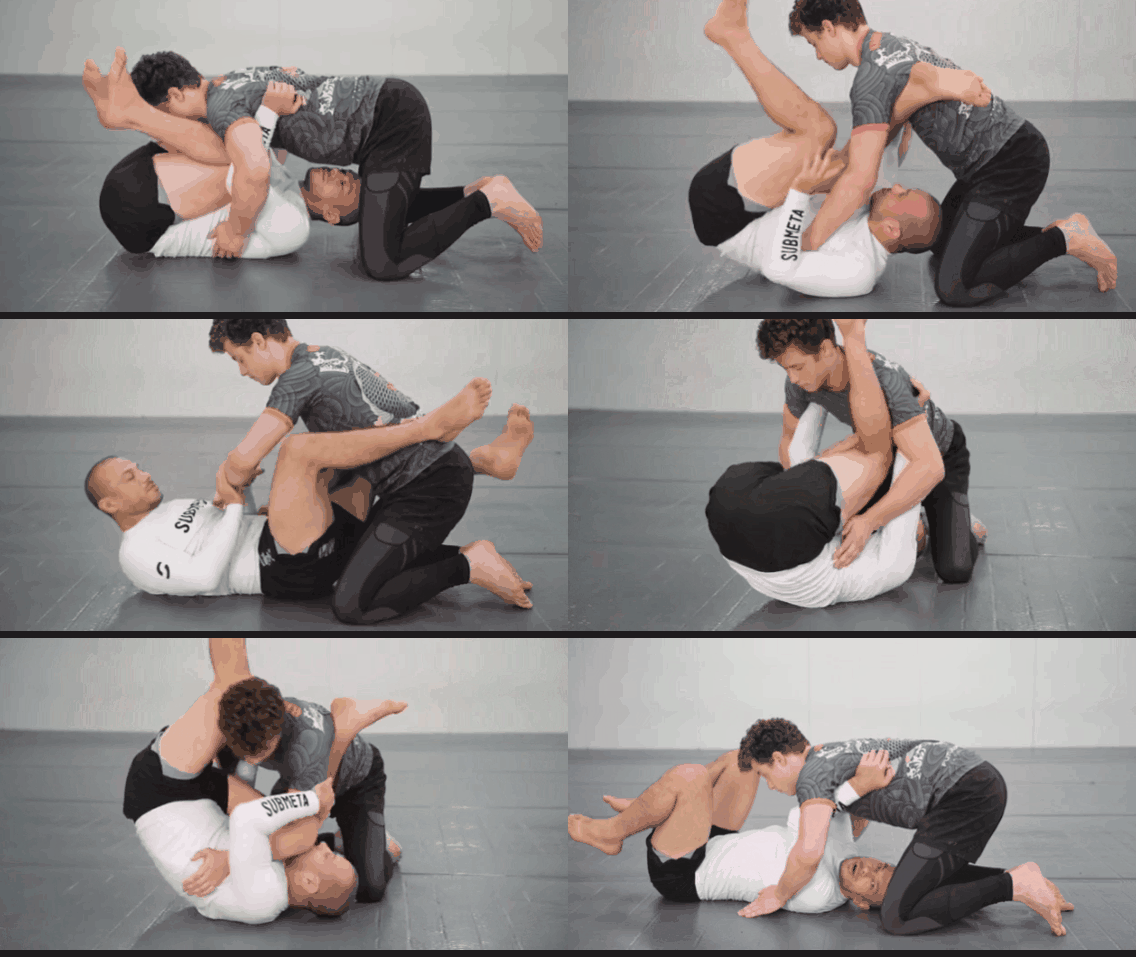
Fig. 5
Against Jussier Formiga, Miyao repeatedly used his astonishing flexibility and leg dexterity to return from an almost-pin to a K-guard attack on Formiga’s leg. It was this cross pummel with the foot that enabled him to get on offence from seemingly disadvantaged positions.
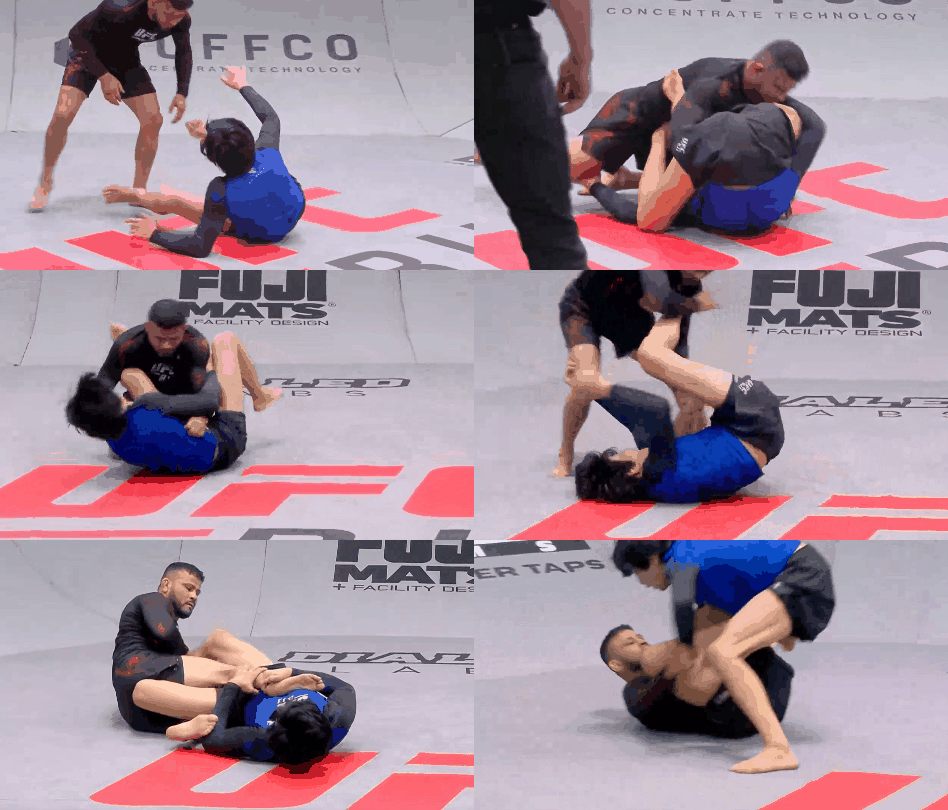
Fig. 6
Formiga adopted the usual MMA fighter vs professional grappler strategy of staying low and attempting to fight Miyao from his knees. It was as he attempted to pass that his legs became more available.
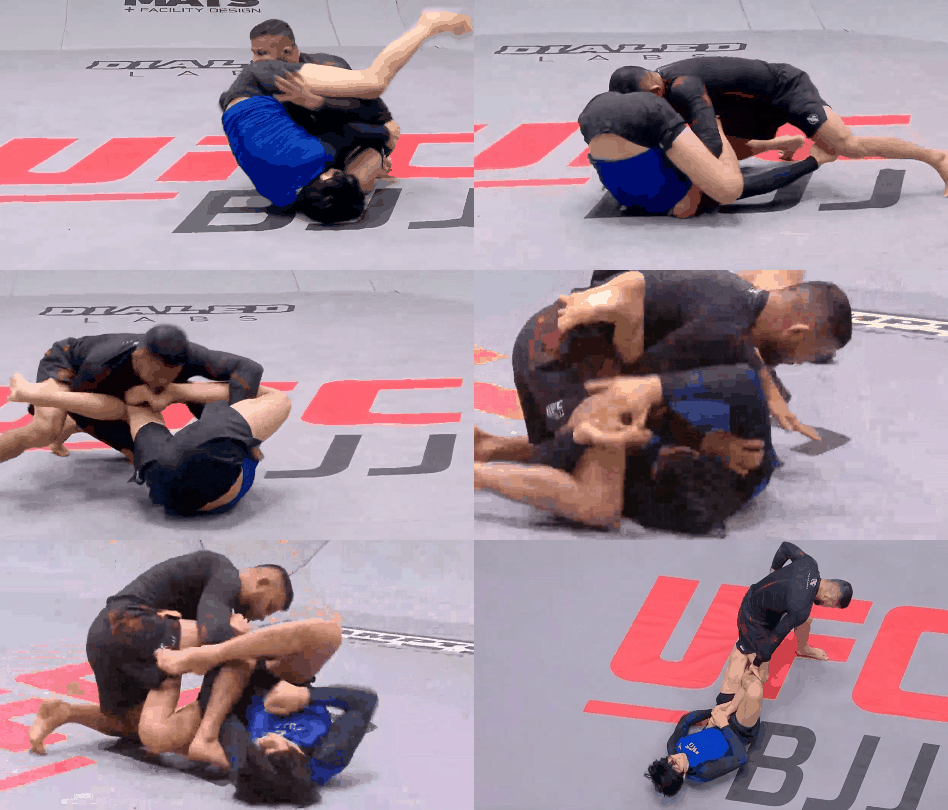
Fig. 7
Another example of the same principle can be seen when Miyao inverts from half guard, then frees his trapped leg to place it on the outside of his opponent’s body while he is upside down. This allows him to turn his hips back into the opponent and attack from K guard again.
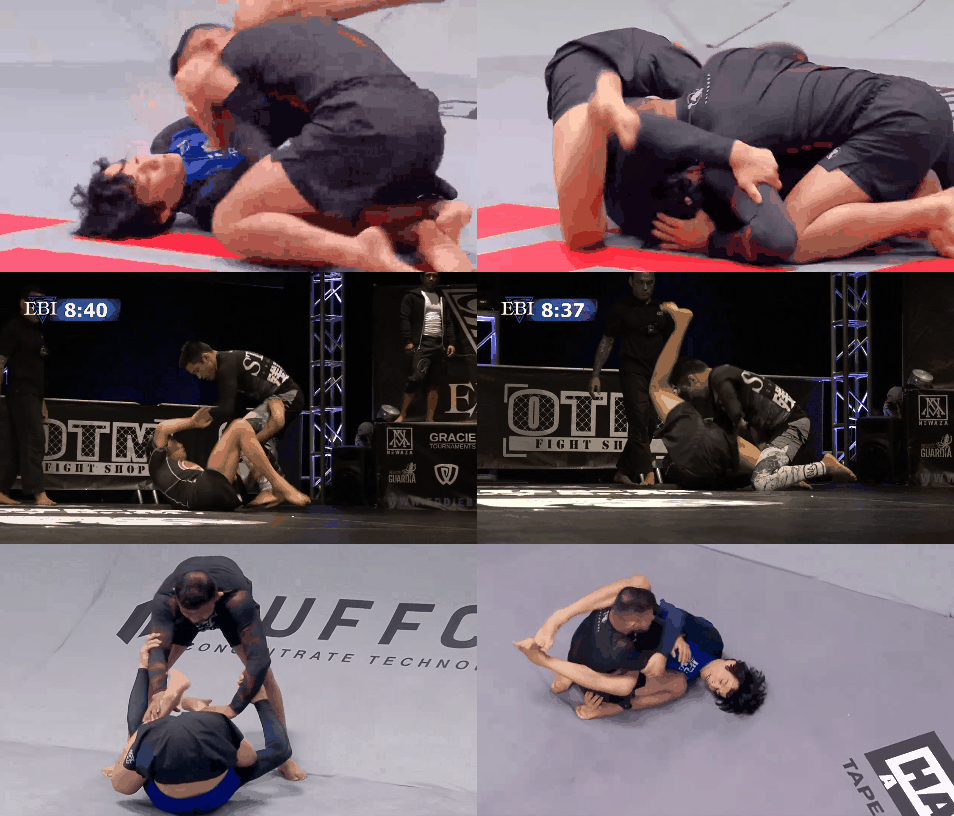
Fig. 8
Here is an entire sequence as he inverts from half guard, frees his leg, returns to K guard, and Formiga sits to concede top position.
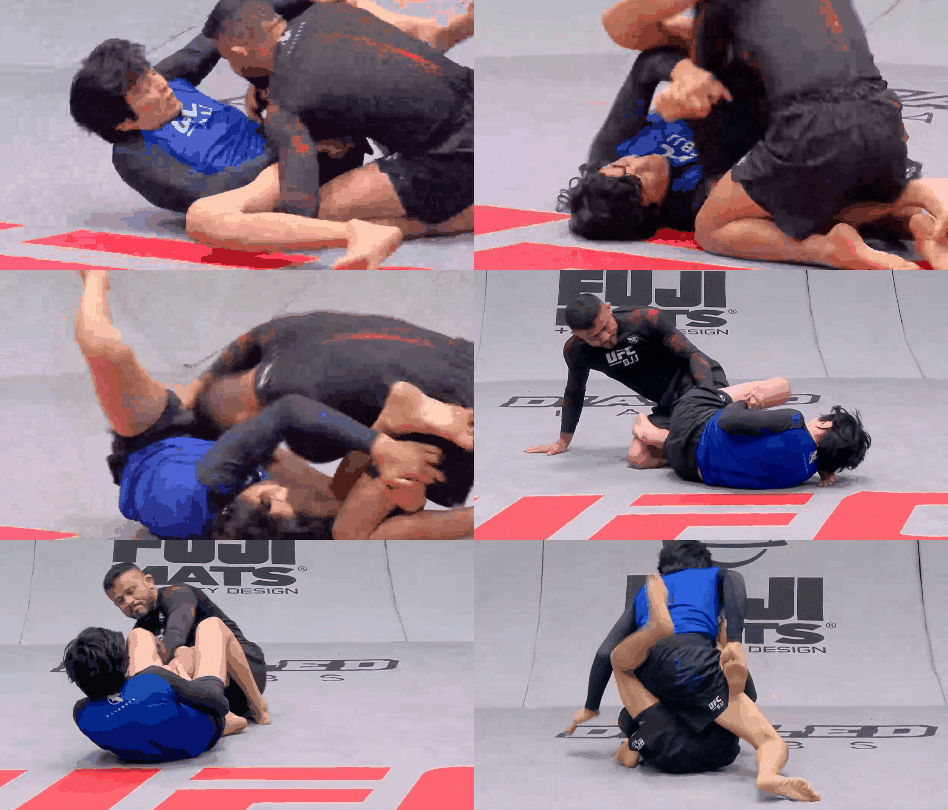
Fig. 9
There are a number of finishing points after entering the K guard. Levi Jones Leary believes in getting the opponent’s foot across the body to create what he calls “the strongest back take.”
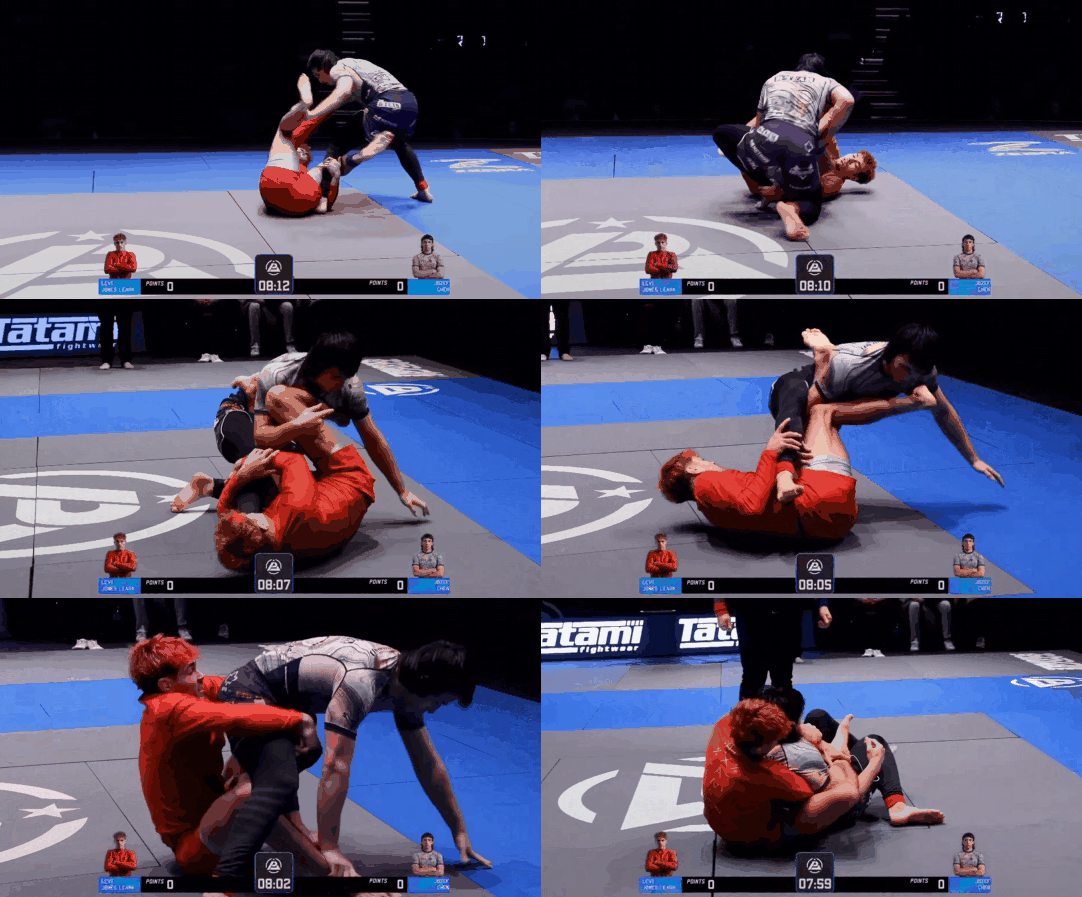
Fig. 10
But more commonly the match will end up in a “chop down” position. Figure 11 illustrates how this happens. Miyao has entered the K guard and pulled Formiga’s knee to his stomach (a). Miyao’s right leg can now swing over the top and chop down behind Formiga’s knee (b). Miyao reaches over with his right hand and pulls Formiga’s foot out in line with his knee, forcing Formiga to turn away (c) and placing Miyao into the calf slicer position (d). While it is rare to see a calf slicer finished as a submission at the highest levels, this position provides a straight shot at Formiga’s back which is, after all, what the Miyao brothers are all about.
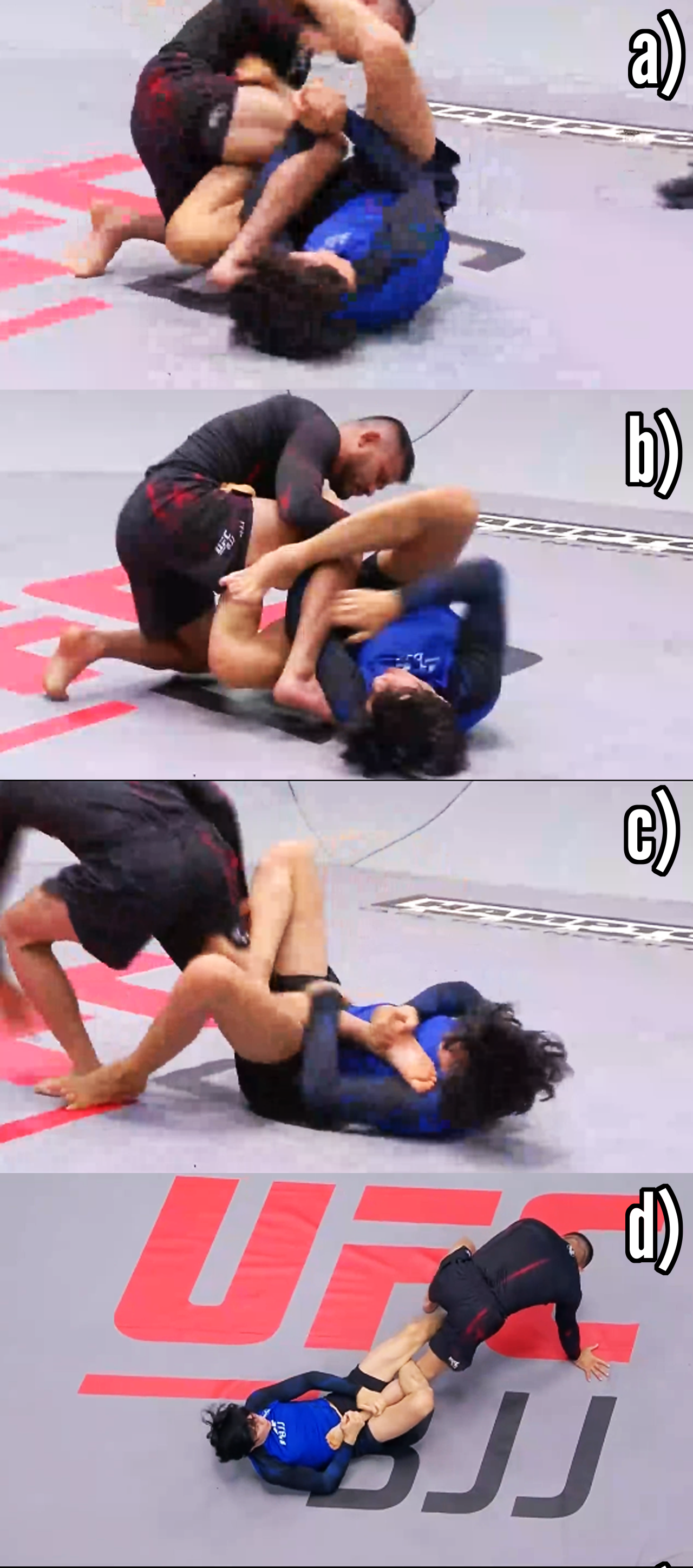
Fig. 11
More commonly, the opponent will sit to a hip, or backstep into 50/50. This brings us to a technique that the Miyaos were using to mess up the world’s best black belts in the early 2010s.
The Miyao Drag
The Miyao drag is a trick that I expected to stop working for the brothers as the world became enamored with leg locks. For a good while the Miyao brothers’ no-gi strategy was to force the 50/50 entanglement, pass their own leg to the other side, and crawl up on top of the opponent. The landing position is similar to a leg drag.
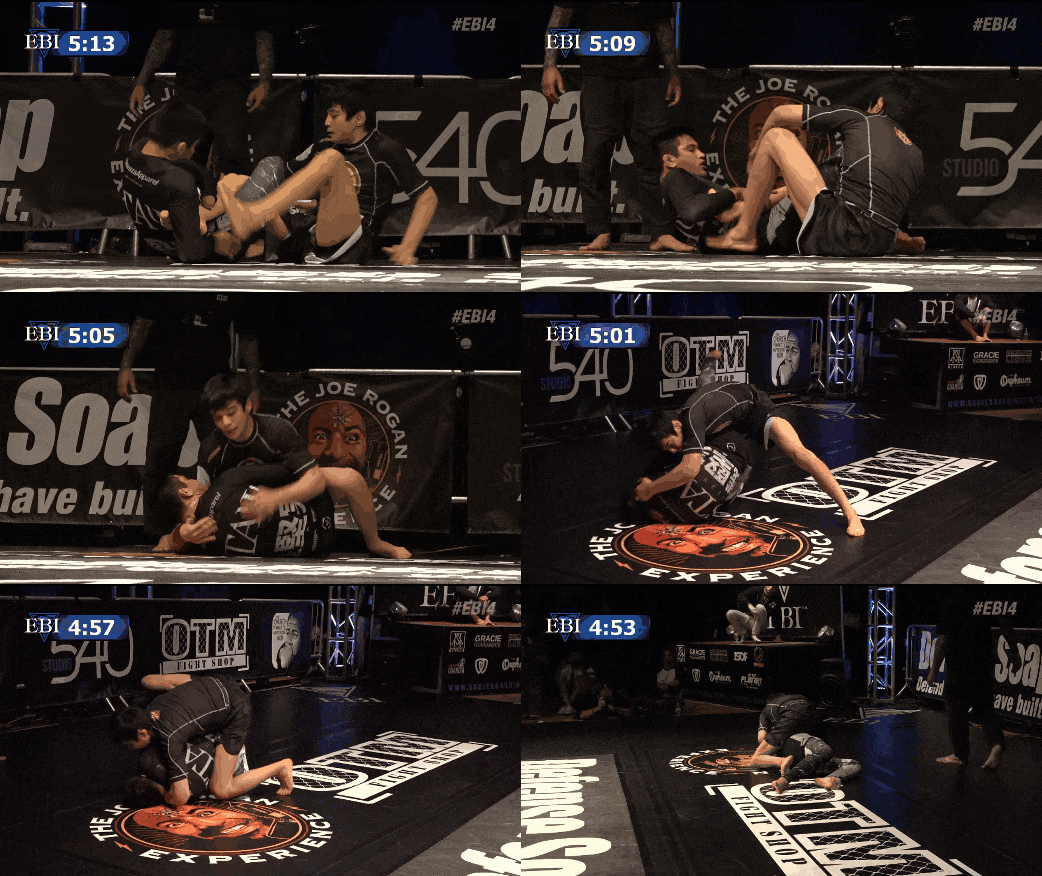
Fig. 12
In a true leg drag, you are shin stapling the opponent’s bottom leg to the mat. Notice in Figure 13, Gianni Grippo’s left foot is pressed into the floor, backstopping his opponent’s hamstring. His knee is between the opponent’s legs, but the rest of his body is behind the opponent.
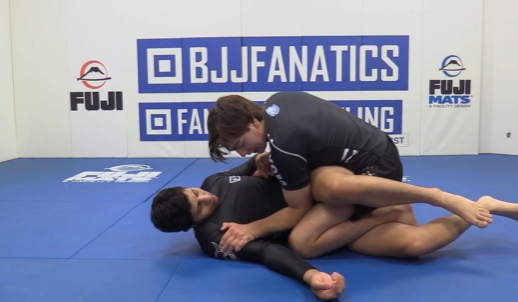
Fig. 13
In the Miyao drag, your knee is deep through their legs, on the mat.
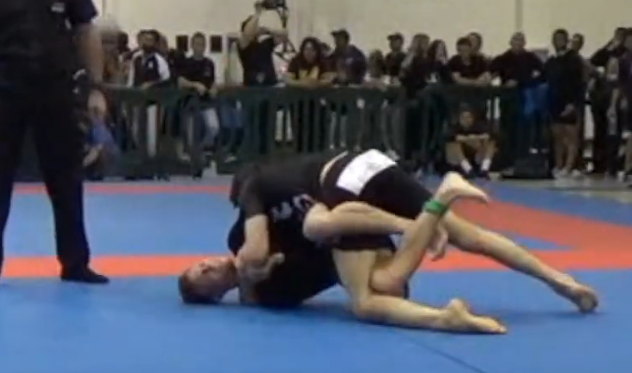
Fig. 14
It brings you hip to hip with the opponent and allows you to pull yourself into their upper body before you disentangle your legs and fall straight into side control.
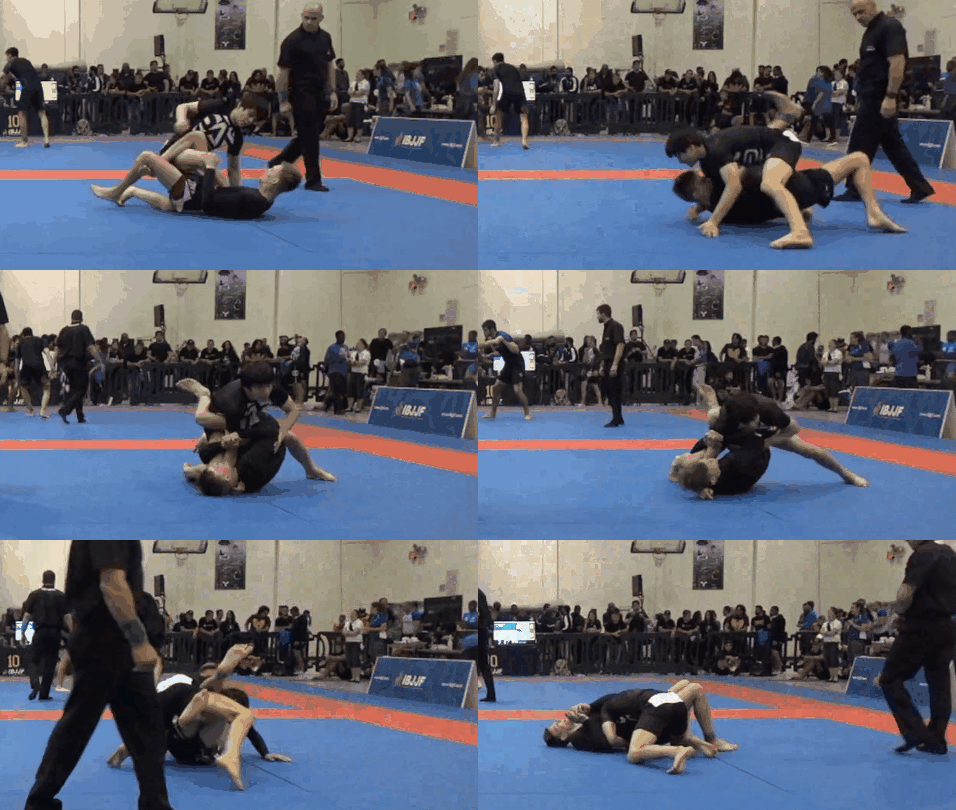
Fig. 15
Against Jussier Formiga, the Miyao drag was on full display and as powerful as ever. Figure 16 shows an example.
To avoid a back take from the K-guard / calf slicer, Formiga sits to a hip (a), and leaves his leg unweighted, on top of Miyao. Miyao passes the leg across his body (b) and comes up on top (c).
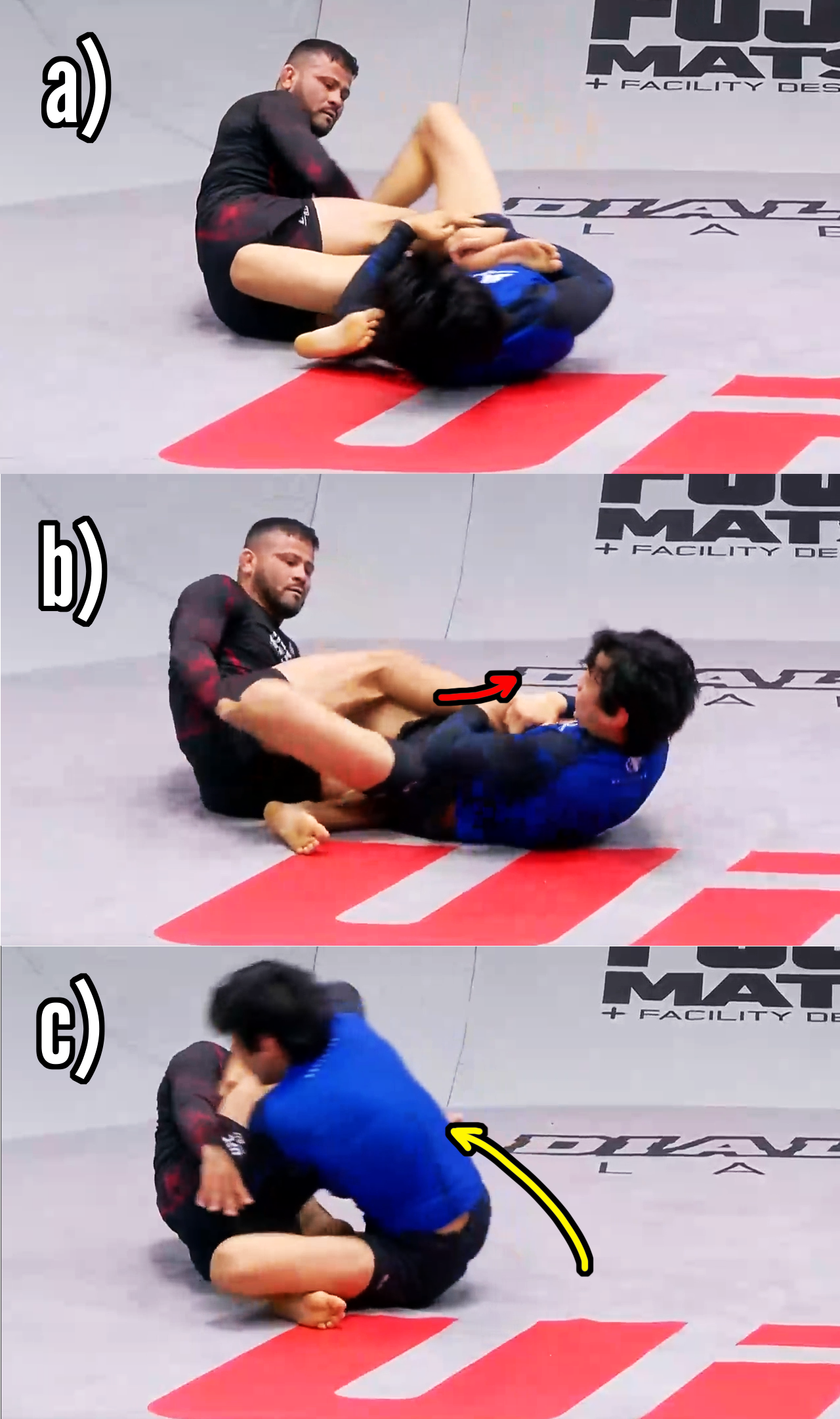
Fig. 16
Figure 17 continues the action. Formiga is able to keep his right foot on Miyao (d). Miyao drags the leg across and falls on top of the shoelaces of his right foot at the same time (e). Miyao drops his weight on Formiga and his knee goes from on top of Formiga’s biceps (f), to flat on the mat (g).
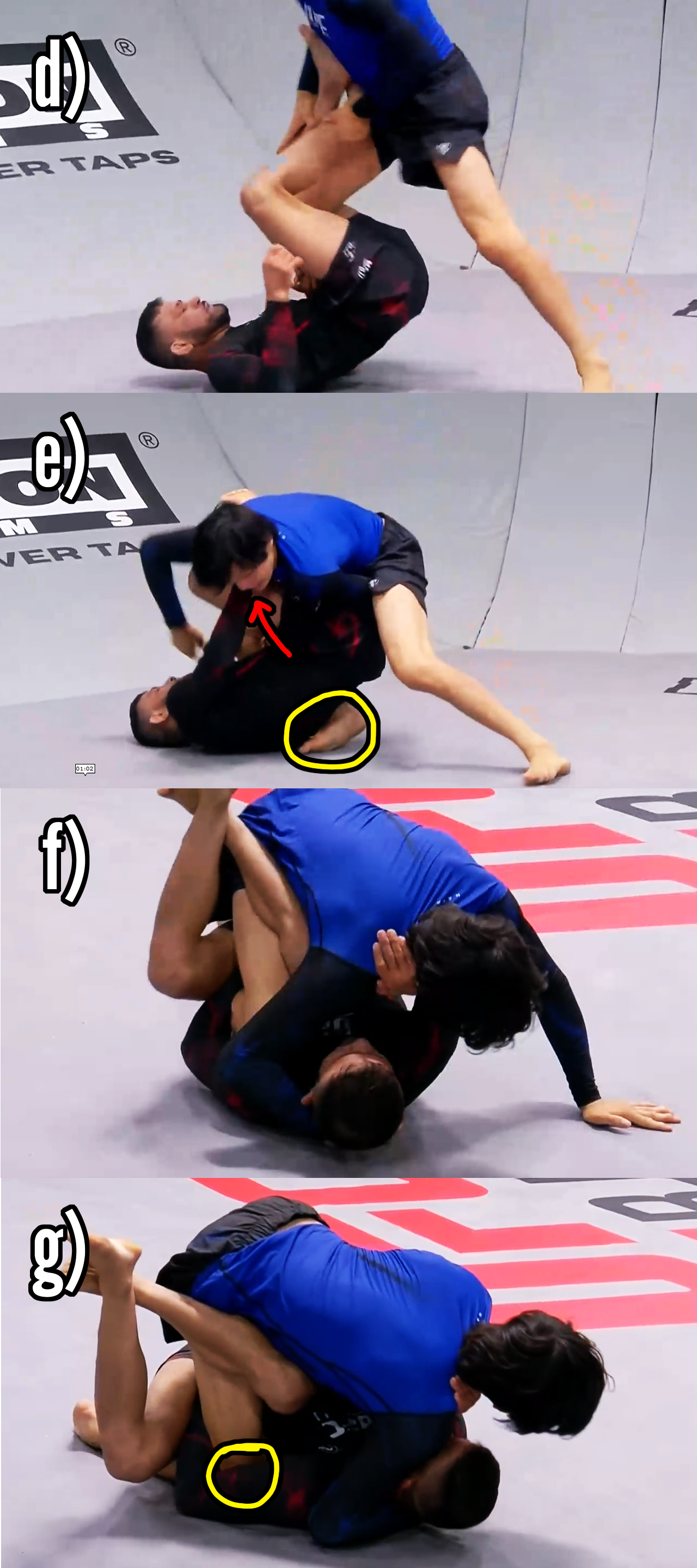
Fig. 17
Figure 18 shows a different instance from the same match. Notice that Miyao is passing to the other side. Opponents will often cross their ankles and keep Miyao’s leg as they try to work out where to go (f). Miyao windshield wipers his free leg on top (g), and kicks down to the mat (h).
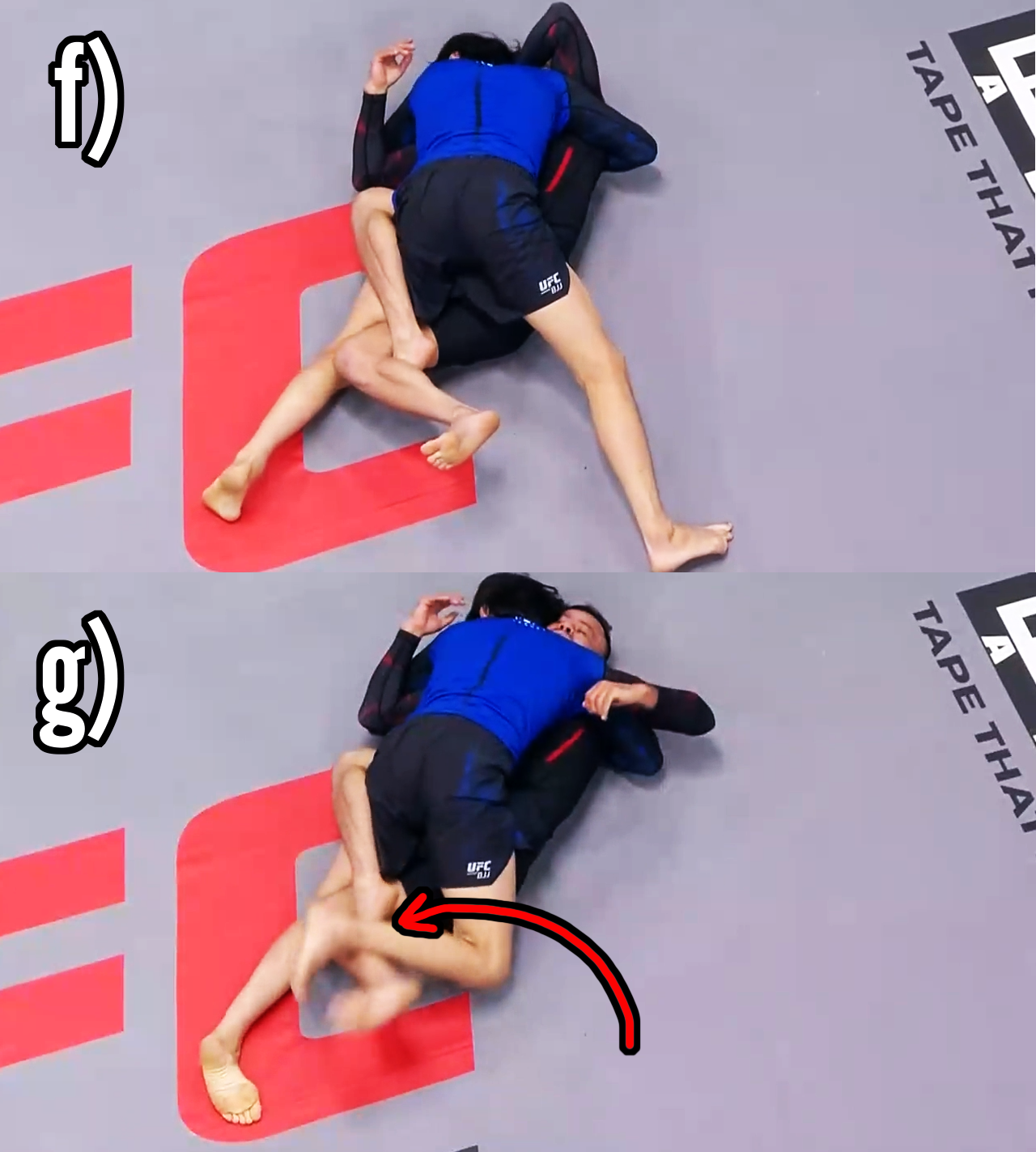
Fig. 18
Miyao cements the pass in Figure 19. With Formiga’s legs unlocked (h), Miyao is already chest-to-chest, and hip-to-hip. As Miyao brings his left knee out from between Formiga’s thighs (i), Formiga turns flat to the mat (j) and Miyao has landed in a strong side control.
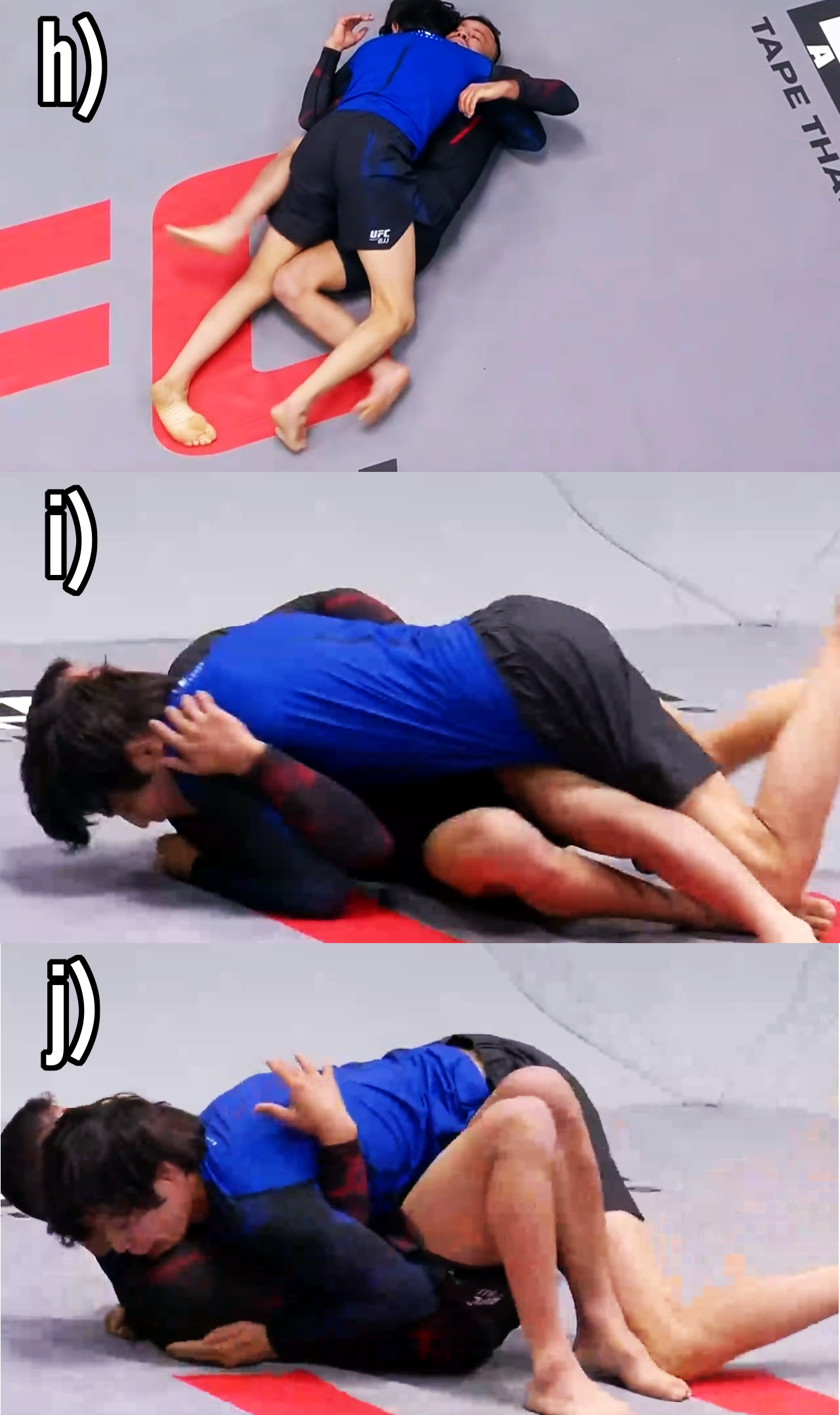
Fig. 19
Choi Bars / Reverse Reap
I mentioned that Jussier Formiga adopted traditional MMA fighter vs grappler tactics. Both leg locks and inversion back takes can be eliminated if the top player’s knees stay cemented to the mat. Traditionally it has then been that the jiujiteiro must use his closed guard attacks. And to be honest, trying to triangle choke a stocky MMA fighter is more likely to get your guard passed than finish the match.
Mikey Musumeci’s ONE Championship matches with Shinya Aoki and Jarred Brooks are good examples. Musumeci was able to get the K guard going on Aoki by leg pressing him off his knees, but he was forced to use climbing triangle attempts to eventually get Brooks.
One development that has really helped guard players is the Choi bar. This is a half guard armbar, where you essentially walk your way all the way around the opponent. Joao Miyao looked for the Choi bar constantly in his match with Formiga.
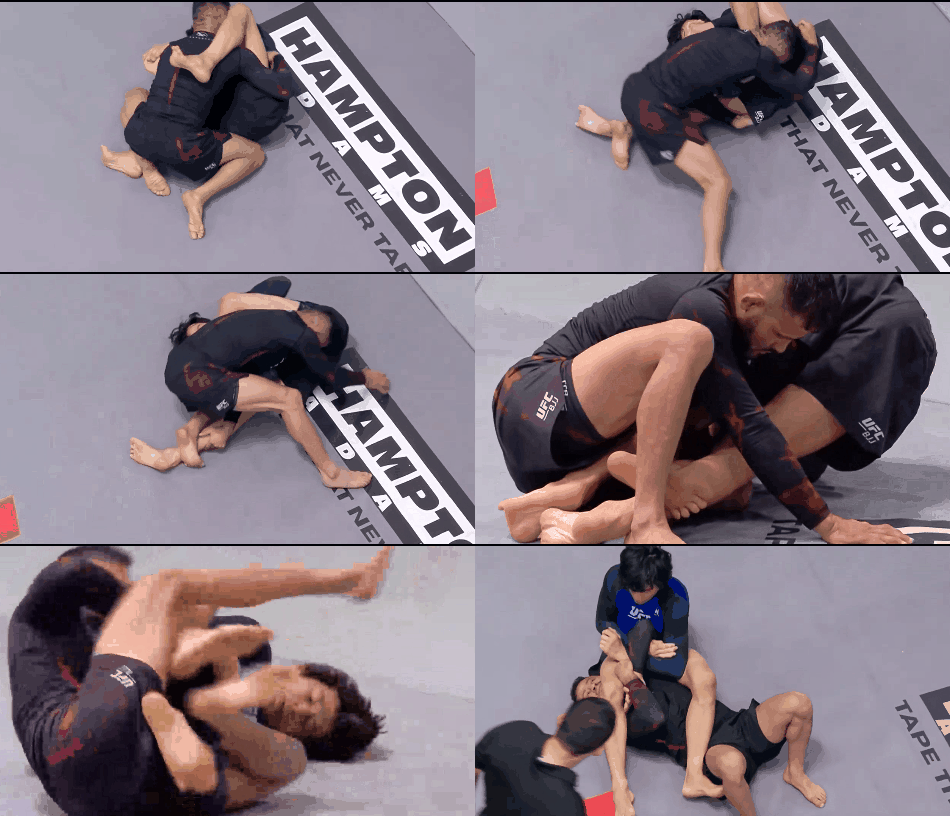
Fig. 20
Simply threatening the Choi bar often forces an opponent to posture, allowing the guard player to scoop grip a leg and threaten the K guard again.
Late in the Formiga match, Miyao made use of a thoroughly underrated technique called the “reverse reap.” This is closely linked with the K guard and the De La Riva—the outside position guards.
With a De La Riva hook, the bottom player underhooks the same leg, links his hands, and uses his knee to turn the opponent’s knee in while pulling the foot up to his shoulder. Here is Garry Tonon using it to look for leg entanglements against Dillon Danis.
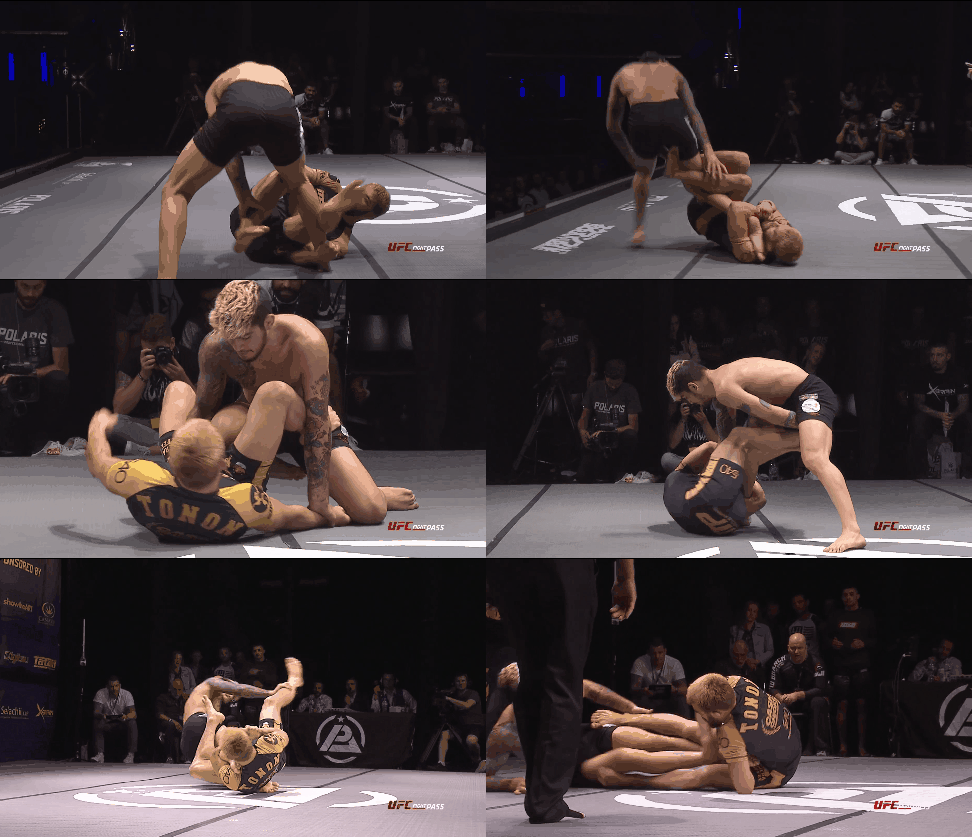
Fig. 21
In the late 2010s, through the age of Gordon Ryan, it seemed as though no gi grappling was becoming its own sport and art. Gi players were having to unlearn gi habits to succeed in no gi competition. Yet one of the themes in the last few years has been accomplished gi players trying to bang the square peg of gi technique through the round hole of no gi competition. Levi Jones Leary has perhaps the best guard in the world right now and he doesn’t go in for any of the “inside position”, “protect your legs”, “be ready to heist up to your feet at any time” rules.
I mention this because the reverse reap comes from gi competition. Caio Terra was using this to take backs in the 2010s and it was causing all kinds of debate regarding the rules against knee reaping.
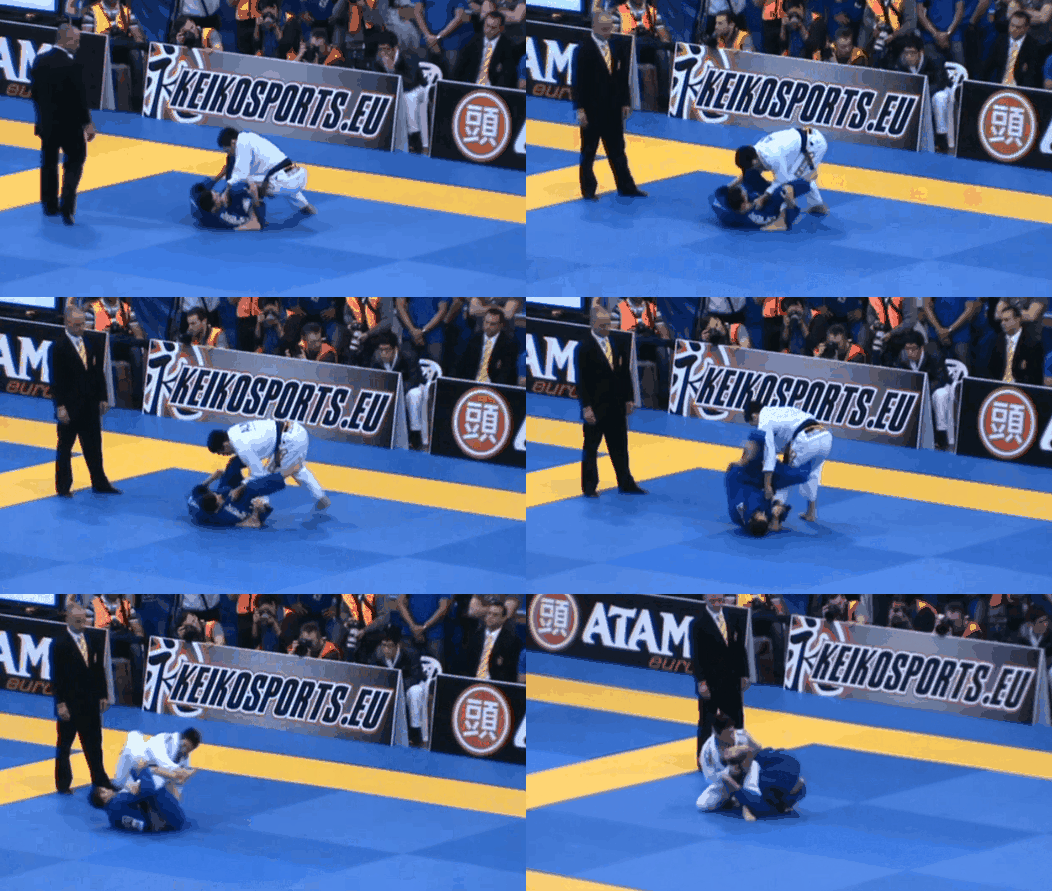
Fig. 22
The gold standard of illegal knee reaping is from a single leg x guard, throwing your leg across in front of the opponent and using your knee to buckle their knee in across their centreline. A great example would be the time that Jake Shields destroyed Cub Swanson’s knee and sidelined him for more than a year. Heel hooks were not legal under Quintet rules, but the lateral pressure of the reap alone was enough.
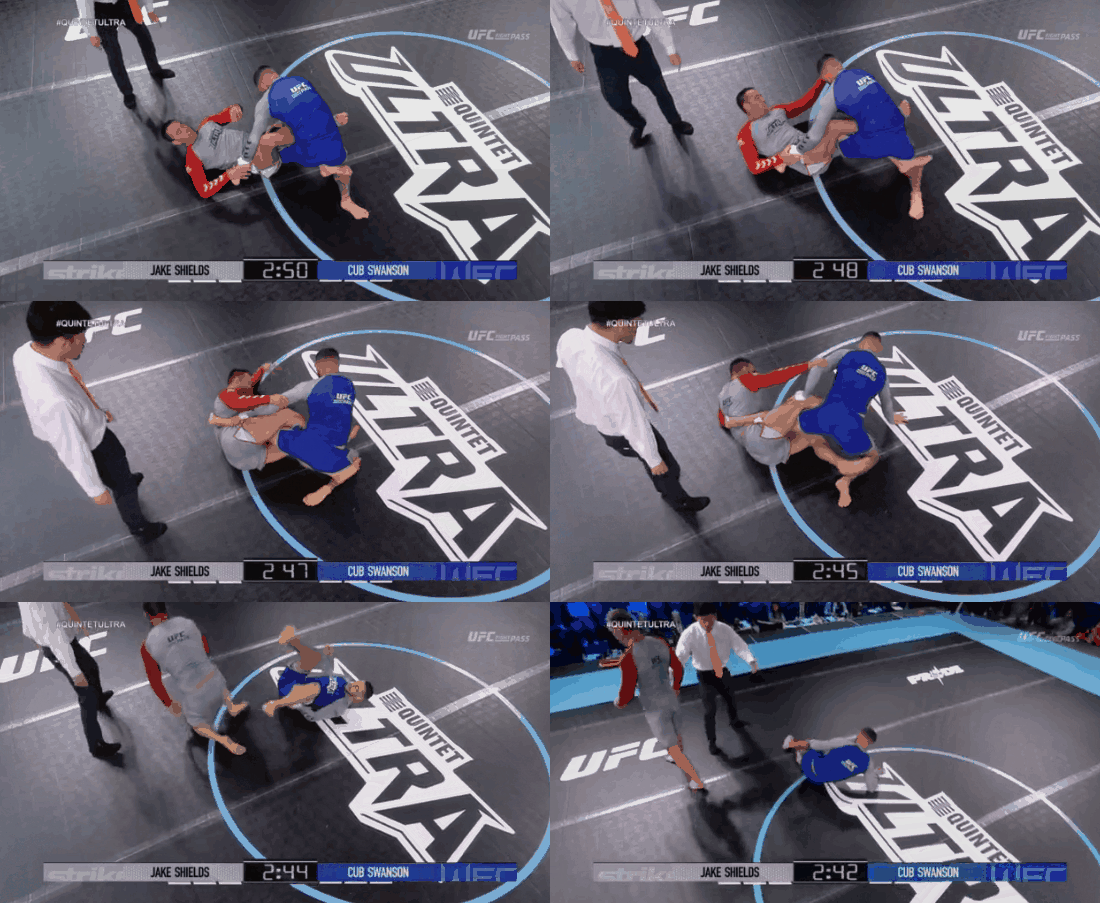
Fig. 23
Mechanically the reap and the reverse reap do the same thing: they force the knee inwards while keeping the foot outside the reaper’s body. The addition of the arms pulling in the reverse reap might even make it more dangerous. There was quite a bit of back and forth on this, some disqualifications, and Caio Terra and others stopped using the underhook De La Riva to reap the knee.
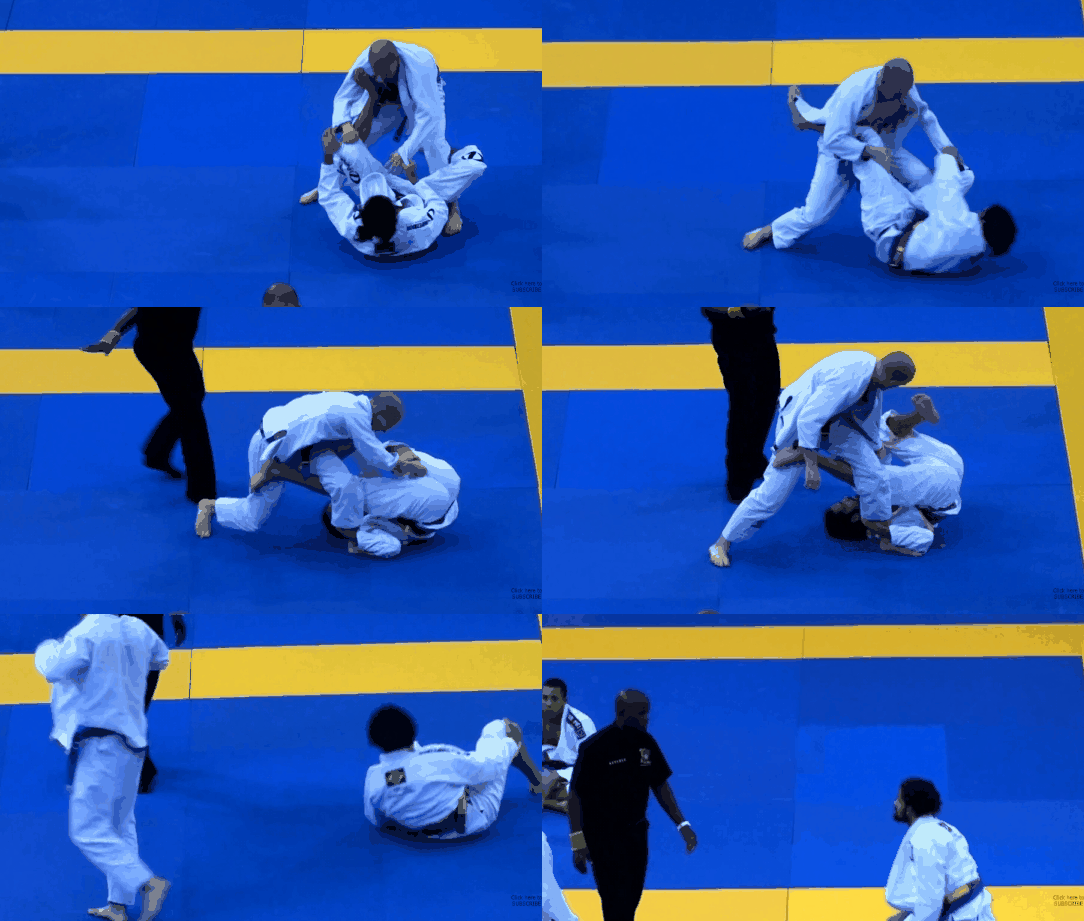
Fig. 24
But in a world where reaps are legal, the reverse reap can be explored again as a means to attack the back. Here Giancarlo Bodoni demonstrates a method of using the reverse reap to create back exposure, and then sitting up to grab the overback / octopus grip as a pitstop on the way to take the back.
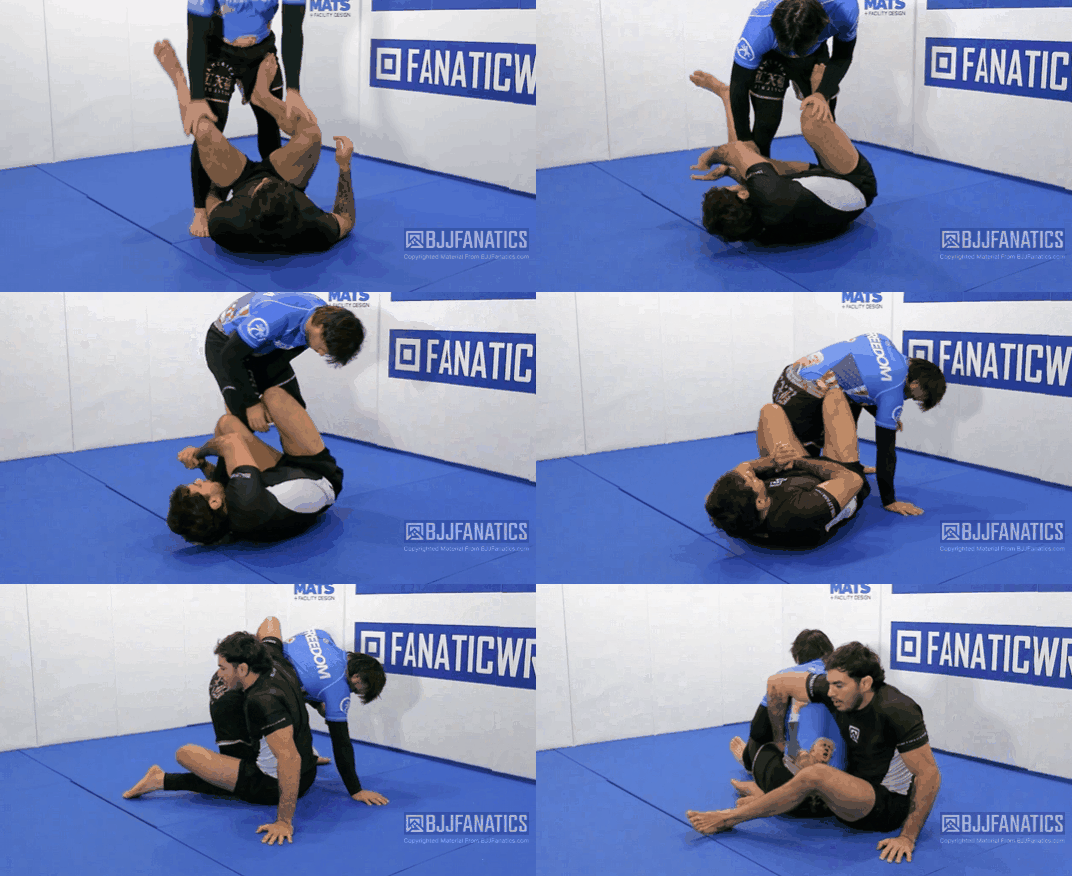
Fig. 25
Figure 26 unfolded late in the match. Formiga brings a knee up into combat base and Miyao wedges in his De La Riva hook with his left foot (a). Miyao checks Formiga’s knee with his right hand (b), as he punches his left hand inside Formiga’s ankle, before locking his hands to create the reverse reap (c).
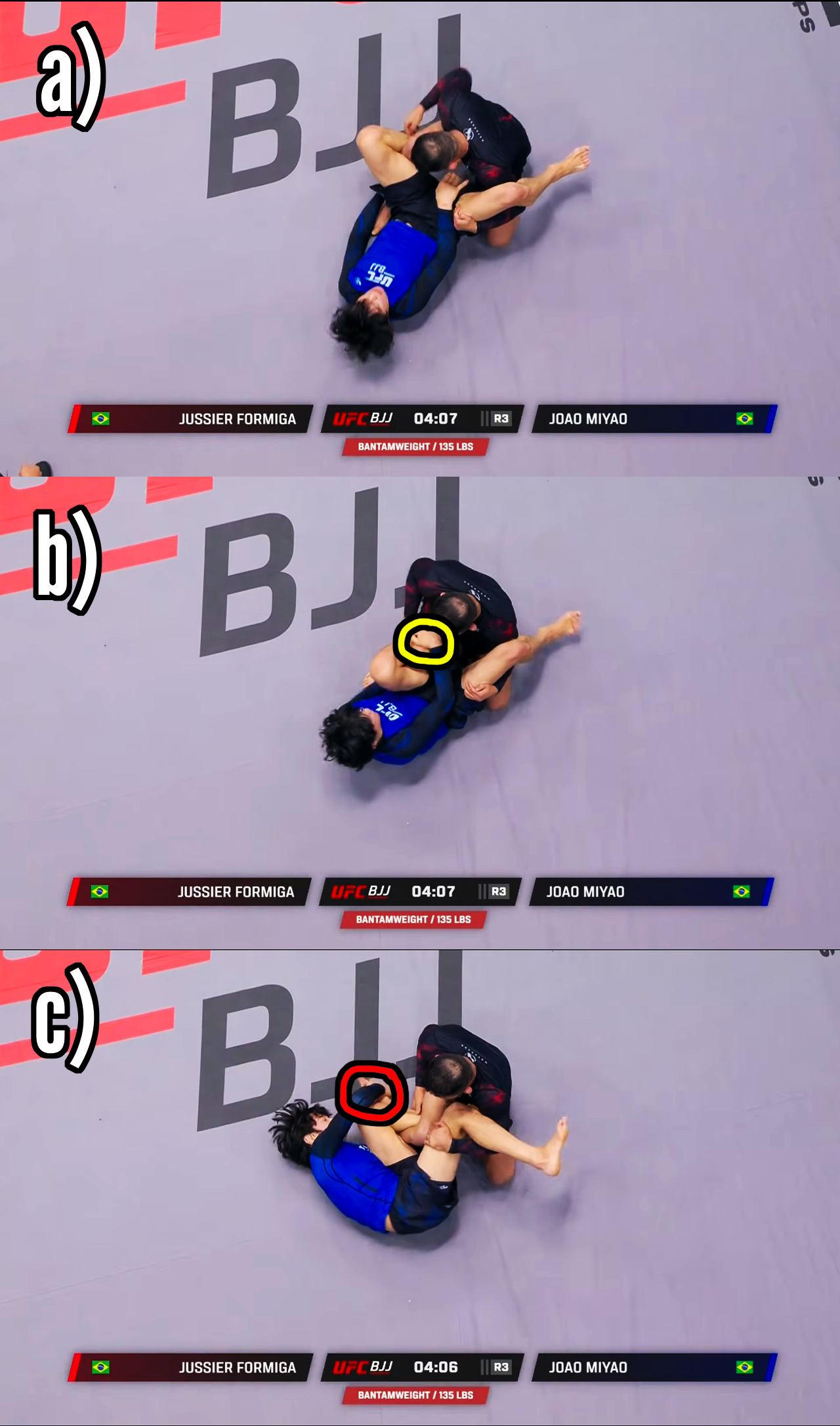
Fig. 26
Miyao brings his right knee above Formiga’s and pinches his knees together, preventing Formiga from turning his knee out (d). Mikey Musumeci often describes this as “cutting off” the opponent’s leg in pursuit of their back. Miyao can now sit into Formiga and take the overback / octopus grip (e). Rather than allowing Miyao to scoot around onto his back unimpeded, Formiga opts to fall to the bottom (f), and Miyao follows to take top position (g).
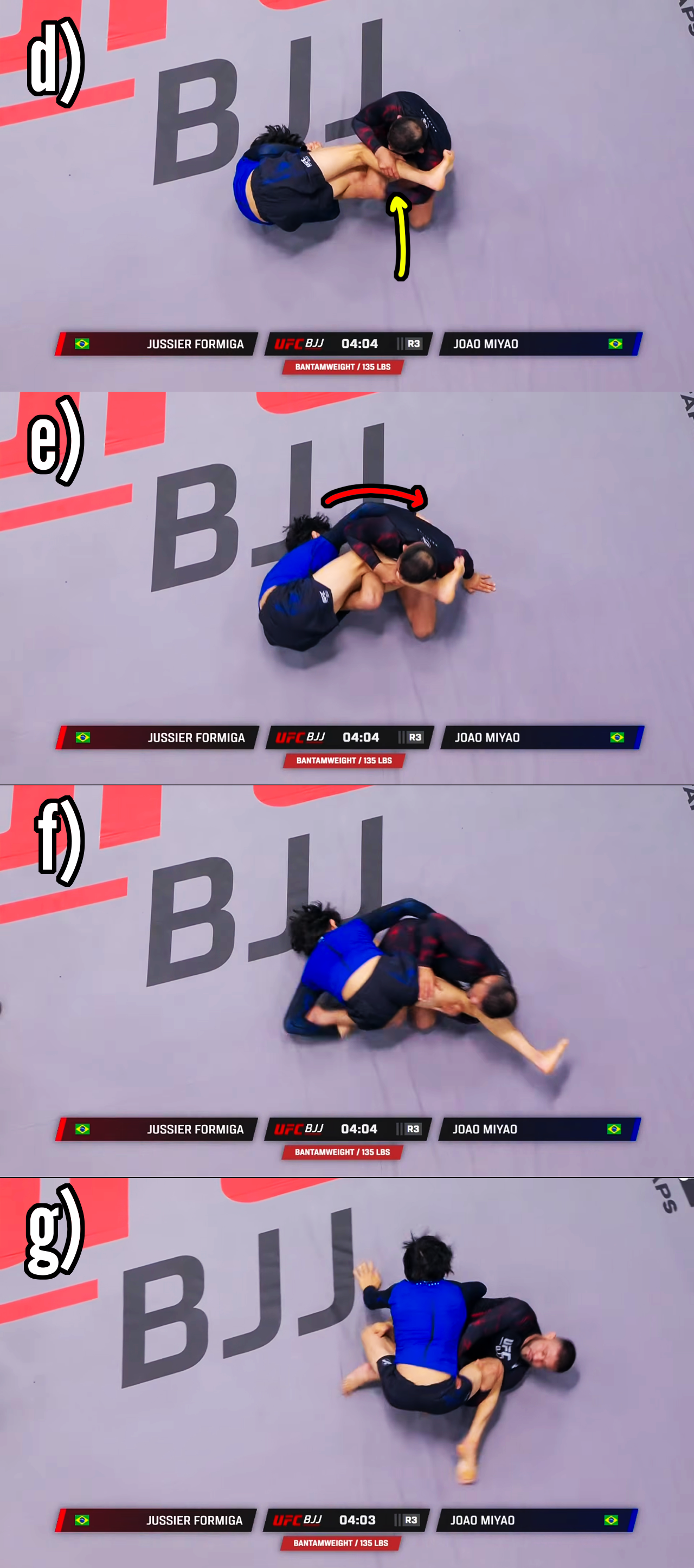
Fig. 27
It is a beautiful sequence and it all happened so quickly that it benefits from a frame-by-frame examination.
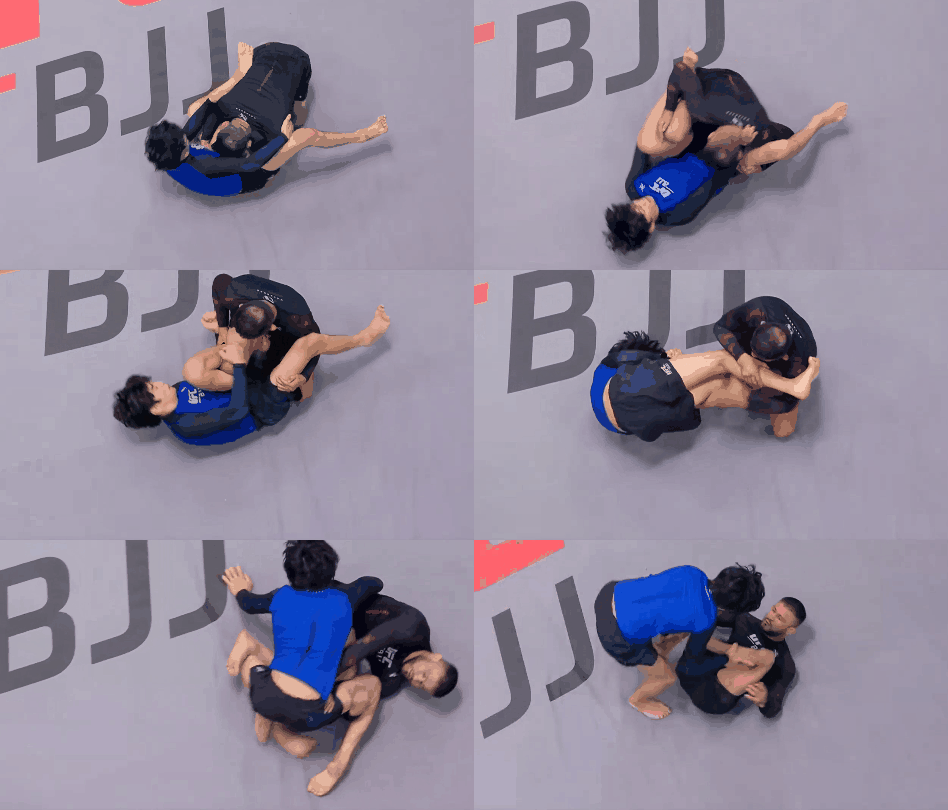
Fig. 28
While we are honouring Joao Miyao, the elder statesman, it is important to note that Jussier Formiga is forty years old and Miyao is just thirty four! Formiga’s body has undoubtedly seen a lot of hardship in an MMA career that spanned almost twenty years, but it is Miyao who seems to have been made prematurely elderly by his occupation.
While we were living through it, it became cliche to note that the Miyao brothers would not have a happy later life if they kept eating kneebars and toe holds and refusing to tap out. Even inverting under the weight of an opponent is not a particularly healthy practice for your spine. It was assumed that the Miyaos would fly high and burn out quickly. Maybe they would become legends in the process.
Yet there is something invigorating about Joao Miyao. He shares his injuries on his rather funny instagram account, but there is not even a whiff of “poor me.” He has achieved some of the highest highs in jiu jitsu and his body is a wreck as a result. But it wasn’t a straight trade or a Faustian bargain. He could live comfortably off coaching and seminars but he is still out there on the competition mats every month, having the time of his life in the masters division.
Joao Miyao’s exploration of the baratoplata and use of it in every tournament has become a fascinating sideplot in grappling forums. In anyone’s book, Joao Miyao has mastered jiu jitsu, and as an athlete he is far beyond his best days. And yet he is still inventing new ways to score submissions with bizarre moves.
Like many others at the time, I was guilty of looking at the child prodigies spinning on their heads and deathgripping their opponents’ gi pants, and thinking it was stupid and not what jiu jitsu was supposed to be. Now that Joao Miyao and I are both old men—in the grappling world at least—I want to declare wholeheartedly that we should all be a bit more like Joao.