
Ian Garry’s Masterclass:
Disarming the Division’s Most Dangerous Striker
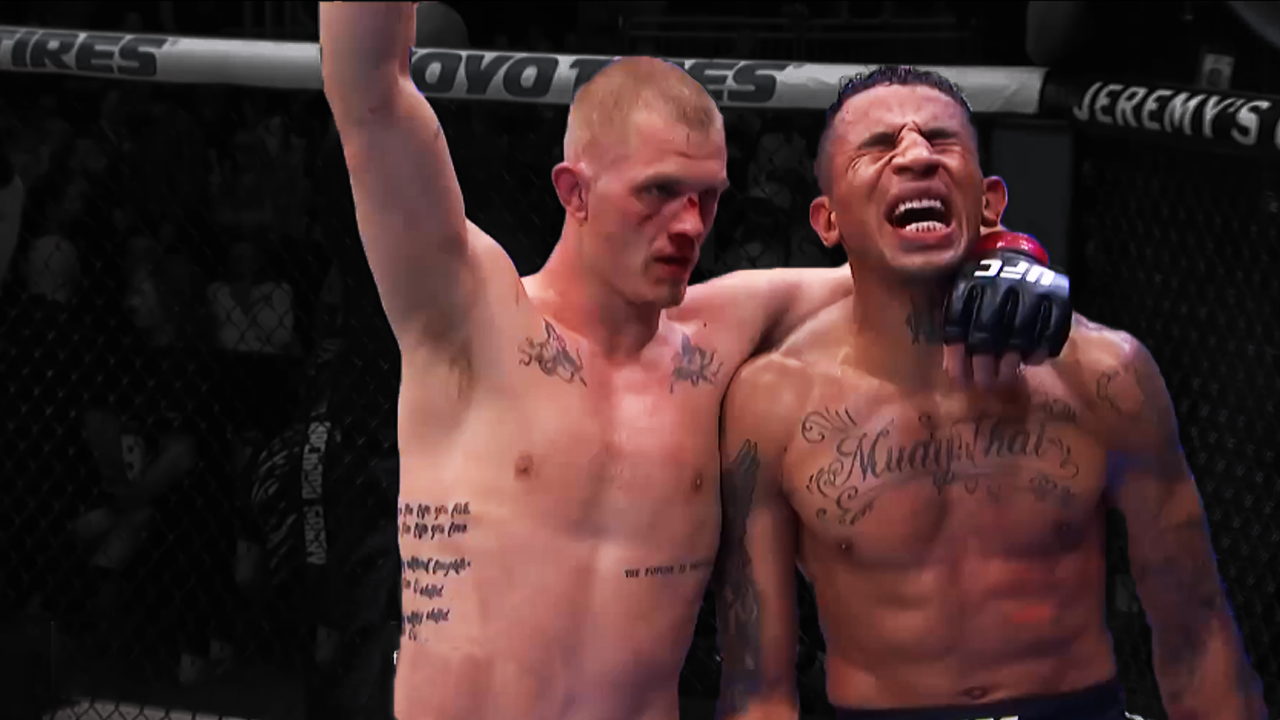
Few victories have aged as well as Ian Machado Garry’s five round decision over Carlos Prates in 2025. The disappointment of a brutal case of hype derailment often leaves fans and pundits searching backwards for the evidence that the beaten fighter was not that good in the first place. Yet Prates kept on winning and doing so against better fighters than he had met to that point, in an even more devastating fashion. In his last two fights, Prates brutally knocked out two former UFC welterweight champions, with the second knockout coming against the only recently dethroned, Jack Della Madalena. Prates stopped the slick JDM for the first time since 2016.
The fact that Ian Garry dismantled Prates so thoroughly for twenty-two minutes of their twenty-five minute fight, and did so on short notice, is tough to reckon with. Garry always looks tricky, and adaptable, but he has never looked like a world beater. His victory over Prates was a masterclass that played out in lateral and vertical movement, in striking and in grappling, and was the kind of performance that left fans so bewildered that many wish to believe it was some kind of fluke. Even if Prates fought Garry ten more times and knocked him out in each, Garry’s gameplan in the first fight was sensational and should be studied by MMA coaches and fighters for years to come.
Kick and Move
Garry’s gameplan hinged heavily around two kicks: primarily the high kick, helped along by the occasional oblique kick / chasse. Through the first four rounds, Garry’s right high kick was a constant presence and served to keep Prates’ vaunted left hand at home. While ideally you block kicks with two hands, the arm on the side of the kick is the barrier against a kick you see too late. In an open stance match up this is especially true because the fighter cannot turn his back to the kick and sneak his head down below his shoulder line to avoid a high kick at the last second.
One of the clever choices that Garry made with his high kick was to throw it up off failed shots, on the end of exchanges, or even off a level change right hand, because these were unusual times to throw the high kick. Had he simply thrown it from directly in front of Prates for four rounds, Prates might have found his confidence much quicker.
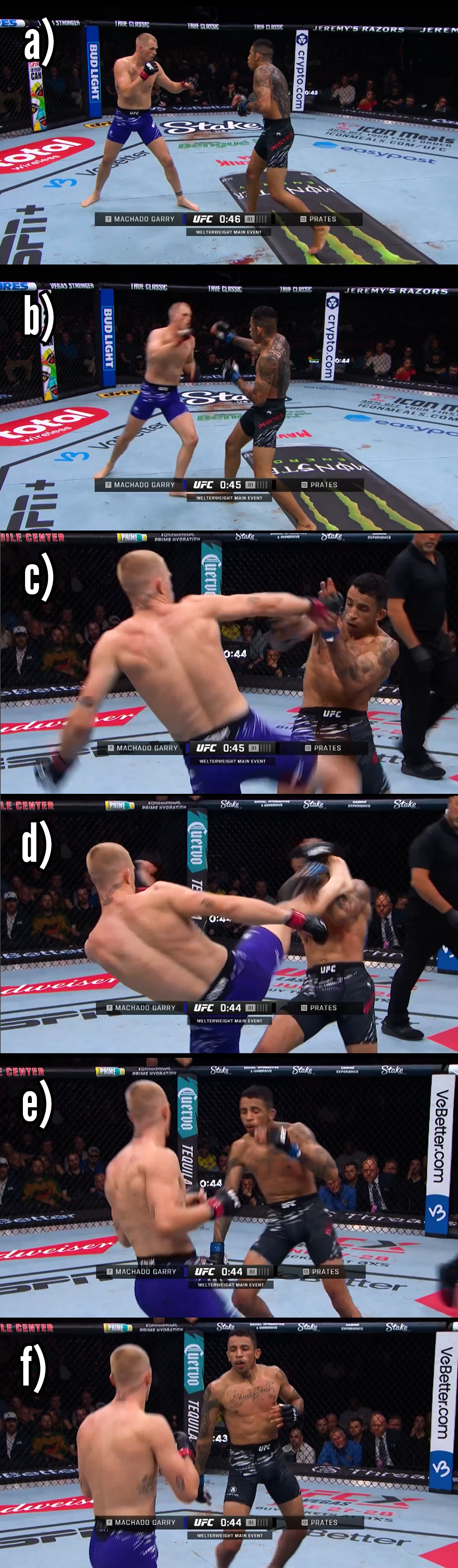
Fig. 1
While this “keeping the hand at home” is an attack on the opponent’s mind, a good high kick has the added benefit of pushing the opponent off balance and breaking their base. That can be used to step in with follow up attacks in some instances, but for a fighter attempting to operate a mobile, outfighting gameplan this gives the chance to recover the kicking leg and begin circling off while the opponent is forced to recover their balance. Figure 1 shows Prates stumbling out of his stance and having to catch himself before he can take control of his footwork again.
This links with the second kick that Garry used: the oblique kick to the lead leg or the chasse. When I began writing, this was the new move that fighters and fans were trying to get banned. In time it proved to be neither game breaking nor especially knee breaking once fighters were familiar with the kick. What it does provide is a check on pressure, and the kick works better the more the opponent pushes into you. In the Prates fight and against Belal Muhammad, Garry used a piston of an oblique kick to send his opponent’s hips flying back and give himself a bit of breathing room.
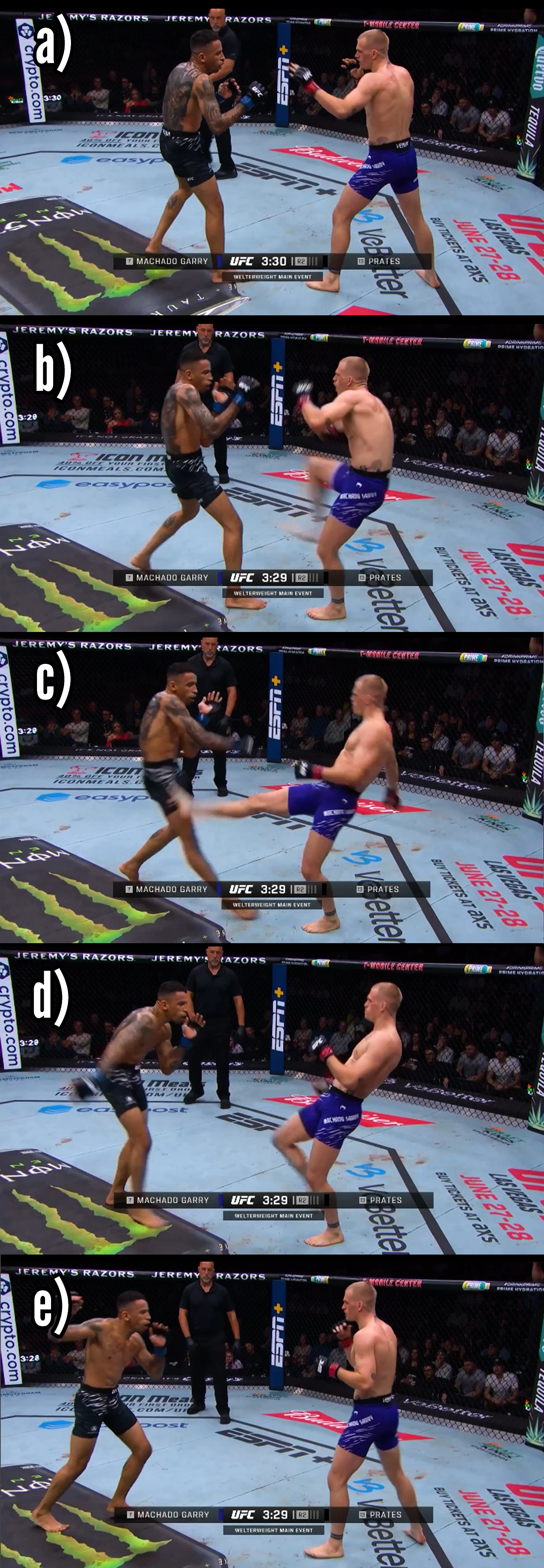
Fig. 2
Rather than any tactical decision, it is worth pausing to note the mechanics of Garry’s kicks. It is noticeable that Ian Garry retracts his kicks extremely quickly. Just as with punching, it takes discipline and a lot of practice to not begin exaggerating the hurting part of the punch and getting lazy with the recovery portion. That is obviously made worse by hurling the weight of one leg, while standing only on the other. When Garry kicked, his right leg snapped back to the ground before Prates could recover his position and he was on the move before Prates could begin a counter.
Often with his high kick, Garry would use the trick that Yuki Yoza does with his low kicks, turning the toes upwards after connecting so that the foot can be hamstring curled back and pulled straight down instead of arcing lazily back to stance.
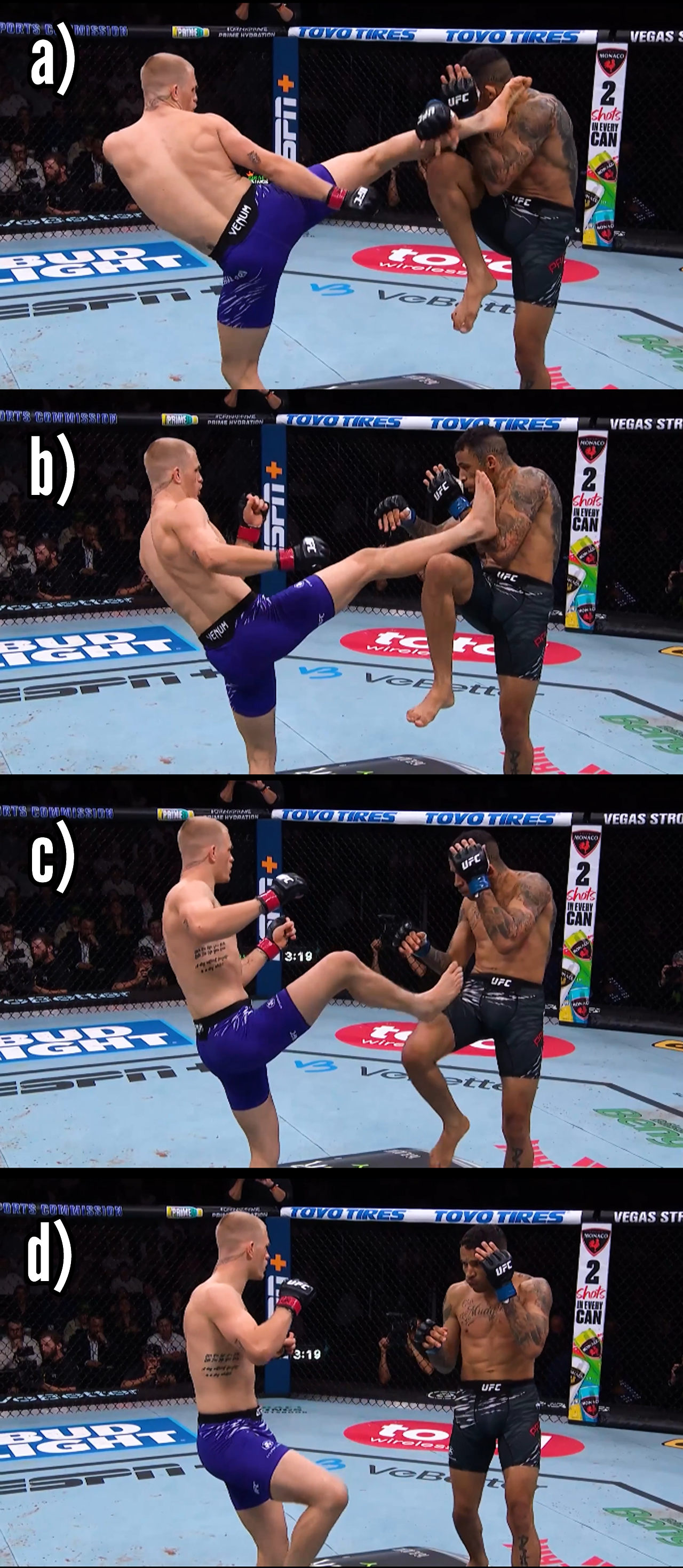
Fig. 3
Building off the Jab
These two kicks facilitated the mobile gameplan that Garry used to stay out of bad spots and beat Prates to the punch out in the open mat. It seemed telling that Carlos Prates had experienced so much success handfighting his opponents until he met Garry, who forced him to abandon it at many points out of frustration.
Much of Garry’s success was built on a jab as he slid down the outside of Prates’ lead foot. We are here calling this a “jab”, but because Garry always raised his elbow and arced the blow in from the side slightly, you might call it a hook. It simply lacks all the power and bodyweight that a hook traditionally carries, and extends towards the opponent rather than cutting through them from one side to the other. Bruce Lee described this sort of punch in The Tao of Jeet Kune Do as a “corkscrew hook.”
In footwork this blow was akin to the “safety lead” Edwin Haislet described, but that punch is typically used in a closed stance match up to draw and counter the opponent’s right hand, in this open stance match up Garry stepped to the outside angle and faced no further threat from Prates’ right side.
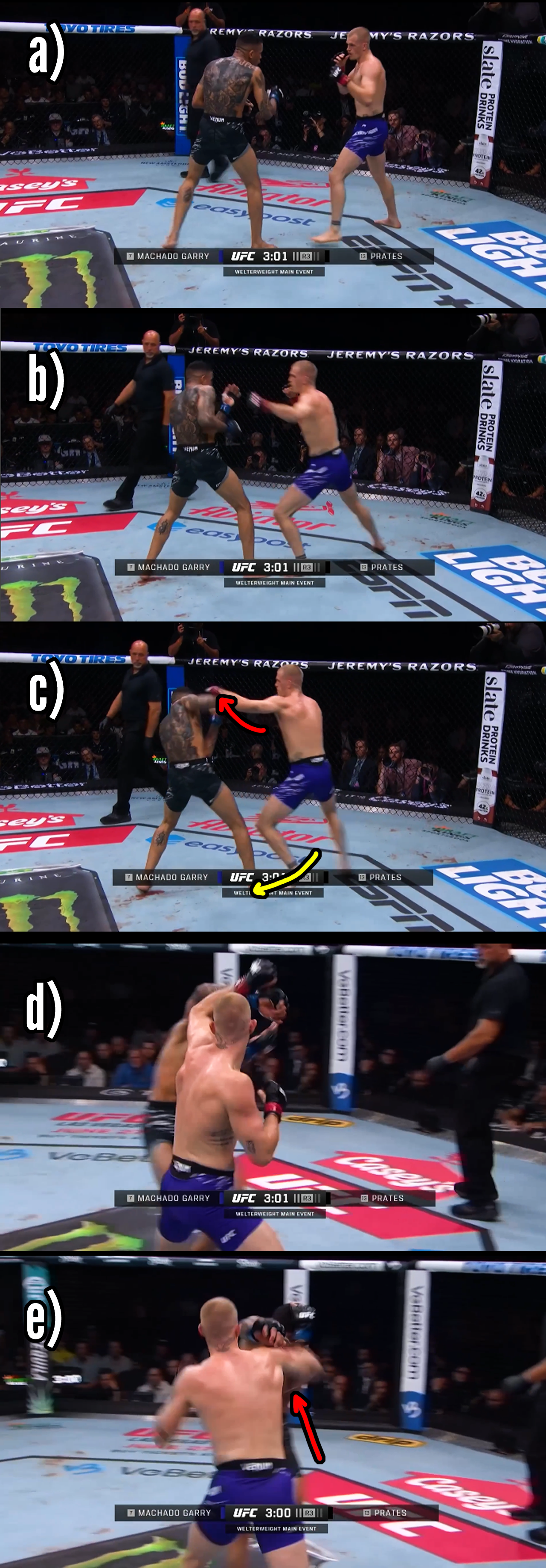
Fig. 4
The example in Figure 4 is made even better by the change of camera angle from frame c) to frame d). Here you can see how Garry has established outside foot position and can throw his right straight more neatly down Prates’ centreline by matching that centreline up with his right shoulder.
This outside angle jab also took Garry away from the side of Prates’ stance where all his best weapons originate. By stepping left with the jab whenever Prates engaged, Garry had a great chance of escaping unscathed. More than that, Garry used this outside stepping jab as a direct counter for Prates’ left knee and left kick.
Prates’ knee was a more versatile weapon against Jack Della Madalena because JDM fights hunched, is shorter than Prates, and level changes a lot in the course of his striking but offers little takedown threat. Any time Prates threw it, JDM was in danger. Garry was beautifully upright through his fight with Prates, looking as much like a sketch from a fencing manual as he did an MMA fighter. So Prates only attempted to knee when Garry was at the fence, and mostly after he had initiated the handfight. This gave Garry a good read on when it was coming.
When Prates stepped to commit to his knee, Garry could slide down the side and pop him with the jab for free. This worked out the same as Robert Whittaker sliding down the inside of Nikita Krylov’s left kicks at UFC 329. In one instance in the first round, Garry was able to bundle Prates off his feet and accumulate a little time on top without the hard work of securing a takedown.
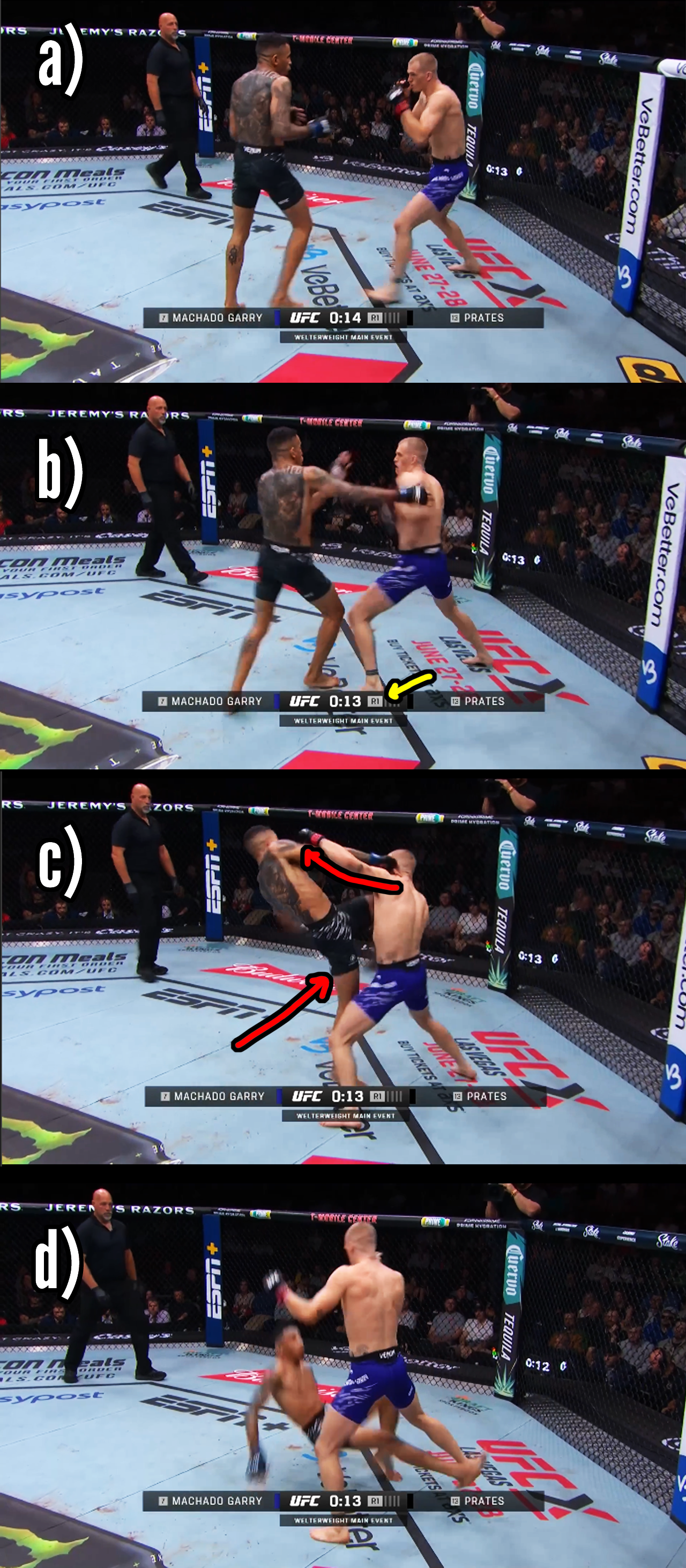
Fig. 5
Another great example came in round four, where Garry was able to angle out and then completely one-eighty Prates, putting Prates’ back on the fence.
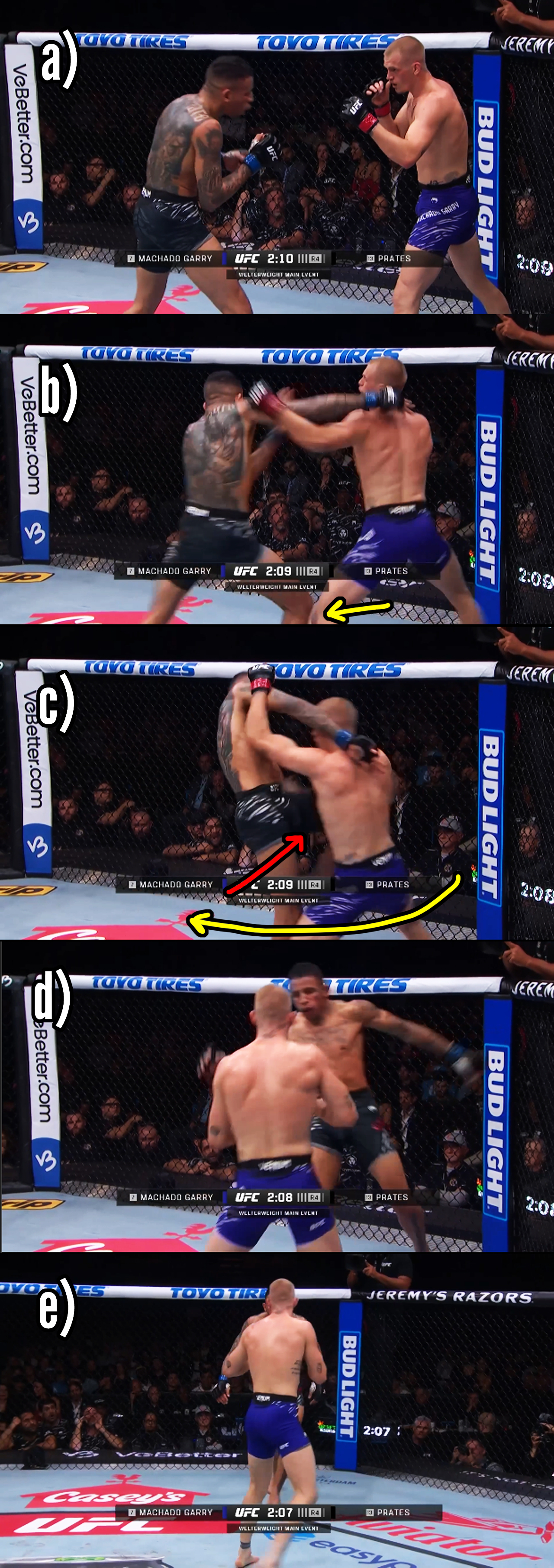
Fig. 6
In an open stance jabbing battle, the lead hand of the opponent is often obstructing the line of the jab. Through handfighting, outside steps, and inside steps, a fighter can shoot his jab around the line that the opponent’s lead hand is occupying. Garry paired this outside stepping jab with an inside stepping jab, stepping his foot to the inside of Prates’ and shooting his jab up the inside of Prates’ lead hand. This worked especially well when Prates was reaching to begin the handfight, fresh off a reset of position. Figure 7 shows Prates advancing into the handfight and taking outside foot position himself, and Garry responding with a stiff jab on the snoot and a two-footed bounce back out of range.
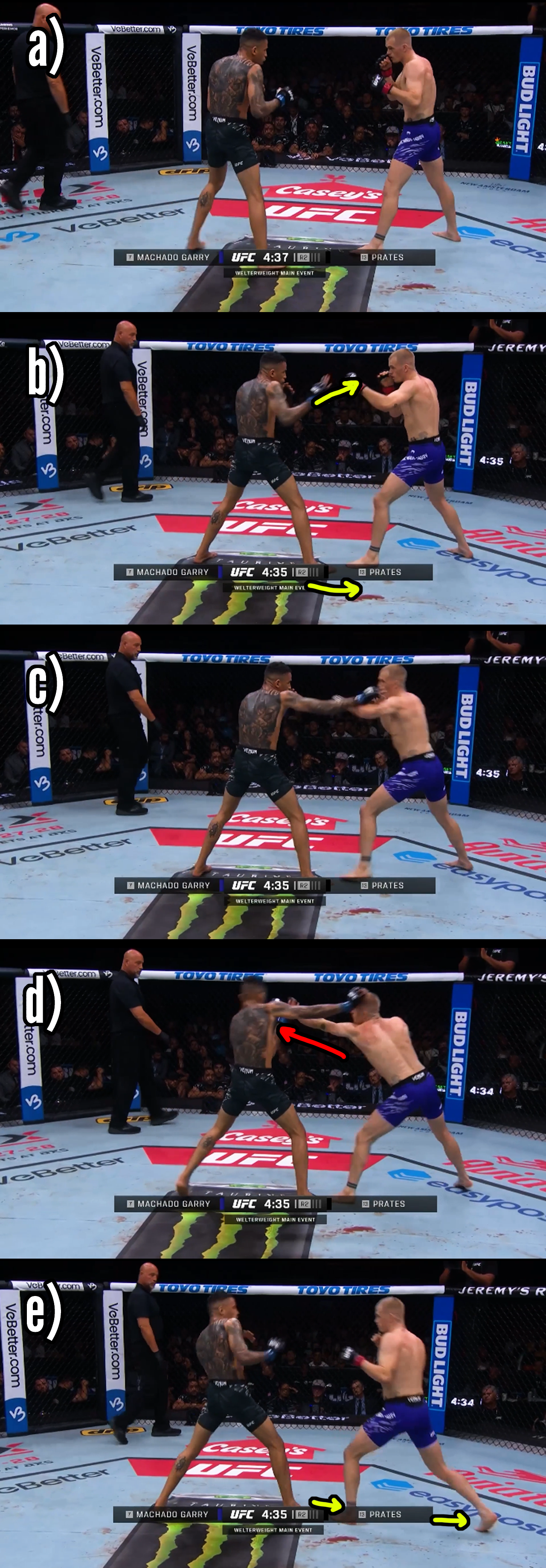
Fig. 7
Prates became so vexed by being unable to suppress Garry’s lead hand that he often dropped his lead hand below the handfight. This is a less-than-ideal habit that Alex Pereira has demonstrated several times in important fights. Both Pereira and Prates found themselves losing the handfight while trying to walk the opponent down. The solution of dropping the lead hand gives a fighter the occasional element of surprise, jabbing up from underneath the opponent, but mostly serves to remove his defensive tools. The purpose of handfighting aggressively is to suppress the opponent and bully them to begin with.
The upjab is always popular in an open stance match up, and Garry found good success with both this and the left uppercut proper. Figure 8 shows Garry using the handfight to sneak in an upjab to high kick. At many points in the fight Garry held his lead hand extended (a), asking Prates to engage him in the handfight. As Prates covered Garry’s lead hand (c), Garry dropped it (d) and came up with an upjab (e).
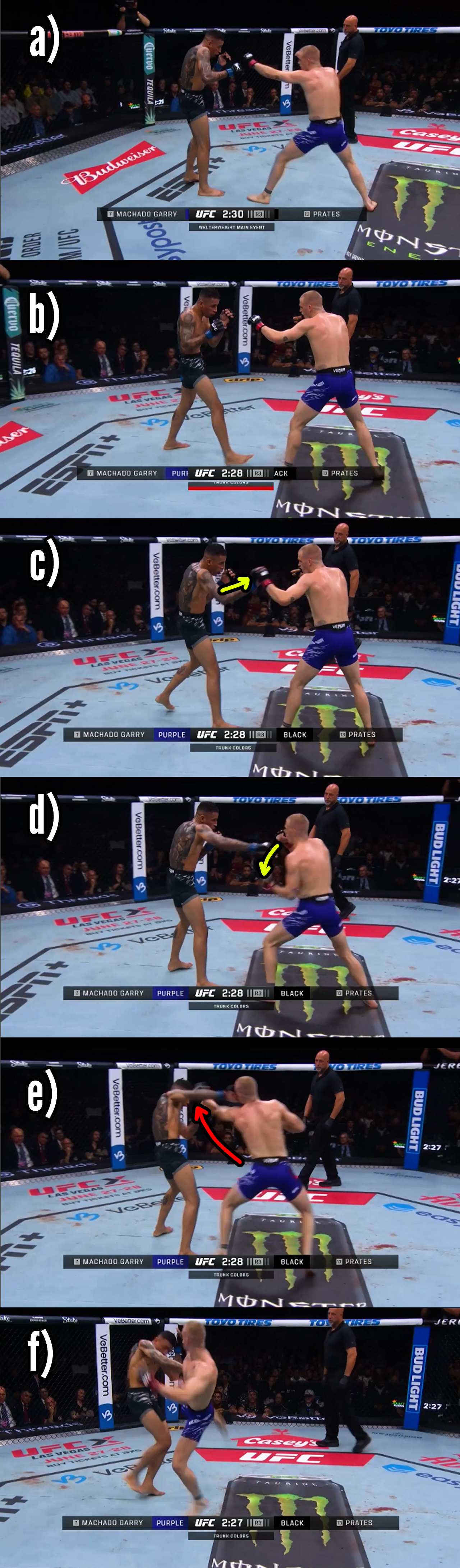
Fig. 8
The handfight is proactive / pre-emptive defence. After abandoning it, Prates often found himself adopting a high guard and a static long guard, which allowed Garry to get creative with the left uppercut—one of the trickiest punches in the boxing arsenal. But first we must look at the other constant check on Prates’ aggression: the level change.
Winning on the Y Axis
Garry is not the kind of wrestler who can routinely power through a fighter of Prates’ level off a loose leg grab, but if he got in on an entry while Prates was busy swinging, Prates would be in real trouble. Like feinting on the feet, there is a fine balance to be struck in using takedown attempts to further your striking. You do not want to commit to the leg and get drawn into a two minute clinch grind in the middle of your striking gameplan, or get sprawled out under the opponent. On the other hand, you don’t want to be slapping their thigh and getting absolutely no reaction.
Garry found the balance by making a good faith effort on the takedown: the kind that would have yielded quick results had he timed it well enough, and then quickly broke away with a knee or a high kick if he could not convert the attempt into top position.
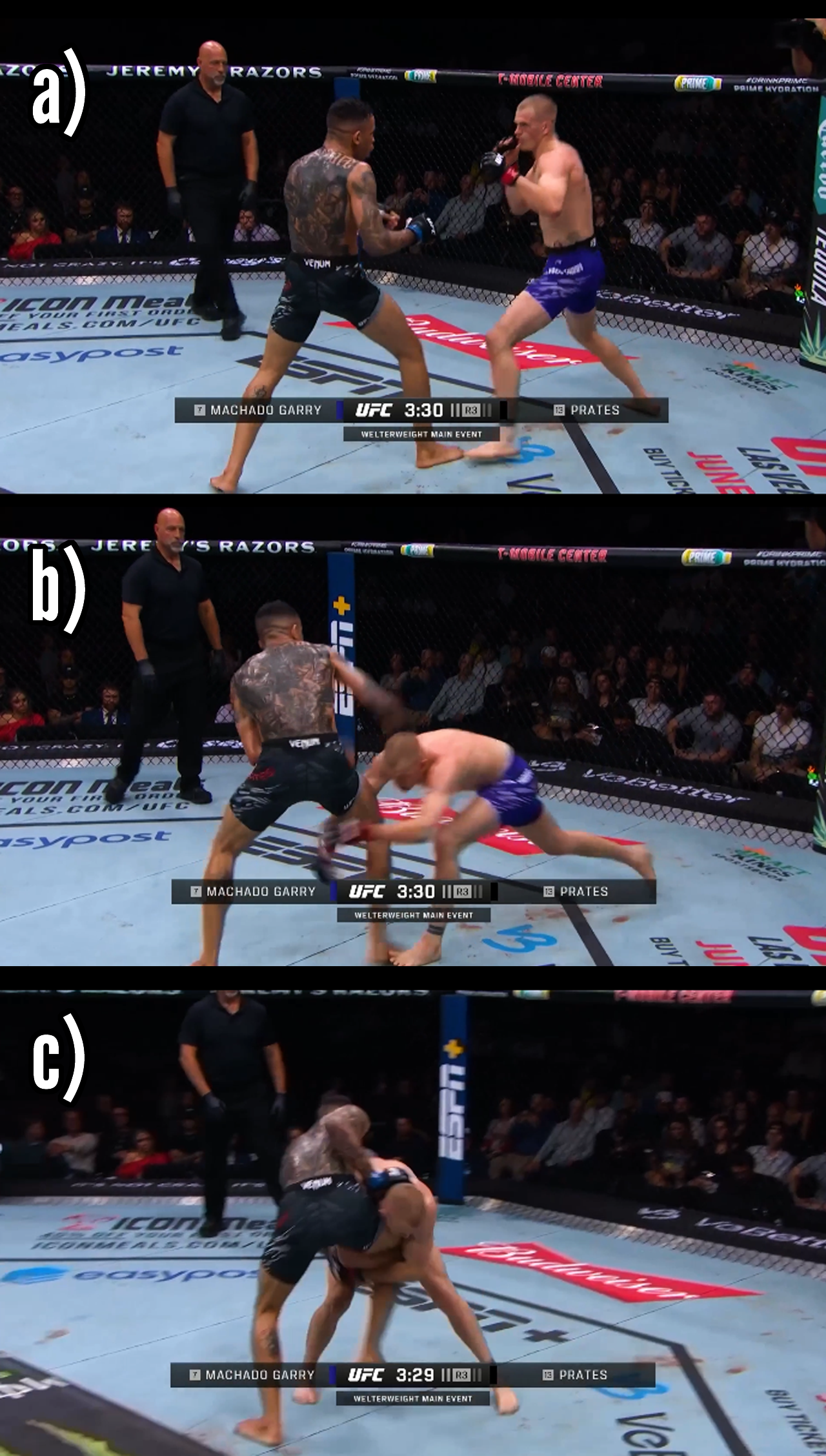
Fig. 9
Garry’s entries synergized with his constant use of the high kick. The kick forced Prates to fight more upright in his stance, creating more opportunity to beat Prates on the level change. Colby Covington relied heavily on kick-and-shoot, and Austin Bashi has picked up the baton now that Covington has mercifully moved on.
The level change is often viewed as integrating wrestling into striking, but changing levels is a vital part of good boxing. The body jab and the right straight to the body (or “2b” for short), are useful point scorers, fatigue the opponent, and create openings for more valuable shots upstairs. Garry quickly established that he would be level changing to grab the leg, and he would be level changing to punch the body.
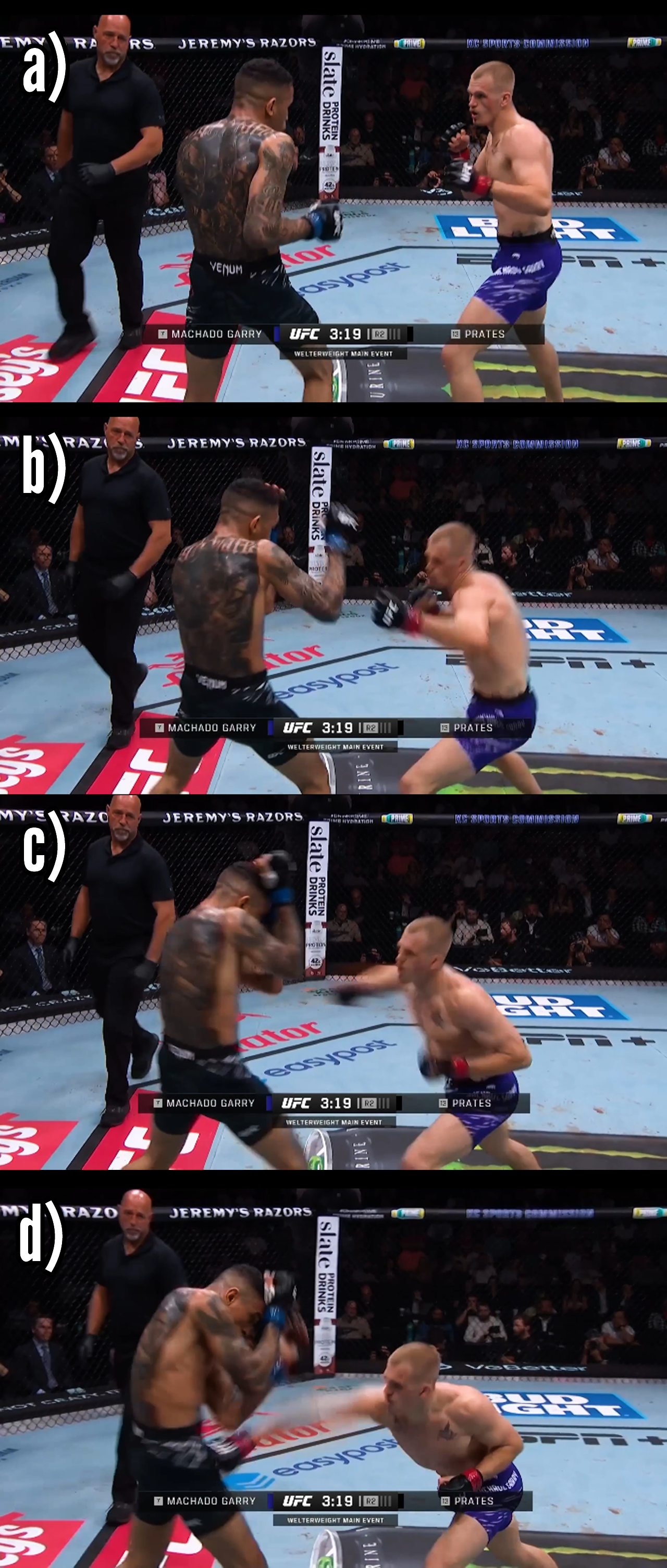
Fig. 10
Once the right straight to the body is established, it has done its job. If the opponent ignores it, the fighter can push his chances and try to put some hurting force onto the body shots as the rounds progress. If the opponent fires back, he opens himself up to counters when he is bait-and-switched on the level change. Junior dos Santos’s knock out of Cain Velasquez is a great case study. A couple of poking shots to the body from Dos Santos and Velasquez thought “he looks really hittable when he’s doing that.” The moment Velasquez opened up, Dos Santos looped his right hand over the top instead. JDS had a beautiful ability to make the opponent punch across themselves to try to get to his head when he level changed as well.
But whether it is a clever counter or part of an ongoing bombardment against a tight guard, the body straight as a set up is still a peach. A classic example is Barry McGuigan’s knockdown of Eusebio Pedroza. McGuigan established the threat of the right hand to the body, threw it for six rounds, and in the seventh he looked low, made a slight level change, and blasted Pedroza in the head instead.
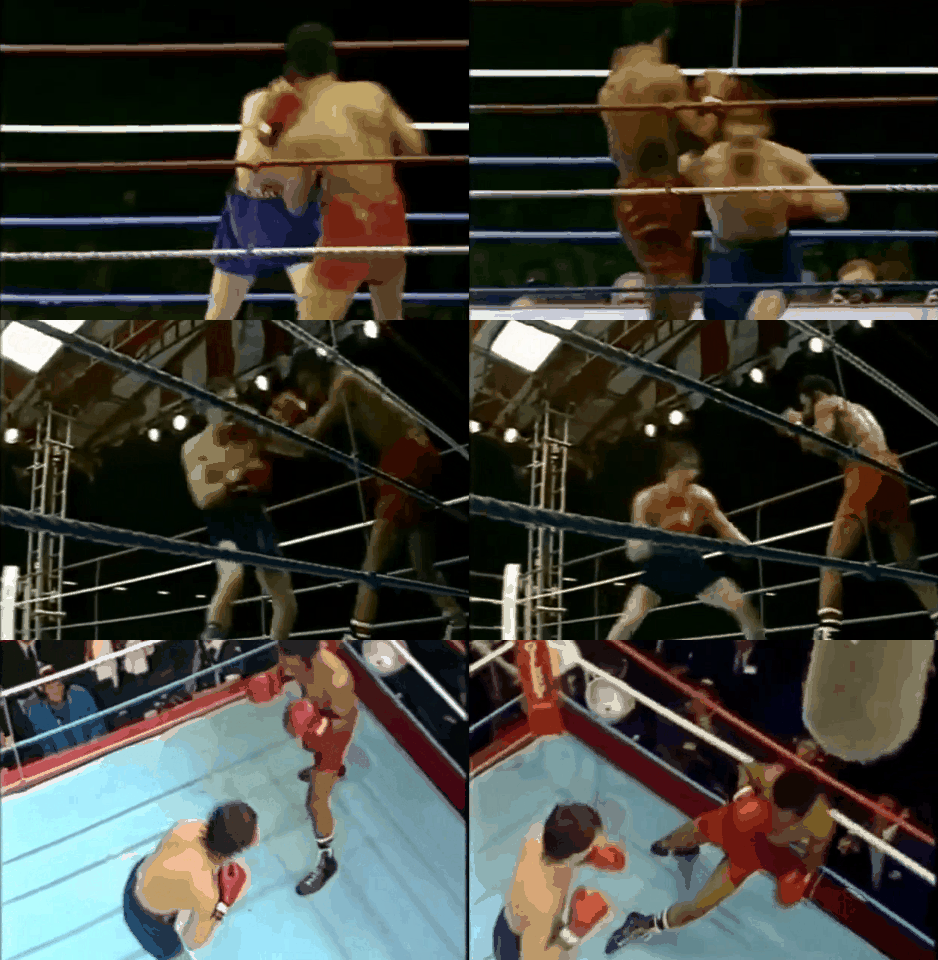
Fig. 11
Throughout the fight, Garry dipped to throw his right hand low, and threw it to the head instead.
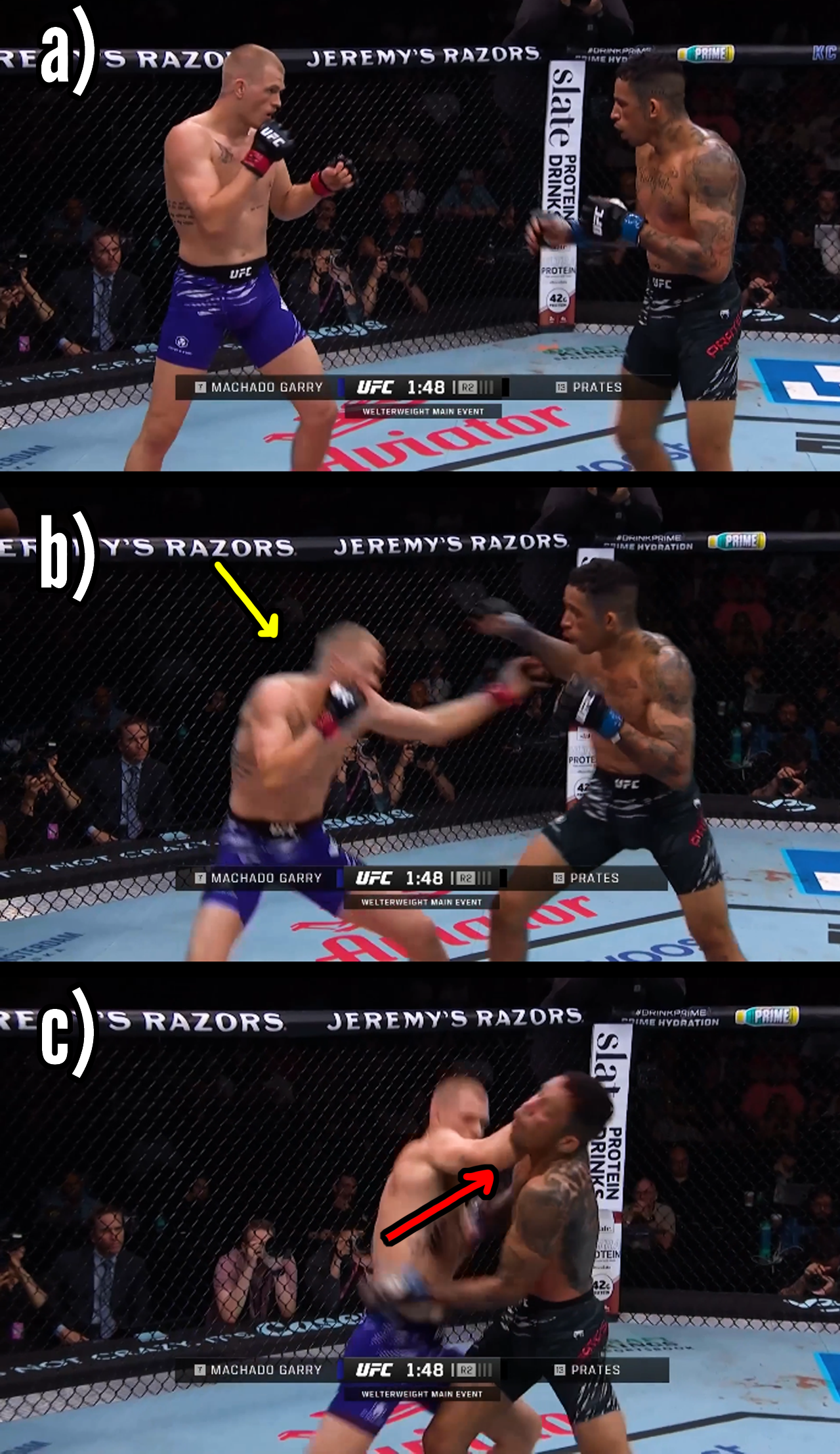
Fig. 12
Garry’s best flurry of the fight came in round three, as a direct result of this set up. Figure 13 shows the sequence.
As Prates presses Garry towards the fence, he reaches out to handfight (a). Garry changes levels to punch the body or shoot a takedown (b). He throws the right hand to Prates’ head instead (c). He follows with a left hook (d), a right straight (e), and brings his feet with him to land the left uppercut, beautifully exploiting the hole in Prates’ hunched long guard (f).
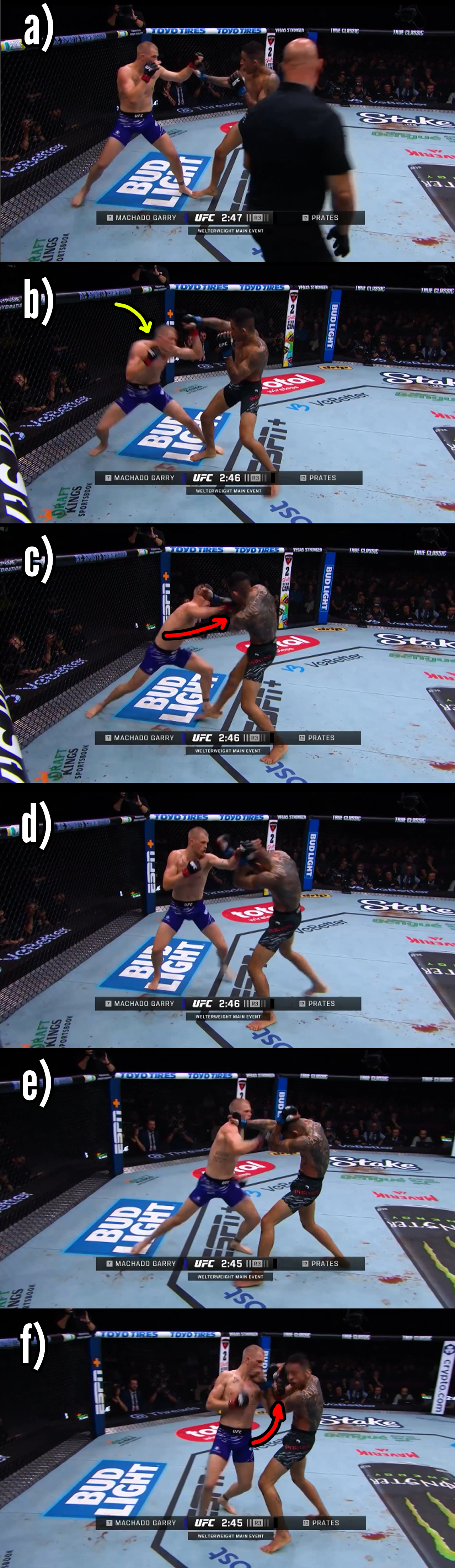
Fig. 13
To bring everything full circle, Garry used his level change to set up the high kick. Level changes to high kicks can be spectacularly effective. The example we all recall is Carlos Condit dropping Georges St. Pierre, but in proper kickboxing this is very rare. Aside from a few standouts like Badr Hari and Artur Kyshenko, not many kickboxers are regularly using a good, level-change right straight to the body, and so few can benefit from this set up. Because of the more boxing-centric striking dynamic, and the threat of wrestling, the level change to high kick seems a technique tailor made to be used (and mostly ignored) by MMA fighters.
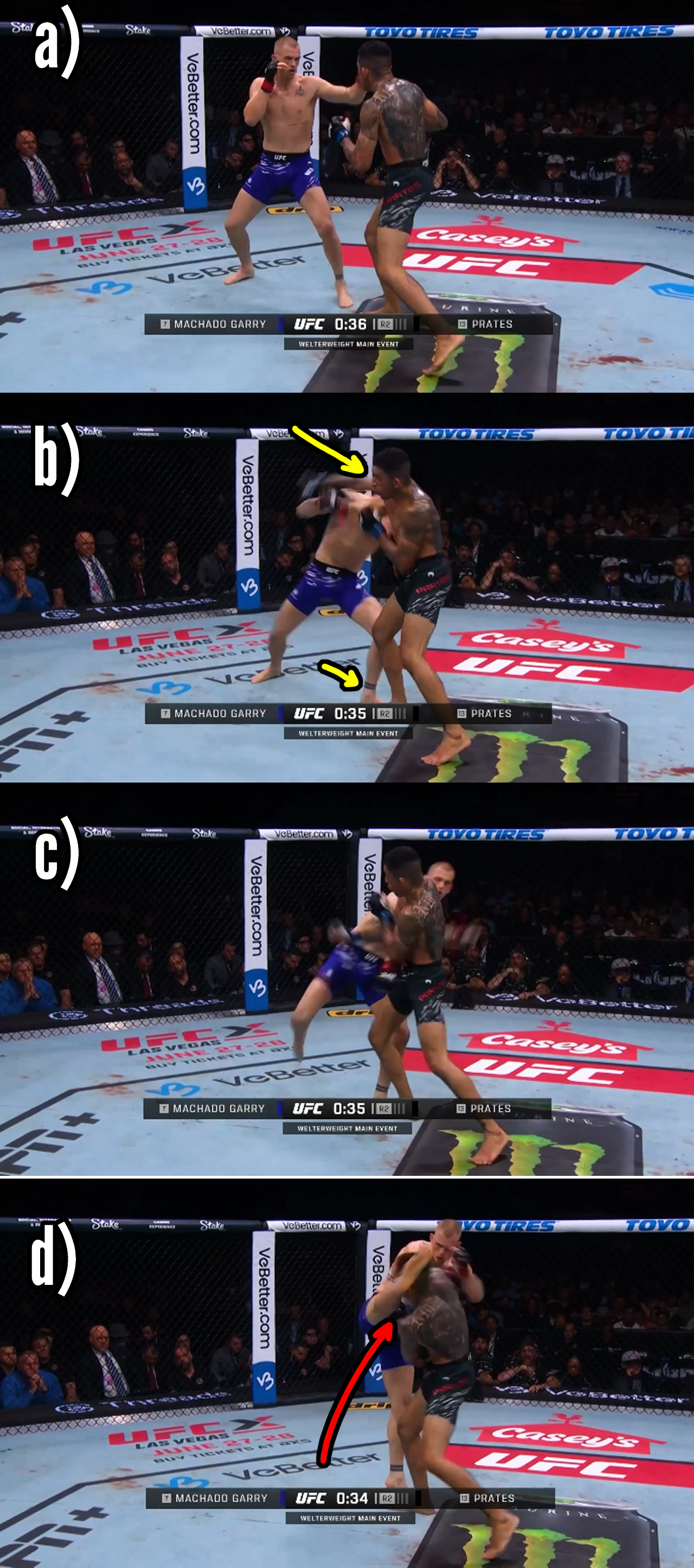
Fig 14
Garry’s takedowns in truth are serviceable. Open Note Grappling has pointed out that Garry’s upper body clinchwork far outshines his lower body wrestling. This fits with his story: he started in boxing and then took up judo, and then found his way to MMA with the Teddy Roosevelt base. It was one of the fascinating aspects of his fight with Shavkat Rakhmanov: Rakhmanov’s trips make him unique, but against Garry he was forced to shoot to find success.
When Garry grabs onto a leg, there is little of the drive that you would expect from a life long wrestler. Against Prates he grabbed a head outside single and looked for a crackdown—a well established slow man move in MMA—or tried for a double and ran his feet just enough to attempt this peculiar trip that turned into almost a sacrifice throw as he pulled Prates on top of him.
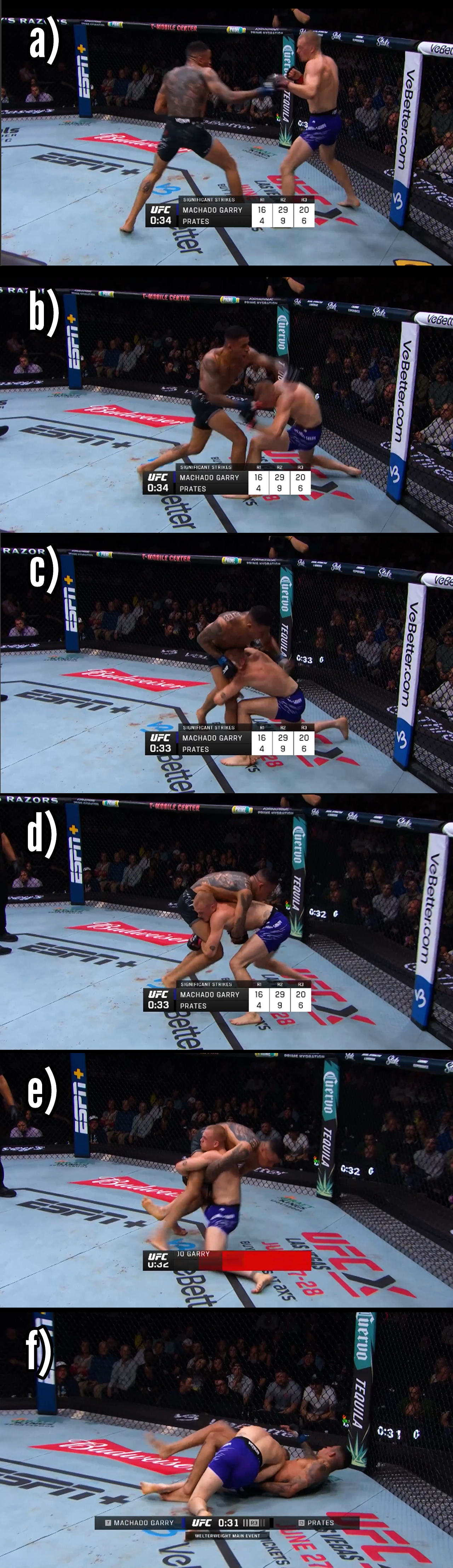
Fig. 15
Prates looked to counter Garry’s head low, hips high shots by using what is sometimes called a head tilt or back roll—pushing the opponent’s head down outside the hip, and grabbing the near leg to threaten to send the him “arse over tits.”
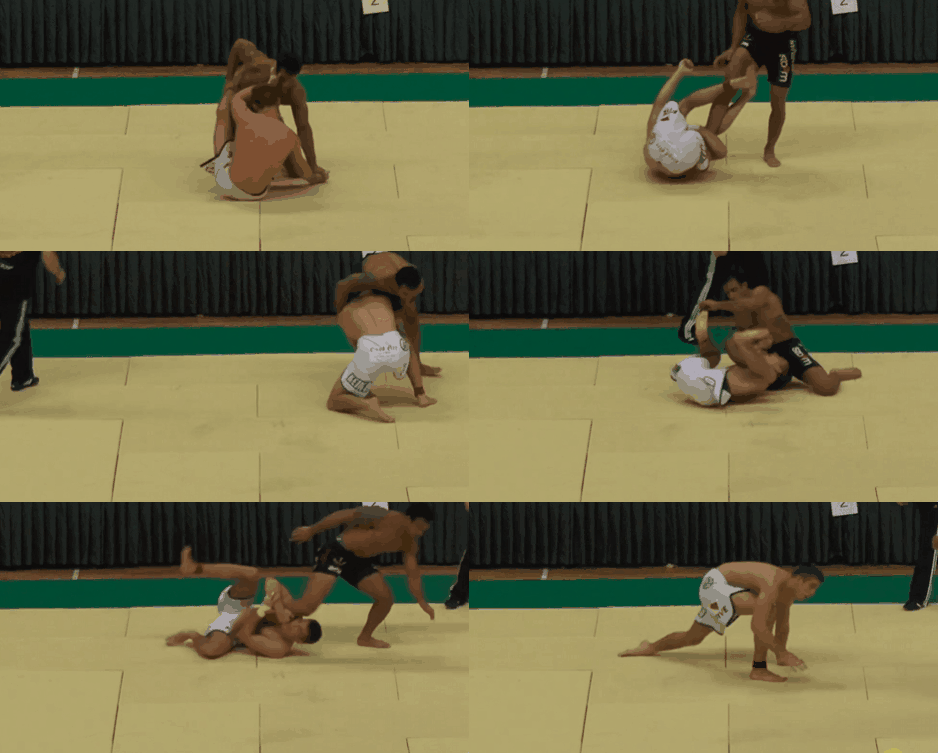
Fig. 16
In ADCC, Buchecha would sometimes stand up from his guard, feeding the opponent one leg, and then attack head tilt to transition to his own offence.
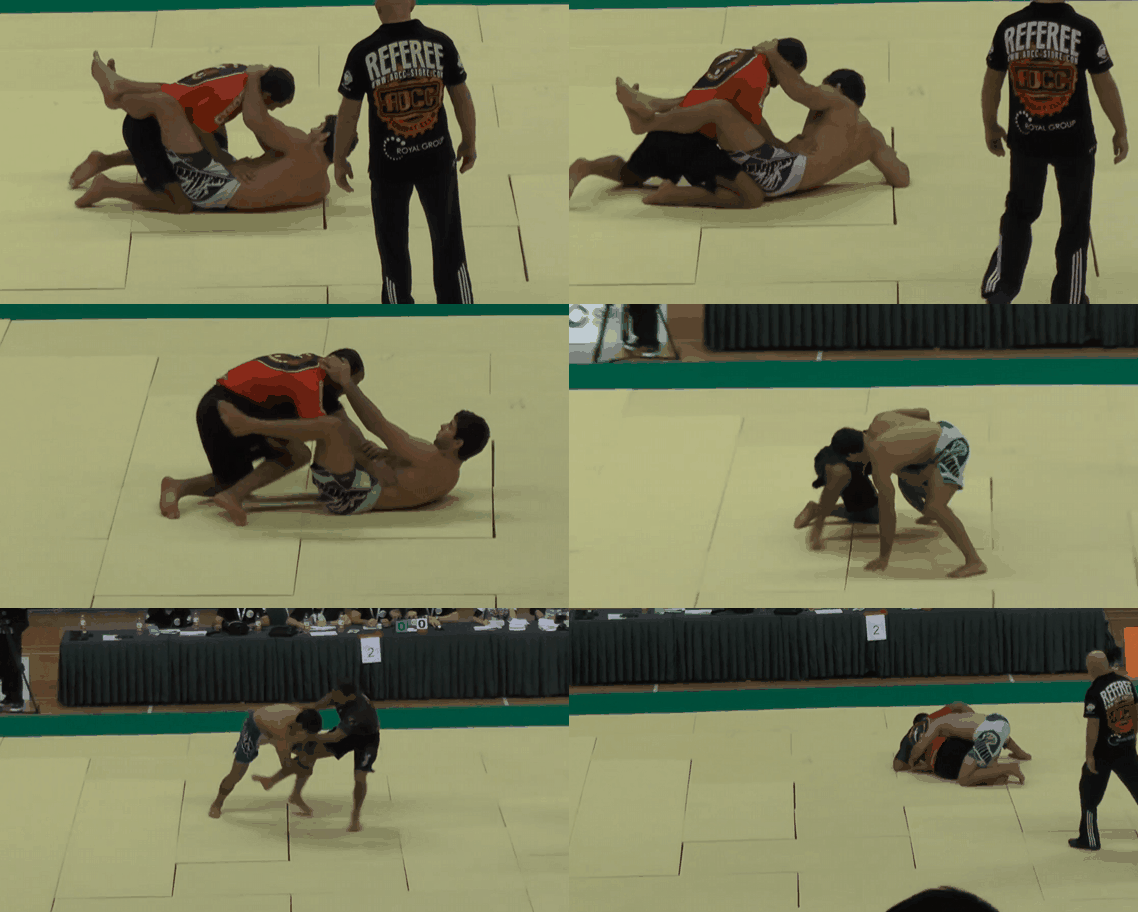
Fig. 17
This technique is most commonly used as a counter to the high crotch / head outside single leg, but Prates used it against Garry’s double leg attempts as well. Figure 18 shows the calamitous moment in round five when Prates was able to send Garry into a forward roll and step over to take top position. It was here that he was almost able to TKO Garry and undo four and a half rounds of beautiful work.
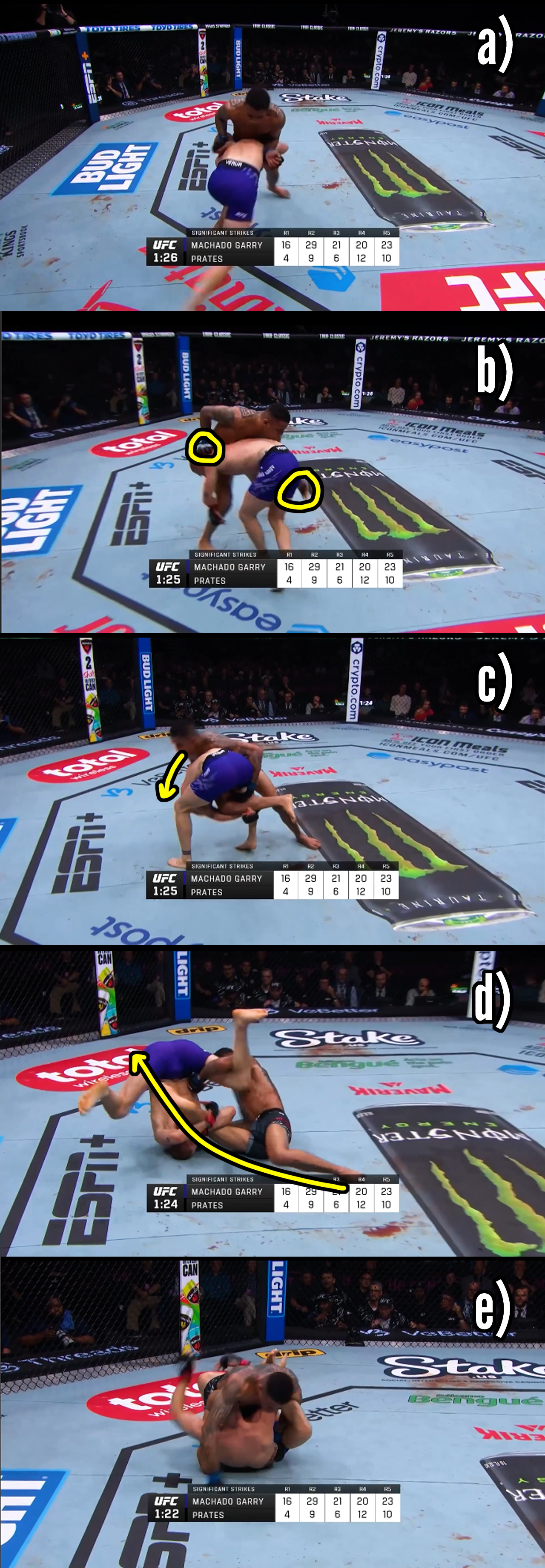
Fig. 18
That flirtation with complete disaster gave Prates fans something to cling to in the aftermath, but in some ways it serves to make Garry’s work look even better. Stopping high level fighters is extremely difficult, and in any generation of fighters there are a few notable non-finishers like Garry, Gray Maynard and Mateusz Gamrot who seem to have it all and just cannot get the stoppages that are nearly vital to achieving wider appeal. Then there are fighters who seem lacking in other areas but have the magic, and Prates is clearly one of those.
Garry’s performance was so impressive because he was dancing on a knife edge, with complete confidence to the outside observer. If Prates had not come so close to snatching victory from the jaws of defeat in that fifth round, we might have forgotten just how much danger Garry was in the entire time that he was putting on the performance of his life. Next week, Garry is tasked with the number one pound-for-pound fighter in the world in Islam Makhachev, and if he can make even half as many good reads as he did on Prates, Garry might give Makhachev his trickiest fight yet.