
Finding the Art
I have been fascinated by martial arts and combat sports since childhood, and have studied them at every opportunity. I can't put my finger on when they became my reason to exist, but I do remember why. It wasn't the display of strength or speed, the assertion of one fighter's physical dominance over another. It was the little tricks and traps. The moments where, were it not a fist fight, one could exclaim “A-ha! Tricked you!”
In that respect, I believe my love of combative technique and strategy is similar to many people's love for the game of chess. It was not the abnormal power or speed of a fighter which kept me enraptured, nor the shows of great heart, it was the fighters who could best lie to their opponent. The ones who, through their movement, strike selection and anticipation, could make themselves seem faster, stronger, tougher.
That was how I came to love the footage of Willie Pep, Kid Chocolate and the other great boxing masters. But there were still plenty who bored me. Jack Johnson? All he did was clinch. Years later, I would realize the art of Johnson's work. Why could he clinch with impunity and wear men out there? Shouldn't he be getting hit? Why could he land punches in the clinch while his opponent couldn't?
It doesn't matter what occupation you fall into, you find ways to make your day-to-day tasks easier. From waiting tables, to bricklaying, to laying out spreadsheets on Microsoft Excel, there are shortcuts we learn to make our work more efficient. And fighters are just the same. There's the occasional fool who genuinely doesn't mind getting hit, but almost every fighter in the world would rather land a good few blows and get through it without getting hurt. There isn't a fighter alive who you can watch and fail to learn a trick, a technique, or a method from.
Even after learning this lesson, that there is art to everyone's method, I compartmentalized what I had learned. I loved boxing and kickboxing, but then the Ultimate Fighting Championship came along and I hated the idea. It was too brutal, they were hitting each other on the floor. Then, after a few years, I watched an event from the Japanese promotion, PRIDE FC, and I could see the art.
Something had changed, the sport had matured. These weren't men blindly swinging at each other and trying to assert the dominance of their individual fighting discipline. These were men amalgamating knowledge. There was art here. Mixed Martial Arts became the greatest passion of my life, and years later through the twists and turns of fate, writing about it became—as Robert Frost would put it—both my vocation and my avocation.
Right now, as I write this, I know that there are more of those eureka moments around the corner for me. Just as you can avoid a food your entire life due to a bad experience in your youth, then discover you adore that food when you consume it by accident at a party or a restaurant overseas, a second look makes all the difference.
If you are reading this, I probably don't have to beg you to give combat sports a second chance. But I contend that a far, far greater percentage of the population would enjoy boxing, kickboxing and mixed martial arts if they were familiar with the methods. Not just the rules and the techniques, but the tactics and strategies. The difference that ring positioning makes, the purpose and method of cutting angles, the role of the handfight and the headfight,
Where a fight happens is of primary importance. Once you realize the significance of the fence or ropes in a bout, you will see fighters running themselves onto it and getting knocked down everywhere. Once you understand how to cut off the ring, you will notice when fighters ineffectively follow their opponent around the ring. And once you understand the roles of the head on the inside, and the concealment of dirty tactics, you will not be able to ignore them.
This short collection of essays began as an attempt to answer a request which I receive often: how does one get the most out of watching a fight? The topic is a daunting one, and I was afraid to approach it for a long time. I study fighters, I believe I understand fighters—I had never given much thought to the study of studying fighters!
After lengthy consideration, I have decided that while there is an near infinite list of factors which govern fights—sometimes as small as the slack in the ropes or the resin on the ring mat—some can be given greater significance than others. The short list contained in this book will not be anywhere close to exhaustive, but I believe it is a good start.
Stick and Move: The Meaning of Angles
Before venturing into the world of combat sports practice or fandom, it's important to understand that hitting people is not difficult. If you're standing straight in front of each other and if you throw enough punches, a few are bound to get through. The essence of good fighting, that sweet science to which authors keep referring, is to hit and be out of the way of a retaliation. Not if the opponent punches back, but when.
A young fighter can tear through a good few opponents by taking a punch to give a hard one of his own, but if a career is to be made in combat sports is to be attempted with any hope of success, the fighter must find a way to stack the exchanges in his favour. A fighter who can give his opponent “looks”, that is to move off of the line of attack and strike from there, is likely to make a vastly superior fighter to a man who simply comes in head on.
Taking a dominant angle is simultaneously the most difficult aspect of the fighting game to comprehend, and the most basic human instinct. Remove yourself from all cultural and social constraints and think rather about survival than about putting on a good fight. You are a naked, starving human being who wants to eliminate a stronger, competing human being. How do you do it? The correct answer will always be to sneak up behind him and bash him over the head from where he can't see it coming and from where he cannot retaliate. As he turns to face you, head still aching and still regaining his senses you hit him again, and again until he falls.
“Taking an angle” in combat sports is, at its heart, no different to this, the mechanics are just a little bit different. It is the art of moving to a position where your foe cannot get at you nearly so easily as you can get at him. When you think about it in it's purest form it sounds a lot like cowardice, but after you open your eyes to it you will quickly realize that this is the difference between the good fighters and the greatest fighters. If a fighter is a great brawler, by all means he might stand in front of an opponent and take him on head-to-head—but where is the science in giving an opponent equal chance?
If fighting is truly a scientific method, every advantage should be taken and every possible opportunity should be brought to lever against an opponent. It is a fighter's task to not only get the job done, by out-scoring or finishing off his opponent, but to protect himself while doing so. Brain cells are money in the bank for a fighter, and each strike a fighter takes is a cruel tax on his work. It is in a fighter's interest to preserve himself and to keep the prospect of food on his family's table for as long as he can and only good movement and angling can do that.
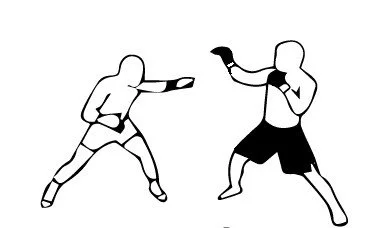
At it's most elementary level this means taking a step to the left or right, off of the opponent's attacking line as shown in Figure 1. In Japanese martial arts it is called tai sabaki, in boxing it is simply called angling or giving the opponent “looks”. When you see a fighter circling his opponent it is normally simply to test his opponent's turning speed and reactions.
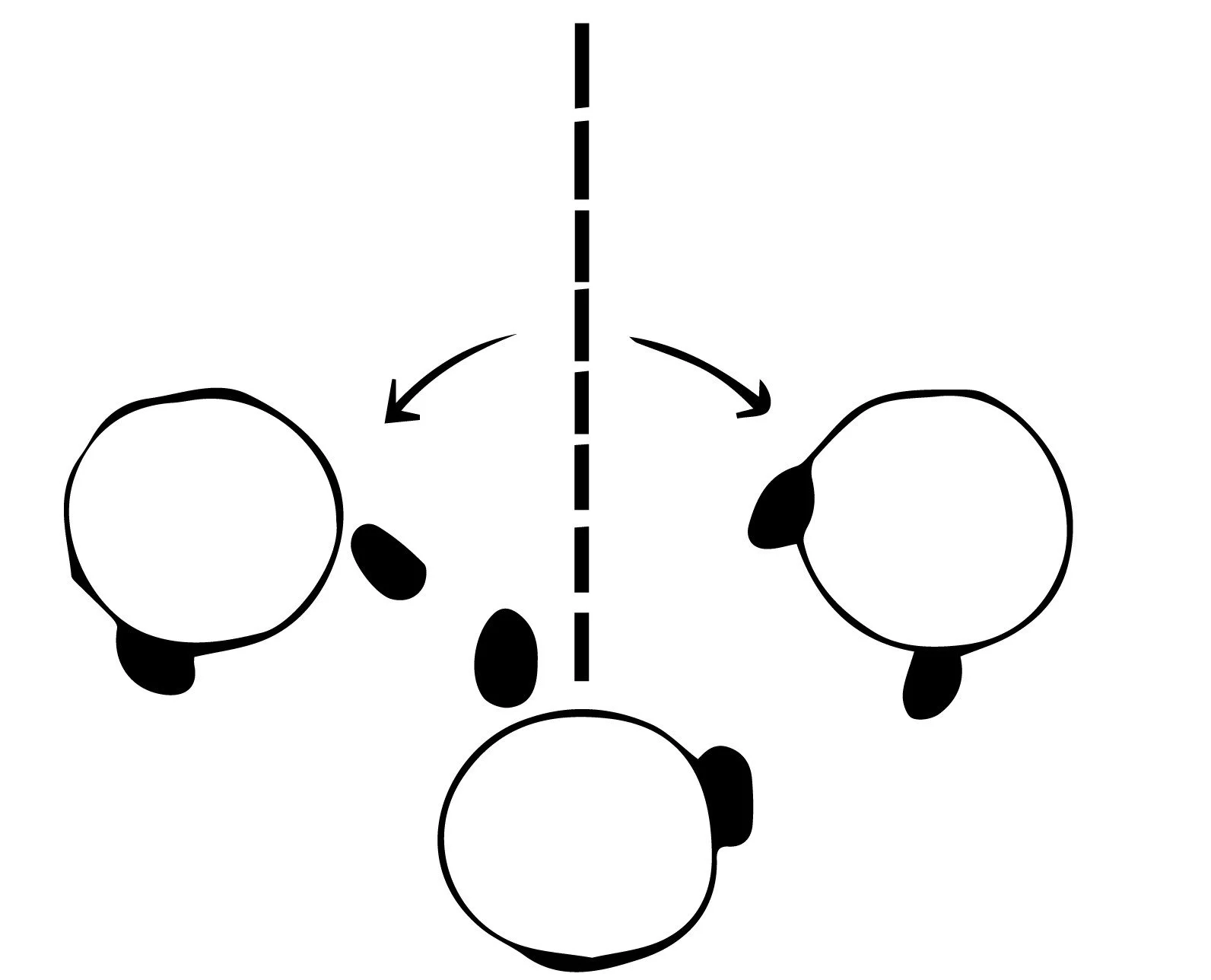
Fig. 1
All of a fighter's offensive and defensive techniques are set up to deal with an opponent who is directly in front of him. Stepping off of the line of attack removes the efficiency of his blows, and sets up the fighter in motion's own blows. Stepping to the right, past the static fighter's lead shoulder, lines up the right straight behind his left hand, and the left hook between his guard. Stepping to the left lines the right straight up between his gloves.
Anyone who lets an opponent simply circle around to a dominant angle and strike from there with no set up is obviously not going to make it very far in the ring, but the act of circling forces the opponent to turn. He cannot give up angles for free, it's human instinct to face your opponent. This not only keeps the turning fighter on edge and numbs his reactions to strikes at times, but also removes the power in his strikes for the instant that he is pivoting.
Figure 2. demonstrates the pivot to recover position as an opponent circles to the fighter's right. Figure 3 shows the pivot to counter an opponent's movement to the fighter's left.
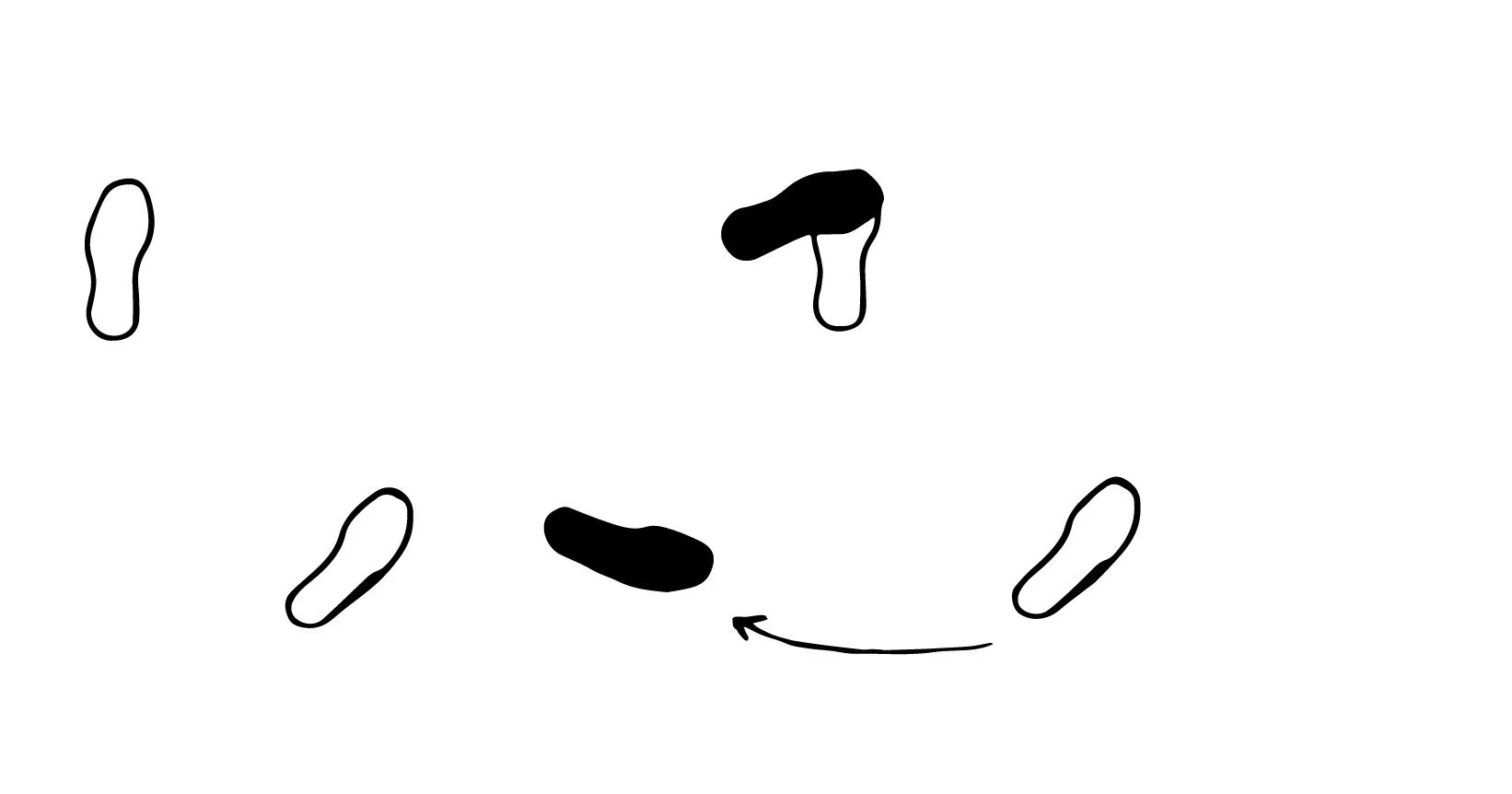
Fig. 2
A turn in any discipline is accomplished by pivoting around one foot—in almost all cases the method taught is to pivot on the lead foot so as to keep the guard and stance. When doing so the other foot is in motion and therefore not planted on the floor and ready to drive off of. When you hear a trainer yelling “keep turning him” or “keep him from getting set” this is what he means – a power puncher cannot hit hard if he cannot plant his feet and use them to transition his weight. As the pivoting fighter plays catch up, he provides an excellent opportunity for the circling fighter to step in with a good one-two, then continue circling away without getting into too much trouble.
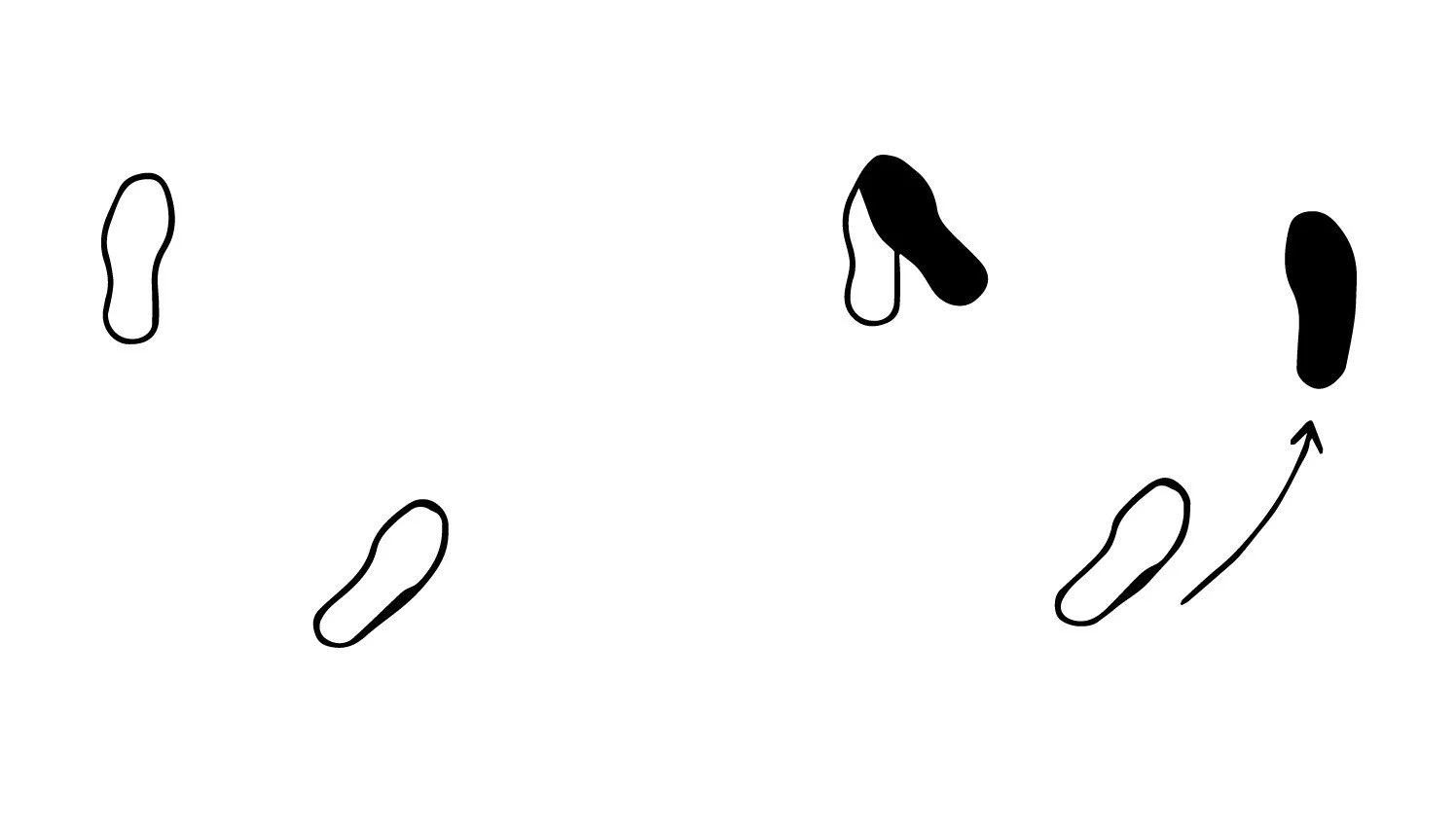
Fig. 3
Simply following a circling fighter around the ring is not good practice, but in order to cut off the ring properly some defensive sacrifices must be made–squaring up the stance and giving oneself less time to react to straights. Even the most gifted ring cutters get hit when they pursue an opponent so it is always worth at least attempting to move around and prolong the outfight before falling back on plan B (whether that be clinching, infighting or even the rope-a-dope).
Moving to dominant angles doesn't just deny an opponent his punching power and force him to constantly adjust, it is also an important factor in recovering from offensive efforts. The traditional means of using angles both offensively and defensively is the so called “V-Step”. An “in and out” style boxer might drive in with his jab and then step out in any number of directions. Straight backward is the least advisable because it can be capitalized on by simply following the jabber back towards the ropes and flustering him.
An outfighter might bounce in with his jab and then bounce backwards to his right, taking him away from his opponent's power hand and setting him up to step off and stay away from the ropes. Figure 4 shows this method, the left hand diagram detailing the direction in which the outfighter steps with his jab, and the right hand diagram details his retreat onto an angle. If his opponent attempts to counter the jab, and is aggressive enough to follow, he will provide the outfighter with a deeper angle (identical to that shown in Figure 5). Wildly rushing the man performing the V-step would give him the opportunity to sneak a powerful right hand in from his new angle, behind his opponent's left glove.
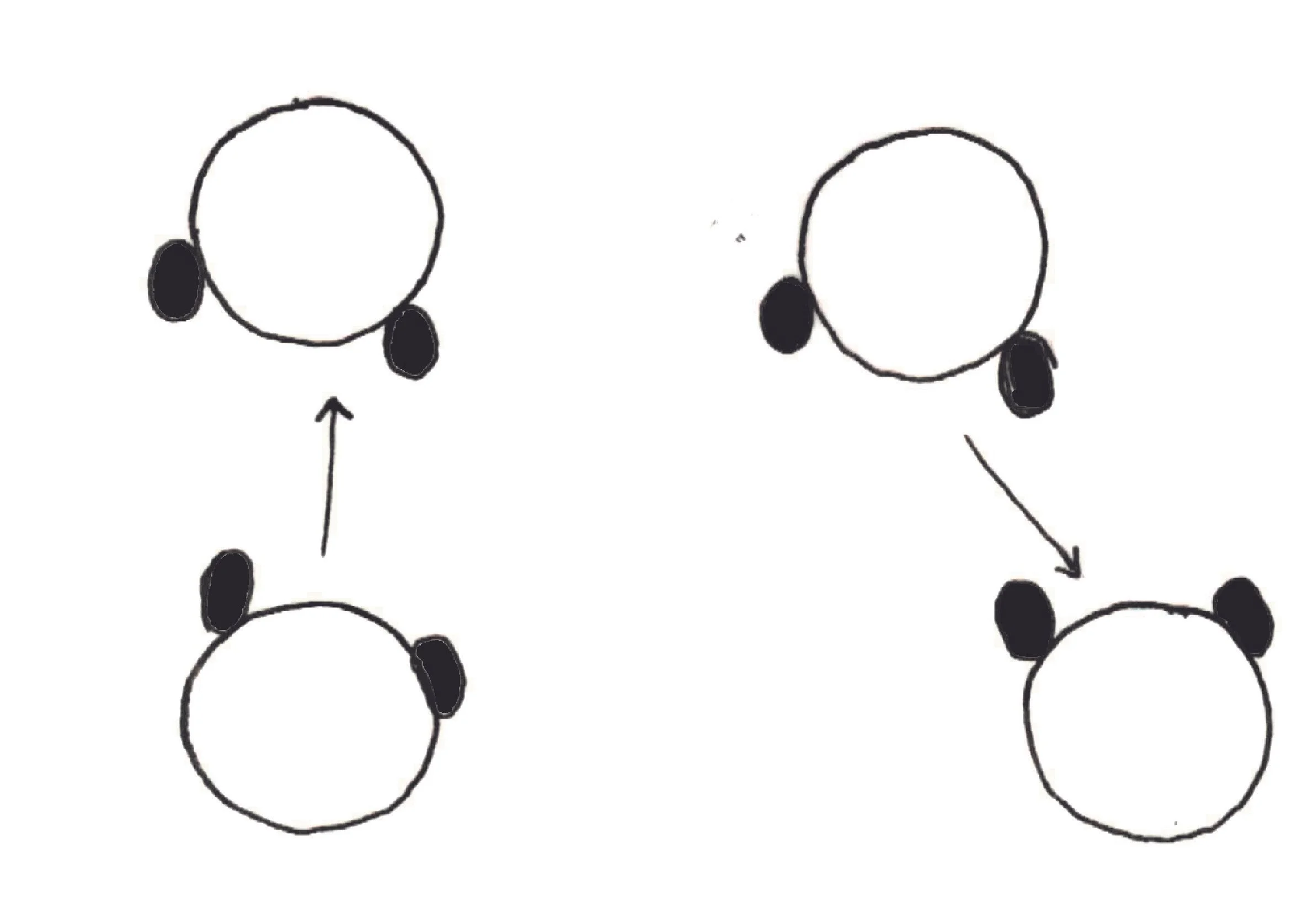
Fig. 4
Alternatively, the skilled outfighter might jab in and then using his front foot as a pivot, swing his back leg around behind him to his left and push back out towards his left. When retreating to the left side, it is important for a fighter to be cognisant of his opponent's right hand which can come around and clock him behind his own left hand. Consequently when retreating off to the right, a smart boxer will keep his left hand high, or drop it but keep his shoulder up, ready to duck down behind it if a punch comes back.
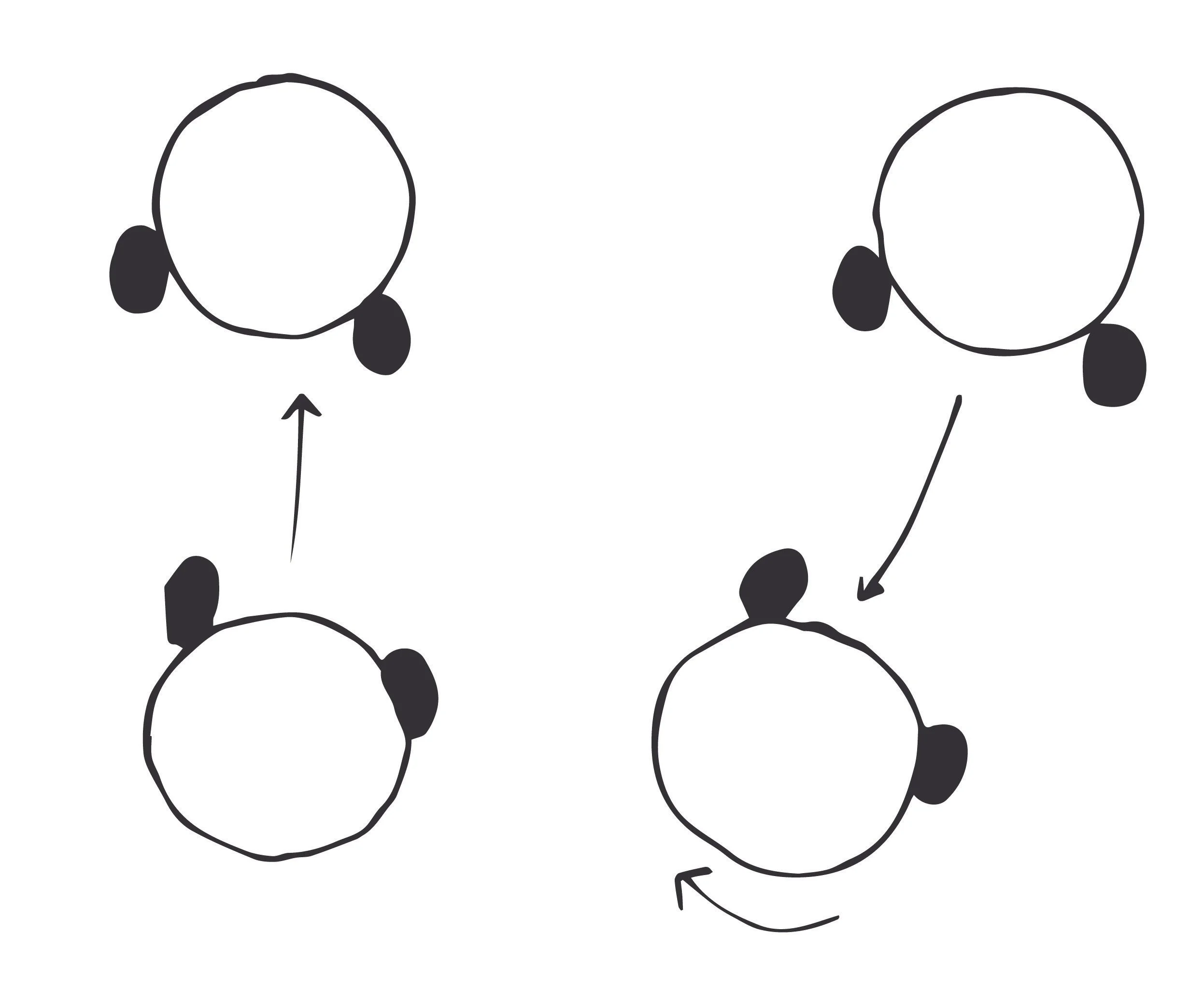
Fig. 5
Both of these V-steps have tremendous value as recovering manoeuvres—for the fighter to get in with a snapping jab and retreat untouched. But the best fighters don't think in either offensive or countering modes, this technique is best used as a mount for getting in both a lead and a counter. The fighter leads with a jab—hit or miss, doesn't matter—and recovers to a position which, if the opponent drives in with punches, will leave the original jabber at an advantage.
To see this sort of strategy at its absolute best, it is worth reviewing the vast body of work which Roberto Duran put forth in the ring. 'Manos de Piedra' was known as a heavy hitter, but really he was one of the finest all around boxers to ever live. At the start of every fight, Duran would flick out jabs and angle off or duck out in one direction or the other after every single attack. And he rarely angled off the same way twice in a row. If his opponent stood still he'd start nailing them with the jab and getting off scott free. If they started trying to catch him when he shot in close enough he'd escape out to the side, blocking their swings, and hammer them with a counter right hand.
To see how the absence of an angling out motion can adversely influence a fighter's performance, look no further than Amir Khan. Khan's speed is almost preposterous, and he is probably a more physically gifted fighter than Roberto Duran ever was. But against many of his opponents Khan will get into what is termed in the business “admiring his work”. Stepping in with a hard jab, Khan will stand still for a moment, then step straight back. Because of this, he often gets caught with wild punches which have been thrown while the opponent is eating a jab.
A surprising number of punches in any fight are thrown blind. Fighters take a blow and they throw back, they can't always see what the opponent is doing. Khan has been knocked down and even knocked out by these sort of “lucky punches” just because he doesn't remove himself from the only area where his opponent can effect him.
The two techniques mentioned above are called V-steps because a fighter comes in on one line and leaves on another. The shape of entry and exit should produce something resembling a V. As with any technique in combat sports, these in-out angles work even better when used in combination with other movements.
For instance, a boxer might glide around his opponent to the left, then switch on a dime to circle a couple of steps to the right. Once the opponent has reacted and is catching up with his pivoting, the circling fighter might bound in with a stiff jab and move out to the left again.
In the process of one simple footwork pattern he has made his opponent follow him, change directions, eat a jab and then change directions again. The jab might not even land, but defending such tactics can become mentally and physicallyt taxing and slow a fighter's wits.
There have been so many wonderfully graceful outside boxers who have used similar footwork and played on their opponent's expectations to land jabs that it is tough to name just a few. Of course the legendary Muhammad Ali was one of the most active ring circlers at heavyweight. Kenny Buchanan skated around the ring beautifully between jabs. Willie Pep didn't have the jabbing class of many other greats, but his constant changes of direction allowed him to score easily on opponents who were busy playing catch up with his feet and who had forgotten that he was there to throw hands.
A more aggressive application of a V-step is to bounce in with a jab and then bring the right foot up to side step directly past the opponent's lead leg. The purpose of this entering through the front door and leaving through the side window is to take the jabber's right shoulder outside of the defender's lead hand and shoulder. This makes it very easy for the attacker to line up a powerful straight right, behind his opponent's lead hand.
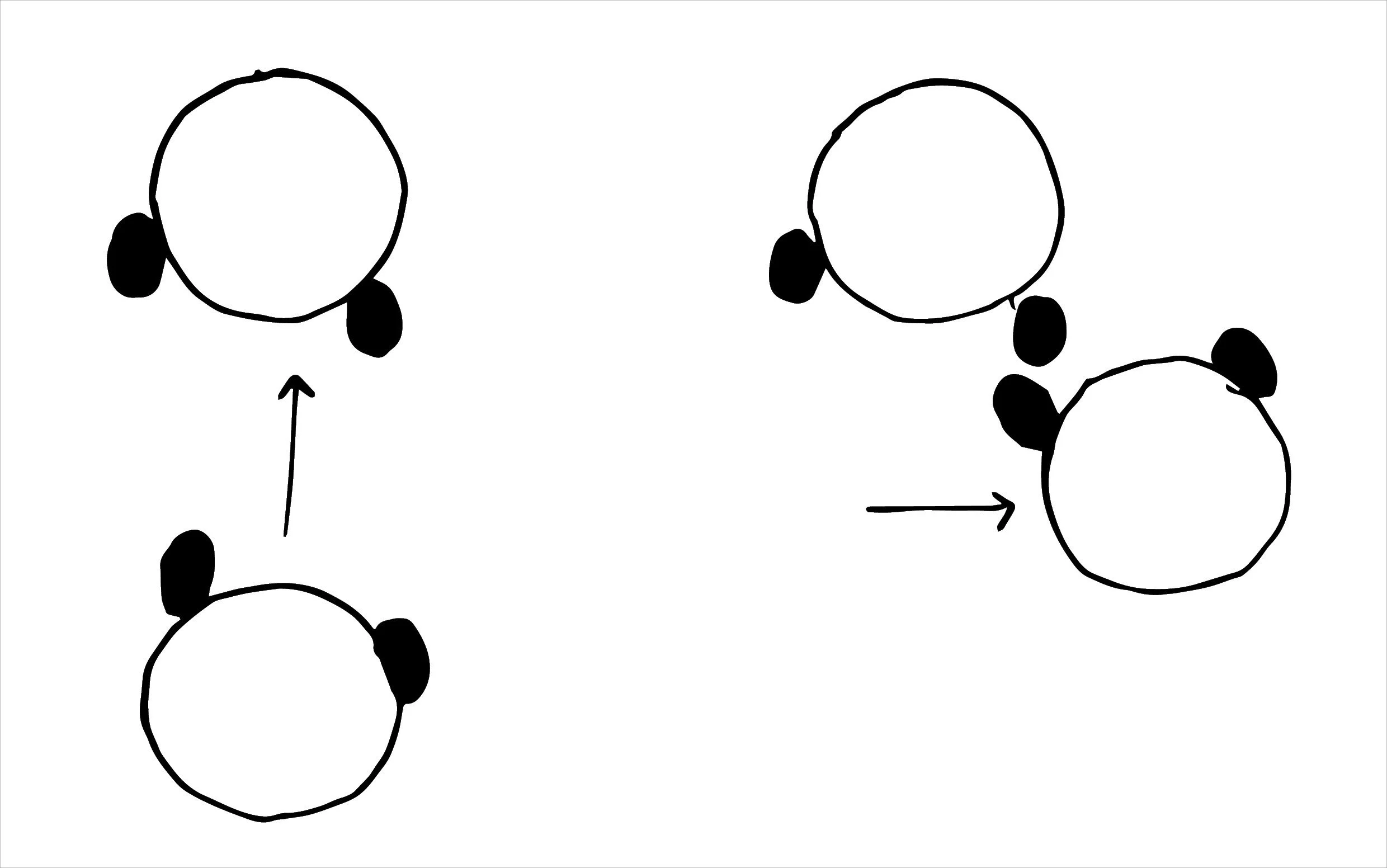
Fig. 6
To take the most powerful angles, attacking the opponent from ninety degrees, it is necessary for them to be aggressive. When a fighter is driving in wildly, as when frustrated or seeing their man with his back to the ropes, he may be readily sidestepped by the wily outfighter.
The classical side step, depicted in Figure 7, consists of a full step with the right leg out to ninety degrees, and then the left foot is recovered into a stance to the right of where the fighter began. This method can be used to get around the ring, to escape the ropes, or to test the opponent's reactions and turning speed.
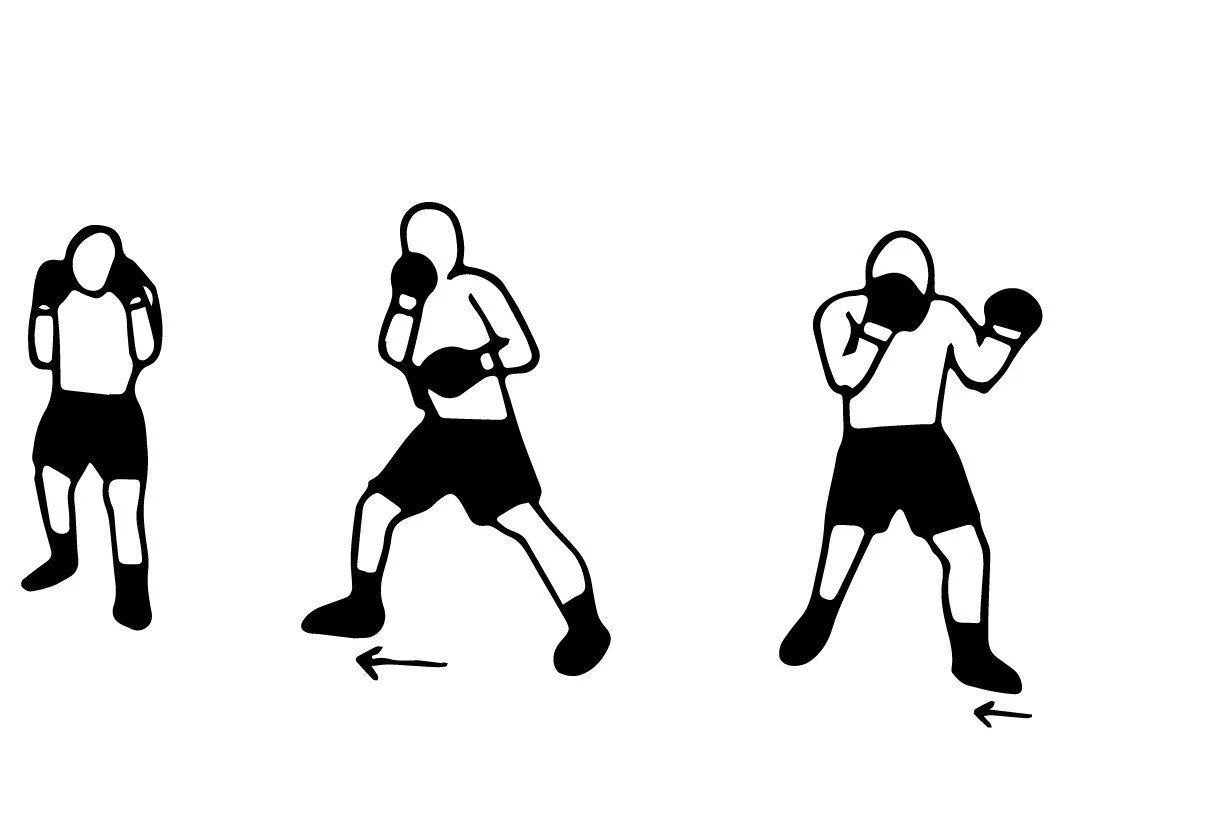
Fig. 7
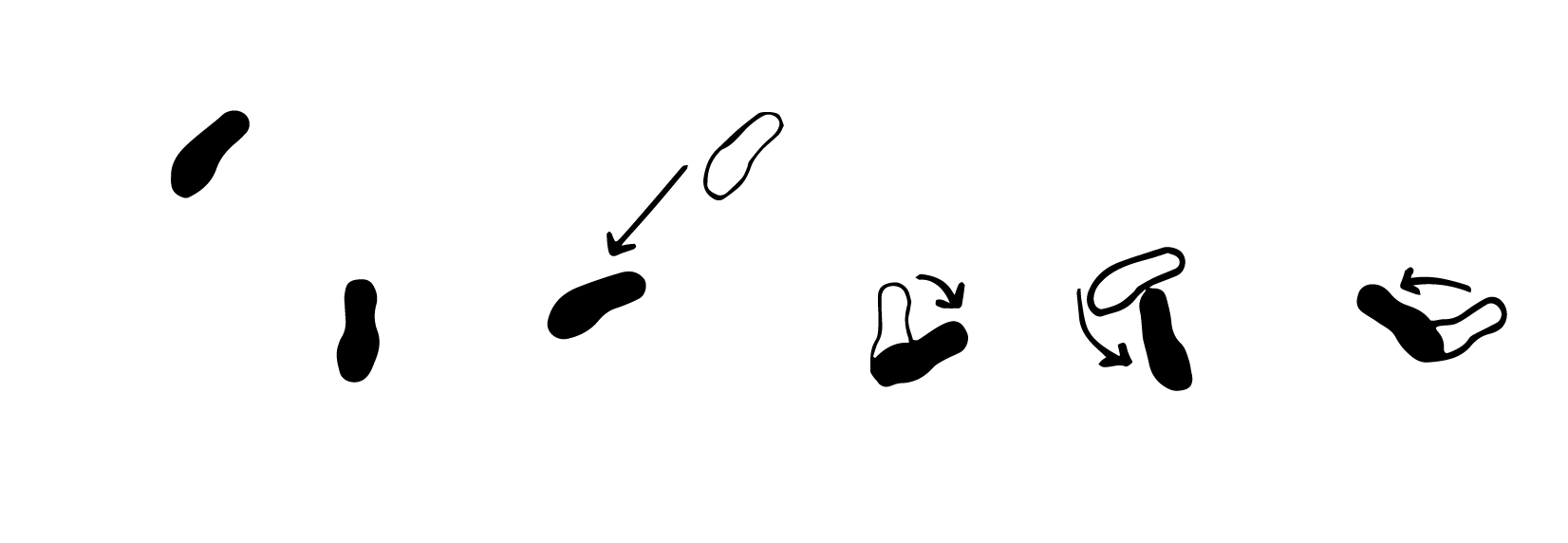
Fig. 8
Figure 8 shows the footwork. From an orthodox stance a fighter steps out to his right with his right foot, pivoting on his left so that he is moving completely to his right. This is accompanied by a lean forward at the waist, a raising of the right hand (in case he runs into a left hook) and a dropping of the left, in case he wants to thread a nice jab through as his opponent approaches him. Finally, having turned his body to the right, the fighter rotates his hips back towards his opponent and retracts his left foot back into his stance.
Against an aggressive opponent, this side step can yield the most powerful angle in the game.
Figure 9 shows the side step being used to counter a forward charge. In this instance, the fighter in white comes in with a simple, lunging jab. The fighter in black performs a side step to his right to evade the charge, and achieves the perfect angle to throw a right hand behind the fighter in white's left hand.
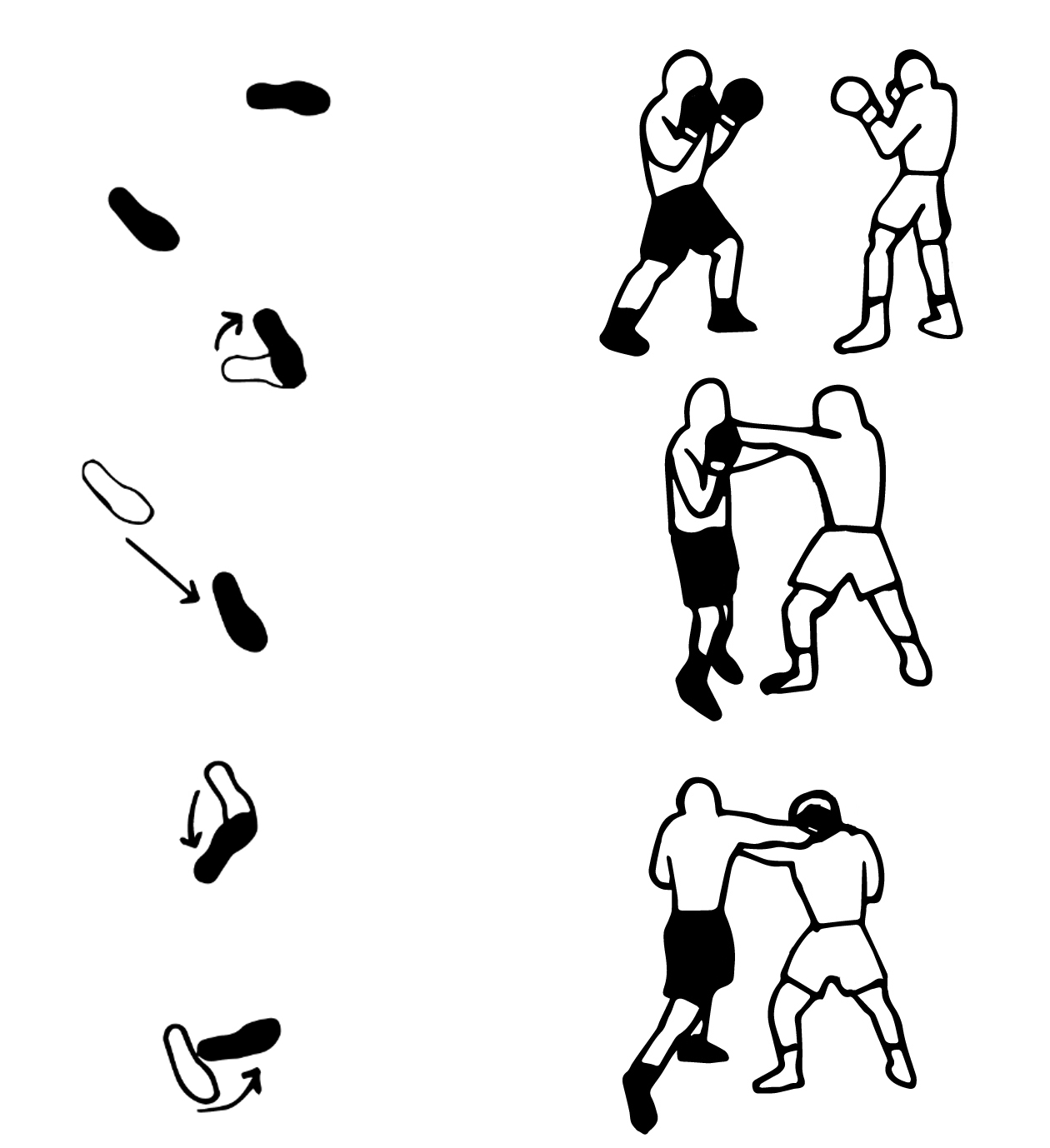
Fig. 9
When a fighter achieves such a dominant angle his opponent only has three choices—turn to face him, stand still and cover up, or step away. Turning to face involves pivoting on one foot, meaning that the fighter cannot hit with power during that time. Covering up is almost impossible with an opponent on the flank because his straights can travel behind your lead hand, and his hooks come in through the front of your guard. Often, stepping away and resetting in the centre of the ring is the best bet. Fighting is about winning exchanges after all, why prolong one where you are clearly at such a disadvantage?
And this is the danger of lunging at a fighter while he's circling the ring, he could sidestep you and suddenly he's throwing right hands from your blind spot.
So how does a fighter go about countering his opponent's lateral movement, without exposing himself to unanswerable punishment? He cuts off the ring.
Cutting Off The Ring
“The ropes are halfway house to the floor” - George Plimpton, When We Were Kings
Until about a century ago, there was simply no need for a scientific approach to cornering an opponent because the man was there to fight. Getting hit was an accepted part of that. Boxers from Grecian times to the bareknuckle days were not in the ring to pick up a pay check. They were fighting for money placed in side bets by their sponsors (usually rakes) in the case of the latter, or because they were enslaved and commanded to.
The line between simply running away from engagement and being a movement based boxer is a fine one and consequently few attempted the method of scientific boxing pioneered by James J. Corbett (1866 – 1933). In the years before boxing became a respected sport and was more a test of masculinity there was no point in moving away from blows as one would simply lose face. It was Corbett who realized that firstly, he did not want to be hit by men like John L. Sullivan and secondly, if he avoided Sullivan's blows the champion would soon wear himself out.
It is not nearly so exhausting to avoid a man as it is to chase one and miss with powerful swings. One need only watch a heavyweight mixed martial arts match where exhaustion is commonplace, and notice that every missed punch after about the five minute mark throws the fighter off balance and completely exposes him to retaliation.
When Corbett came to the fore and defeated Sullivan he was at first despised. Sullivan had been the only man to wear the new world heavyweight title and had transcended sport to become easily the most famous man in America. Soon the public came to adore Corbett as the “Dancing Master” and the foremost proponent of scientific boxing. Corbett was so passionate about his scientific method that Gene Tunney, who idolized the heavyweight, later recounted how Corbett would draw pages of diagrams and constantly re-examine his footwork.
When Corbett lost to Robert Fitzsimmons and Jim Jeffries it was not against the ropes, it was in the middle of the ring where he ended up due to fatigue. Both of those fighters took a great many punches en route to wearing down Corbett, neither of them directly challenged his use of footwork but rather waited for him to tire and tried to hit him as he stepped in.
Even the great Jack Dempsey, thirty years after Corbett beat Sullivan, was known as a fantastic infighter when he got close and did excellent work along the ropes, but was easily flustered by the lateral movement of Gene Tunney. Dempsey struggled throughout their two bouts to get Tunney to the ropes and instead got lit up with jabs in the centre of the ring.
One of the first great ring cutters who comes to mind is Sandy Saddler. Saddler was a great featherweight and is perhaps most famous for his rivalry with Willie Pep, his hard punching, and his dirty tactics. If ever there were a qualification in offensive ringcraft, a win over Willie Pep has to be considered equivalent to a PhD. Pep was one of the most elusive boxers of all time, and became known as Will o' the Wisp for his ringcraft.
Pep once reportedly won a round without throwing a single punch but simply feinting and moving without allowing the opponent to ever come close to him. As a featherweight, certainly until he met Saddler, Pep was considered peerless. The two engaged in a number of all out wars as Pep looked to box and Saddler looked to get a hold of the smaller man and batter him with his vicious salvoes.
What Saddler did so masterfully in his bouts was something which he later instilled in his student, George Foreman, many years down the line. Saddler came in with his right hand (as an orthodox fighter this was his rear hand) extended well in front of him, checking the opponent's jab.
From here Saddler would square up slightly before unleashing a stiff jab or left hook to the body or head. Then Saddler would swing his right hand and if at all possible catch a hold behind his opponent's neck. With a hold of the opponent, Saddler would land short left uppercuts. Absolutely illegal under boxing's rules as it was holding and hitting, but something which he routinely got away with regardless.
However great a fighter Sandy Saddler was he was nowhere near the destructive force that his student, George Foreman became. Foreman was a fighter whom heavyweights actively ran from and whom the press loved as both a great fighter and an excellent bad guy for the heavyweight division's narrative. Foreman's record is packed with knockouts and his power was enough (with the help of wily coaches and great durability) to even regain the heavyweight title from Michael Moorer at the age of 40.
The difficulty in cutting off the ring comes, again, from the flaw in the basic pivot. That pivot around the lead foot is a valuable mechanic which rotates a fighter back onto his guard—hiding him behind his stance again. The problem is that the pivot is a defensive movement. Each time a fighter pivots to keep his opponent in front of him, his back leg swings around behind him and away from the opponent. Where the job of a ring cutter is to get in close and physically obstruct his opponent's path around the ring, traditional pivoting provides space for the opponent to move freely.
Once you know about it, it will drive you crazy when watching fights. Instead of cutting off the ring, you'll notice a man following and turning to face. It is the difference between a hunt and a chase. There is always a period of moving around, but the chase is wild—there is no control and it relies on raw speed from the pursuer or a stumble from the pursued party. A hunt is about positioning.
The adept offensive ring general is not about immediately pushing his opponent to the ropes, or chasing him there, he is about circling the ring with his man for a little while, taking away distance with each few steps. Real estate in ring holds a similar value to that in down town Tokyo—it is almost priceless. Distance is the buffer zone for the outfighter, the time to react and the space to keep the contest from becoming a grinding infight and trade of two-handed salvoes. A ring cutter doesn't need to rush through that, he only needs to reduce it until he can smother it and get to work with his own blows.
In cutting off the ring taking up space is of crucial importance, meaning that finest ring cutters have always used a more squared stance than the great counter punchers and jabbers. Sandy Saddler and George Foreman used a smothering, hands forward, palms-out stance which led to Muhammad Ali mockingly nicknaming Foreman “The Mummy”. But Ali couldn't stop it, at no point in the famous Rumble in the Jungle was Ali able to out manoeuvre Foreman or out-box him. It was Ali's clinch work and durability which saved him that day.
Carrying the hands so far forward limits the offensive output of a fighter, but it creates a window in front of the body through which the opponent must punch at range. Carrying the hands so far forward makes the slapping down and parrying of straight punches—the jab and right straight which would normally serve to keep the infighter at bay—far easier. In fact, much of the time Foreman and Saddler were close enough that their right hand would actively obstruct the path of their opponent's lead hand. If their opponent started trying to swing around Foreman or Saddler's outstretched hands, the longer path gave the ring cutters plenty of time to react, get down behind their elbows or shoulders, and then suddenly the fight had turned into a two handed exchange, exactly what they wanted.
But the hands forward guard is just one method which proved effective. Plenty of ring cutters have had success with the classic “earmuffs” guard, or a peek-a-boo guard, and so forth. The one factor which is vital to any attempt to cut off the ring is the ability to step across, to break stance, to move with both feet.
Because in many boxing, kickboxing and mixed martial arts gyms footwork is taught as if it should be the same for all occasions, many fighters form the habit of one foot moves, then the other foot drags in behind. Outside foot, inside foot. Push off on foot, then pull it back into the stance. The best ring generals have been the ones who were able to move both of their feet to accomplish the task.
The most obvious example of this is as the opponent circles around to his left side as shown in Figure 1.
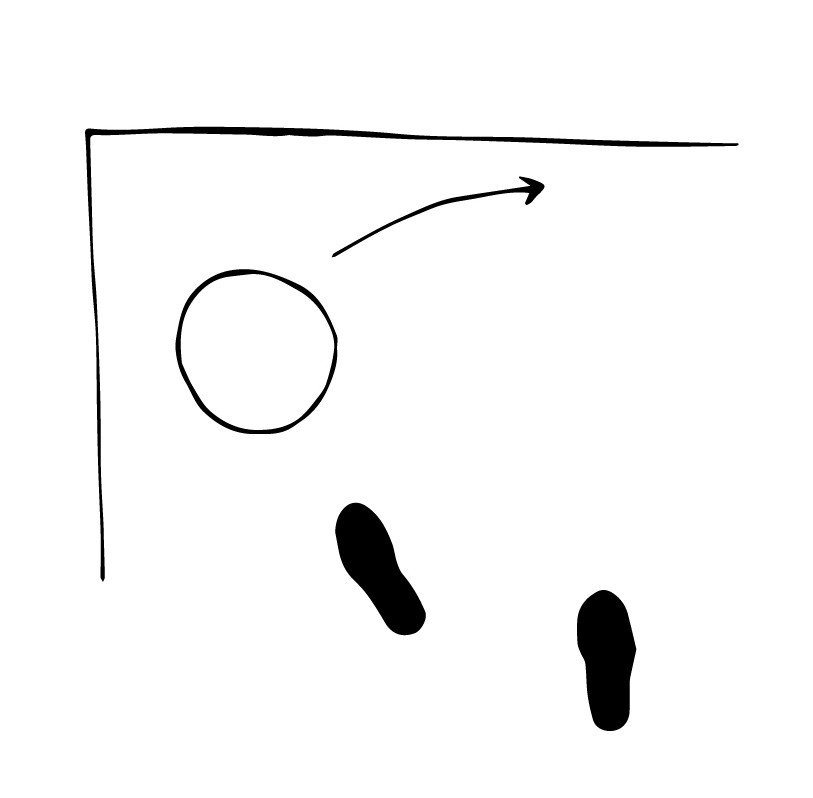
Fig. 1
If the pursuing fighter pivots around his lead foot and follows, as in Figure 2, he will provide space for the circling fighter to follow the ropes and then move back out into centre ring. You will see this happen dozens of times even in the professional boxing ranks. The ring cutter wants to use the ropes, and his body, to force the circling fighter to move through punching range and, ultimately, get pinned down in it.
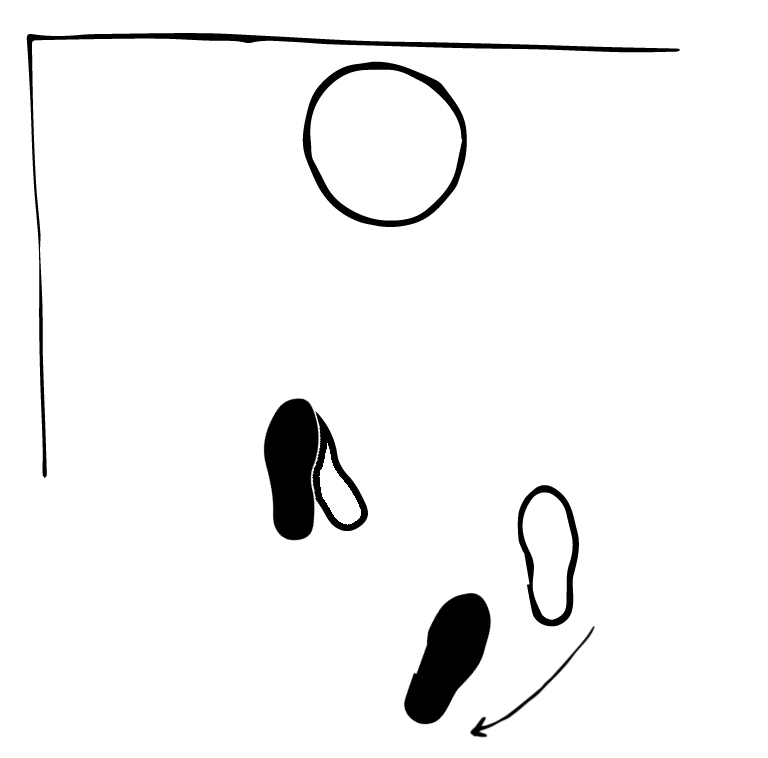
Fig. 2
This time, in Figure 3, when the circling fighter moves around and along the far ropes, our ring cutter performs an offensive side step with his right foot. He has taken away some of the space and now he, or rather the threat of his punching, is obstructing that path along the ropes.
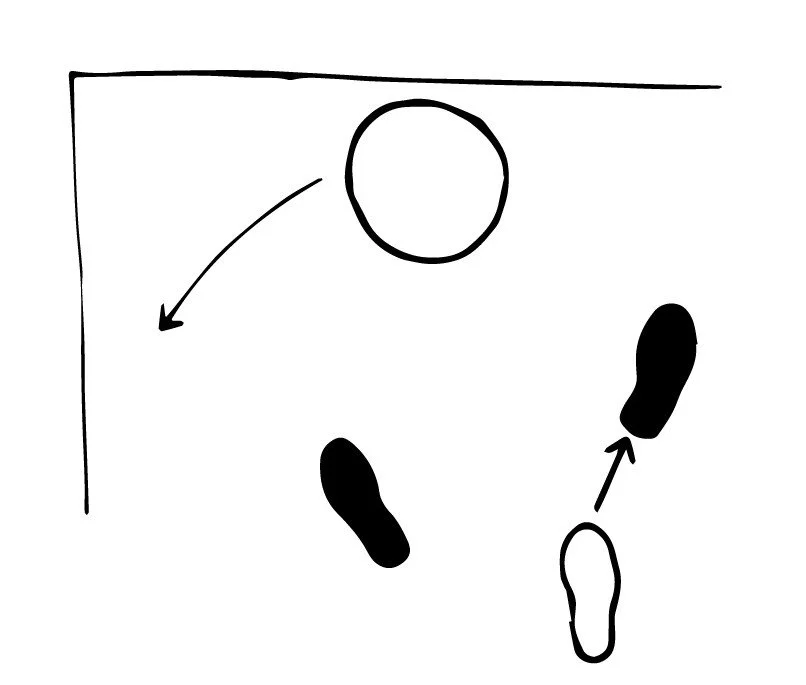
Fig. 3
The circling fighter is forced, by the pressure produced by the ring cutter, to change direction. Occasionally a fighter will attempt to run right through, but he is moving straight through his opponent's hitting range. Many fighters, like George Foreman or the kickboxer, Ray Sefo, would use a stepping right hook to pin a running opponent down or knock them out. In this instance, and in most instances, the circling fighter reverses direction in an attempt to avoid resistance.
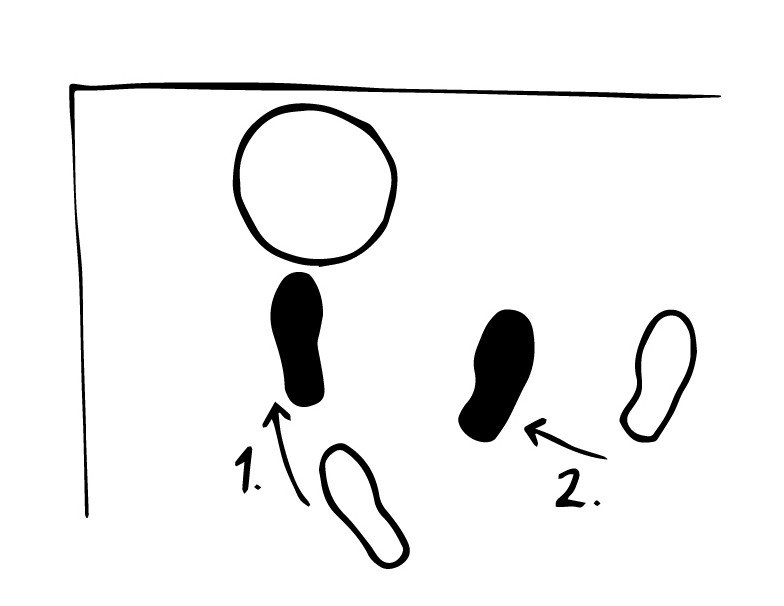
Fig. 4
Figure 4 demonstrates the follow up from the ring cutter as he drives his left foot across to cut the ring again, bringing his right foot in behind. Whether the circling fighter gets caught on the ropes or in the corner just depends on where he gets cut off. The key is that every step should take away some of the distance between the fighters, and reduce the size of the area which the circling fighter can work in. Cutting down the ring from its full size, to a half of its size, to a quarter—and then the circling fighter is basically in the corner at all times.
That cutting step is the crucial part of cornering an opponent. It makes the ring cutter a good deal easier to hit, but that is why he must develop smothering hands—a la Saddler and Foreman—or constant head movement as Mike Tyson and Julio Cesar Chavez. The ring cutter is going to get hit, he is going to let his man escape the corner at times, and he is going to have to keep starting the process over. But it's not meant to be flawless or pretty, he is attempting to force a fight rather than a boxing match.
If the ring cutter can trap his opponent on the ropes / fence, or in a corner, he has several options. He can wing away with flurries, he can wait for the opponent to try to fight his way off the fence (as the opponent will likely be hurrying under pressure) and counter, or he can transition to that art form which separates the men from the boys, infighting.
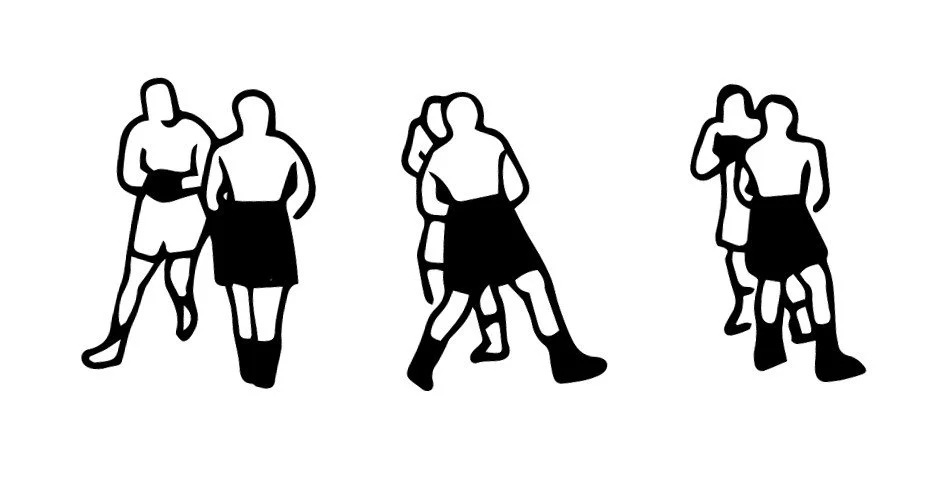
Fig. 5
It will rarely be simple, the difficulty is in not overcommitting on the cutting step to obstruct the opponent's path and force the direction change. If the ring cutter steps too deeply to obstruct his opponent's path, the opponent will be free to escape out the other side. Really, ring cutting is using the body and the threat of punching to hold a bubble under water.
The best defensive ring strategists are the ones who use feints and direction changes along the ropes to force a ring cutter to mistime their steps. The best ring cutters are those who can assess when it is appropriate to commit. And this is where the world of boxing leaves the cold and technical and moves into the realms of psychology.
The ropes are a power puncher's best friend because they can be used to herd his opponent into blows. As soon as a fighter's back is to the ropes, his possible directions of movement have cut down from a possible 360 degrees to just 180 degrees. A good deal of those options are also blocked by the fighter who is cutting the ring.
Essentially the fighter along the ropes is given three choices—move left, move right, or stand and fight—as shown in Figure 6. The latter simply means that the ring cutter can start working with flurries and move to the infight—flattening the stance of the man on the ropes and removing his punching power. Movement to the left or right is the expected response to the danger of getting trapped on the ropes and that leads into the herding game.
Essentially all power hitting is about creating collisions. Rather than one man's punching power, a knockout punch is a product of two forces. The hardest hitter in the world isn't half as effective if his opponent is moving in the same direction as his punches. That is the purpose of rolling with punches—to take the force off of them by moving with them.
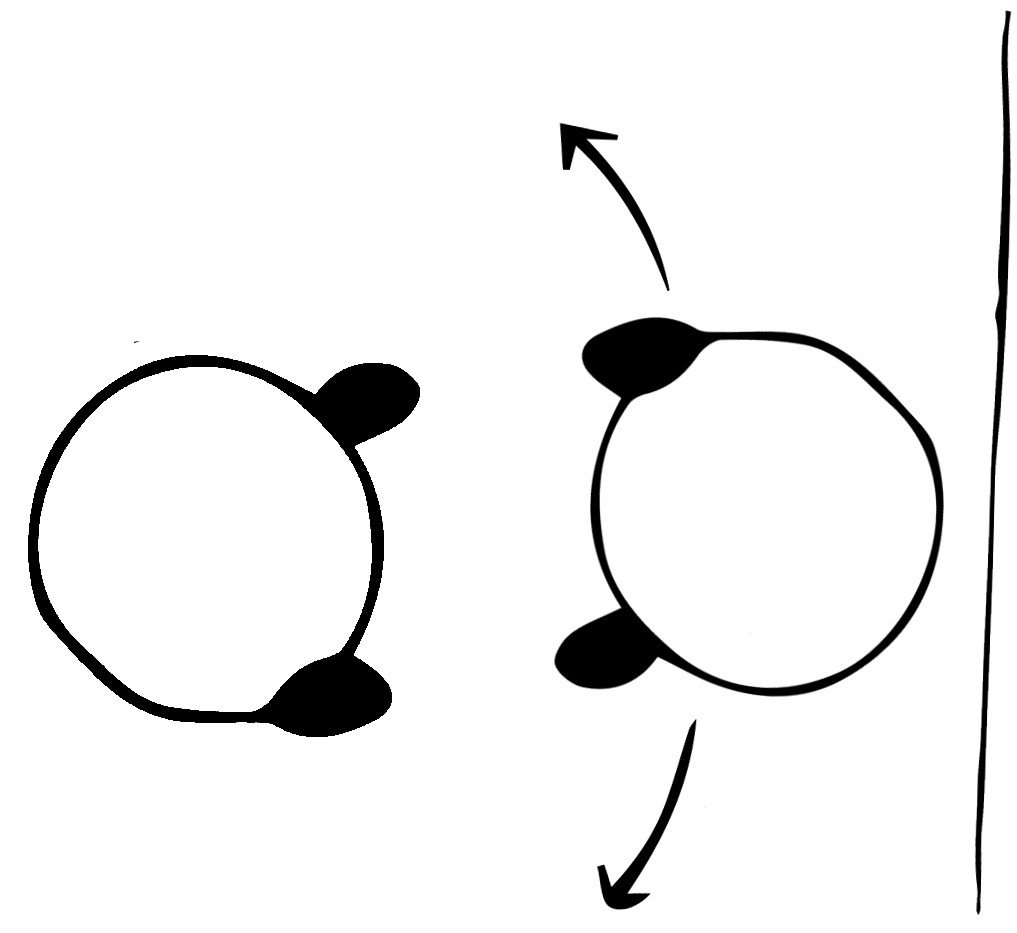
Fig. 6
A quality ring cutter has a double threat—two techniques which will punish his opponent for moving right or left. In boxing, the best ring cutters must have a quality left and right hand. In kickboxing and MMA, many fighters have a solid left hook and a strong right round kick. Some even use a right round kick if their opponent circles right.
If the fighter who is trying to escape the ropes circles into a strike, he will effectively double the force of it. Many of the best one punch knockouts have come as a fighter circles out into a left hook or an overhand right which he just didn't see coming. But if he blocks the punch? That's fine, he cannot physically move through the strike, so it will serve to pin him in place while the puncher follows with combinations.
George Foreman used to cut across his opponent and as they attempted to escape to his left, he'd hammer them with a left hook as in Figure 7. This pinned them in place as he loaded up his terrific right hook or uppercut.
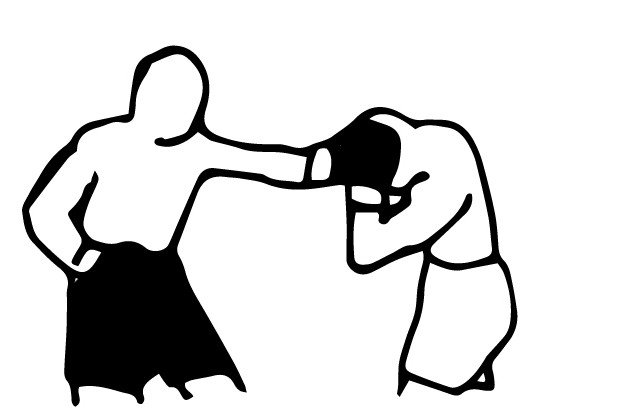
Fig. 7
When Foreman's opponent circled out to his right, Foreman would throw his right hook to the body as in Figure 8. Against a side on opponent, Foreman was happy to catch the kidney, but against most it would catch the ribs or land on the elbow. The primary objective—standing Foreman's opponent still for the coming storm—was achieved either way. If he caught and broke their rib in the process, even better.
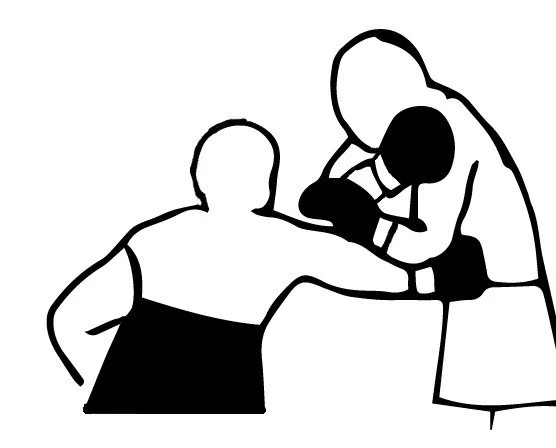
Fig. 8
Sports can often be boiled down to one important fight to get the upper hand. In chess it is often control of the centre, in wrestling it is dominating the tie ups, in Judo it is getting the right grips. In the case of striking based sports, the key fight is where the bout takes place. The man who ends up on the ropes or against the fence is at a tremendous disadvantage.
The ring cutter may swing in with blows, wait for the opponent to attempt to fight off the ropes and then counter, or transition to that grittier sphere of battle, the infight.
Infighting
He makes you think you're in a glove factory and shelves of them are tumbling down on you. - Jack Dempsey on sparring with Harry Greb.
The art of traditional infighting is almost lost in modern boxing. Yet, when infighting is done well it is truly fight changing. Adept inside work is a smothering blanket of punches, pushes and turns which keeps a good boxer from being able to do what he does best: box.
There are two main phases to any boxing contest—the outfight and the infight. The outfight is that of long, straight punches, of set ups, parries and counters. The infight is the wild and wooly exchange from inside of punching range. Now an infight can be two men trading blows, just as the outfight can, but just like the outfight—there are scientific approaches designed to make the action a stream of one way traffic.
In scientific, traditional infighting, the opponent must be smothered at every opportunity. His offense must be suffocated and stifled, but you must avoid clinching at all times—because that is what the weaker man wants. If you're losing on the inside, you tie your man up, then the referee breaks you and you have a chance to move again. Infighting effectively is the balance between wrestling with your opponent, and allowing yourself enough freedom so that you can always throw enough punches that the referee won't call a break.
In traditional infighting, the head is used a great deal. That is not to say that it should be used for butting and opening cuts, but modern referees feel so uncomfortable seeing heads come together even at low speed that traditional infighting techniques don't even get a chance to get going.
In the classical method which became so popular in the 1920s and 1930s, the head braced against the opponent to control his position and stance, and also to keep the infighter's head safe from punches. There are very few men who can throw a powerful uppercut or hook right up next to their own head or in front of their own sternum. Distance is needed to punch and by jostling for head position, an infighter turns a match of footwork into a match of grips and slips in order to expose the good blows.
In the days of bare knuckle pugilistic contests men were allowed to wrestle and throw each other if they liked, making the infight more of a wrestling match. By the gloved period there was still a good emphasis on wrestling and the clinch. Jim Jeffries was terrible defensively but wore down 'The Dancing Master' Jim Corbett and Robert Fitzsimmons over a course of rounds by use of his enormous strength any time he got close enough.
While throwing was absolutely illegal by the time that Jeffries became heavyweight champion, he trained extensively with the great wrestler Farmer Burns and his student, Frank Gotch. Fifteen years before Jeffries took the title, the inaugural belt holder, John L. Sullivan had famously been coached and brought into tip top condition by the wrestling champion William Muldoon ahead of his bout with Jake Kilrain.
After Jeffries retired undefeated as heavyweight champion of the world, the belt fell into the hands of Jack Johnson, the first black fighter to ever win it. Johnson's bread and butter in the ring was the clinch and the infighting. Though exceptionally tall for a fighter of the time, Johnson did not 'stick and move', and the modern notion of him as a traditional boxer is a false one. Johnson's entire game was diving into a long clinch and battering his opponent from there.
When I say long clinch I mean that Johnson's hands were on his opponent as in Figure 1, and he was undoubtedly wrestling with them, but it was not a classical tie up. Johnson was absolutely free to punch which prevented the men from being broken apart. Using what are commonly called “bicep ties” in the modern era Johnson would smother his opponent's punches, push him around, and when he felt a return would free one hand and throw a snapping uppercut.
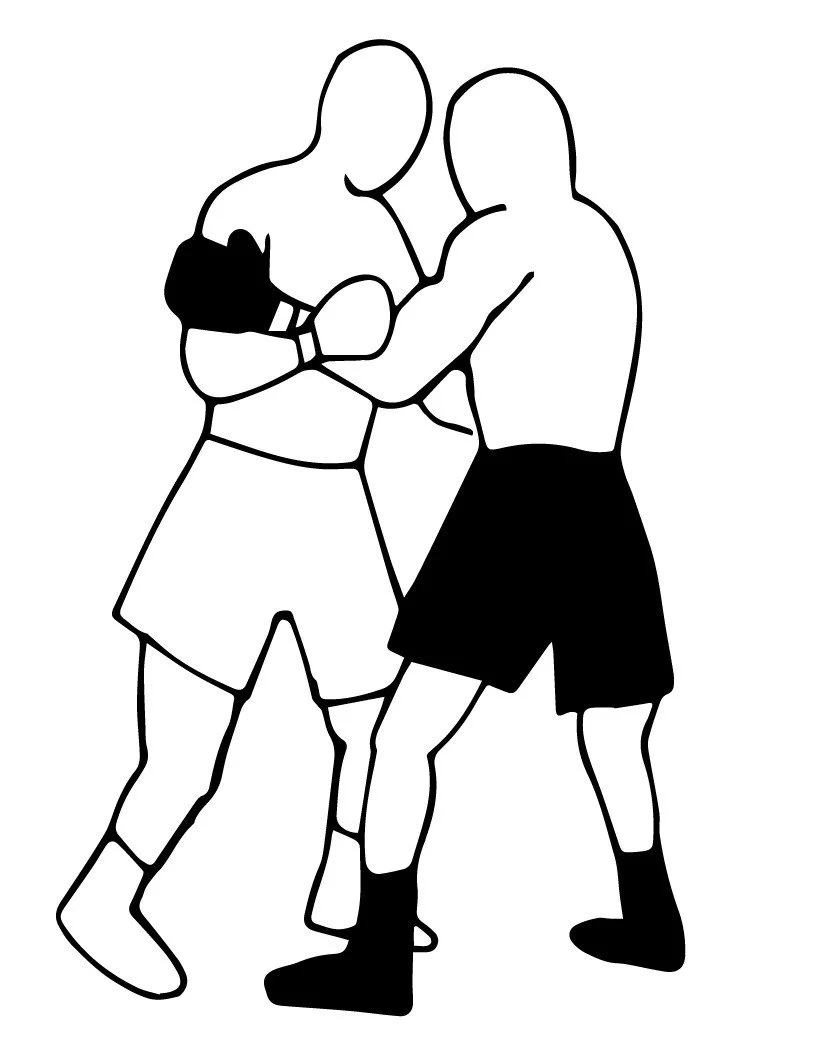
Fig. 1
Jack Johnson excelled at smothering his opponent's offense while staying out of a true tie up. He achieved this by using his hands to hold his opponent at the biceps. Each time the opponent tried to swing, Johnson would push back or raise his elbow and stop the blow. Remember that in Johnson's day the thumb of the boxing glove was separate from the main fist, allowing him to grip the biceps.
In this manner Johnson beat Tommy Burns, Jim Jeffries, Stanley Ketchel and numerous other famous fighters of the times. It was an alien style of boxing – one of prevention rather than relying on overwhelming an opponent with offense. It earned Johnson a reputation as a defensive genius, but also as a boring fighter. His arrogance certainly didn't help his negative press; Johnson talked to his opponents and their coaches incessantly during his bouts, fighting by feeling rather than by looking.
But what Johnson did was one punch at a time. It was more attrition by smothering than an offensive strategy. Through the 1920s and 1930s, boxing in the United States became more and more enamoured with the infight. Meanwhile, Britain was still producing upright outfighters. The rivalry was as much one of words as it was of styles, and both sides seemed reluctant to admit to there being any merit in the other's method.
Jim Driscoll—referred to as “Peerless Jim” by the press and public alike—was a great Welsh boxer. Deified in the British press, Driscoll—in defence of the British art of upright boxing—wrote:
The “Bear-Cat” brigade are fond of boasting that they pick their punches up from the floor. This is just boast (for, as I trust to be able to show later on, all punches should be picked up from the floor), but they omit to mention that their arsenals are almost entirely occupied with the manufacture of giant howitzers and that their attacks are consequently only of real use when they are directed against a more or less stationary and exposed fortification.
Meanwhile, Frank Klaus, a great American infighter wrote this about traditional boxing methods:
“… [one] must not be confounded with the jab, which is but a rap to the face or body, carrying but trivial consequences. The expression “jabbing a man's head off,” although often used by writers, is sometimes an inaccurate description of a series after series of half-arm left flicks.”
“It seems to me that decisive victories are seldom brought about by the aid of this mysterious 'jab'.”
Perhaps the most notable infighter of all time was Henry Armstrong. “Perpetual Motion” owned almost as many world titles as he did nicknames. Through his brutal pace and brilliant inside game Armstrong won the featherweight, welterweight and lightweight world titles. He challenged for the middleweight and lost a controversial decision. What makes Armstrong so fascinating is that the infight is perceived to be a stronger man's game, but Armstrong's style allowed him to perplex fighters from his natural weight—featherweight—all the way up to middleweight where he was robbed of a decision win over the middleweight champion of the world.
Armstrong's modus operandi never changed and it confused a great many pundits that he was so successful at four major weights despite fighting nothing like an orthodox boxer. Most writers remark that from the first bell Henry would be pressed up against his opponent and looking down at their feet, and this aptly describes the infighting posture which Henry took.
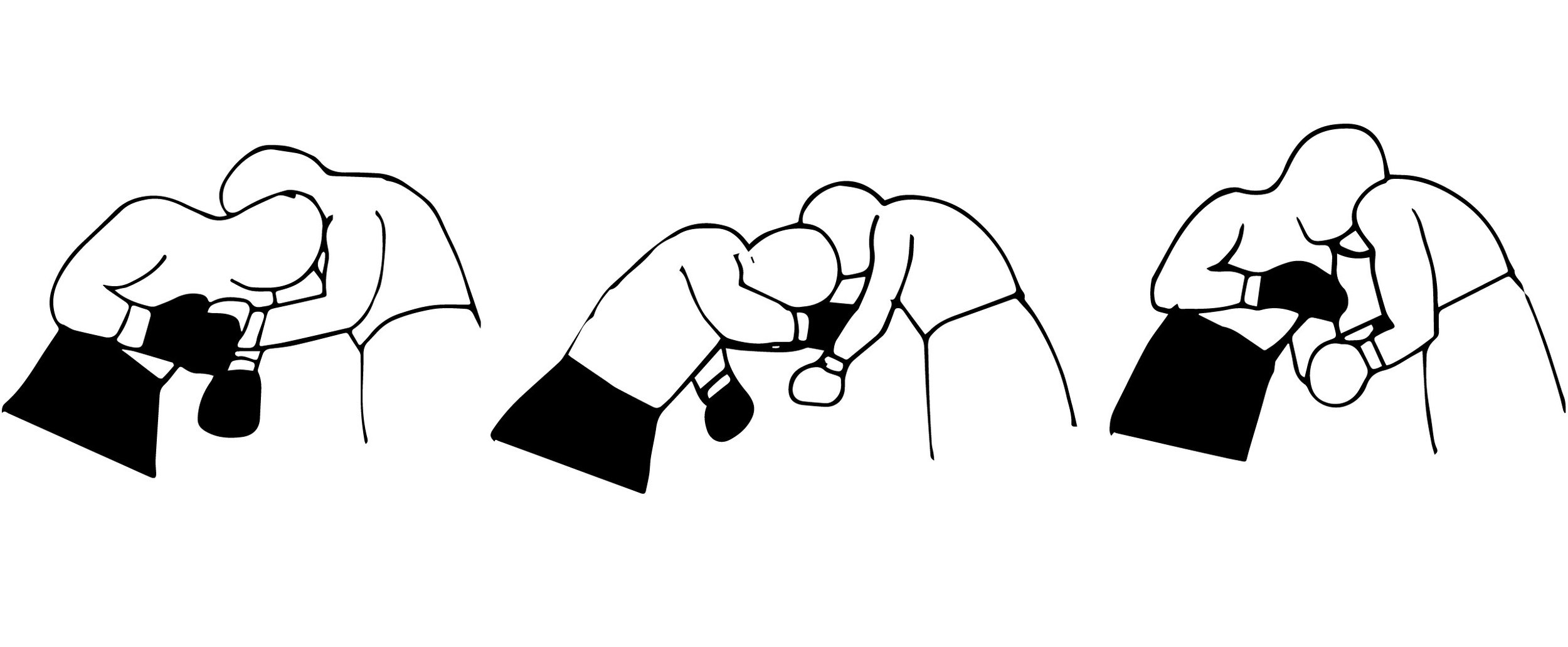
Fig. 2
Armstrong's “headquarters” position was with his head placed on his opponent's left shoulder. From here he would check their left hand into their chest with his right, load up his left hook, then land a left hook to the sternum and return his head to their left shoulder.
From his head to head position with his opponent, Armstrong would constantly be working his short, digging left uppercut to the solar plexus as in Figure 2. It didn't look like much, but Armstrong landed more of these short shots to the mark than most outfighters landed jabs in a bout with him. Breaking the opponent's breathing rhythm and sneaking in when they were trying to break free or clinch, it was almost Armstrong's equivalent of the jab.
The short left to the solar plexus allowed Armstrong to stay in close, but of course Armstrong had his head safely on his opponent's left shoulder, the opponent was in the exact same position—well away from Armstrong's right hand. In hoping to land his “sneaker” right hand, which he referred to as a “blackout punch” Henry would often look to bump his upper arm and shoulder into his opponent's chest (or face) to lift their head and cause a separation as in Figure 3. With his opponent's head elevated, Armstrong would immediately smash in a right hook to the head.
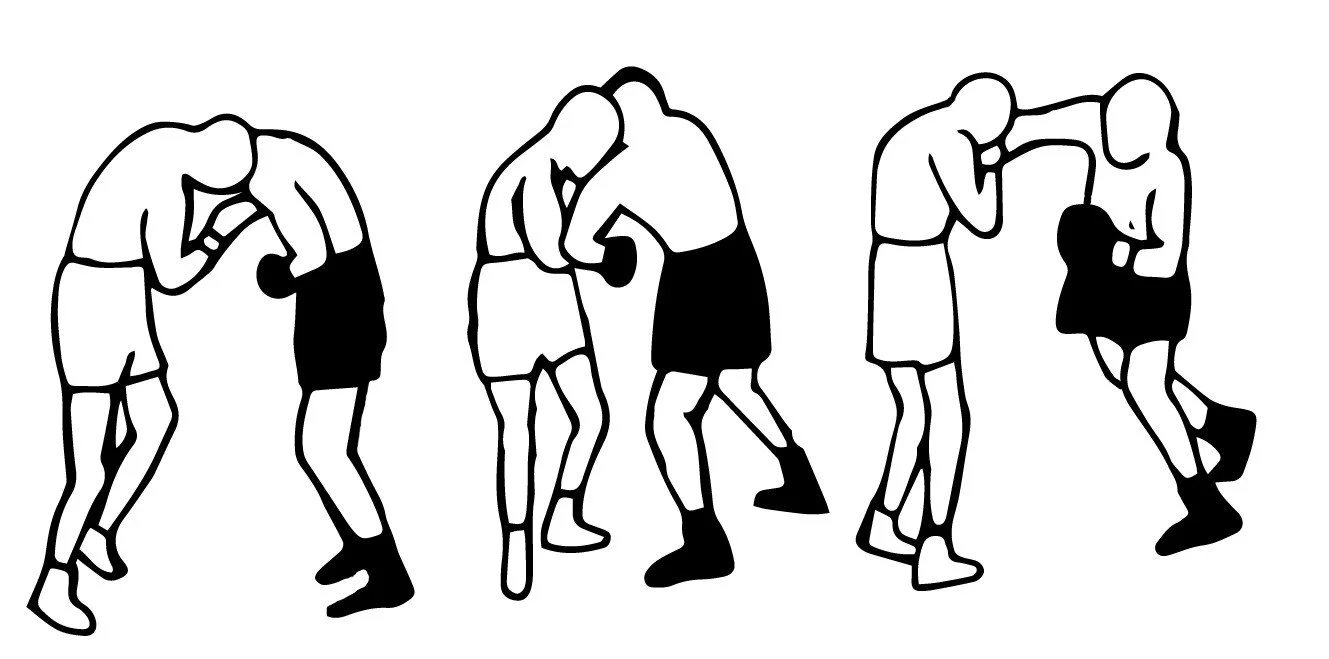
Fig. 3
Armstrong's infamous “sneaker” right, or “blackout punch” was a right hook, preceeded by a sneaky shoulder bump to raise the opponent's head.
Obviously, infighting was not—as Klaus and so many other Americans advertised it—an answer to all the problems a skilled boxer can put forth. Much of the difficulty in infighting against a skilled opponent is avoiding being tied up. One of the reasons that infighting is more suited to fighters with shorter reaches is that, as they punch from close range, they leave less space to overhook or underhook an arm.
In layman's terms, an underhook is reaching under someone's armpit to gain control—as you would if you were hugging someone. An overhook is wrapping your arm over an opponent's arm, which is in your own armpit. The classical tie up is the use of one of each—holding the opponent close, and tying up one of his hands completely.
An example of a fighter who did an excellent job of avoiding being tied up by skilled boxers is Rocky Marciano. Marciano, who retired undefeated as the heavyweight champion, also possessed the shortest reach in heavyweight championship history—it was imperative that he got to the inside, and that when he was there, he was free to work.
In his bout with Ezzard Charles, arguably one of the finest ring technicians of all time, Marciano kept up his brutal assault on the inside by jemmying his head between himself and Charles whenever Charles tied him up. By using his head to create space between their chests, Marciano was able to slide his arms free and go back to pounding Charles' body.
Any time Charles attempted to tie him up, Marciano would get his head underneath Charles' or against Charles' shoulder and use it to create space between their bodies. If Charles kept trying to hold as his arms stretched out, Marciano would throw a chopping punch to the ribs as in Figure 4. Marciano was able to get a huge amount of power on what Jack Dempsey termed “partial punches”. Those punches which have little hip movement and no great transfer of weight. They are impure and traditionally lack power, but Marciano could deliver hundreds in a fight with a good bit of wallop.
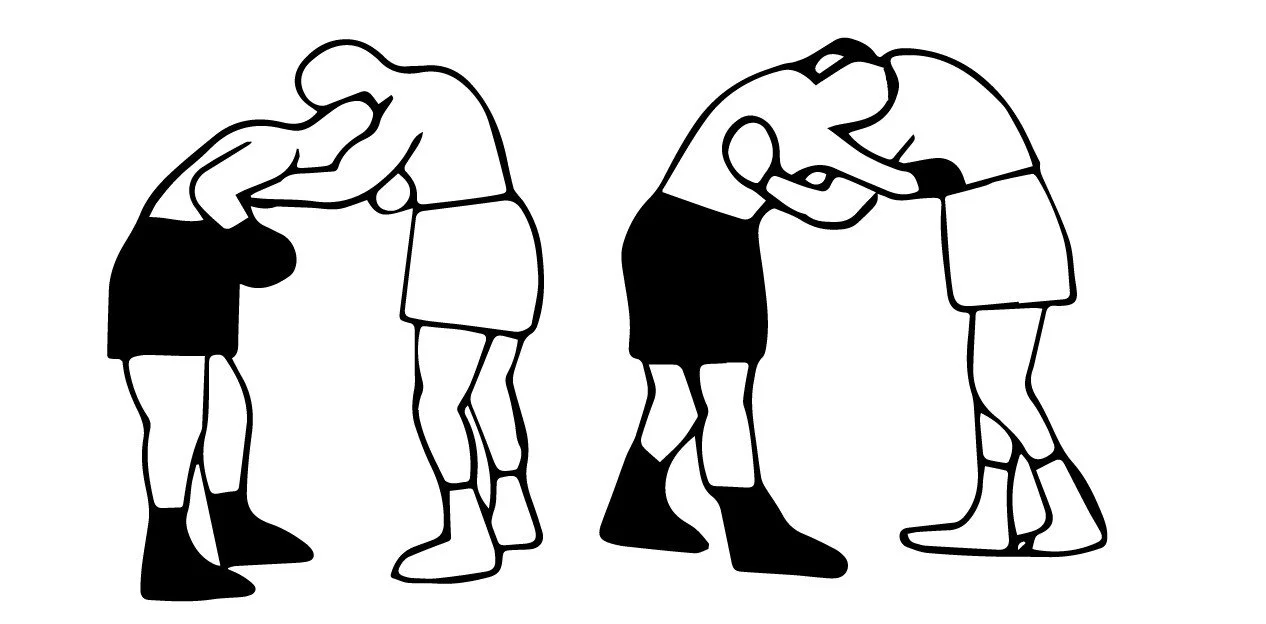
Fig. 4
When a fighter keeps his head underneath his opponent's, he makes it difficult to pull him into a full, chest-to-chest clinch. By creating this room, Marciano ensured that he could still work. His right hook to the rib cage underneath the opponent's outstretched underhook (the arm reaching underneath the armpit) was a real winding blow.
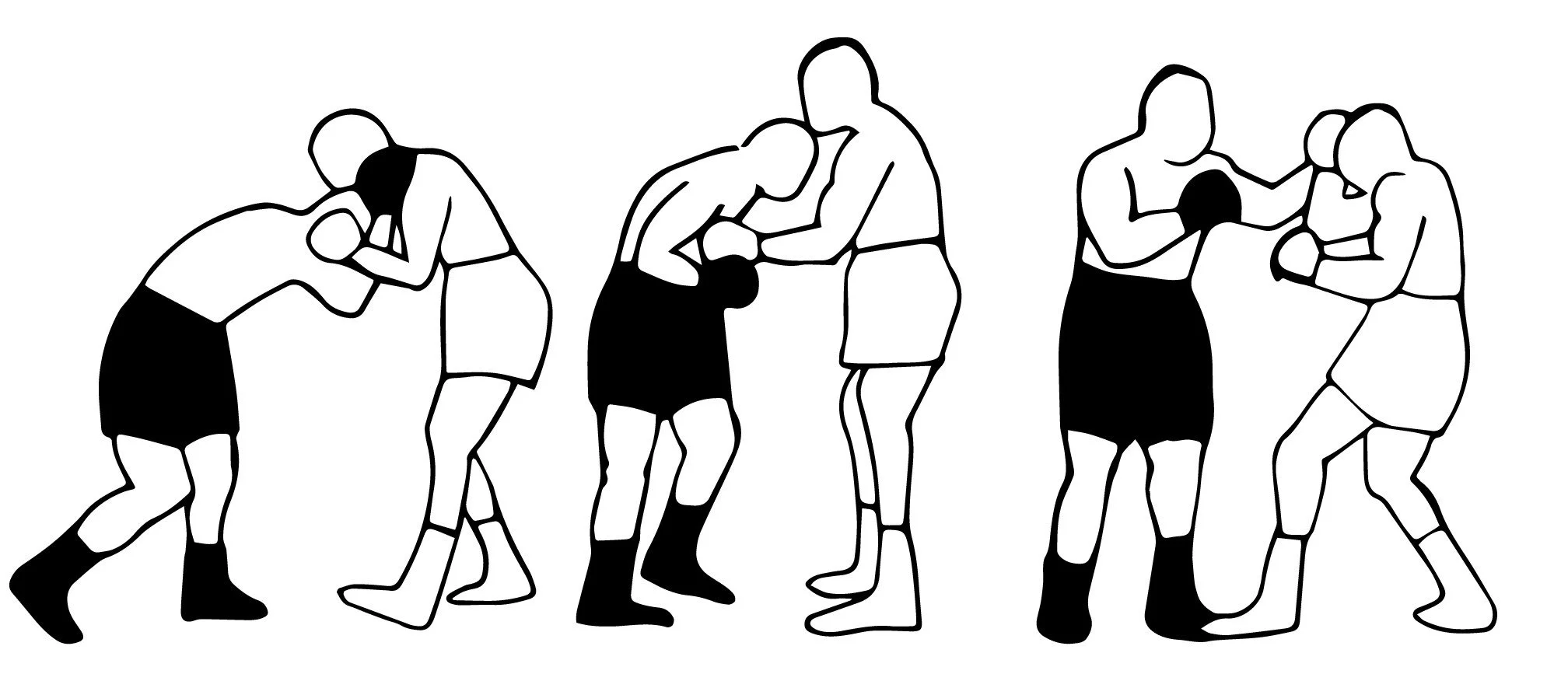
Fig. 5
Marciano would also use his head underneath his opponent's to drive them up out of their stance as in Figure 5. Once their feet were level, and they lacked the balance that stance provides, Marciano would swing a left hook in.
A great deal of the beautiful wrestling technique that was visible in infighting in the early twentieth century has disappeared in professional boxing. But the rise of mixed martial arts has brought the importance of head position and punching on the inside with limited space back into fashion. The Ultimate Fighting Championship heavyweight champion at the time of writing is Cain Velasquez—a tremendously skilled wrestler who pins his opponents to the fence with an underhook, frees one hand, and then uses his head underneath his opponent's to create space to punch with power.
If the outfight can be compared to a chess match, the infight is not dissimilar to a dog fight much of the time. It is a dirty business even for clean fighters as heads clash, feet get trodden on (a favourite of Archie Moore) and punches fall low. It is certainly easy to see why British boxing purists looked down on “two fisted hitting”. Yet Henry Armstrong's success against fighters with twenty pounds of muscle over him should destroy the idea that it is solely a size and strength game—and his escaping without a mark against tremendous counter fighters like Barney Ross stands as a testament to infighting's defensive qualities.
There is no denying, particularly as we see more and more MMA fighters using the hand fight and the head fight to land two handed salvoes, that infighting is an ugly business, but there is certainly beauty in the method.
Dirty Tactics
Since the first time rules were laid down for a fight, there have been fighters who feel constrained by the legal strikes and techniques and instead want to mix in some extra-curricular violence. Dirty tactics are enormously varied because as soon as a rule is made against an act it is essentially confirmed as disproportionately effective in a contest.
Dirty tactics share an enormous amount of cross over with what is called “savvy”. Savvy is simply knowledge brought by ring experience. A savvy fighter will use any slight advantage against his opponent in order to out-fight him.
One of the first instances of savvy and dirty tactics crossing over was the art of “dropping”. In the days of bareknuckle boxing contests rounds were decided by the first man to touch the floor (whether this be by a throw, a slip or a punch). Dropping was the art of writing off a round in which one was doing badly (or avoiding a blow when positioned terribly) by dropping to one knee.
While technically illegal it was pretty easy to hide, or at least feign fatigue as if struggling with the effects of a body punch. This meant that rarely were there disqualifications taking a knee, but crowds despised it. Remembering that these were the days when moving away from a blow rather than blocking or taking it would see a fighter called “yellow”, dropping was not always a great career move even if it was a sound strategic one.
Hitting low is, of course, as old as pugilism itself. There have always been men who are happy to give a quick tap south of the border when in close to make the opponent's eyes water a bit, or simply to take his mind off of his game while he complains to the referee in disbelief. The most infamous case I can think of in recent history is, of course Roberto Duran's low blow on Kenny Buchanan.
Duran's blow came at the end of the 13th round as the referee attempted to separate him from Buchanan after they continued past the bell. The uppercut highlighted the issue that many cups do not provide adequate protection from blows coming from underneath rather than straight on. This means that body hooks which fall low can be fairly well weathered but deliberate blows from underneath the crotch are still as hazardous as ever. Years later Buchanan conceded that he thought of his old foe often. In fact, whenever he pissed.
An even more recent example was Abner Mares' first bout with Agbeko. The referee, Russell Mora, was either corrupt or dangerously inept as he allowed Mares to double and triple up with hooks to the crotch. It was an embarrassing night for boxing and illustrated that officials are now so bad that no-one can work out whether the egregious officiating is corruption or plain old incompetence.
Butting is something which has always been illegal because it is an effective method of opening cuts on an opponent and simply because the skull is a large, ungloved, solid surface. To illustrate the efficacy of the headbutt one need only watch the first few Ultimate Fighting Championship events where Mark Coleman was present. A brilliant wrestler he was able to take his opponents down and negate their ground game by simply head butting them to a stoppage.
Headbutting is now coming close on an art form with all the many ways fighters manage to get away with it. Perhaps the master of headbutting without warning was Evander Holyfield. Evander would use his head as a counter punch all of it's own. A perfect set of examples are Holyfield's bouts with Mike Tyson.
Tyson, a great puncher who excelled in close, would charge to close the distance and Holyfield would slip Tyson's lead by just enough that his head was still in Tyson's line as Tyson came in. This in itself takes commendable defensive ability. As Tyson charged in behind his jab he would crash face first into the top of Holyfield's head as in Figure 1 and look visibly stunned.
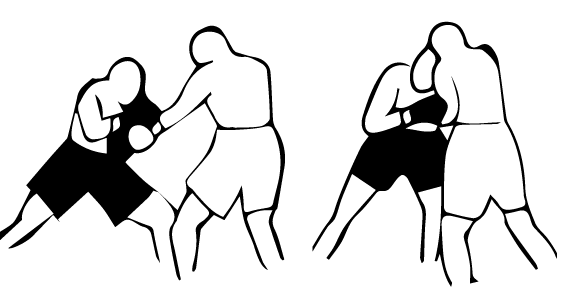
Fig. 1
Other fighters have excelled at throwing their jab and immediately ducking in behind it, resulting in a collision between the hard top of the head and the opponent's face as in Figure 2.
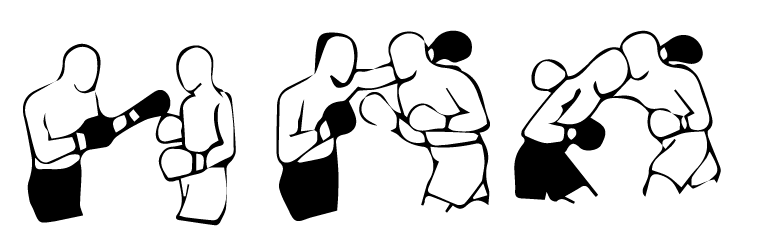
Fig. 2
Of course blatant butting will still get you disqualified in most combat sports fairly quickly. One of the most hilarious instances of this was Fireman Jim Flynn's shot at Jack Johnson's heavyweight title. Frustrated by Johnson's stifling of every offensive attempt, Flynn found himself in close with the taller Johnson and decided to jump from underneath the champion's chin. He attempted this several times before being disqualified in an embarrassing performance.
Outlawed in almost all combat sports and promotions for much more severe reasons is the blow to the back to the back of the head. The term “rabbit punch” comes from the short, sharp chop to the base of a rabbit's skull used to finish it off during a hunt. The supposed master of this technique was Jack Slack, heavyweight champion of the world from 1750. Slack is reported to have blinded several men during his career with this technique.
A modern day master of the rabbit punch is Bernard Hopkins. Hopkins uses a variant of a technique that Georges Carpentier pioneered called waltzing. Ducking an opponent's punch, Hopkins will turn the opponent as he moves out to the side. He will the swing in a right hook over the back of the head. The true skill in this technique comes in not moving so far behind the opponent that the strike from behind is blatant.
Banned in boxing for similar reasons is striking with the elbow and forearm. Anyone who has watched some Muay Thai or a great ground and pounder in MMA will know how effective elbow and forearm strikes can be. There are several ways to land elbows illegally in boxing while reducing one's chances of getting caught.
Sandy Saddler, the great featherweight champion, greatly enjoyed holding and hitting (another illegal tactic) but would often deliberately miss an uppercut in order to follow through with a rising elbow strike. These kind of blows are wonderful for cutting an opponent's skin and simply giving him a hard bump that he couldn't have seen coming.
Mike Tyson was also masterful at hiding elbow strikes. When the referee was behind him in a clinch he would simply bring his elbow up into the opponent's face, entirely hidden from the referee's sight by his enormous frame.
Floyd Mayweather Jr.'s favoured method of connecting elbows on his opponent is to lift his lead elbow high in front of his opponent as they charge in. This is similar to Holyfield's lowering his head into the path that he knows his opponent's face is coming in on. Foul play but seen as the opponent running onto a head or elbow rather than a deliberate strike.
A look at Mayweather's bouts with Ricky Hatton and Shane Mosley will show you all you need to know about sneaking elbows into a boxing match.
A dirty technique which goes significantly under-appreciated is the act of stepping on an opponent's toes as a punch is launched. Hitting a fighter with a decent blow while pinning his lead foot basically assures a knockdown as he is severely limited in adjusting his balance. Stepping on the foot before the punch is thrown also prevents him from moving out of the way of it. Archie Moore was reportedly a master at this technique. In more recent times it has been used by James Toney and Naseem Hamed.
A savvy fighter can be a dirty fighter, but they are not one and the same. Some tactics which could be called savvy are used by more experienced, wily fighters and aren't so much dirty tactics as taking small advantages.
A brilliant example is Roy Jones Jr.'s walking around the back of the referee every time he and an opponent were broken from a clinch along the ropes. Jones had no interest in being pinned against the ropes most of the time, so as the referee broke a clinch between him and his opponent he would walk behind the referee back into the centre of the ring, using the referee as a barrier between himself and his opponent.
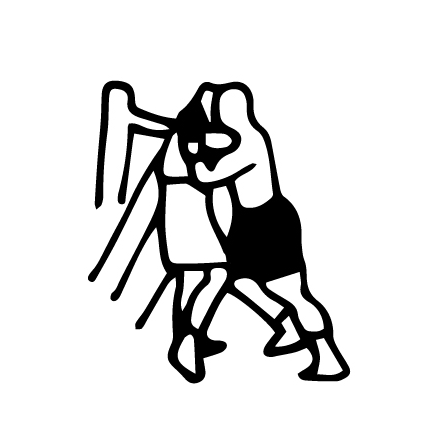
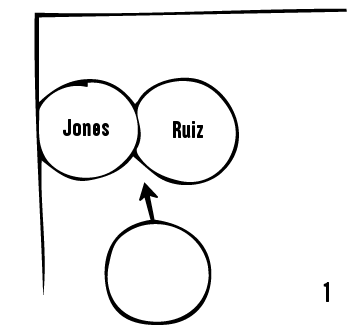
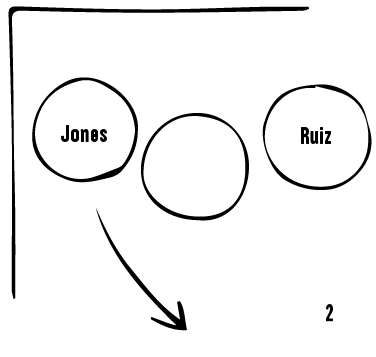
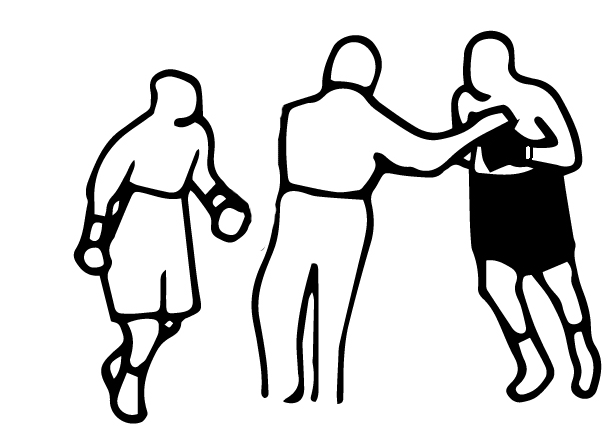
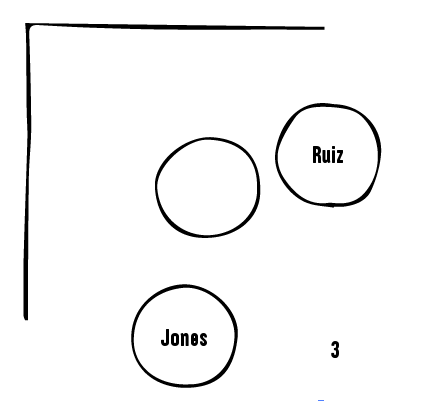
Very few referees actually stop Jones from doing this, and few even notice it is going on, but his opponent certainly does. Against John Ruiz, Jones performed this technique on almost every break, much to the chagrin of Ruiz's corner.
The reverse of this tactic was used by Roberto Duran against Davey Moore. Every time the referee came to seperate the men near the ropes, Duran would let the referee get between them but would stand firm. As the referee separated the two men, he would push Moore back onto the ropes and Duran would be no further from his opponent. A better referee would stop Duran from doing this but so few are willing to assert themselves.
A final savvy tactic worthy of consideration because of it's questionable morality is hitting on the break or the so called “sneaker”. Hitting on a break instigated by the referee is blatantly illegal, but hitting on a break agreed upon by the fighters is entirely legal and an excellent way to land a telling blow.
This tactic was recommended by Jack Dempsey in Championship Fighting and really comes into effect in a fight with a great deal of clinching. If the referee repeatedly breaks the fighters and on one clinch a fighter ceases activity he may lure his opponent into breaking before the referee has commanded the fighters to. At this point the first fighter can land a blow basically freely. As I said, questionable morally, but unquestionably effective.
Lyoto Machida and the Pursuit of Perfection
I have always believed that perfection is unattainable, but that the naïve pursuit of it makes the best of us. The suspension of reasoning and the make-believe that we can achieve it, that it's just over that next hill, produces world champions out of the gifted and unexpected results from those who seem dull and untalented. In the world of fighting you learn early that going into a fight and expecting to make your way through it without getting hit is a recipe which yields only the ashy taste of disappointment.
The old saying insists that going into a fight and expecting not to get hit is like going out in a storm and expecting your umbrella to keep you bone dry. Yet that childish belief that perfection can be attained has existed in most of the best fighters in the world—the ones who come out of a fight and even after winning recognize that they got hit too much and head back to the gym the next day, shoring up their defences.
Yet if the definition of scientific fighting is 'to hit and not get hit', there have been a few who have routinely come close to achieving it to the letter. From Willie Pep—the famous Will o' the Wisp who supposedly once won a round without throwing a single punch—to Roy Jones Jr., who scored the only full round on record in boxing with no punches landed on him. But the man who I believe has come the nearest to the definition of perfection in combat sports is the Brazilian karateka and former UFC champion, Lyoto Machida.
Over the years of covering his bouts, Machida has become my obsession. I have studied every movement he has made in the ring and in the Octagon, and written articles on many of the key ones. I have even travelled to Japan to train with men like Kojii Ogata who have bested him in pure karate competition. And just as I had gotten comfortable in propagating the notion that he was half the man on the lead that he was on the counter, a one trick pony even if he was a genius at that one gambit, Machida unveiled a new knockout blow just a few metres from where I sat at ringside in Manchester.
On the Nature of Karate
I have declared before that I believe Lyoto Machida to be the last true karate master, as he uses his art to take on the most accomplished fighters from all disciplines—but there is a good deal of confusion as to what 'karate' itself is.
Karate might bring to mind a group of children trumping up and down in white pyjamas, spasmodically pumping their limbs and yelling in unison when instructed. It's no secret that most traditional martial arts classes are aimed at children rather than focused on teaching fighting skills to adults. Machida has been practising the art of karate since childhood, but banish this idea from your mind when we're talking about Machida's karate.
You might, if you have been around combat sports for a while, remember the tremendous kickboxers who hailed from full-contact karate backgrounds. The legendary Andy Hug and his terrifying axe kicks for which, to this day, no-one has developed a decent defence or counter—in fact, since Hug's demise they haven't had to! Or perhaps the Brazilian brawlers, Glaube Feitosa and Francisco Filho, with their tremendous toughness and that brilliant Brazilian kick which came up as if a straight front kick, before tracing the arc of a question mark and ending in a round kick to the neck.
Or even the great Semmy Schilt, the most accomplished kickboxer in history, whose tremendous lead leg snap kick broke ribs and bruised solar plexi the world over. But none of these men came from the same style as Machida.
Karate as it was on Okinawa—the famous unarmed island, where weapons were banned for all since the 1500s—was nothing like any of the karate we see today. In fact it was called Tode (pronounced Toh-day), meaning 'Chinese hand'. It was simply Chinese martial arts mixed with whatever else Okinawans could get their hands on. It was only once the art was introduced to the Japanese mainland that it became Karate or 'empty hand'. This change is understandable when one considers the staunchly anti-Chinese sentiment on the Japanese mainland both in the lead up to and aftermath of the Second World War. With a focus on body conditioning and extremely limited live sparring, old karate is nothing like Machida's karate either.
No, Machida karate is Japanese karate. Shotokan—Machida's style—developed in Tokyo universities through the 1930s and 1940s. Experimentation with sparring was extensive, but contact was limited. These were men who genuinely thought they were developing Ikken Hisatsu ('one hit, certain death' power). Gichin Funakoshi, the teacher of these karateka, and his insistence that one should treat the arms and legs as if they were blades only encouraged the need to treat exchanges with the opponent with great caution.
Consequently Shotokan became more and more like Kendo. Blitzing across the floor with tobi-komi ('leaping in') techniques came to be the most valuable offensive movements in karate. When competition came in, the game became more like one of tag, with pulled punches. The distance between the two competitors has led to point karate being called the longest range martial art without weapons. This is the form of karate which Machida excels in, but almost no-one else who excels in point karate has had any success in other combat sports at the elite levels. Machida is unique, and his synthesis of actual combative techniques with his karate is responsible for his success.
The Path to Perfection
When Lyoto Machida entered the UFC, he was considered a hot prospect, but in the most tedious way. Through his use of distance he maintained the best strikes landed to strikes taken ratio in UFC history, but by the time he was 13-0, Machida had just five finishes (and only one in recent memory). As almost a pure counter fighter, Machida was best able to express himself against more aggressive opponents. When he was slated to face fellow undefeated Brazilian, and knockout artist, Thiago Silva, Machida was in position to step from the shadows.
Thiago Silva is one of the most aggressive and overtly emotional fighters I have ever seen. The young man oozes machismo, throwing out his hands in genuine frustration if an opponent circles away from him. This was the perfect canvas for Machida. As Machida circled around the cage, Silva gave chase.
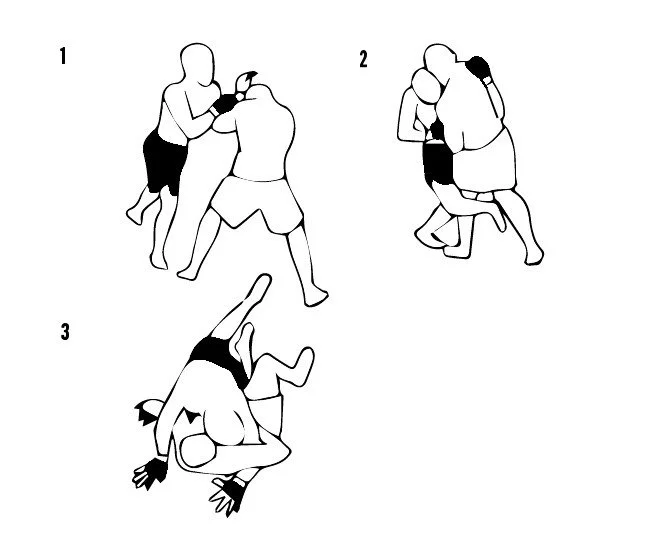
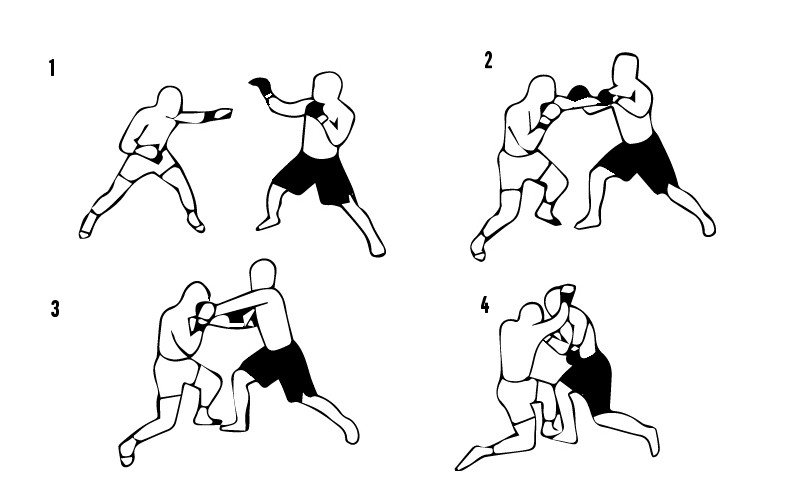
Machida fired the first shot, slapping down Silva's lead hand (from a southpaw stance) and stepping in with a left straight (1). From here, rather than obliging Silva with the exchange he so desperately desired, Machida immediately dug his left hand underneath Silva's right armpit, hooked his right calf behind Silva's left (2), and tripped the bigger man to the mat, landing in half guard (3).
When the two returned to the feet, Machida was never in position for Silva to hit him. Silva lumbered after the more upright, mobile fighter and eventually ate a gut-munching knee. Where Machida had usually intercepted with the left straight when he had his opponent chasing him, in his last fight he had introduced a beautiful springing knee strike to the abdomen. Because Machida's opponents chased him so often, he could often convince them to run themselves onto this strike with enough force that he could knock the wind out of them and retract his leg before they had the sense to grab a hold of it.
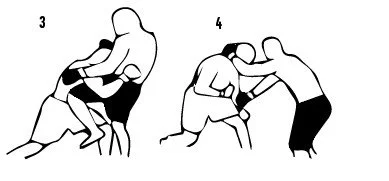
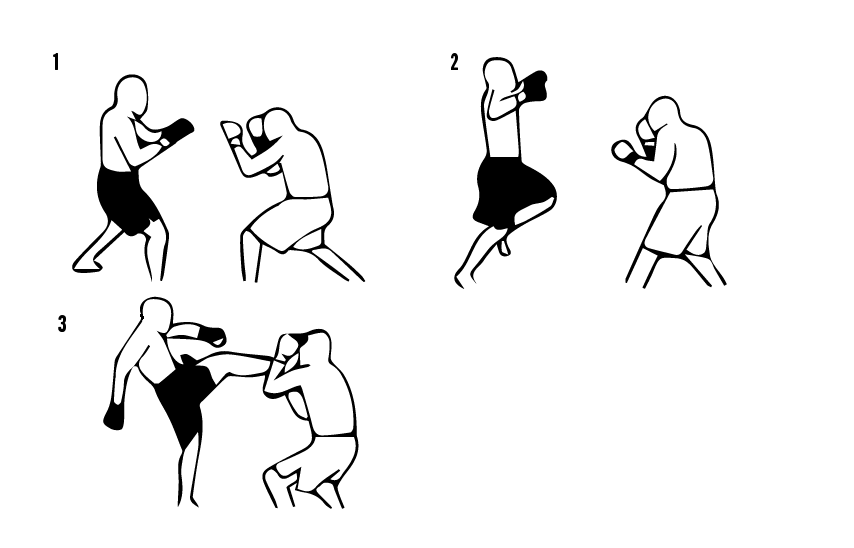
One of the peculiar things about this knee was the set up. Where a skilled boxer will pull his non-punching hand (the passive hand) back to cover his jawline, Machida would often keep the passive hand out, smothering his opponent's lead hand as he punched. Consequently, both of Machida's hands were often extending towards his opponent together. Machida realized that by rapidly extending both of his hands towards his opponent and deliberately throwing them high, he could convince his opponent to duck (2). As they did so, the knee came in (3).
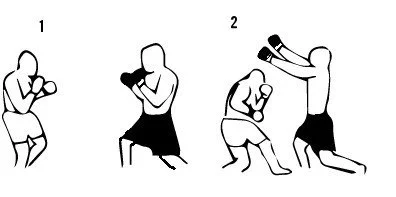
But where Machida usually withdrew his hips following the knee strike, keeping control of the opponent's head and their lead hand (4), against Silva, Machida pushed his man backwards and struck him in the neck with a stiff left hook. The knee and punch in combination threw Silva to the floor again.
As the opening round of the contest was coming to a close, Silva finally got Machida to the fence, where he couldn't retreat any further. The two wrestled in the clinch and after the hammer signalled ten seconds remaining in the round, Machida snuck his right foot behind Silva's left again and hit the exact same simple trip with which he began. The fall wasn't a pretty one, Silva stumbled and turned, landing on his back. As Machida leapt in with a falling punch, the klaxon sounded to end the round. Machida jumped up and returned to his corner, but Silva remain sprawled out on the floor, moving but not responding. After several seconds the referee waved off the fight as Silva couldn't get to his feet. A peculiar finish put a memorable stamp on a spectacular performance in which Machida had been on the receiving end of almost no offence.
The bout earned Machida the recognition that he had always deserved, but also a shot at the UFC light heavyweight title, then held by Rashad Evans. Evans had just knocked out Chuck Liddell and Forrest Griffin back-to-back without much trouble and seemed to be the stiffest test of Machida to date.
It is at this point which I would like to expand upon just what makes Lyoto Machida so special. It is the idea of maai. In karate, and in kendo, maai is the combination of distance and timing. Ma, which is distance, is the most important facet of setting up one's timing. In boxing, fighters get acquainted with each other's rhythm, and men like Wilfredo Benitez have been able to do this with such skill that they have been jokingly referred to as having an inbuilt radar for punches. In points style karate, the timing is manufactured. A fighter gives himself the time to respond. He does not have to identify and react in an instant. And that is down to the distance, or the buffer zone.
Ordinarily, fighters will stand at a distance where they can push in with a jab and connect. Machida is almost never in that distance. In fact, Machida sets himself up at a distance whereby the opponent is going to have to really lunge to get at him. Add to that the fact that Machida will almost always retreat in response to his opponent stepping in. All of this seems like cowardice or timidity, but it is simply baiting the chase. As soon as that opponent starts taking an extra step, committing his weight to a chase, Machida will step in and meet him, creating a collision with tremendous force.
Because the opponent is rushing in, Machida seems both wickedly fast and extremely powerful, when in fact his opponent is doing half of the work for him. It is the difference between being in your car and getting rear ended while moving in the same direction, and driving straight into a head on collision.
This interception of the opponent as he enters is the basis of all of Machida's best techniques and stems from the three initiatives (or timings) of traditional Japanese martial arts. The first initiative sen, is the one Machida often dispenses with—leading, attacking first. Then there is go-no-sen, or the delayed or indirect counter. This is where the opponent attacks, you evade / block the blow, and then you retaliate as he is recovering his position. The final, and most important, of the three initiatives is sen-no-sen or attack of the attack. This is where the opponent attacks, you see this and attack, but yours lands and his doesn't. This is Machida in a nutshell: establish the range which allows time to react, retreat from attacks to bait the trap, step in when the opponent chases aggressively and land your strike as his misses.
And that is what Rashad Evans was ready for. For the entire opening round, Evans remained on the outside, refusing to give chase. Machida provided the sole moment of action as he threw up a left round kick and a left straight as it was being retracted. A classic karate combination (and a favourite of the aforementioned Andy Hug), the short left had Evans' legs go for a moment, before he was up and back in the fight.
In the second round, little happened again. Then Evans stepped in.
As he jabbed in to follow with a right hand (the same right hand which had laid Chuck Liddell out cold) Evans suddenly found himself on the end of a left straight. As he had stepped in, Machida had stepped in as well, parried his jab dowwards (2), landed the gyaku-zuki (reverse punch) (3), and even slipped the right hand which followed as Evans fell to a knee (4). Evans' legs were gone, Machida clipped him a couple more times, dropped him and as Evans rose, Machida chased him to the fence. Swinging hooks, Machida sent Evans to the mat for a third time and the bout was waved off.
The Wheels Fall off the Wagon
Unfortunately, the Machida Era which many were expecting was short lived. Mauricio Rua was able to expose the flaw in the point fighting strategy with his low kicks. As a points style karateka retreats, he may be hard to hit, but one leg is always trailing. By chopping that leg out, Rua was able to slow Machida significantly and undo the retreating and intercepting strategy.
Dropping close decisions to men who fought cautiously against him, refusing to lead, it seemed as though the so-called Machida riddle had been solved. If you didn't give him anything to counter, he couldn't hurt you. But Machida was working on something new. His left leg, his rear leg roundhouse kick, was becoming a more and more effective lead.
When Machida stepped into the ring with Randy Couture, an aged but extremely intelligent fighter, he put this on full display as he had Couture flinching at every showing of it.
In the second round, after feinting the kick several times with his hips (another karate feature, picking up the leg to feint doesn't allow one to explode across the mat and capitalize with punches), Machida raised his left knee, Couture crunched over and dropped his right elbow to catch the kick, and Machida leapt into the air with a right front kick underneath Couture's chin.
This technique, known in karate as nidan-geri (two level kick) is ancient, appearing in the classical forms Kusanku, Chinto and Suparinpei among others, but has found relatively little success in combat sports. After Machida knocked out Couture with it, a spate of attempts were made in MMA. Wild Korean grappler, Dong Hyun Kim, attempted the kick at least twenty times during his bout with Sean Pierson before connecting it. Why was he so unsuccessful? He lacked any form of set up.
Machida had been threatening to break Couture's ribs with his rear leg round kick all fight, when he began his bicycle kick movement, Couture was completely committed to preventing himself from eating another winding body shot. He had no idea that Machida's right foot was going to smash into his skull while he was worrying.
But following the Couture match, Machida found himself in with Phil Davis, who refused to commit to attacks, kicked low, and stole a thoroughly unimpressive decision. It was clear that something was missing in Machida's game.
UFC cards in the United Kingdom are almost invariably headlined by middling local talent. For some reason, it is thought that British MMA fans would rather see a declining Michael Bisping than a truly elite fighter. When news broke that Bisping had pulled out of the main event of the 2013 UFC Fight Night Event in Manchester and been replaced by Machida, I made my arrangements to see the man who had fascinated me for so long. And so, I found myself in the press row at the Phones4U arena to watch Machida take on the Filipino Wrecking Machine, Mark Munoz.
Munoz was a terrific wrestler, and had trained with Machida before—he had to be smart enough to not give Machida an easy counter. I had my questions, I still considered Machida one dimensional on the feet. Much like his training partner, Anderson Silva, he almost refused to fight on the lead.
The two moved around the cage a little, and surprisingly it was Machida who was on the inside, cutting off the cage. It was Munoz who was moving around the outside. Machida showed him feints with his hips and shot in with one-twos. A minute passed as they circled the cage and feinted. As Munoz's back grazed the fencing, a body kick shot in underneath his right arm. Thirty seconds later, on the opposite side of the cage, Machida feinted to step in along the fence, and shot another kick underneath Munoz's right arm. Munoz was winded, he circled out frantically. A faked kick and Munoz's elbow shot down to his side, closing off his ribs. Machida knew he had him.
Seconds later, Machida threw the same kick but a foot higher. It clacked off of Munoz's head with that sound which fight journos are all too familiar with, but which never gets any less discomforting. Bone on bone, but one surface had a brain inside of it. The kind of connection which ousts the feint of heart from this niche occupation. As I wrote later that night, awake in my hotel room and revisiting the video from the event time and time again, Munoz had offered Machida nothing to counter, but it had taken Lyoto Machida just three kicks in three minutes to put Munoz out cold.
And so, when asked to define perfection in combat sports I usually point to three fights. Machida's knockouts of Thiago Silva—the madman, Rashad Evans—the calculated banger, and Mark Munoz—the conservative wrestler. In each Machida took nearly zero damage, and inflicted an amount which proved to be fight ending and he did it not through tremendous reactions, strength or speed. It was through distancing and manufactured timing alone. And that is fighting as an art form, a level above the sweet science of bruising, and a million miles removed from simple brutality.
Since I sat down to recount my views on Lyoto Machida and the notion of perfection, Machida has topped what I saw from him against Mark Munoz. Coming off of a hard fought decision loss to UFC middleweight champion, Chris Weidman, Machida was matched against a veteran going through something of a career rebirth in C. B. Dolloway. Most thought it was a mismatch, but Dolloway had proven to be nothing if not dangerous.
Dolloway came out savvy, circling away from Machida's rear side and that dangerous left leg. He pumped the jab in doubles and triples. After a period of circling, Dolloway made as if to step in with a jab, but changed his mind. In his move to jab, Dolloway's right elbow had flared just a little. He might not have even known. But as Dolloway returned to his stance, Machida's left foot shot out like a dragon's forked tongue. It wasn't as though Machida threw the kick, but more as if Dolloway's exposed ribs pulled Machida's foot to them.
The snap was audible as Dolloway covered up and went to the mat. Where I had been so astounded at Machida finishing a fight in three kicks, he'd just knocked out a dangerous middleweight contender in one.
His boxing is sloppy, and if you hold his form to the standard of any other art than his own, he looks goofy. But by the golden rule of every fighting art—hit and do not get hit—Lyoto 'The Dragon' Machida might have come the closest to painting perfection on the ring canvas.