
Chito Vera Rediscovers His Violence
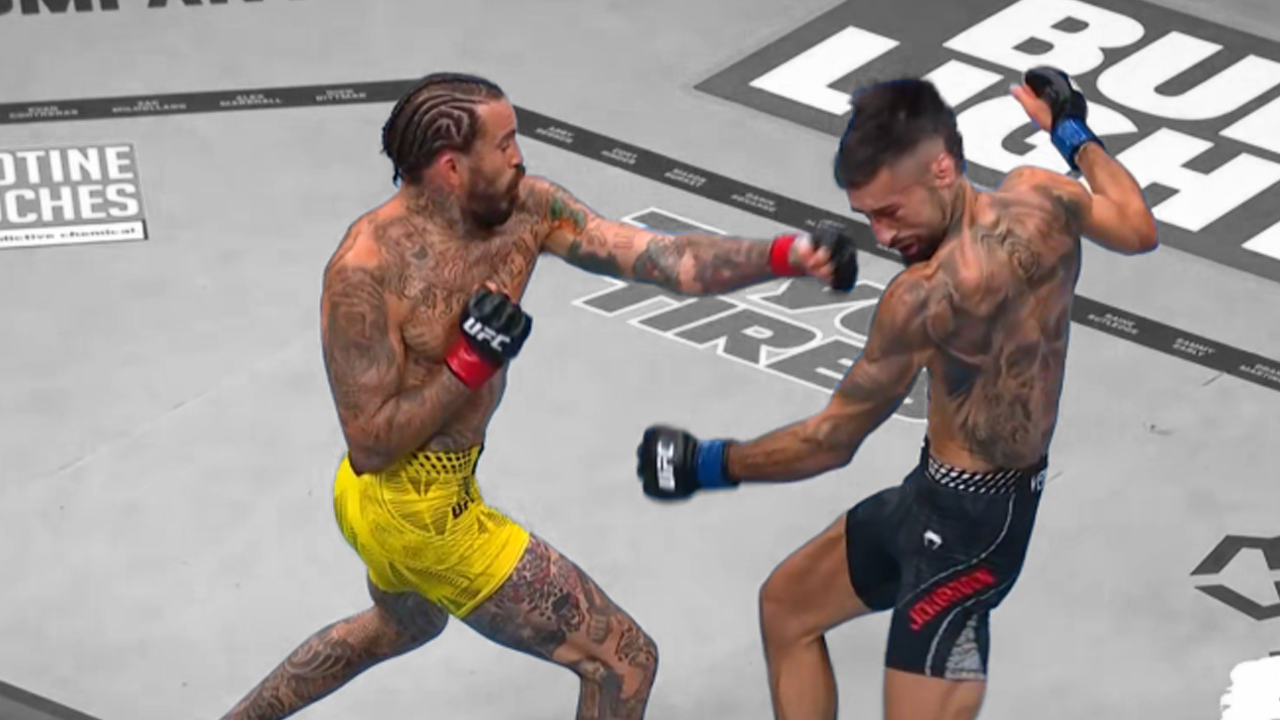
Most fighters who find themselves “washed” are the same as they ever were on the inside, but find themselves at a disadvantage on speed, on reflexes, on strength. Their weight cut gets harder and the youngsters they are fighting seem to get bigger. Still a few declines seem entirely mental. You will have heard a thousand times of a fighter getting “gun shy,” particularly off a brutal knockout loss. Often when a fighter is “never the same” after suffering a knockout it is not that their chin is shot, or that they flinch as soon as the opponent opens fire, it is just that they enter every exchange slightly on the defensive in their mind, not willing to commit too much.
Marlon ‘Chito’ Vera’s decline has been more puzzling than that. He has never found himself on the wrong side of a knockout or even a submission. He has proven to have one of the hardest chins in bantamweight MMA, in fact. You cannot accuse him of being gun shy because he lets opponents throw punches at him without returning his own, while moving forward, for whole fights at a time. Something stranger happened to Vera: he lost the ability to pull the trigger.
Vera was never a high volume fighter, losing fights to Song Yadong and Davey Grant early in his UFC run basically because he did not do enough. In recent years it had become a parody, as Vera’s corner begged him between each round to start throwing some volume, and each round Vera would stand there taunting his opponent without even attempting to strike in combination. Yet against Charles Jourdain, something changed within Vera and he was able to put on his best performance in years.
Grabbing the Head
After a tentative start, Vera began opening up in combination, just to move to the double collar tie. From there he was able to land knees and accumulate some volume against Jourdain. To my eye it seemed that forcing the double collar tie early was as much kidology for Vera himself as it was effective offence, because he could force it and begin landing some strikes, without succumbing to the “paralysis by analysis” that he does in long range kickboxing matches, where he spends much of the time mean-mugging. Even in his worst recent performances, there has been a moment where the seal finally gets broken and Vera begins to build a bit of momentum, so breaking that seal earlier is worth making the fight a little ugly. On top of that, Vera’s clinch striking game has always been terrific and he beat up Song Yadong and Davie Grant from the clinch in their fights.
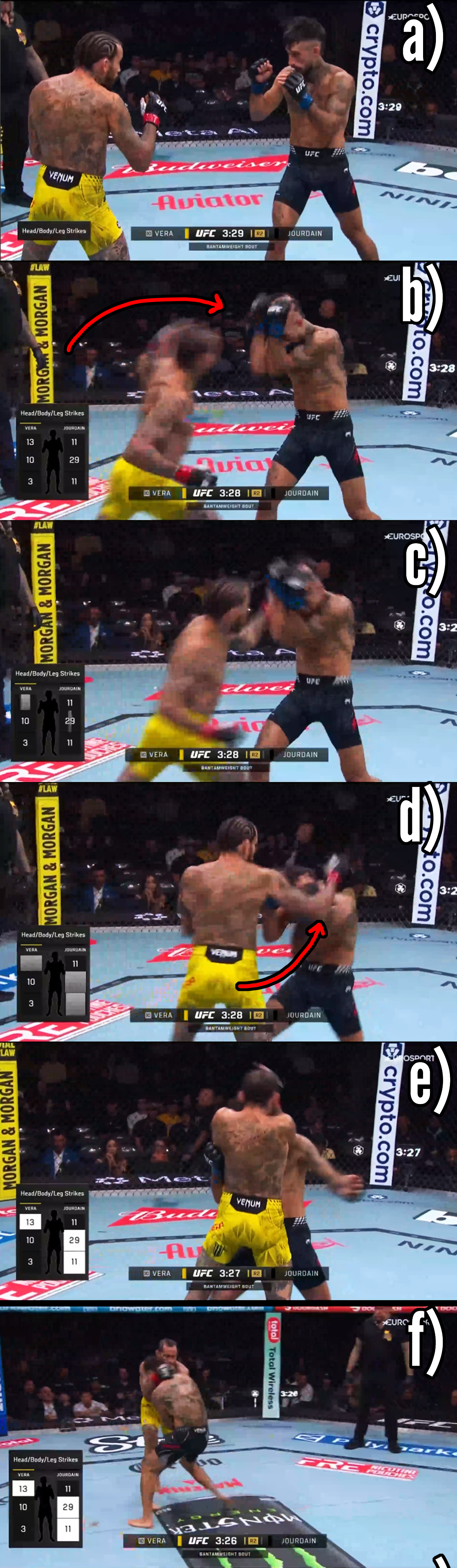
Fig. 1
By using a high guard with both elbows up at face level, Vera could also force his way into the double collar tie reactively, even as Jourdain was letting off his own combinations. Figure 2 shows an example of Vera using the high cover off a low kick, then moving in to clinch. Vera shows excellent form here by holding his hands high and going in with his head. He does not reach out to grab the head and leave himself completely exposed as we see week after week in the UFC.
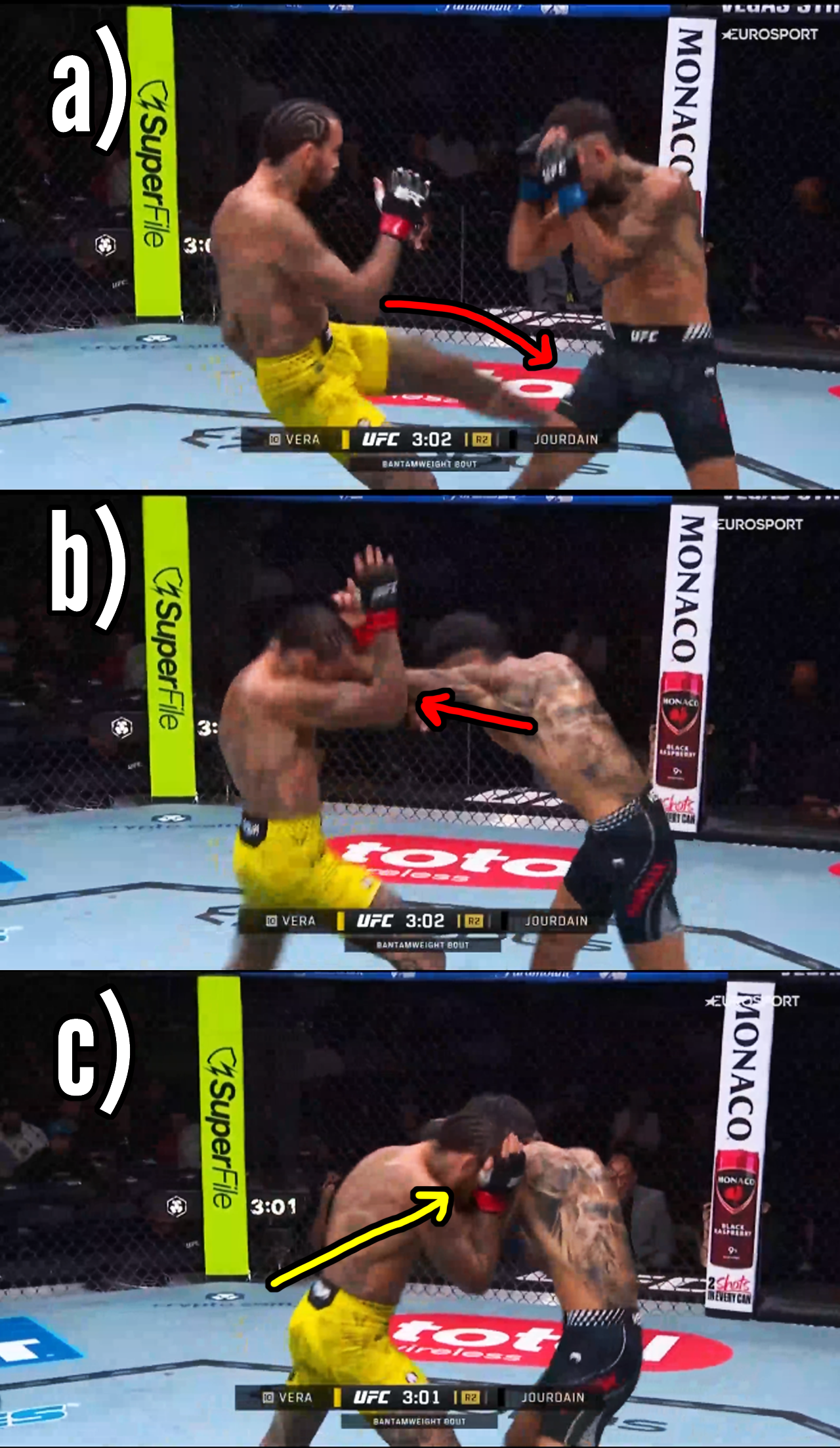
Fig. 2
The high guard even gave Vera the opportunity to duck under straight to Jourdain’s back midway through the fight (Figure 3). Weaving to the back from a boxing exchange was something that Ricardo Ramos did from time to time and it remains one of the most underused methods in MMA. It is opportunistic, of course, but whenever an opponents’ elbows are open the opportunity is there.
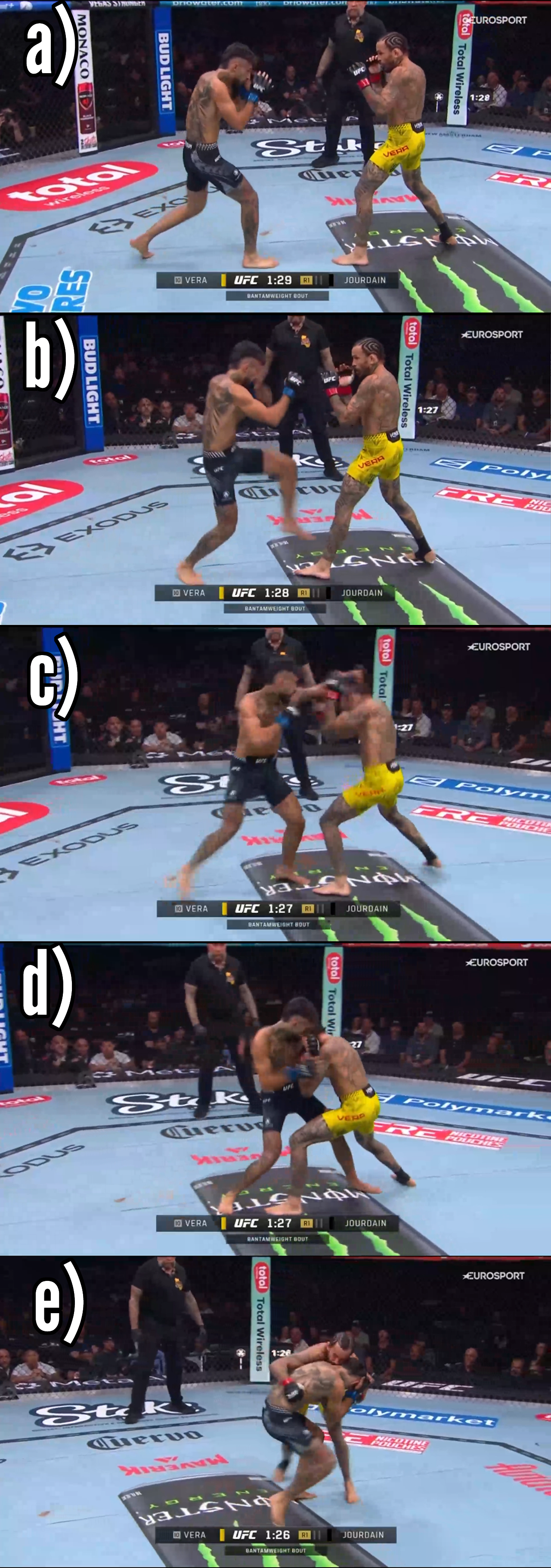
Fig. 3
The double collar tie can be pursued proactively—throwing some punches and grabbing it around or through the opponent’s guard—and reactively, by covering up and moving in on the opponent as he swings. One slightly slicker method of acquiring it proactively is to throw the left hook to the body first as in Figure 4.
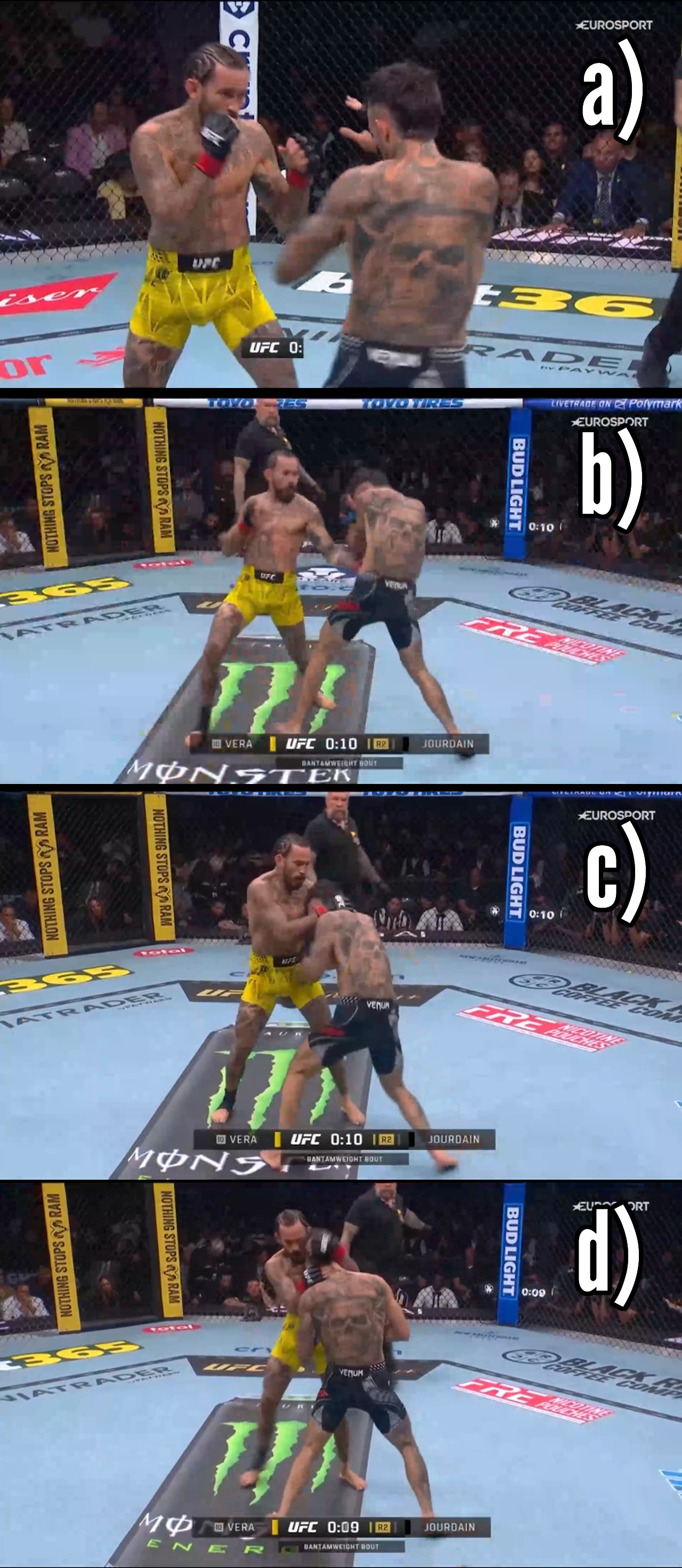
Fig. 4
Where pumping out volume upstairs will force the cover, it tends to lead to a weak connection, around the opponent’s arms. This was the crux of Fabricio Werdum’s striking renaissance, aggressive straight punching into grabbing the head. But by slipping in the body shot, the fighter suggests that his opponent might want to drop his elbows, meaning that even if the defender has inside position as the attacker reaches for the double collar tie, it is often just his fingers and the backs of his hands in the way, making for a stronger double collar tie.
If the liver shot goes off really well, you might end up following up on a man folded in half anyway. Hayato ‘Mach’ Sakurai’s finish of Jens Pulver in the sensational PRIDE Lightweight Grand Prix comes to mind.
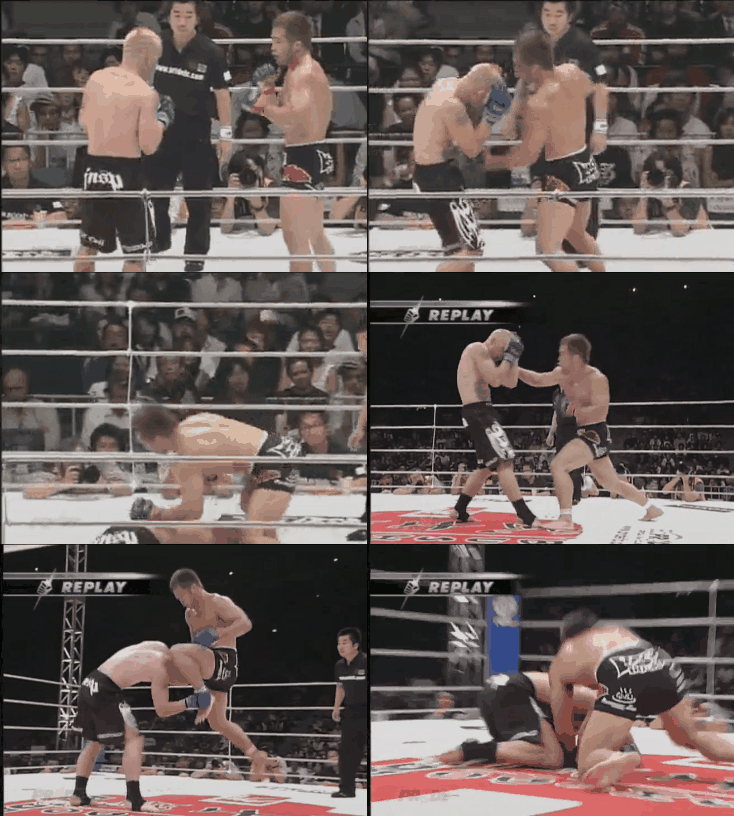
Fig. 5
While we are praising Marlon Vera today, we must note that Charles Jourdain gave as good as he got. It seemed like his main issue was that his strikes did not affect Vera the way. The two of them chopped it up beautifully in the clinch, looking for knees, pummelling for inside position, holding the cross wrist, and tearing off elbows.
In Jourdain’s fight with Victor Henry, the two men sought to one-up each other in the clinch, often by hitting a quick trip attempt and looking to strike or score a snapdown in the aftermath. Jourdain got Vera off him at one point with a nice sasae attempt into a missed uppercut in this one.
Much of this fight was undertaken with each man having a single collar tie and fighting to get to the double collar tie. Figure 6 shows a slick counter that Vera scored a couple of times as Jourdain tried to uppercut from the collar tie.
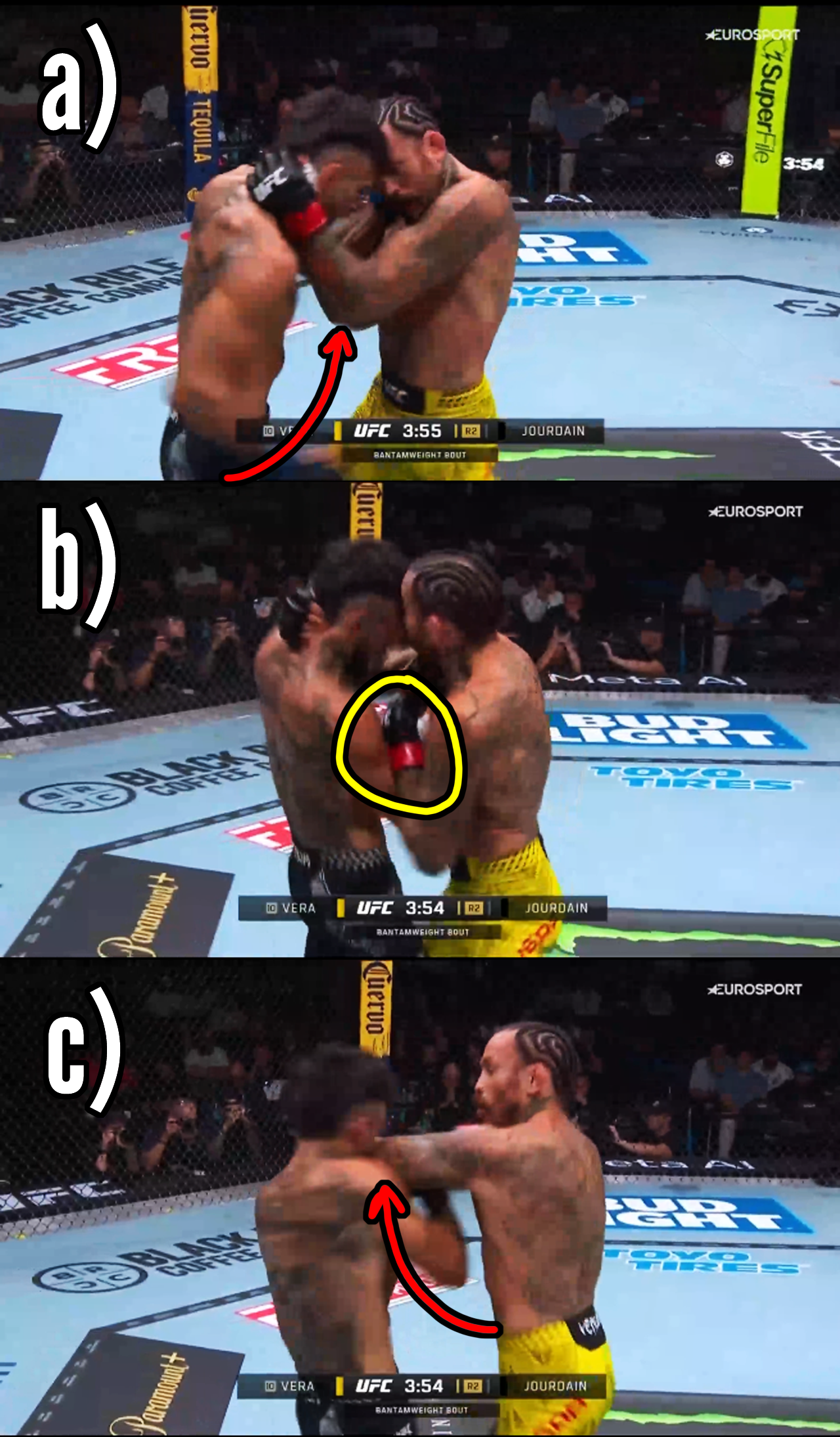
Fig. 6
Vera brings his forearm down on the path of the uppercut (b) between his chest and Jourdain’s, then throws the same elbow to Jourdain’s head (c).
This is the same as that timeless exploit of the left hook flying through the gap after an uppercut: if you feel the uppercut and you throw your left hook blind, you have a great shot of landing a cleaner shot than anything you pick out with your eyes out in the open.
Classical Muay Thai
If pulling himself into the double collar tie and landing knees early was a way that Vera could trick himself into getting to work earlier, it would not have mattered all that much if he did not start throwing regularly when the fight returned to the outside. At several points in this fight Vera opened up with four punches combinations, and many times he stepped in to initiate a mid range punching combination behind a double jab.
Vera is the kind of hitter where convincing him to just push something, anything, out there is half the battle. Jab for jab, his opponent will probably come off worse. If he throws four punches and lands one, that is still not fun for the man he’s fighting.
As someone who has been checked out for Vera’s last few fights, this fight was confirmation that he has not lost it. “It” in this instance is that gift for violence that makes him so special. The ability to stand over an opponent and jab their body, or elbow their leg, just because it is nasty. In some ways this fight deepened my frustration with Vera because he is not just a puncher who won’t throw, he has a remarkably deep bag of tricks and he has not been showing any of them!
Years of work with Jason Parillo have given Vera a terrific jab, off both stances, which you would never know if you watched his last four fights. Here he had it moving exactly as it should be: bullshit volume between big commitments. And it was working a charm! In the second round, Vera hit a beautiful set up from traditional Muay Thai, the jab to lead hand up-elbow.
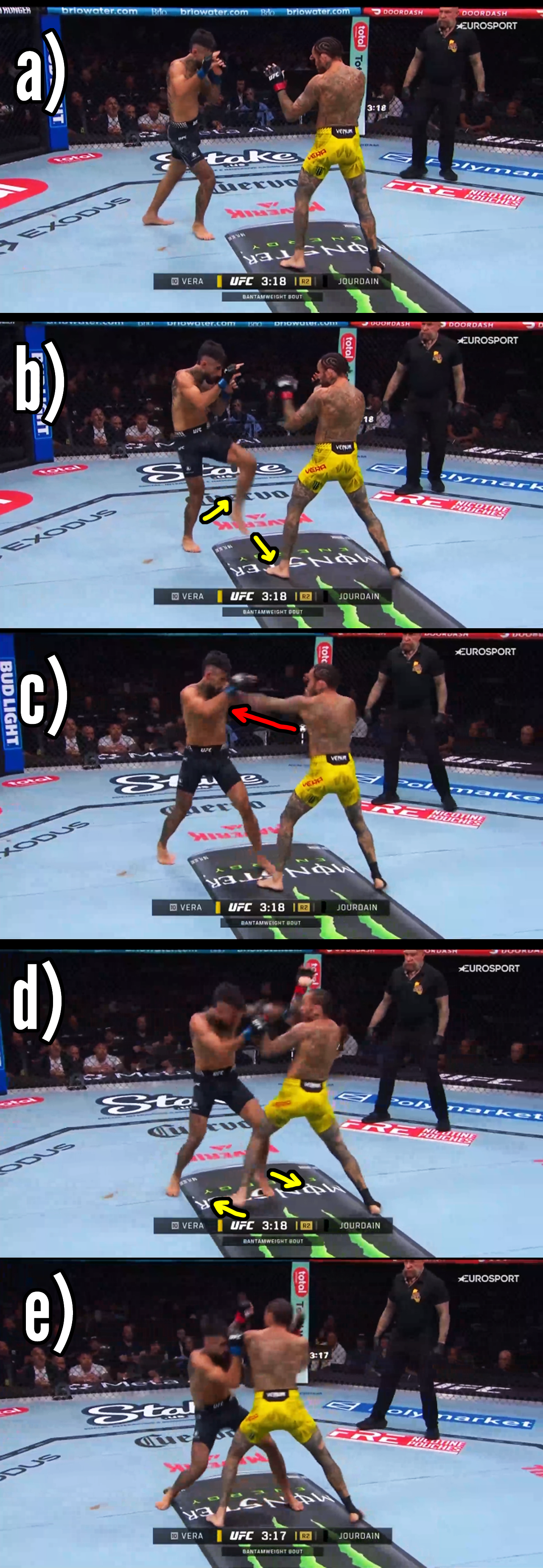
Fig. 7
This and the 1-2-right elbow are staples of boxing-for-Muay-Thai, and work fantastically in two specific instances. The first is against opponents who commit to shelling up when you show them straight punches. Whenever an opponent shells up as a go-to defence, it is time to try to slip an elbow through and cut them while they are handcuffing themselves and their head is remaining stationary. This is why folding elbows are a must-have technique, and in truth Jourdain would have down well to use folding elbows and the jab-to-up-elbow against Vera’s high guard.
The second circumstance under which this technique works well is if the opponent is simply walking through your jab. So it perfectly punishes both the ultra-defensive and ultra-aggressive fighter.
Because they are so short range and committed, up elbows are not without danger. Ozzy Diaz tried to slip one in on Ryan Gandra as he performed a jab and dip, and ended up getting bullied back to the cage and blindsided with a flurry of two hundred swings, all off getting himself out of position looking for a slick counter.
Another example of traditional Muay Thai could be seen in Chito Vera’s repeated use of “ploughing.” Ploughing is something we touched on a few weeks ago when Yothin used it against Fairang. It is the act of catching the kick and then running the opponent to the ropes.
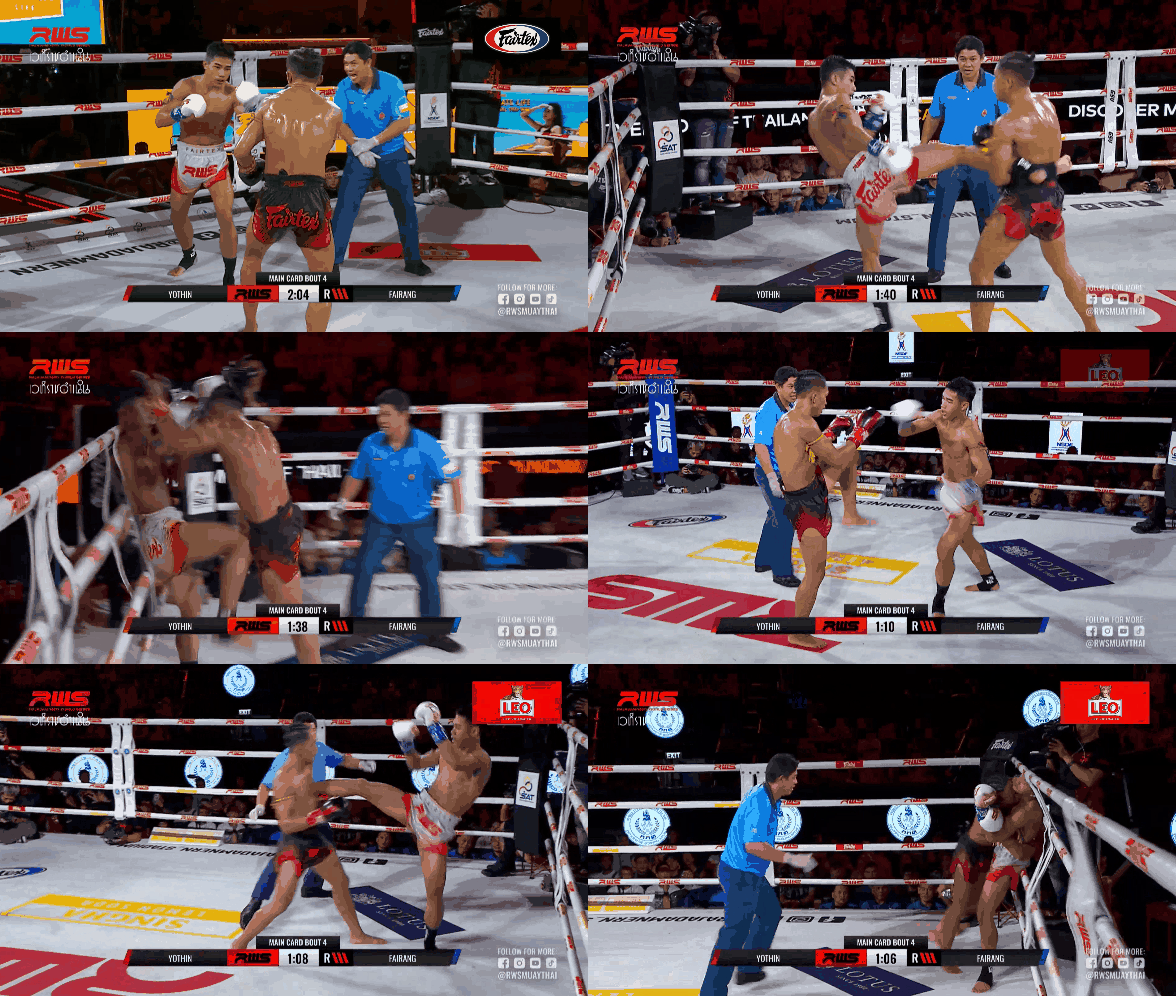
Fig. 8
In that article we noted that the rules on ploughing have been changed since the Golden Age, and now a fighter can only take two steps with his opponent’s leg caught. But look back at videos from the eighties and nineties and you will see fighters like the great Namkambuan, catching the kick with their back to one set of ropes, and running the opponent almost twenty feet across the ring to the other ropes. The frequency with which Namkambuan himself flew out of the ring while doing this will give you a clue as to why they banned it.
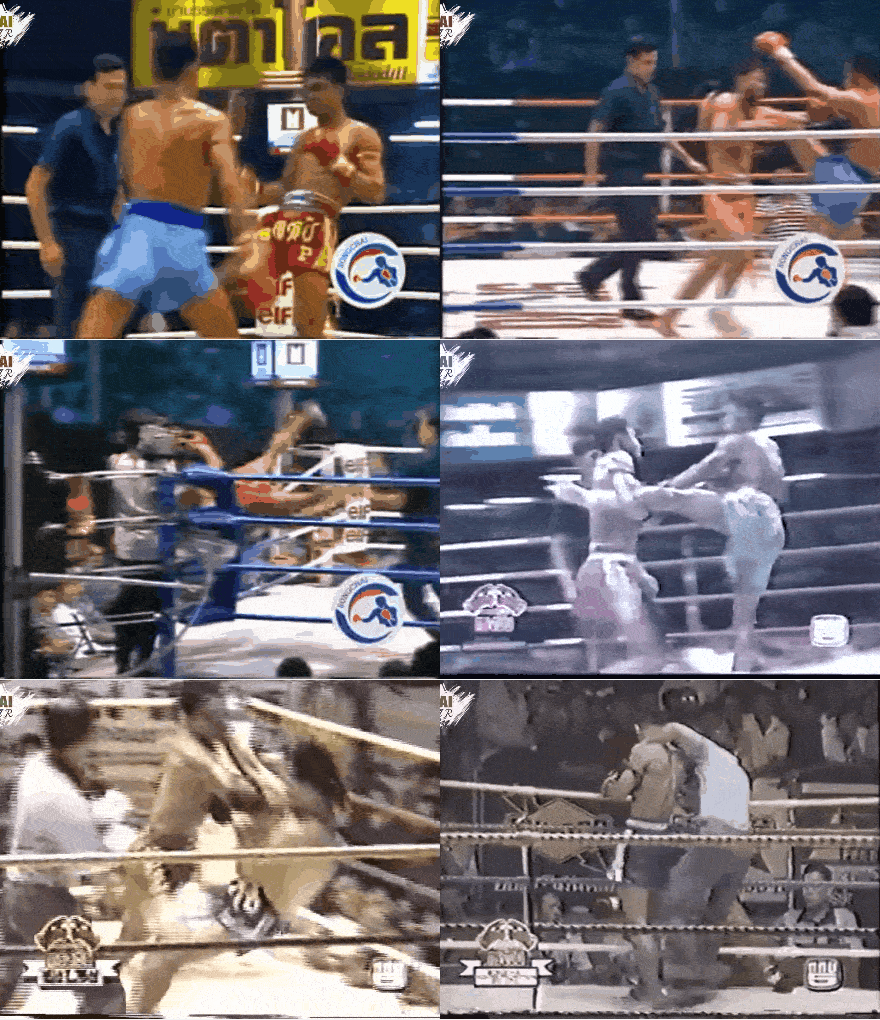
Fig. 9
This puts ploughing in that curious spot where the only place you can see the true application of this aspect of Muay Thai is in the more permissive ruleset of MMA. There are banned, or perhaps “abandoned,” techniques like this in most combat sports and one day it might be fun to go through a few in detail. That is not to say you will see a whole lot of ploughing in MMA though, Vera’s use is notable because it is an anomaly. And also because it was cool as hell.
In Figure 10, Vera parries a kick across his body (c), then uses his parry to raise the foot and get the palm of his free hand under the heel (d). With two hands on Jourdain’s foot, Jourdain cannot pull his foot back or loop it over the top as he could if Vera had stuck with the initial parry grip. As Jourdain is ploughed across the cage he turns away and points his knee down to try to slip free (e), but falls to the mat as he cannot outrun Vera on one leg (f).
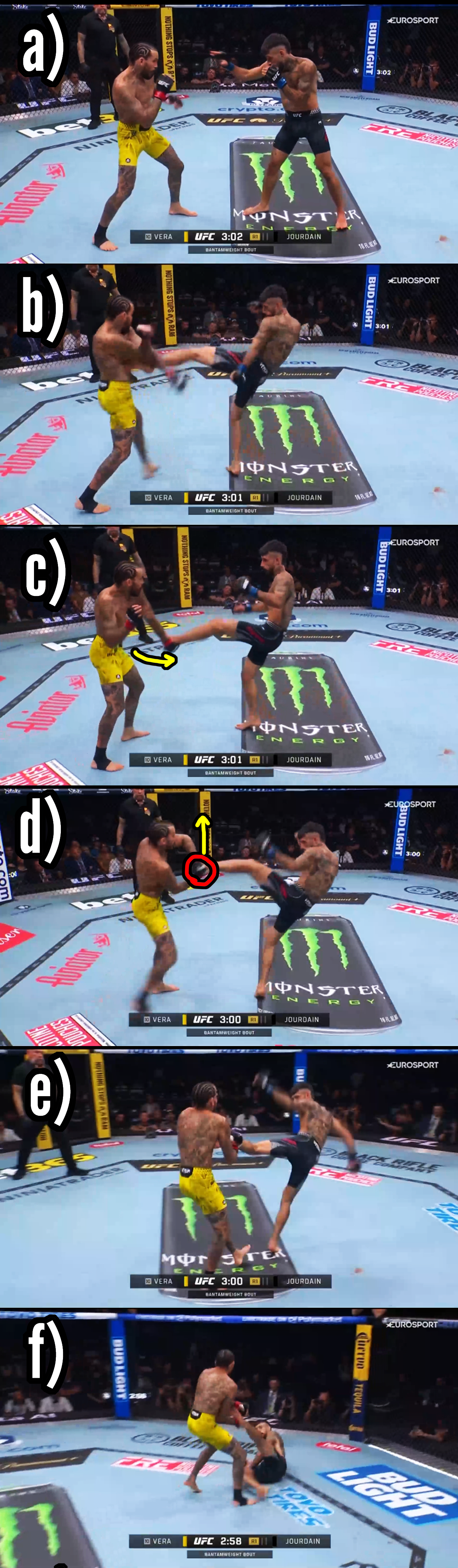
Fig. 10
Figure 11 shows another instance where Vera was able to throw Jourdain into the fence and achieve a clean takedown with almost none of the effort that a wrestling takedown attempt would require.
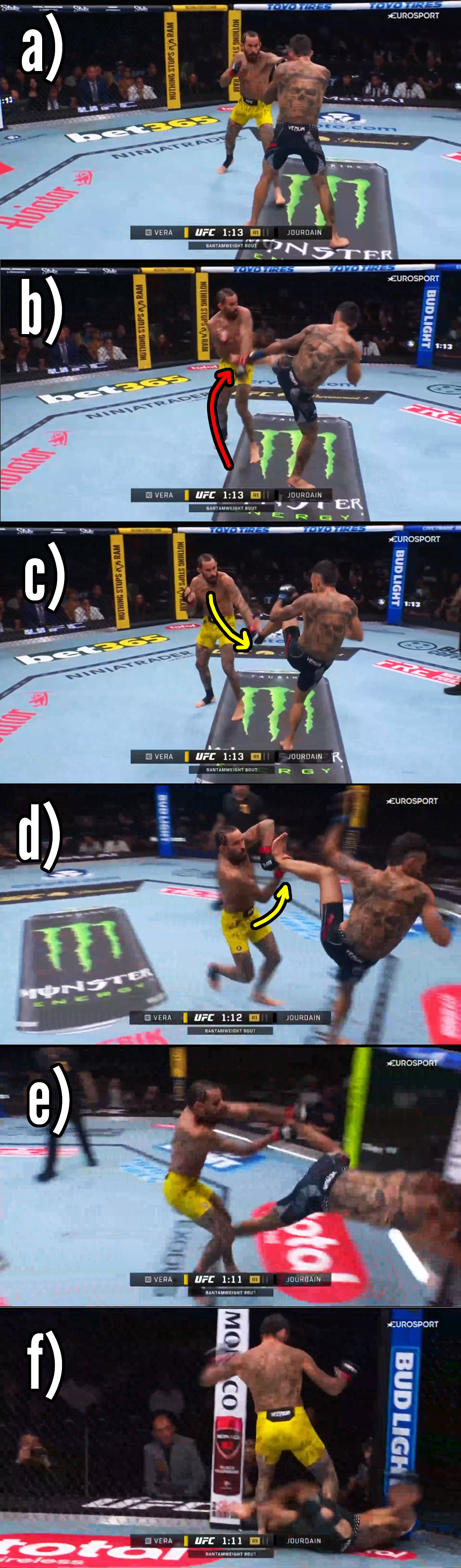
Fig. 11
This ploughing combined with a good ground fighting principle that Vera demonstrated throughout, that if you want your opponent to stay down you should lift one of his feet to the ceiling. If he still gets up, he’s going to be hopping in a very precarious position. Jourdain kept returning to this interesting scissor guard on his side, and Vera kept holding Jourdain’s right leg and punching the body or elbowing the leg.
Figure 12 shows that when Jourdain shakily worked his way up onto one leg, Vera ploughed him to the fence and landed a knee to the body that would have made Yothin proud.
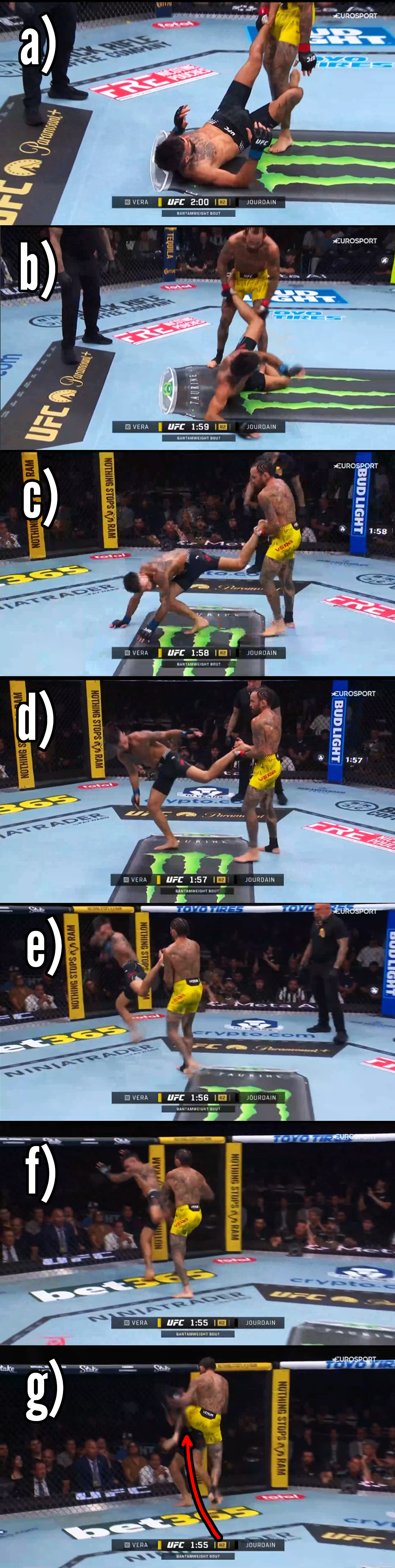
Fig. 12
Jourdain got so frustrated with being denied a clean stand up that he attempted a flashy rolling thunder type kick off his back, while Vera held his leg.
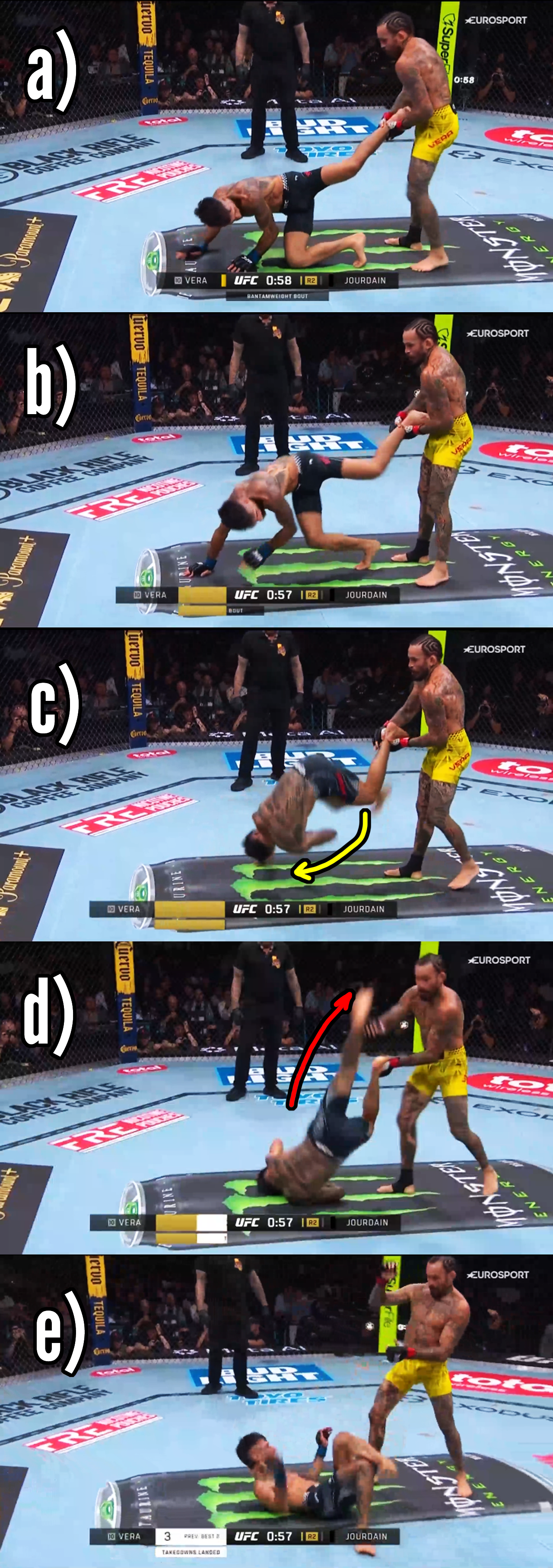
Fig. 13
A final note on Vera’s tactics: he used his low kick to build into punching combinations very well. In an inversion of traditional Dutch kickboxing tactics, Vera threw the right low kick naked, returned his leg to a shorter stance, and was stood on top of Jourdain as he started throwing hands. This tactic was responsible for two of the fights three knockdowns.
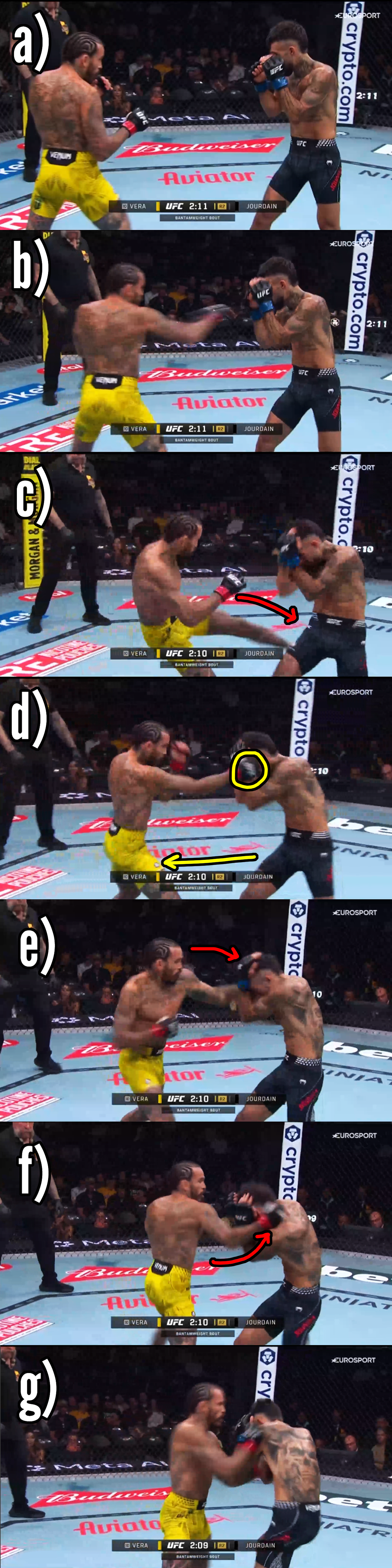
Fig. 14
How much of this new form was a corner lighting a fire under his behind, and how much was Charles Jourdain being a relatively straight up, easy to find fighter, remains to be seen. How much can be attributed to Vera himself seeing this as a do or die fight? With a spectacular finish under his belt, will he return to his laid-back ways in his next fight?
A bad Marlon Vera fight is one of the dreariest chores you can subject yourself to on a Saturday night, but when he finds his form it is as though some ancient warrior deity has been given a few minutes of power to use him as a conduit into our world.